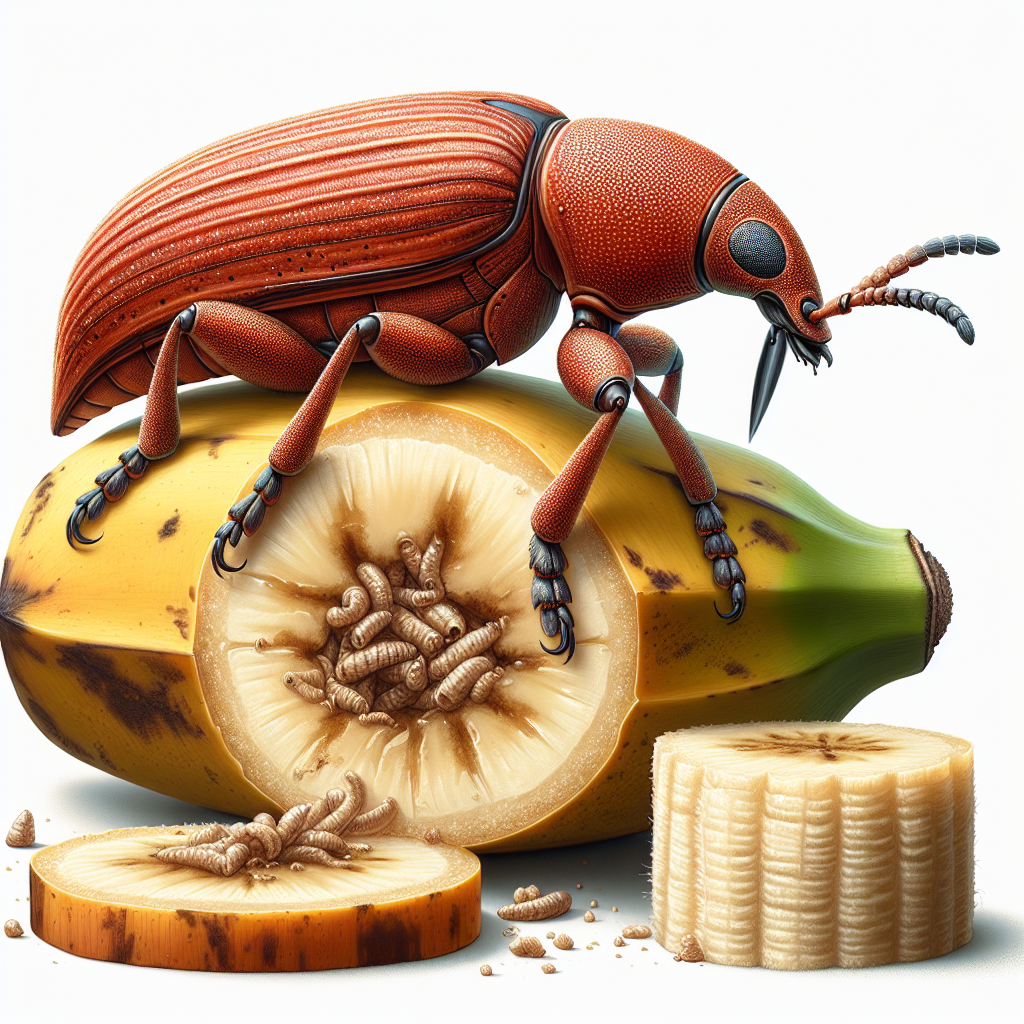
Introduction to Banana weevil borer
The banana weevil borer, scientifically known as Cosmopolites sordidus, stands as one of the most destructive pests threatening Banana cultivation across tropical and subtropical regions. This nocturnal beetle, often called the banana pseudostem borer or corm weevil, inflicts severe damage by laying eggs at the base of banana plants, where larvae bore into the corm and pseudostem. Adult weevils are reddish-brown, elongated (10-15 mm long), and wingless, blending seamlessly with plant debris, which makes early detection challenging.
First identified in Southeast Asia, the pest has dispersed worldwide via infested planting material, now plaguing major banana-producing countries like Uganda, the Philippines, Colombia, and parts of Central America. Yield losses can exceed 50% in unmanaged fields, with plants buckling under their own weight due to internal girdling. Smallholder farmers and commercial growers alike face economic hardship, as bananas are a staple crop and key export commodity. Understanding this pest's biology is crucial for implementing integrated pest management (IPM) strategies that minimize chemical use and promote sustainable agriculture. For more on companion planting to deter pests, check this guide.
Identifying Symptoms & Damage
Banana weevil borer damage manifests subtly at first, escalating to catastrophic levels if unchecked. Key symptoms include:
- Pseudostem Damage: Look for longitudinal slits or tunnels at the base of the pseudostem, often filled with frass (insect excrement resembling sawdust). Young plants show buckling or toppling, especially during wind or heavy fruit load.
- Corm Destruction: Excavate the corm to reveal galleries tunneled by larvae, reducing root anchorage and nutrient uptake. Affected corms appear riddled with holes, soft, and rotten.
- Leaf Symptoms: Yellowing or wilting of lower leaves (pseudostem flag leaf syndrome), premature leaf drop, and stunted bunch development. Severely infested plants produce small, misshapen bunches.
- Adult Signs: Presence of adults hiding in leaf sheaths or debris during the day. Traps baited with banana pseudostem or pheromone lures capture them effectively.
Differentiate from similar pests like root-knot nematodes or corm rots, which cause surface rotting without clean tunneling. Scout weekly by slicing pseudostem bases of 10-20 plants per hectare; more than 5% infestation warrants action. Economic threshold: 1-2 adults per trap per week or 10% corm damage in ratoon crops.
Lifecycle and Progression of Banana weevil borer
Cosmopolites sordidus completes its lifecycle in 25-40 days under optimal tropical conditions (25-30°C, high humidity), with overlapping generations year-round.
- Eggs: Females lay 1-5 pearly white eggs (1 mm) singly in leaf axils or corm cracks. Eggs hatch in 5-7 days.
- Larvae: Cream-colored, legless grubs (up to 20 mm) bore upward into pseudostem and downward into corm, feeding for 15-25 days across 5 instars. This stage causes 90% damage.
- Pupa: Larvae pupate in earthen cells within tunnels, lasting 6-8 days.
- Adults: Emerge as long-lived (6-12 months) beetles, dispersing by crawling (up to 500m). Peak activity at night; females produce 100-200 eggs lifetime.
Lifecycle accelerates in warm soils (>28°C), slows below 18°C. Multiple generations per year amplify populations, especially in dense plantings. Monitor with cut pseudostem traps: place chopped banana stems upright; count weevils after 3 days.
Environmental Triggers & Risk Factors
Banana weevil borer thrives in humid tropics (70-90% RH, 25-32°C), with populations exploding under specific conditions:
- Climatic Factors: High rainfall (>2000 mm/year) and temperatures >25°C favor egg hatching and larval survival. Drought-stressed plants are more susceptible due to weakened defenses.
- Cultural Practices: Old ratoon crops (>4 cycles), dense spacing (<2m), and poor sanitation (leftover debris) harbor weevils. Using infested suckers spreads the pest.
- Soil Conditions: Loose, organic-rich soils ease larval tunneling; heavy clays limit spread.
- Planting Material: Susceptible varieties like Cavendish lack resistance; intercropping with non-hosts like cassava reduces risk.
Risk peaks post-harvest when adults seek refuge in residues. Global warming extends suitable habitats, threatening new areas. Mitigate by avoiding planting during rainy peaks and ensuring clean stock.
Organic Control & Treatment Plans
Organic management emphasizes IPM, integrating multiple tactics for 70-90% control without synthetics.
Cultural Controls
- Sanitation: Chop and bury infested pseudostems/corms immediately post-harvest (bury 50cm deep). Remove old plant debris.
- Trap Crops: Plant susceptible suckers as traps; destroy after infestation.
- Hot Water Treatment: Dip suckers in 50°C water for 20 min to kill eggs/larvae.
Biological Controls
- Entomopathogens: Apply Beauveria bassiana or Metarhizium anisopliae spores (10^12/ha) to bases monthly. Steinernema carpocapsae nematodes target larvae in moist soils.
- Natural Enemies: Encourage ants, ground beetles, and birds via mulching.
Mechanical & Physical
- Pheromone Traps: Deploy 4-6 bucket traps/ha with sordidin lures; check weekly.
- Pseudostem Traps: Refresh every 2 weeks.
Organic Botanicals
- Neem Oil: Spray 5% azadirachtin on bases (2L/ha, 7-day intervals). Mix with garlic/chili extracts.
- Mulching: 10-15 cm organic mulch repels adults.
Integrated Plan: Scout + traps (monitor) → sanitation + mulching (prevent) → biopesticides (curb). Rotate with non-hosts like legumes. Expect 80% reduction in 3 months.
Preventing Banana weevil borer in the Future
Long-term prevention builds resilient systems:
- Resistant Varieties: Plant FHIA hybrids or Dwarf Cavendish Banana with tolerance.
- Clean Propagation: Use tissue-cultured plantlets; macropropagate only certified stock.
- Crop Rotation: 2-3 years with maize or legumes breaks lifecycle.
- Field Hygiene: Wide rows (3m), desuckering (retain 2-3 suckers), timely harvesting.
- Monitoring Tech: Use AI apps for trap counts and predictive modeling.
- Quarantine: Inspect imports; destroy volunteers.
Annual audits reduce incidence <5%. Combine with soil health practices for robust plants.
Crops Most Affected by Banana weevil borer
Primarily attacks Musa spp., including dessert and cooking bananas:
- Cavendish Banana (/wiki/cavendish-banana): Most commercial; highly susceptible.
- Lady Finger Banana (/wiki/lady-finger-banana): Small farms.
- Plantain (/wiki/plantain-horn): Cooking types in Africa/Asia.
Minor hosts: Ginger, Taro, Yam. No damage to cereals or brassicas. Focus protection on Musa plantations.