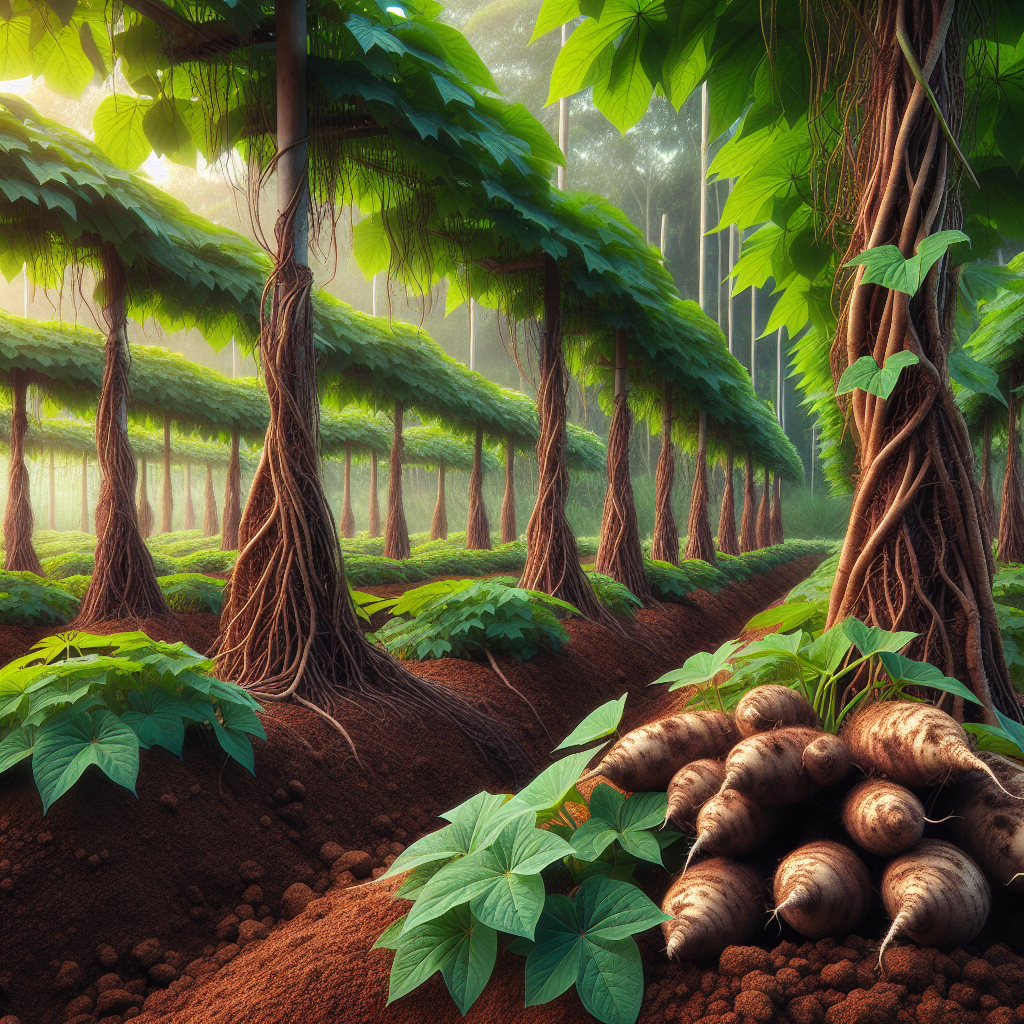
Introduction to Yam
A staple food crop of enormous cultural and economic significance, yam is one of the world’s most important tropical root and tuber crops. It is especially central to food systems in West Africa, where species such as Dioscorea rotundata and Dioscorea cayenensis dominate, but many other species are cultivated regionally, including D. alata (greater or water yam), D. esculenta (lesser yam), D. bulbifera (air potato, though not all forms are edible), and D. trifida (cush-cush yam). Farmers value yam for its calorie density, strong market demand, flexible culinary uses, and ability to store for months under proper conditions.
Yam is frequently confused with sweet potato in North America, but they are botanically distinct crops. True yams are monocotyledonous vines with tubers formed from enlarged underground stems, while sweet potatoes are dicotyledonous storage roots. For a comparison with another tropical starchy root crop, see Cassava. This distinction matters because planting material, vine habit, nutrient demand, pest complex, and harvest methods differ significantly.
From a production standpoint, yam is a relatively high-investment crop. It needs a long frost-free season, well-prepared loose soil, seed tubers or tuber setts of good health, and often staking or trellising for maximum photosynthesis and tuber fill. However, with proper management, yields can be excellent, and high-quality tubers command premium prices in fresh markets.
Botanical Profile of Yam
The genus Dioscorea belongs to the family Dioscoreaceae. Most cultivated yams are perennial vines grown as annual crops for their tubers. The plants emerge from planted tubers or tuber sections, produce one or more vigorous twining vines, and develop underground tubers that vary in shape from cylindrical to club-shaped, branched, flattened, or deeply irregular depending on species and cultivar.
Key botanical features include twining stems, cordate to lobed leaves in many species, and tubers with species-specific skin and flesh colors. D. rotundata often has white flesh and rough brown skin; D. cayenensis tends toward yellow flesh; D. alata frequently has winged stems and can produce very large tubers with white to purple flesh. Some yams produce aerial bulbils in leaf axils, which may be used for propagation in certain species.
Yam rooting is relatively shallow in compacted soils but can explore deeply in loose, mounded ground. The tuber itself develops best in soil with low mechanical resistance. This is why ridging and mounding are standard agronomic practices. The crop usually progresses through four broad stages: sprout emergence, vigorous vine establishment, tuber initiation, and tuber bulking followed by natural senescence. During early growth, canopy formation is critical because tuber size is closely linked to how much leaf area the plant builds before the peak bulking period.
Most cultivated yams are propagated vegetatively rather than from botanical seed. This preserves cultivar traits but also increases the risk of carrying nematodes, rots, and viruses from one season to the next. Cultivar selection therefore matters greatly. Farmers should choose lines known for local adaptation, dormancy length, tuber shape, culinary quality, and resistance to Anthracnose, nematodes, or storage rot according to regional pressures.
Soil, pH, and Climate Requirements for Yam
Yam performs best in deep, loose, well-drained sandy loam to loam soils with high organic matter and good structure. The ideal rooting zone should be at least 30-45 cm deep, though deeper soils are better for long tubers and easier harvest. Heavy clay soils can produce misshapen tubers, increase the incidence of cracking and rot, and make harvest laborious. Extremely sandy soils can work if organic matter and irrigation are managed carefully, but nutrient leaching becomes a risk.
Optimal soil pH is generally 5.5-6.8. Yam tolerates mildly acidic soils better than alkaline ones. Below pH 5.2, aluminum and manganese toxicity may reduce root vigor, while phosphorus availability often declines. Above pH 7.0, micronutrient availability can become limiting, and some soil-borne issues increase. If lime is needed, apply it well ahead of planting so pH adjusts before setts are planted; fresh lime placed directly with planting material can injure sprouts.
The crop is adapted to warm conditions and generally needs 7-11 months of frost-free growth depending on species and cultivar. Ideal temperature range is about 25-30°C for active growth. Growth slows below 20°C, and chilling injury can occur if soils remain cool and wet. Temperatures below 10-12°C are particularly harmful, especially to seed pieces before emergence. Yam is not a frost-tolerant crop.
Rainfall or irrigation requirements are substantial, especially from sprouting through tuber bulking. A total seasonal water supply of roughly 1000-1500 mm is favorable for many cultivars, provided drainage is excellent. Moisture should be consistently available but never stagnant. The best practical target is evenly moist soil in the root zone, not saturated soil. In field terms, when you squeeze a handful of soil from the ridge, it should hold together lightly but crumble with a gentle touch. If it forms a slick, sticky mass or water can be pressed out, it is too wet.
Waterlogging is one of the fastest ways to lose a yam crop. Low-oxygen soil suppresses root activity, delays emergence, encourages sett rot, and causes tubers to develop lenticel swelling, cracking, and secondary infections. On the other hand, severe drought during canopy establishment reduces vine length and leaf area, while drought during bulking leads to undersized tubers, internal hardening, and reduced market quality.
Full sun is strongly preferred. While yam vines can survive under partial shade, productivity drops when light interception is limited. High light intensity supports vigorous canopy growth and better carbohydrate movement into tubers.
Step-by-Step Planting & Propagation
Start with healthy planting material. Most growers use whole small seed tubers or cut pieces called setts. A typical sett weighs 150-250 g for many production systems, though larger seed pieces often produce stronger early growth. Each piece should contain at least one sound bud or “eye.” Cut from disease-free tubers only. Avoid soft, shriveled, discolored, or nematode-damaged stock.
After cutting, cure setts in a shaded, well-ventilated place for 1-3 days, or longer if conditions are humid and the cut surfaces are still moist. The goal is to allow a dry protective layer to form over the wound. Some growers dust cut surfaces with wood ash, finely powdered biofungicidal materials, or approved biological seed treatments to reduce rotting. Never plant freshly cut, wet seed pieces into cool or saturated soil.
Prepare the field thoroughly. Deep tillage is helpful where compaction exists, but avoid pulverizing the soil into a structureless powder. Build ridges or mounds 25-40 cm high. In wetter regions, taller ridges improve drainage; in drier regions, moderate ridging may conserve more moisture. Rows are commonly spaced 1.0-1.5 m apart, with plants 0.6-1.0 m within the row depending on species, expected tuber size, staking method, and labor system. Wider spacing favors larger tubers; closer spacing increases plant population and can improve total yield but may reduce average tuber size.
Plant at the beginning of the rainy season or when soil temperatures are reliably warm. Place setts 8-15 cm deep, usually on the shoulder or crest of the ridge. Deeper planting can delay emergence and complicate sprouting in heavier soils; shallow planting risks exposure and desiccation. Position the bud upward where possible.
Mulching after planting is highly beneficial. A loose mulch layer of straw, dried grass, or chopped crop residue moderates soil temperature, reduces crusting, and protects ridges from erosion. Keep mulch light enough that emerging shoots are not physically blocked.
If staking is practiced, install stakes early before roots and developing tubers are disturbed. Traditional systems use individual poles 1.5-2.5 m tall. More intensive systems may use trellis lines with twine. Guide young vines onto supports as soon as they begin trailing. Delayed staking can reduce light capture and increase disease pressure by keeping foliage close to humid soil surfaces.
In some species, minisett techniques are used to multiply planting stock. Small tuber pieces are planted densely in nursery beds or propagation plots to generate seed yams for the following season. This can greatly improve planting material supply but requires very careful sanitation because diseased material multiplies just as efficiently as healthy stock.
Care & Maintenance regimes for Yam
Early weed control is essential. The first 8-12 weeks after planting are the most critical because yam establishes slowly at first, and weeds can outcompete emerging vines for light, water, and nutrients. Hand weeding is common because mechanical cultivation can damage ridges and forming tubers. Weed shallowly around plants. Once the canopy closes well, weed pressure often declines.
Nutrient management should be based on soil testing whenever possible, but yam generally responds to balanced fertility rather than excessive nitrogen. Over-application of nitrogen can produce lush vines at the expense of tuberization, delay maturity, and increase susceptibility to some foliar diseases. A practical program in moderately fertile soil may include substantial compost or well-rotted manure incorporated before ridging, combined with measured applications of nitrogen, phosphorus, potassium, calcium, magnesium, and sulfur as indicated by test results.
Potassium is especially important for tuber crops because it supports carbohydrate movement, water regulation, and storage quality. Deficiency often appears as leaf margin scorching, weak vines, and poor tuber fill. Phosphorus supports rooting and early establishment; deficiency may slow emergence and reduce vigor. Calcium contributes to cell wall strength and can help reduce some internal tuber disorders in low-calcium soils.
As a broad agronomic pattern, apply most phosphorus and potassium before or at planting, while splitting nitrogen into at least two doses can reduce losses and better match crop demand. The first nitrogen side-dress is often given after establishment, and the second near early vine expansion, avoiding very late application during senescence.
Irrigation scheduling should be tied to crop stage and soil type. During sprouting, soil should remain uniformly damp but not wet; repeated saturation at this stage causes sett decay. During canopy expansion and tuber initiation, avoid letting the top 15-20 cm of the ridge become powder-dry. During bulking, maintain steady moisture to prevent growth checks that cause irregular tuber shape or cracking. As foliage begins to yellow naturally near maturity, gradually reduce irrigation so skins harden and harvest conditions improve.
Signs of underwatering include midday wilt that persists into evening, reduced new leaf size, shortened internodes, and dry, crumbly ridges below mulch. Signs of overwatering include yellowing lower leaves despite moist soil, sour-smelling or anaerobic soil, soft stem bases, delayed growth, and tubers that rot or develop rough, split skin.
Training vines is more than cosmetic. Properly spaced vines on stakes increase air movement, improve spray penetration where used, and expose more leaf surface to sunlight. Remove only damaged or diseased foliage; aggressive pruning usually reduces yield because yam depends on strong canopy development.
Where soils erode or settle, light earthing-up around the plant base may be useful, but do not heap soil aggressively late in the season because tubers near the surface can be scarred or broken.
For broader organic fertility principles that align well with root and tuber crops, see soil health strategies.
Pests, Diseases & Organic Management
One of the most destructive pest groups in yam is plant-parasitic nematodes, especially root-knot and Yam nematodes such as Scutellonema bradys. These can cause dry rot, cracking, rough skin, reduced tuber size, and severe storage losses. Prevention is far more effective than cure. Use clean planting material, rotate away from susceptible hosts, destroy infected residues, and avoid moving contaminated soil on tools. Organic matter additions may improve soil biology and suppress some nematode pressure, but heavily infested land should be rested or rotated carefully.
Yam beetles attack underground tubers in some regions, boring holes that downgrade market value and open infection sites. Field sanitation, timely harvest, crop rotation, and soil disturbance before planting can reduce pressure. Mulch should be managed so it does not create excessive habitat for pests right at the plant crown.
Mealybugs, Scale insects, and Mites may affect vines or stored tubers. Good airflow, clean seed stock, and prompt removal of infested plant material are important. In storage, inspect regularly and remove compromised tubers immediately.
Anthracnose, especially in D. alata, is among the most important foliar diseases. It causes leaf spots, stem lesions, dieback, and collapse of vine growth under warm humid conditions. Resistant cultivars are the best defense. Also space plants adequately, stake early for airflow, avoid excessive nitrogen, and remove volunteer plants that can harbor inoculum. Copper-based products approved in organic systems may offer partial protection in severe situations, but cultural control remains primary.
Tuber rots caused by fungi and bacteria often start with mechanical injury, poor drainage, infected planting material, or rough handling. The best prevention is a chain of care: healthy seed, well-drained ridges, careful harvest, proper curing, and clean storage conditions.
Viruses can reduce vigor, distort leaves, and lower yield over time. Because yam is vegetatively propagated, virus accumulation is a chronic challenge. Renew planting stock periodically from clean sources rather than recycling tubers indefinitely.
Integrated organic management for yam depends on five habits: use healthy setts, rotate fields, maintain excellent drainage, support vigorous but balanced growth, and minimize wounds to tubers from planting through storage.
Harvesting, Curing & Optimal Storage
Harvest timing depends on species, cultivar, planting date, and intended market. For maincrop storage yams, harvest when vines naturally yellow and die back, indicating that tubers have reached physiological maturity and skin set is improving. Immature harvest may be acceptable for fresh local markets, but such tubers bruise more easily, skin poorly, and store badly.
In many systems, harvest begins 7-10 months after planting. Stop irrigation beforehand so ridges are workable and tubers are less prone to surface damage. Use digging forks, hoes, or specialized lifters with extreme care. Yam tubers are notoriously easy to cut, and even small wounds become entry points for storage rot. Begin digging at a safe distance from the plant crown and loosen soil gradually.
After lifting, keep tubers shaded. Direct sun on freshly harvested yams can overheat the skin and encourage moisture loss. Do not wash tubers intended for storage unless absolutely necessary; brushing off loose soil is preferable. Sort immediately: keep only sound, mature, uninjured tubers for long-term storage.
Curing is essential. Place tubers in a warm, shaded, well-ventilated environment for several days to about two weeks depending on conditions. Ideal curing temperatures are roughly 29-32°C with high relative humidity around 85-95%, though practical farm systems often approximate rather than precisely control these conditions. Proper curing heals minor abrasions by forming corky protective tissue. If humidity is too low, tubers shrivel; if ventilation is poor and free moisture persists, rot organisms flourish.
For storage, aim for cool but not chilling conditions, generally around 12-16°C for many yam types, with relative humidity near 70-80% and good airflow. Temperatures that are too low can cause chilling injury; temperatures that are too high accelerate sprouting and shrinkage. Store tubers on slatted shelves, in crates, or on raised platforms so air circulates freely. Never heap them deeply while warm from the field.
Inspect stores regularly. Remove any tuber showing soft spots, leaking tissue, mold growth, or foul odor. One rotting yam can infect many others in close contact. Well-cured tubers of suitable cultivars can keep for several months, but dormancy length varies greatly among species and varieties.
Companion Planting for Yam
Because yam is a vigorous climbing tuber crop with a long season, companion planting should be designed around three goals: protecting soil, reducing weed pressure, and avoiding competition in the immediate root zone. The best companions are usually low-growing or temporally separated crops rather than tall aggressive feeders planted too close to the ridge.
Leguminous cover or intercrops can be particularly useful when managed carefully. Low-growing cowpea, peanut, or certain bush beans can suppress weeds, reduce erosion, and contribute biologically fixed nitrogen to the system, especially if residues are returned to the soil. The key is to prevent dense competition during yam establishment. Keep companions away from the crown area and terminate or thin them if they begin shading young vines.
Short-cycle vegetables may fit between wide yam rows early in the season before vine canopy closes. Leafy greens or quick radish-type crops can be harvested before yam demand peaks, but only if irrigation and fertility are sufficient for both crops. Avoid deep-rooted or sprawling companions that disturb ridges or make harvest difficult.
Living mulches can work in larger agroecological systems, but they must be selected carefully. Overly competitive grasses often reduce yam yield sharply by stealing moisture and nutrients. In contrast, sparse low legumes can be beneficial if pruned and controlled.
Do not pair yam closely with crops that host similar nematode or rot problems in fields already under pressure. Rotation remains more important than decorative intercropping. Good companions for yam are therefore those that fit the labor calendar, leave the ridges intact, and support soil cover without stealing sunlight from the climbing vines.
In traditional mixed systems, yam is often integrated with maize, legumes, or tree-based supports, but success depends on timing and spacing. If using living supports, choose species that do not cast dense shade. In many commercial systems, dedicated stakes still outperform mixed support systems for maximizing tuber yield and simplifying management.