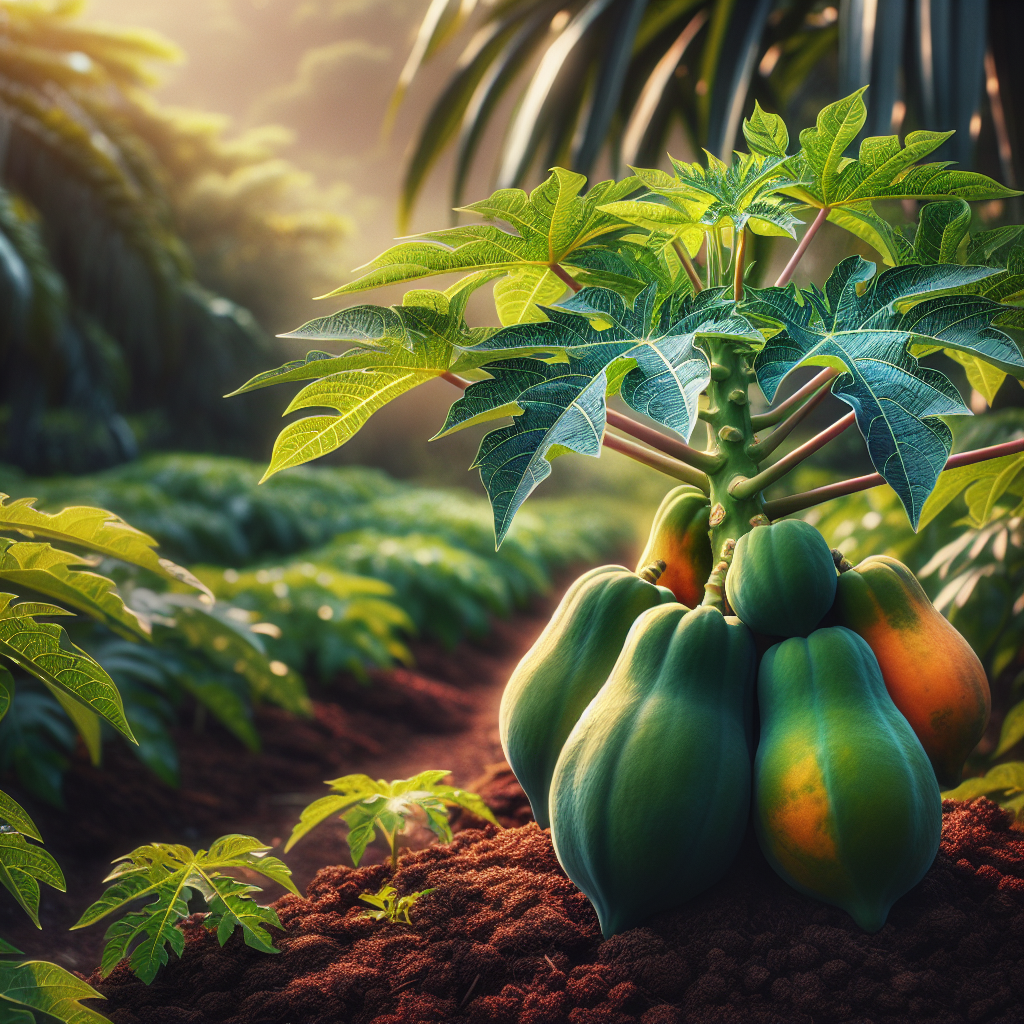
Introduction to Papaya
Native to tropical America and now cultivated across Asia, Africa, the Caribbean, and warm parts of the Americas, papaya is one of the most rewarding fruit crops for growers who can meet its climate requirements. It reaches bearing age quickly, often producing marketable fruit within 8 to 12 months from planting, which makes it attractive for both home orchards and commercial systems. The crop is especially important in humid and sub-humid tropics where year-round warmth supports continuous flowering and fruiting.
Papaya is unusual because productivity depends heavily on early management decisions. Site drainage, planting material quality, sex expression, fertility balance, and disease exclusion all determine whether a planting thrives or collapses within a season or two. In well-managed systems, papaya can produce heavily for 2 to 4 years before yields decline. Commercial orchards are often replanted on a staggered schedule because older plants become taller, harder to harvest, and more vulnerable to wind damage and disease.
Fruit quality varies by cultivar, environment, and harvest stage. Red-fleshed types often command premium fresh-market value, while yellow-fleshed selections may be preferred locally for processing or cooking at immature stages. Small-fruited solo types suit direct retail markets; larger-fruited dioecious or gynodioecious lines may be favored in wholesale or processing channels. Growers familiar with tropical fruit systems may also compare papaya spacing and wind sensitivity with banana, though papaya generally demands even better drainage and stricter virus management.
Botanical Profile of Papaya
Papaya belongs to the family Caricaceae. It is a large, soft-wooded herbaceous perennial rather than a true woody tree. The stem is typically single, hollow, green to gray, and marked with leaf scars. Under favorable conditions it can grow 2 to 6 meters or more in a short time, with fruit borne on the trunk below the leaf canopy.
Leaves are large, palmately lobed, and borne on long petioles arising spirally near the crown. The plant continuously produces new leaves in warm weather, and leaf number is directly tied to carbohydrate production and fruit fill. Premature leaf loss from nutrient deficiency, Mites, drought, root disease, or virus infection sharply reduces yield and sugar accumulation.
Papaya is botanically complex in sexual expression. Plants may be male, female, or hermaphrodite, and some cultivars show instability in flower form under environmental stress. Hermaphrodite plants are generally preferred for commercial fresh fruit production because they set elongated or pear-shaped fruit with a smaller seed cavity and more uniform market type. Female plants usually require pollen from male or hermaphrodite plants, depending on cultivar. In seed-propagated orchards, growers traditionally plant 2 to 4 seedlings per hole and rogue undesirable sex types after flowering. Modern commercial systems often use selected seed lines or tissue-cultured material where available, but seed remains the dominant propagation method globally.
Flowers arise in leaf axils. Male flowers are borne in long panicles, while female flowers are larger and closer to the trunk. Hermaphrodite flowers combine functional male and female structures. Pollination may occur via wind and insects, though fruit set in some lines is variable under cool or excessively wet conditions.
The fruit is a berry with smooth skin, fleshy mesocarp, and a central cavity filled with black, mucilaginous seeds. Unripe fruit exudes white latex rich in proteolytic enzymes, notably papain, which has culinary and industrial uses. Ripe fruit color ranges from yellow to orange-red depending on carotenoid composition.
Soil, pH, and Climate Requirements for Papaya
Papaya performs best in deep, fertile, well-aerated soils with rapid internal drainage. The single greatest avoidable cause of failure is waterlogging. Because roots are relatively shallow and highly sensitive to oxygen deprivation, even 24 to 48 hours of standing water around the root zone can trigger root rot, stem base infection, yellowing, and sudden collapse. Ideal soils are sandy loams to loams with good structure, at least 1 meter of workable depth, and no hardpan that traps water.
The preferred soil pH is typically 5.5 to 6.7, though papaya can grow in slightly more acidic or slightly alkaline soils if drainage and fertility are well managed. At pH below about 5.2, aluminum and manganese toxicity may impair root growth, while calcium, magnesium, and phosphorus availability may decline. At pH above 7.2, deficiencies of iron, zinc, and manganese become more common, often showing as interveinal chlorosis on young leaves. Where necessary, adjust acidic soils with agricultural lime several months before planting; in alkaline soils, rely on organic matter, localized acidifying fertilizers, and foliar micronutrient correction rather than aggressive pH modification.
Papaya is strictly tropical to subtropical and highly frost sensitive. Optimal temperatures are around 21 to 32°C. Growth slows below 15°C, flowering may become irregular below 18°C, and chilling injury can occur well above freezing if conditions are prolonged and wet. Temperatures near 0°C are usually lethal. In very high heat above 35°C, especially with hot winds and low humidity, flowers may abort, fruit may sunburn, and irrigation demand rises sharply.
Rainfall of 1000 to 2000 mm annually can support good production if it is well distributed and soils drain freely. In monsoonal climates, raised beds, mounds, or ridges are strongly recommended. In dry tropics, irrigation is essential for stable flowering and fruit sizing. Papaya prefers consistent root-zone moisture, not boom-and-bust cycles. As a practical benchmark, the top 15 to 20 cm of soil should remain lightly moist but never saturated. If soil squeezed in the hand forms a wet, sticky mass and leaves water sheen, it is too wet; if it crumbles into dust and leaves wilt during the hottest part of morning, it is too dry.
Wind protection is critical. The stem is brittle, roots anchor poorly in wet soil, and top-heavy fruiting plants snap easily. Establish living windbreaks or temporary barriers before planting. Full sun is required for best sugar development and canopy vigor.
For broader fertility planning and organic soil building, see soil health tips.
Step-by-Step Planting & Propagation
Begin with high-quality seed from a reputable source or from healthy, true-to-type fruit taken from productive, disease-free plants. Avoid seed from orchards showing virus symptoms, root disease, or severe off-types. Extract seed from fully ripe fruit, wash off the gelatinous aril, and dry it in shade for 1 to 3 days until surface moisture is gone. Fresh seed often germinates better than old seed, though short cool storage in dry conditions is possible.
Sow seed in trays, polybags, or small pots filled with a sterile, free-draining medium such as composted bark or coco coir blended with coarse sand or perlite. A pH of about 6.0 to 6.5 is ideal. Plant seed 1 to 1.5 cm deep. Germination usually occurs in 2 to 5 weeks depending on temperature, with best emergence around 25 to 30°C. Keep the medium evenly moist, not wet; damping-off is common in overwatered nurseries.
Seedlings are usually ready to transplant at 15 to 25 cm tall or 6 to 8 weeks old. Do not let roots become pot-bound, because papaya checks badly after root disturbance. Handle seedlings carefully; stem bruising and root breakage can permanently stunt growth.
Site preparation should include deep weed control, drainage correction, and incorporation of well-decomposed organic matter. In heavy or flood-prone soils, plant on mounds 30 to 60 cm high and 60 to 100 cm wide. Standard spacing depends on cultivar vigor and intended orchard life, but common ranges are 2 to 3 meters between plants and 2.5 to 3.5 meters between rows. High-density systems may begin closer and thin later.
At planting, dig a hole only as deep as the root ball and wider than the container. Set the seedling at the same depth it grew in the nursery; planting too deep encourages stem rot. Backfill gently without compacting heavily. Water immediately to settle soil, then mulch with straw, leaves, or composted material while keeping a 10 to 15 cm gap around the stem to prevent collar rot.
If using dioecious seed lines, plant 3 seedlings per station and reduce to the best-performing female or hermaphrodite plant after flowering, retaining a few male plants only where needed for pollination. Rogue weak, virus-suspect, or malformed seedlings early. In commercial settings, uniformity pays: eliminate lagging plants rather than trying to nurse them indefinitely.
Vegetative propagation of papaya is less common but can be done through cuttings or micropropagation for elite lines. Tissue culture offers clonal uniformity and known sex expression, but field success depends on acclimatization quality and careful hardening.
Care & Maintenance regimes for Papaya
Irrigation must be frequent and moderate. Young plants need light, regular watering to encourage continuous root expansion without saturation. Mature fruiting plants often require 25 to 50 liters per plant per irrigation event depending on soil type, canopy size, and weather, but the correct schedule matters more than the absolute volume. Sandy soils may need water every 2 to 3 days in hot weather; loams may need it every 4 to 7 days. Drip irrigation is strongly preferred because it maintains stable moisture and keeps the trunk base drier than basin flooding.
Signs of underwatering include midday leaf droop that persists into evening, slowed new leaf emergence, small misshapen fruit, flower drop, and reduced sweetness. Signs of overwatering include yellow lower leaves, soft stem base, sour-smelling soil, edema-like blistering, and sudden wilt despite wet ground. Overwatered papaya often appears drought-stressed because roots have suffocated.
Nutrient demand is high because papaya grows quickly and fruits continuously. Nitrogen drives canopy growth, phosphorus supports early rooting and flowering, and potassium is essential for fruit sizing, sweetness, firmness, and disease tolerance. Calcium and boron are especially important for cell wall strength, pollen function, and reducing fruit deformities. Magnesium supports leaf greenness, and micronutrients such as zinc, manganese, and iron are often limiting in high-pH soils.
A practical feeding program begins with compost or well-rotted manure before planting, then shifts to split applications of balanced fertilizer every 3 to 6 weeks during active growth. Many growers increase potassium once flowering starts. Overuse of nitrogen creates lush, weak growth, softer tissues, delayed ripening, and greater susceptibility to Mites and disease. Underfed plants show reduced leaf size, pale foliage, poor fruit set, and low soluble solids.
Mulching conserves moisture, buffers soil temperature, and suppresses weeds, but mulch must never be piled against the stem. Weed competition is serious because papaya roots occupy the same upper soil layer as weeds. Control weeds shallowly; deep hoeing damages feeder roots.
Pruning is minimal. Remove dead leaves, diseased tissue, and damaged fruit stalks using sanitized tools. Do not over-strip leaves, since fruit filling depends on active canopy area. In storm-prone areas, some growers earth up around the base or provide staking for young plants carrying heavy fruit loads.
Because papaya is short-lived, renewal planning is part of maintenance. Many professional growers establish new blocks annually or biannually so old and declining plants can be removed before height and disease reduce profitability.
Pests, Diseases & Organic Management
Papaya is highly vulnerable to several serious pests and pathogens, so prevention is more effective than rescue. The first principle is exclusion: start with clean planting material, remove infected volunteers, control weeds that host insect vectors, and avoid planting near older diseased papaya blocks.
Papaya ringspot virus is among the most destructive diseases worldwide. Symptoms include mosaic, leaf distortion, shoestring leaves, oily streaks on petioles and stems, ring spots on fruit, and severe yield loss. It is spread mainly by Aphids in a non-persistent manner, meaning insecticides often fail to stop transmission once Aphids probe plants. Organic management relies on rogueing infected plants immediately, planting virus-free seedlings, removing wild cucurbits or other nearby hosts where relevant, reflective mulches in small systems, border crops, and spatial isolation from infected fields.
Papaya leaf curl and other virus-like disorders can also stunt growth and distort leaves. If plants show systemic symptoms early, removal is usually more economical than treatment.
Phytophthora palmivora causes root rot, stem rot, fruit rot, and sudden collapse, especially in poorly drained soils or after heavy rain. Initial signs include water-soaked lesions near the collar, leaf yellowing, wilting despite moist soil, and fruit lesions that rapidly enlarge. Organic prevention includes raised beds, excellent drainage, sanitation, avoiding trunk injury, removing infected fruit, and using biological drenches based on Trichoderma or Bacillus where available.
Anthracnose and other post-harvest rots become serious in warm, wet conditions. Field sanitation, improved airflow, timely harvest, and careful fruit handling are essential. Avoid bruising, because latex burn and wounds become infection courts.
Common insect pests include Aphids, Whiteflies, Mites, Mealybugs, Fruit flies, and Scales. Aphids and Whiteflies are especially important as virus vectors. Spider Mites thrive in hot, dry periods and cause fine stippling, bronzing, and webbing on leaves. Mealybugs weaken plants and contaminate fruit surfaces with honeydew and sooty mold.
Organic management should combine monitoring, sanitation, biological control, and selective inputs. Encourage beneficial insects by limiting broad-spectrum sprays. Use yellow sticky traps for whitefly and aphid monitoring, inspect leaf undersides weekly, remove heavily infested leaves when practical, and wash small infestations off young plants with water. Horticultural oils, insecticidal soaps, neem-based products, and sulfur or biological miticides can suppress soft-bodied pests and Mites if coverage is thorough and applications are made during cooler hours to avoid phytotoxicity. Bagging fruit can reduce fruit fly damage in high-value plantings.
Nematodes may impair root function, especially in sandy soils with continuous papaya cropping. Crop rotation, soil organic matter improvement, biofumigant cover crops, and clean transplants help reduce pressure.
Harvesting, Curing & Optimal Storage
Harvest timing depends on market distance and intended use. For local sales, fruit can be harvested at the color-break stage when a small portion of the skin, often 10 to 25%, has turned yellow. For distant shipment, harvest slightly earlier at mature green, provided the fruit has reached full physiological maturity. Immature fruit will not develop proper sweetness or aroma after picking.
Maturity indicators include full fruit size, rounded shoulder development near the stem end, slight lightening of skin color from deep green to lighter green, and the appearance of the first yellow streaks in ripening cultivars. Days from flowering to harvest vary with climate and cultivar, often 5 to 8 months.
Harvest by hand with gloves, clipping or twisting fruit carefully to avoid stem tears and latex smearing. Fresh latex can stain and burn the skin of the fruit, reducing appearance. Handle fruit gently; papaya bruises easily, and impact damage may only become visible after ripening.
After harvest, place fruit in shade immediately. Wash if needed in clean, sanitized water, then dry thoroughly. Sorting should remove cracked, diseased, misshapen, or bruised fruit. Some growers cure fruit briefly in a clean, airy packing area to allow surface moisture and latex residues to dissipate before packing.
Optimal storage depends on ripeness. Mature-green papaya generally stores best around 10 to 13°C with 85 to 95% relative humidity. Riper fruit may be held slightly cooler but should not be exposed to chilling temperatures below about 7 to 10°C depending on cultivar and maturity, or surface pitting, poor color, off-flavors, and uneven ripening can occur. Fully ripe fruit is highly perishable and is best marketed quickly or held only for a few days under cool conditions.
Ethylene exposure accelerates ripening, so segregate papaya if slower ripening is desired. Conversely, controlled ripening can be encouraged in packing operations where uniform color development is needed. Once fully ripe, fruit should be consumed, processed, or refrigerated promptly.
Companion Planting for Papaya
Companion planting around papaya should serve agronomic functions rather than create competition. The best companions are low-growing, shallowly managed species that suppress weeds, attract beneficial insects, improve soil cover, or add modest nitrogen without shading the papaya trunk and canopy.
Suitable companions include basil, marigold, cowpea, peanut, sunn hemp, and low-growing legumes used as managed living mulches. Aromatic herbs can help diversify insect ecology, while legumes can contribute biomass and reduce erosion if kept trimmed. Papaya also benefits from flowering insectary strips placed in adjacent alleys rather than directly at the stem base. See our Thai basil guide for an herb option that can fit tropical mixed plantings.
Avoid aggressive vines, tall cereals, cassava planted too close, or any crop that competes intensely for water in the upper soil profile. Also avoid companion species that harbor Aphids, Whiteflies, or viral reservoirs near young papaya. In humid climates, dense understories can reduce airflow and increase disease pressure, so companion plants must be managed by cutting back regularly.
A practical pattern is to maintain a mulched weed-free ring 50 to 100 cm around each plant, then establish low companion species in the inter-row. This protects the sensitive collar area, preserves access for harvest, and still delivers biodiversity benefits. In small orchards, alternating papaya with strips of pollinator-friendly herbs and managed legumes often works better than crowding multiple species into the tree row.
Well-designed companion planting should never compromise sunlight, drainage, or sanitation. For papaya, those three factors remain more important than any companion effect.