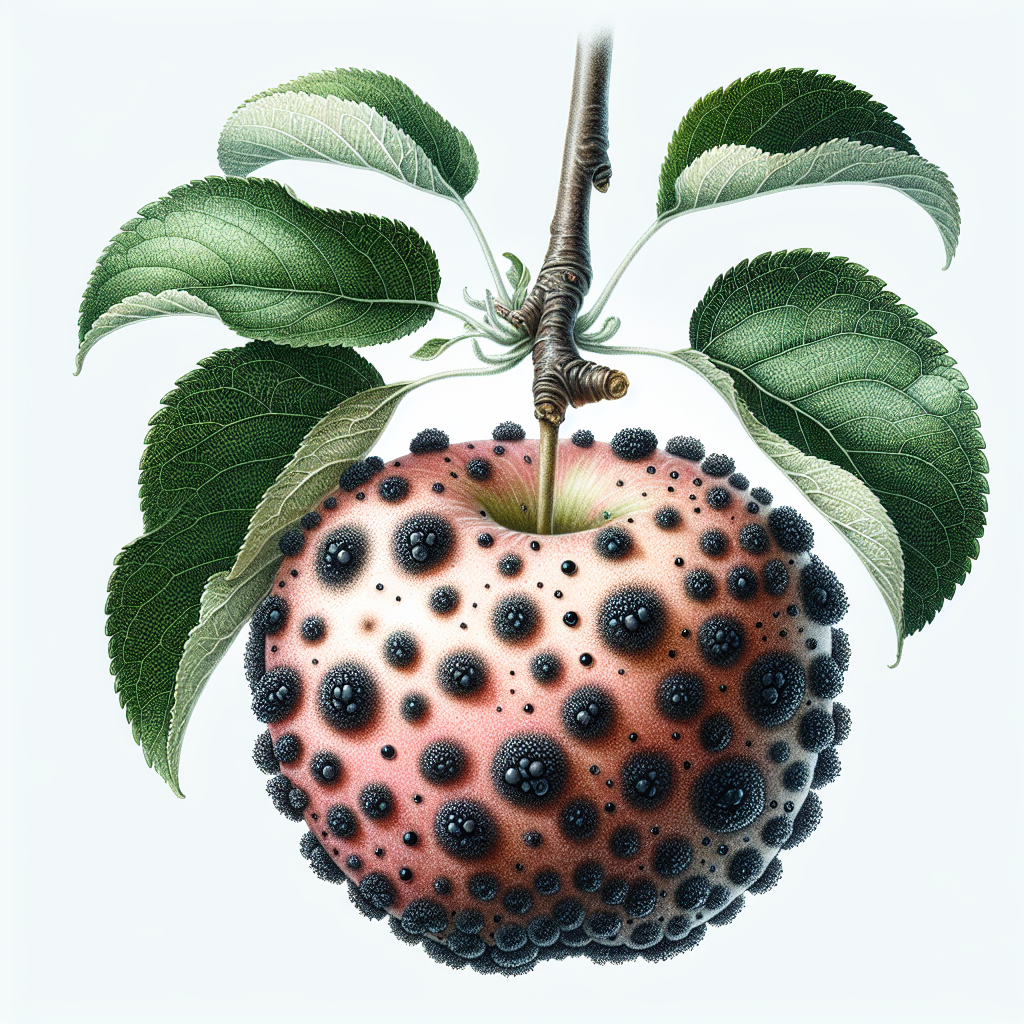
Introduction to sooty blotch/flyspeck
Sooty blotch and flyspeck represent a complex of superficial fungal diseases that mar the appearance of fruit crops, particularly in humid regions. Sooty blotch manifests as diffuse, dark, sooty-like patches on fruit skins, caused by a consortium of mycelial fungi such as Cladosporium spp., Leptodontidium spp., and Aureobasidium spp. Flyspeck, on the other hand, appears as clusters of tiny, shiny black dots, primarily from Schizothyrium pomi. These diseases do not penetrate the fruit flesh or cause internal damage, but their aesthetic impact significantly lowers cosmetic quality, making affected produce unmarketable for fresh sales. In commercial orchards, losses can exceed 20-50% of the crop value in severe epidemics.
Primarily targeting apple and pear trees, sooty blotch/flyspeck (SB/FS) complexes are most problematic in the eastern United States, southeastern Canada, and similar temperate-humid climates worldwide. The pathogens overwinter on infected twigs, leaves, and bark, colonizing fruit during prolonged leaf wetness periods from late spring through summer. While not directly yield-reducing, SB/FS drives post-harvest sorting costs and consumer rejection. Early detection and integrated management are crucial for maintaining high-quality fruit. For more on related fungal issues, see sooty blotch and flyspeck.
Organic growers face unique challenges as synthetic fungicides like captan are off-limits, necessitating cultural and biological strategies. This guide provides definitive diagnostic criteria, lifecycle insights, and proven organic management plans to minimize SB/FS incidence. By optimizing canopy airflow and timing interventions, producers can achieve 80-90% control even in high-risk environments.
Identifying Symptoms & Damage
Accurate diagnosis begins with visual inspection during fruit development stages (typically 4-10 weeks post-petal fall). Sooty blotch appears as irregular, olive-green to black, velvety or thread-like mycelial mats on fruit surfaces, often 1-5 mm in diameter. These can coalesce into larger blotches covering up to 50% of the fruit skin. Under magnification, fungal hyphae are evident, and the growth rubs off easily with thumb pressure, distinguishing it from sooty mold associated with insect honeydew.
Flyspeck lesions are more discrete: 0.1-0.3 mm black, flask-shaped pycnidia arranged in clusters of 10-30, resembling fresh fly droppings. They emerge 7-14 days after infection and do not rub off. Mixed infections are common, with sooty blotch providing a background for flyspeck specks. Damage is purely cosmetic; flesh quality, flavor, and storability remain unaffected. However, in fresh markets, even 5-10% surface coverage triggers downgrading.
Differential diagnosis rules out apple scab (deeper olive lesions with velvety spores), bitter rot (sunken, rotted areas), and powdery mildew (white powdery growth). Scout orchards weekly from pink bud stage, using a 10x hand lens. Severity scales (e.g., 0-10% coverage) aid in tracking progress. Economic thresholds: >5% incidence pre-harvest warrants intervention. In peach orchards, similar symptoms may indicate bacterial spot, requiring lab confirmation.
Lifecycle and Progression of sooty blotch/flyspeck
SB/FS pathogens exhibit polycyclic lifecycles synchronized with warm, wet summers. Primary inoculum overwinters as mycelia in bud scales, bark lenticels, and dead leaves. Conidia (spores) release at bud break (April-May in temperate zones), splashing onto leaves and fruit via rain or overhead irrigation. Infection requires 6-12 hours of leaf wetness at 15-25°C (59-77°F), with optimal at 20-22°C.
Latent period: 10-21 days, followed by visible colony expansion. Secondary cycles repeat every 7-14 days under conducive conditions, amplifying epidemics. Flyspeck's S. pomi produces pycnidia on fruit, releasing conidia in rain splashes up to 1-2 meters. Sooty blotch fungi colonize aerial plant parts indiscriminately, thriving on weeds and understory vegetation.
Progression peaks mid-summer (July-August), slowing in dry fall weather. Overwintering occurs via stromata on twigs. Full lifecycle: 4-6 cycles per season. Understanding this timing informs spray schedules. For instance, in Gala apple orchards, first symptoms appear at 400-600 hours accumulated wetness post-bloom.
Environmental Triggers & Risk Factors
SB/FS epidemics hinge on prolonged canopy wetness (>9 hours/night) and moderate temperatures (18-27°C). High relative humidity (>90%) from dense canopies, poor air drainage, and suppressed winds exacerbate spread. Risk factors include:
- Canopy density: Unpruned trees trap moisture; ideal spacing 3-4m between trees.
- Site selection: Low-lying frost pockets retain humidity; slopes >2% reduce risk.
- Irrigation: Overhead systems mimic rain splash; drip irrigation cuts incidence 70%.
- Weeds/Volunteers: Alternate hosts like clover harbor inoculum.
- Cultivar susceptibility: Thin-skinned varieties like Honeycrisp apple show higher coverage.
Extended wet periods (e.g., 1980s US Midwest epidemics) drive outbreaks. Climate change may intensify risks with increased storm frequency. Monitor with weather stations tracking leaf wetness hours (LWH). Threshold: >200 LWH/month from bloom triggers alerts. Avoid planting in valleys near powdery mildew-prone areas.
Organic Control & Treatment Plans
Organic management emphasizes prevention over cure, as eradicants are ineffective post-infection. Integrated plans yield 85% control:
- Sanitation (Fall/Winter): Prune 20-30% canopy for airflow; remove mummies, cull piles. Flail mow residues to expose inoculum to desiccation.
- Cultural Practices: Train to open-center or central-leader; summer prune watersprouts. Drip irrigate; mulch to suppress weeds.
- Biologicals: Apply Bacillus subtilis (Serenade) or Trichoderma spp. at pink bud, repeat 7-10 days (OMRI-listed).
- Organic Fungicides:
- Sulfur: 5-10 lbs/acre, 3-5 apps from tight cluster to 2nd cover (70% efficacy).
- Potassium bicarbonate (MilStop): 2-3 qts/100 gal, weekly during high risk.
- Neem oil + copper: Alternate for broad-spectrum.
- Horticultural oils: Smother mycelia pre-bloom.
- Timing: Use NEWA or MESIM models for sprays (e.g., 200 LWH post-bloom). 7-10 day intervals, 5-7 apps total.
For blog post on spring pest patrol with organic strategies, see companion resources. Rotate modes to prevent resistance. Efficacy: 80-95% with full program vs. 20% untreated.
Preventing sooty blotch/flyspeck in the Future
Long-term prevention builds resilient orchards:
- Resistant Cultivars: Plant Liberty, Enterprise apples (20-50% less SB/FS).
- Site/Orchard Design: Hillside planting, 4x4m spacing, reflective mulches.
- Scouting/Monitoring: Weekly traps, apps tracking LWH.
- Cover Crops: Mow Thai basil or yarrow understory to reduce humidity.
- Post-Harvest: Wax fruits to mask residues; high-pressure wash (removes 90%).
IPM threshold: Treat if >10% leaves infected by 1st cover. Annual audits reduce inoculum 50% over 3 years. For small farms, apple blocks <5 acres prioritize drip + sulfur.
Crops Most Affected by sooty blotch/flyspeck
Primarily pome fruits:
- Apples (80% cases): All varieties, esp. Fuji apple, Granny Smith apple.
- Pears: Bartlett pear, Bosc pear.
- Secondaries: Cherry, plum, peach, grapes in humid tropics.
Global incidence: US Midwest/Southeast (50% orchards affected), China, Europe. Not systemic in subtropicals like mango or avocado. Co-occurs with leaf spot diseases.