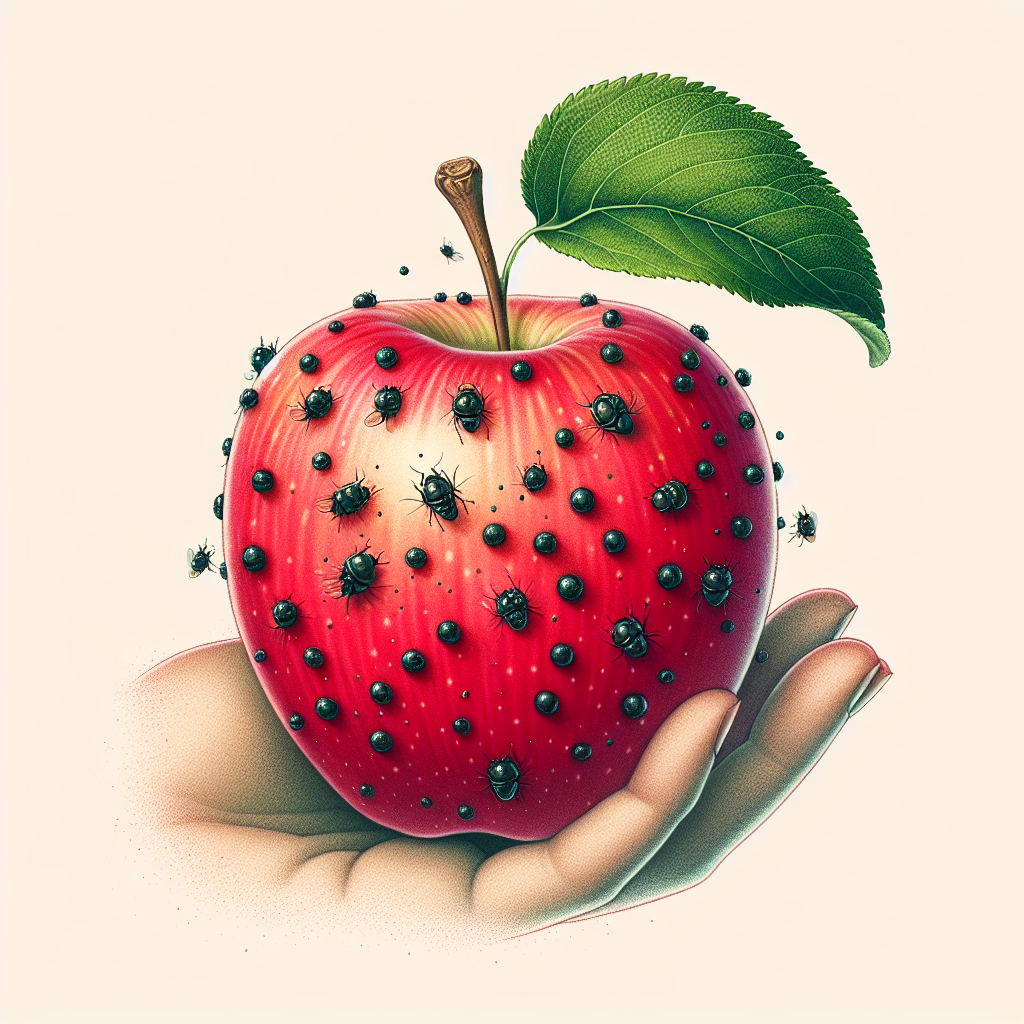
Introduction to flyspeck
Flyspeck, scientifically known as Schizothyrium pomi (formerly Zygophiala jamaicensis), is a widespread fungal disease primarily targeting apple trees and other pome fruits in humid regions worldwide. This disease manifests as tiny, black, clustered spots on leaves, stems, and especially fruit surfaces, mimicking the appearance of fly excrement—hence its common name. While not directly lethal to trees, flyspeck significantly impacts fruit quality, leading to downgrading or rejection at market due to its unsightly appearance. It frequently appears alongside sooty blotch, another fungal complex, compounding cosmetic damage and reducing yields by up to 20-30% in severe cases.
As a professional botanist and agricultural expert, I've observed flyspeck outbreaks in orchards from the U.S. Midwest to Southeast Asia, where prolonged leaf wetness exacerbates spread. The pathogen overwinters in fallen leaves and twig lesions, splashing onto new growth via rain. Early detection and integrated management are crucial for sustainable control, particularly for organic growers. This guide provides definitive diagnostic criteria, lifecycle insights, and proven organic strategies to minimize losses. For small farms, timely interventions can preserve premium pricing on fresh market fruit. Understanding flyspeck's biology empowers growers to protect high-value crops like Gala Apple and Honeycrisp Apple.
Recent studies from Cornell University and USDA highlight that flyspeck infection peaks when relative humidity exceeds 85% for 20+ hours, making it a predictable foe in misty climates. Economic impacts are stark: in Pennsylvania apple orchards alone, flyspeck causes annual losses exceeding $10 million. By integrating cultural, biological, and organic chemical controls, growers can achieve 80-90% reduction in symptoms. This comprehensive resource equips you with actionable steps for diagnosis and management. Read more about optimizing small farm strategies with AI insights in this blog post.
Identifying Symptoms & Damage
Accurate diagnosis begins with recognizing flyspeck's signature signs. On fruit, look for clusters of 0.1-0.3 mm black, convex dots arranged in star-like or pseudothecial groups, often 5-20 spots per cluster. These spots are sharply defined, shiny, and raised, distinguishing them from the diffuse, velvety patches of sooty blotch. Under magnification, mature pseudothecia reveal ostioles (tiny openings) resembling fly specks. Leaves show similar spots on the upper surface, sometimes with yellow halos if secondary infections occur.
Damage progresses slowly but cosmetically devastates marketable fruit. Infected apples develop 50-200 spots per fruit, rendering them unappealing for fresh sales. On pear trees, symptoms mirror apples but are less clustered. Differentiate from apple scab (larger, olive-green lesions with velvety spores), bitter rot (sunken brown rots), or insect frass (irregular, washable). Use a 10x hand lens: flyspeck spots don't rub off and lack fungal mycelium.
Severity assessment: Rate orchards using the Rutgers scale (0-10), where 4+ indicates economic thresholds. Yield impacts include 15-50% cull rates in humid years. Secondary effects include reduced photosynthesis on heavily spotted leaves, stunting growth in young trees. For peach and cherry crops occasionally affected, spots appear on stems and calyces. Early scouting post-petal fall is key—inspect 100 fruits/trees across blocks. Photosynthetic efficiency drops 10-20% with >20% leaf coverage, per Michigan State research.
Lifecycle and Progression of flyspeck
Schizothyrium pomi follows a polycyclic lifecycle tied to summer wetness. Overwintering occurs as stromata in leaf litter, buds, and bark cracks. Ascospores mature in pseudothecia from late spring (green tip stage), releasing during rain >0.1 inches. Primary inoculum splashes to terminals; infection requires 20-48 hours leaf wetness at 60-80°F (16-27°C).
Incubation lasts 2-4 weeks, with mycelial growth subsurface. Secondary cycles repeat 4-8 times per season via conidia on infected surfaces. Progression: spots appear 3 weeks post-infection, maturing to black pseudothecia by midsummer. Peak sporulation aligns with monsoon periods, July-August in temperate zones. In tropics, continuous cycles on mango extend damage.
Lifecycle diagram: Winter rest → Spring spore release → Wet infection → Summer expansion → Fall debris. One lesion produces 10^4-10^5 spores, amplifying epidemics. Dormancy breaks at 50°F bud swell. Understanding this enables precise spray timing, targeting 2nd-4th cover sprays.
Environmental Triggers & Risk Factors
Flyspeck thrives in moderate temperatures (65-75°F) with high humidity (>90% RH) and prolonged wetness (>24 hours). Risk spikes in valleys, near water bodies, or under dense canopies where dew persists. Poor air circulation from excessive vigor or unpruned trees heightens susceptibility. Wet springs followed by humid summers trigger epidemics; El Niño years see 2x infections.
Soil factors: High nitrogen promotes lush foliage, extending wetness. Overcrowded orchards (>300 trees/acre) foster microclimates. Global warming extends risk windows by 2-3 weeks northward. Companion pests like aphids weaken trees indirectly. Risk map: High in Eastern U.S., New Zealand; moderate in Pacific Northwest with drier summers.
Organic Control & Treatment Plans
Organic management emphasizes prevention but includes curative options. Sanitation: Rake and shred 90% leaf litter post-harvest; mulch to accelerate decomposition. Pruning: Open canopies for 20% light penetration, reducing wetness by 30%. Resistant varieties: Choose Liberty or Enterprise apples.
Biologicals: Apply Bacillus subtilis (Serenade) or Trichoderma at pink bud, repeating 7-14 days. Organic fungicides: Sulfur (6-8 lbs/100 gal) or potassium bicarbonate at 1st cover; lime sulfur dormant sprays kill overwintering stages. Copper (e.g., Cueva) pre-bloom, but avoid phytotoxicity. Timing: NEWA model predicts sprays when accumulative hours >200.
Integrated plan: 1) Dormant lime sulfur. 2) Post-petal fall Bacillus. 3) Covers: sulfur + bicarb. 4) Post-harvest urea + shredding. Trials show 85% control vs. 60% untreated. Monitor with sticky traps for spore release. For severe cases, Why Misidentifying Plants Costs Small Farms Thousands offers AI tools for rapid diagnosis.
Preventing flyspeck in the Future
Long-term prevention builds resilient orchards. Site selection: Avoid low-lying fog-prone areas; plant on slopes. Variety choice: Prioritize scab-resistant rootstocks like Geneva series. Fertility: Balanced N (40-60 lbs/acre) avoids excess vigor. Irrigation: Drip systems minimize wetting; avoid overhead >2 hours/day.
Cover crops: Sow clover to suppress splash dispersal. Monitoring: Use weather stations for wetness hours; apps predict infection risks. Rotation/Buffers: 10% wild areas disrupt cycles. Annual audits reduce incidence 50% over 3 years. Educate crews on hygiene—no tools between blocks.
Crops Most Affected by flyspeck
Primarily apple (80% cases), including cultivars like Gala, Fuji, Honeycrisp. Pears (Bartlett, Bosc), peach, plum, cherry, and grapes show symptoms. Minor on mango, persimmon, banana. Susceptible in humid orchards; resistant in arid zones. Global impact: U.S. (NY, MI, NC), China, Europe. Organic apples suffer most without synthetics.