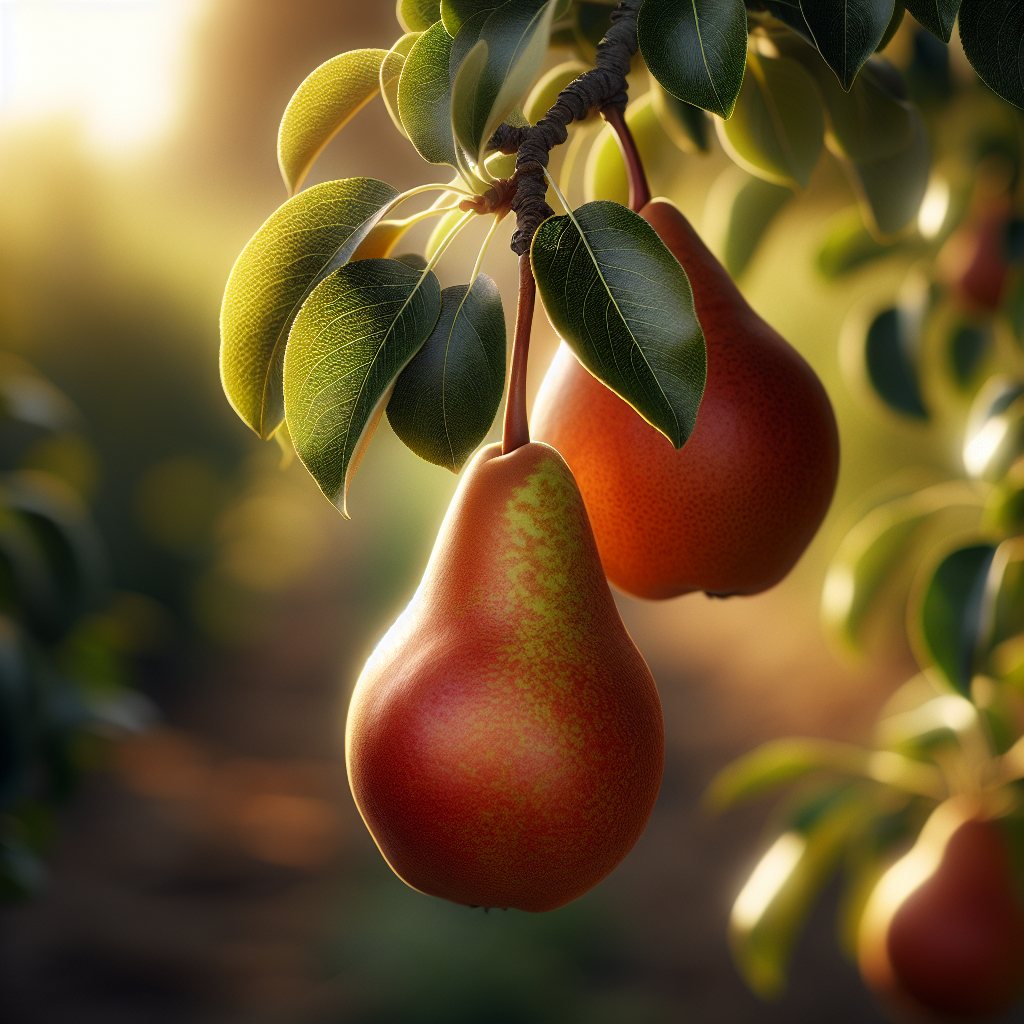
Introduction to Bosc Pear
Believed to have originated in Europe in the early 19th century, this old dessert pear is often listed under the historic name 'Beurré Bosc' and has remained commercially important because it combines distinctive appearance with dependable storage life. The fruit is instantly recognizable: long-necked, elegant, and covered in warm brown russeting rather than the smooth green-yellow finish seen in many other pears. Its flesh is cream to ivory, moderately fine-grained, and denser than melting cultivars, with a spicy, honeyed aroma that makes it especially valuable for baking, poaching, roasting, drying, and fresh eating after proper ripening.
From a grower’s perspective, it is not the easiest pear to master, but it rewards precision. Bosc is less forgiving of poor pollination, excessive vigor, and badly timed harvest than some common pear cultivars. Fruit left too long on the tree can lose storage quality; trees grown on unsuitable rootstocks may become overly large or slow to bear; and poor pruning often results in shaded wood, biennial tendencies, and undersized fruit. However, in a well-managed orchard with compatible pollinizers, balanced fertility, and excellent air circulation, it can be one of the finest late pears to produce.
For broader species-level context on orchard habits, pollination, and pear culture, see Pear. If you are improving the site before planting, the principles in soil health strategies are especially useful for long-lived fruit trees.
Botanical Profile of Bosc Pear
This cultivar belongs to the Rosaceae family and the species Pyrus communis, the European pear. Like other European pears, it is typically grown as a grafted tree rather than from seed, because seedlings are genetically variable and will not come true to type. Commercial and serious home production depends on selecting an appropriate rootstock for final tree size, anchorage, precocity, and soil adaptation.
Key morphological and horticultural traits include:
- Growth habit: upright to somewhat spreading with moderate vigor, often stronger in youth than in maturity.
- Bearing habit: primarily on spurs formed on two-year-old and older wood, though some fruiting can occur on lateral shoots if managed well.
- Bloom period: usually mid-season, overlapping with many other European pears but still requiring a compatible pollinizer.
- Pollination: generally self-incompatible or at least functionally dependent on cross-pollination for reliable cropping.
- Fruit character: elongated pyriform fruit with a narrow neck, heavy russet skin, firm flesh, aromatic sweetness, and good storage potential.
- Ripening pattern: harvested mature but not tree-ripe; flavor develops during postharvest ripening.
Bosc is often considered less 'melting' than Bartlett-type pears. That firmness is not a defect; it is part of the cultivar identity. Properly ripened fruit remains slightly denser and crisper near the core while still becoming juicy and richly flavored. This makes it unusually versatile in the kitchen, because slices tend to hold shape during cooking rather than collapsing.
Rootstock choice matters greatly. Quince rootstocks are used in some regions to control size, but compatibility may be imperfect without an interstem. In many North American orchards, OHxF rootstocks are preferred for disease tolerance and adaptability. A semi-dwarf rootstock can bring earlier bearing and easier management, while a standard rootstock may produce a larger, longer-lived tree but delay productivity.
Soil, pH, and Climate Requirements for Bosc Pear
This cultivar performs best in temperate climates with cold winters, mild springs, warm but not excessively hot summers, and low to moderate disease pressure. It is not suited to tropical or frost-free regions. Winter chill is necessary for regular bud break and flowering; while exact chill needs vary by location and rootstock, a practical target is roughly 700 to 1,000 chill hours below 45°F (7°C). Areas with inadequate chill may produce erratic bloom, weak leaf-out, and poor fruit set.
Spring frost is one of the biggest climatic risks. Open blossoms and young fruitlets can be damaged at temperatures only slightly below freezing, so avoid frost pockets and low-lying land where cold air settles. Ideal orchard sites have gentle slope, good air drainage, and full sun exposure. South-facing sites can encourage early bloom in cold regions, which may increase frost risk; east or northeast slopes can sometimes slow bloom enough to improve reliability.
Deep, well-drained loam is ideal. Trees tolerate a range of textures, but the best performance comes from soils with:
- Depth of at least 3 to 4 feet (90 to 120 cm) for unrestricted rooting
- Organic matter around 3% to 6%
- Good internal drainage with no prolonged saturation after rainfall
- A pH between 6.2 and 7.0, with acceptable performance from about 6.0 to 7.5
Below pH 5.8, nutrient imbalances may appear, especially reduced calcium and magnesium availability and increased risk of manganese or aluminum stress in some soils. Above pH 7.5, iron chlorosis becomes more likely, particularly in calcareous soils. Leaves with interveinal yellowing on new growth often indicate iron availability problems rather than simple nitrogen deficiency.
Drainage is non-negotiable. Pear roots are more tolerant of heavy soils than some fruit trees, but Bosc still suffers in waterlogged ground. If the planting hole fills with water and remains full for more than 24 hours after a heavy irrigation or rain, the site is unsuitable without drainage correction or raised berm planting. Chronic wet feet lead to weak growth, Phytophthora risk, sparse foliage, and reduced fruit quality.
Moisture should be consistent, not excessive. During the growing season, maintain soil moisture in the active root zone at roughly 60% to 80% of field capacity. In practical terms, soil 6 to 8 inches deep should feel cool and slightly moist, forming a weak ball in the hand without smearing like clay sludge. Dust-dry soil at that depth indicates water stress; sticky, airless soil with a sour smell indicates overwatering.
Heat can affect fruit finish. In very hot inland climates, prolonged temperatures above 95°F (35°C) may reduce fruit size and stress trees if irrigation is uneven. Sun-exposed fruit can also develop surface injury, especially after canopy over-pruning.
Step-by-Step Planting & Propagation
Commercially and horticulturally, propagation is done by grafting or budding onto rootstock. Seed propagation is useful only for breeding or rootstock production, not for maintaining true Bosc characteristics.
Select a suitable site. Choose full sun with at least 8 hours of direct light, open air movement, and no standing water. Avoid old orchard ground if possible unless soil has been tested for replant disease issues.
Test the soil before planting. Perform a full soil analysis for pH, phosphorus, potassium, calcium, magnesium, organic matter, and micronutrients. Correct pH and phosphorus deficiencies before planting because these are harder to fix once trees are established.
Choose the right tree form and rootstock. One-year feathered nursery trees often establish well. For backyard culture, semi-dwarf forms are usually easiest to prune and net. For high-density systems, dwarfing or semi-dwarfing rootstocks with trellis support may be preferred.
Provide pollination partners. Bosc generally needs another compatible European pear that flowers at the same time. Plant within bee flight distance, ideally within 50 feet for small plantings and throughout blocks in orchards. Do not rely on a single isolated tree unless a suitable pollinizer is very nearby.
Time planting correctly. Plant bare-root trees during dormancy, usually late winter to early spring before bud break. Container-grown trees can be planted later, but dormant planting is usually superior in temperate regions.
Prepare the planting area. Do not over-amend only the planting hole, as this can create a bathtub effect or discourage outward rooting. Loosen a broad area if soil is compacted. Remove perennial weeds thoroughly.
Plant at correct depth. Set the tree so the graft union remains 2 to 4 inches above finished soil level. Planting too deeply can cause scion rooting and loss of rootstock benefits.
Spread roots naturally. Trim broken root ends cleanly, spread roots over a small mound of soil, and backfill with native soil. Water thoroughly to eliminate air pockets.
Head and train immediately. For unbranched whips, head at the height needed for your scaffold system, commonly 30 to 36 inches for open-center modified systems or higher for central leader. Feathered trees should be pruned to retain well-spaced laterals.
Mulch carefully. Apply 2 to 4 inches of organic mulch in a wide ring, but keep it 3 to 6 inches away from the trunk to prevent rot and vole damage.
Spacing depends on system:
- Standard trees: 18 to 25 feet apart
- Semi-dwarf: 12 to 16 feet apart
- Dwarf/high-density: 8 to 12 feet with support as required
Bench grafting, whip-and-tongue grafting, and T-budding are all suitable propagation methods in skilled hands. Scion wood should be collected during dormancy from healthy, true-to-type wood.
Care & Maintenance regimes for Bosc Pear
Young trees need a balance between structural growth and early fruiting. The first three years should focus on canopy architecture, root establishment, and prevention of stress. Overcropping a young tree slows framework development and can permanently weaken branch angles.
Water management is central to quality. Newly planted trees generally need deep irrigation once or twice weekly depending on soil texture and weather. Sandy soils may require smaller, more frequent applications; clay loams need slower, deeper soakings with longer intervals. A useful target for a young tree is enough water to moisten the root zone 12 to 18 inches deep. Mature trees often need the equivalent of 1 to 2 inches of water per week during active growth, more during fruit swell in hot, dry weather.
Signs of underwatering include:
- Dull, slightly folded leaves during the hottest part of day that do not recover by evening
- Premature fruit drop
- Small, hard fruit with poor sizing
- Short annual shoot growth, often under 8 inches on non-bearing framework limbs
Signs of overwatering include:
- Persistently limp leaves despite wet soil
- Yellowing lower foliage
- Soft shoot growth highly attractive to pests
- Surface algae, fungus gnats, or sour-smelling soil
Fertilization should be based on leaf analysis and vigor, not guesswork. Excess nitrogen is a common mistake and leads to rampant upright growth, delayed fruiting, Fire blight susceptibility, and poor fruit color development. In young non-bearing trees, modest spring nitrogen may be justified if shoot growth is weak. In bearing trees, aim for balanced annual extension growth rather than lush vigor. As a rough field benchmark, many pear orchards target 8 to 12 inches of annual extension growth on bearing scaffolds, though this varies by rootstock and system.
Pruning is best approached as a yearly discipline rather than occasional severe cutting. Bosc tends toward upright growth, so branch angle management is important. Limb spreaders or tying down young shoots to 45 to 60 degrees can increase spur formation and calm vegetative dominance. Dormant pruning shapes the framework; summer pruning can reduce excessive shading and water sprouts.
Thin fruit after natural June drop if crop set is heavy. Leave one fruit per cluster and space pears roughly 5 to 7 inches apart along the branch. This improves fruit size, reduces limb breakage, and helps regular yearly bearing.
Protect trunks from rodents and sunscald in young orchards. White tree guards or diluted white latex trunk paint can reduce winter injury in cold sunny climates.
Bee activity is essential during bloom. Avoid insecticide applications during flowering. Poor pollination can produce misshapen fruit, low set, or many small pears that abort later.
Pests, Diseases & Organic Management
Bosc shares many pest and disease issues common to European pears, but its russeted skin can visually mask minor superficial blemishes better than smooth-skinned cultivars. That said, high-quality production still depends on prevention.
Fire blight is the most serious bacterial disease in many pear regions. It causes blossom blight, blackened shoot tips with a shepherd’s-crook bend, cankers, and in severe cases death of young trees. Risk increases with warm, humid bloom periods and excessive nitrogen. Organic management includes rigorous sanitation, pruning out infected wood well below visible symptoms during dry weather, avoiding high-vigor fertilization, and selecting less vigorous rootstock systems where appropriate. Tools should be disinfected between cuts in active outbreaks.
Pear scab causes dark velvety lesions on leaves and fruit. Good air circulation, leaf litter sanitation, and sulfur or approved copper-based programs timed to infection periods can help in organic systems.
Pear psylla is a key insect pest. Nymph feeding produces sticky honeydew, sooty mold, defoliation, and reduced tree vigor. Dormant oil can suppress overwintering adults and eggs. Encourage beneficial insects by avoiding broad-spectrum sprays, maintaining flowering understory strips, and controlling excessive succulent growth.
Codling moth and Oriental fruit moth may attack fruit in some regions, causing internal feeding. Pheromone traps, bagging fruit in small plantings, sanitation of dropped fruit, and mating disruption in larger orchards are effective tools.
Mites, Aphids, and Scale can also become problematic, especially where canopies are dense or beneficial insect populations are disrupted.
Cultural organic strategies that make the biggest difference include:
- Prune for light penetration and rapid drying after rain
- Remove mummified or infested fruit promptly
- Keep grass and weeds from competing directly at the trunk
- Avoid overfertilizing with fast-release nitrogen
- Monitor weekly during bloom and early fruit set
- Encourage beneficial companions such as Yarrow, Thyme, and Clover near but not crowding the trunk zone
Rodent damage, deer browsing, and bird pecking can also reduce young-tree survival and marketable yield. Physical exclusion is often the most dependable control.
Harvesting, Curing & Optimal Storage
Timing harvest correctly is one of the most important skills in producing premium Bosc fruit. Unlike many tree fruits, European pears are generally harvested mature but firm and then ripened off the tree. Fruit left to soften fully on the tree often develops internal breakdown or a coarse texture before peak flavor is reached.
Harvest usually occurs in late summer to autumn depending on region. Indicators of maturity include:
- Background color shifting from dark green to a lighter green-brown tone
- Fruit separating cleanly when lifted and tilted horizontally from the spur
- Seeds turning dark brown rather than pale white
- Soluble solids and firmness reaching local maturity benchmarks
Pick gently by hand, keeping stems attached. Do not pull downward. A lift-and-twist motion reduces spur damage and preserves next year’s fruiting wood.
Bosc often benefits from a conditioning period after cold storage or short room-temperature holding, depending on harvest maturity. For long storage, keep fruit at 30 to 32°F (-1 to 0°C) with high relative humidity around 90% to 95%. Lower humidity encourages shriveling; higher temperatures accelerate ripening and shorten storage life. Under excellent conditions, Bosc can store for two to four months, sometimes longer in controlled atmosphere systems.
At home, ripen fruit at cool room temperature until the stem end yields slightly to gentle thumb pressure. Because Bosc remains firmer than many pears, softness at the neck is a better indicator than waiting for broad softness over the whole fruit. Once ripe, refrigerate and use within several days.
Handle fruit carefully to prevent bruising. Russeted skin hides some external injury, but internal bruising still reduces quality. Pack in shallow layers or cushioned crates if transporting.
For processing, Bosc is outstanding for poaching and baking because it keeps its shape. For drying, slice evenly and treat against browning if desired.
Companion Planting for Bosc Pear
Good companions for this pear are chosen less to feed the tree directly and more to improve pollinator visitation, beneficial insect habitat, and orchard floor ecology. The best companions stay low, avoid heavy root competition at the trunk, and do not create a humid jungle around the bark.
Clover is one of the most useful understory companions because it fixes nitrogen modestly, protects soil, attracts pollinators, and can be mowed as a living mulch. Keep it managed and avoid allowing it to climb into the trunk flare area where rodents may hide.
Thyme works well in drier orchard margins or herb strips. Its flowers attract beneficial insects, and its low habit avoids much shading or humidity buildup.
Yarrow is especially valuable for predatory insects and parasitic wasps. It can be planted in nearby insectary bands or at row ends rather than directly against the tree.
Garlic is sometimes used in small orchards as a border companion to help suppress weeds and diversify the planting, though it should not be crowded into the immediate root zone where cultivation may disturb tree roots.
Avoid aggressive companions that demand frequent irrigation, heavy feeding, or deep cultivation near the trunk. Keep a vegetation-free circle of at least 2 to 4 feet around young trees, expanding management as needed, and place companion plantings just beyond the most sensitive establishment zone.