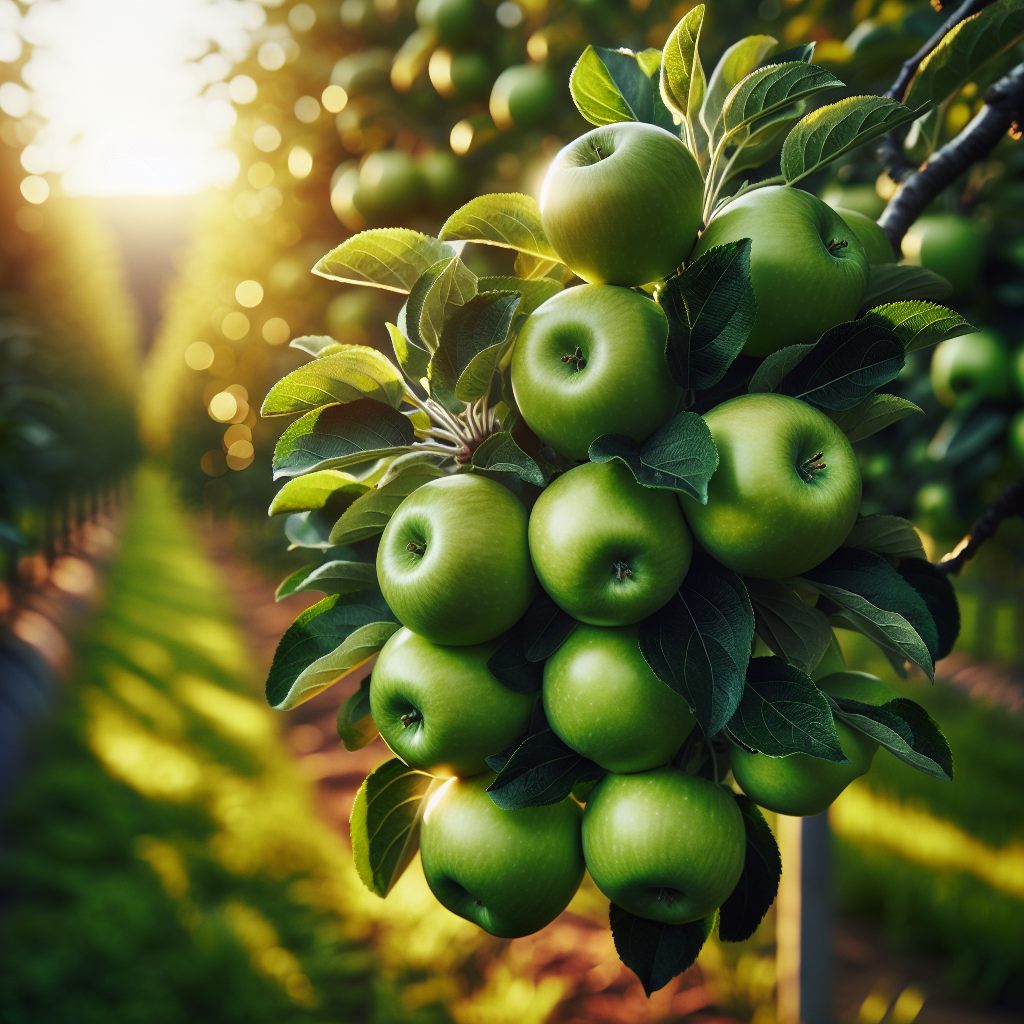
Introduction to Granny Smith Apple
Originating in Australia in the 19th century, this famous green apple is believed to have arisen as a chance seedling selected by Maria Ann Smith in New South Wales. It became globally important because it combines several traits growers and markets value: vigorous growth, dependable cropping under the right pollination conditions, a firm dense flesh that resists bruising better than many dessert apples, and a sharp, high-acid flavor that makes it useful both fresh and for baking.
This cultivar is especially recognized for its bright green skin, though fruit exposed to cool nights and strong sunlight may develop a faint pink blush. Compared with sweeter modern apples, it is distinctly tart, with soluble solids often moderate rather than very high at harvest. That acidity is a commercial strength because it preserves flavor during storage and cooking. For orchardists, however, Granny Smith has a few important management quirks: it can be vigorous to the point of becoming overly vegetative, it benefits from proper thinning to avoid small fruit and biennial tendencies, and in warmer districts it may need careful harvest timing to ensure the fruit has matured physiologically rather than being harvested while merely green.
For readers wanting broader species-level context, see our Apple guide. Also useful for orchard floor management and fertility planning is this article on soil health.
Botanical Profile of Granny Smith Apple
This cultivar belongs to the Rosaceae family, the same family as pears, cherries, peaches, and roses. Like most cultivated apples, it is a grafted tree rather than a seed-grown true-to-type variety. A tree sold as Granny Smith is usually scion wood grafted onto a selected rootstock that determines vigor, anchorage, precocity, tolerance of certain soil conditions, and final tree size.
Botanically, the tree is deciduous, entering dormancy after leaf fall in autumn and requiring winter chilling to reset bud development. Leaves are simple, oval, serrated, and medium green. Flowering typically occurs in mid-season relative to many apple cultivars, with pink buds opening to white blossoms. Blossoms are borne mostly on spurs, which are short, perennial fruiting shoots that become increasingly important as the tree matures.
Granny Smith is generally considered self-unfruitful or only weakly self-fertile, so cross-pollination from another compatible apple cultivar blooming at the same time is strongly recommended. Pollination success depends on bee activity, temperature during bloom, and overlap of flowering windows. Poor bloom weather, such as rain, wind, or temperatures below about 13b0C during bee flight hours, can greatly reduce fruit set.
Fruit is medium to large, round-conical to round, with smooth, glossy green skin that may turn slightly yellow-green as starch converts to sugars. Lenticels are prominent and pale. Flesh is white to greenish-white, very firm, and slow to soften compared with softer dessert cultivars. The tree itself tends toward strong upright growth when young, requiring branch training to create wide crotch angles and balanced scaffold structure. Without this, the canopy can become dense, shaded, and prone to disease pressure and poor color development.
Rootstock choice matters enormously. On dwarfing stocks such as M9, the tree may remain around 2.5-3.5 m with trellis support and very intensive management. On semi-dwarf stocks like MM106 or M26, height may reach 3.5-5 m with wider spacing and moderate support needs. On vigorous standard stocks, it can become substantially larger and slower to come into bearing.
Soil, pH, and Climate Requirements for Granny Smith Apple
This cultivar performs best in deep, well-drained loam or sandy loam with good moisture retention but no prolonged saturation. Ideal effective rooting depth is at least 90-120 cm. Apples dislike anaerobic soils; if the root zone remains waterlogged for even a few days during active growth, fine feeder roots can die back, reducing nutrient uptake and predisposing the tree to crown and root rots.
The preferred soil pH is 6.0-6.8. It will tolerate roughly 5.8-7.2, but performance declines outside that range. At pH below 5.5, calcium, magnesium, and phosphorus availability can become limiting while manganese or aluminum may become excessive. At pH above 7.2, iron, zinc, and manganese deficiencies are more common, often showing as interveinal chlorosis on young leaves. Because Granny Smith stores well only when fruit calcium is adequate, maintaining balanced soil chemistry is especially important.
Organic matter in the 3-5% range is highly beneficial. It improves moisture buffering, microbial activity, cation exchange capacity, and crumb structure. Avoid freshly manured planting holes, which can burn roots and cause uneven settling. Instead, incorporate mature compost into the broader orchard row before planting, not as a concentrated pocket.
Drainage is critical. A practical field test is to fill a 45-60 cm deep hole with water; if it still contains standing water after 24 hours, drainage is likely inadequate for apples. Raised berms or ridged rows can help in marginal soils, but very wet sites should be avoided altogether.
Climatically, Granny Smith is best suited to temperate regions with a defined dormant season. Winter chilling needs are moderate, commonly estimated in the range of 400-700 chill hours depending on local model and source. It can succeed in milder winter areas better than some high-chill cultivars, but inadequate chilling may lead to delayed, uneven budbreak, prolonged bloom, and inconsistent cropping.
The variety also benefits from a relatively long, warm growing season because it matures late. In cool-short-season districts, fruit may remain hard and intensely acidic with underdeveloped sugars before frost risk arrives. In hotter climates, sunburn and heat stress can become serious issues, particularly where afternoon temperatures exceed 35b0C repeatedly and humidity is low. Good leaf cover, evaporative moderation from mulch, and careful irrigation become essential under these conditions.
Spring frost is a major risk during bloom and early fruit set. Open flowers can be injured around -2b0C to -3b0C, and small fruitlets are also vulnerable. Plant on gentle slopes or sites with good cold air drainage rather than in frost pockets at the base of valleys.
Step-by-Step Planting & Propagation
Commercially and in serious home orchards, propagation is done by grafting rather than from seed. Seedlings do not come true to type and can take many years to bear, while grafted nursery trees preserve the exact Granny Smith characteristics and begin fruiting much earlier.
Select a high-quality nursery tree. Choose a certified disease-free one-year whip or a well-feathered two-year tree on an appropriate rootstock for your system. The graft union should be clearly healed, the trunk unscarred, and roots moist and fibrous rather than dried out.
Choose the right site. Full sun is non-negotiable; aim for at least 8 hours of direct light daily. Good airflow reduces scab, mildew, and Fire blight pressure. Do not plant where old apple or pear trees recently grew unless the soil has been rehabilitated, because replant disease can suppress new tree establishment.
Prepare the ground in advance. Control perennial weeds for at least one full season if possible. Deeply compacted subsoil should be ripped or loosened before planting, not after. Incorporate compost across the row strip and correct pH with lime or sulfur based on a soil test.
Plant during dormancy. Late winter to early spring is ideal in cold climates, while mild-winter regions can plant from late autumn through winter. Bare-root trees should be planted while dormant and before buds open.
Soak roots briefly before planting. One to four hours in clean water is sufficient for bare-root trees. Do not soak for an entire day, which can deprive roots of oxygen.
Dig a broad hole, not a deep one. The hole should be wide enough to spread roots naturally. Plant so the graft union remains 5-10 cm above the final soil line; burying the graft can cause the scion to root, eliminating rootstock benefits.
Backfill with native soil. Break up clods and eliminate major air pockets by watering in gently. Avoid heavy fertilization in the planting hole.
Water thoroughly. Apply enough water to settle soil around the roots to field capacity. As a benchmark, young trees often need 10-15 liters immediately after planting, more in sandy soils.
Stake or trellis if needed. Dwarf trees usually require permanent support. Tie loosely with a flexible material to prevent girdling.
Mulch correctly. Apply 5-8 cm of organic mulch over the root zone, keeping a 10-15 cm bare collar around the trunk. Trunk-contact mulch encourages rot, vole damage, and crown issues.
Typical spacing varies by rootstock and training system. Dwarf high-density systems may use 0.9-1.5 m between trees and 3-4 m between rows. Semi-dwarf orchards often use 3-4.5 m between trees and 4.5-6 m between rows. Home gardeners using more vigorous rootstocks should allow even more space.
Propagation by bench grafting, whip-and-tongue grafting, or budding onto rootstocks is standard for professionals. Scion wood should be collected during dormancy, stored cool and moist, and grafted onto compatible rootstocks before spring growth. Successful propagation requires sanitation, exact cambial alignment, and proper aftercare to prevent desiccation.
Care & Maintenance regimes for Granny Smith Apple
Water management is the single most important cultural factor during establishment. In the first year, keep soil consistently moist but never saturated. A useful target is moist soil in the upper 15-25 cm, not muddy or foul-smelling. In practical terms, the soil should form a weak ball in the hand and break apart with light pressure. If it feels greasy, slick, or leaves standing water in a planting basin for more than several hours, it is too wet.
Young trees commonly need 15-25 liters once or twice weekly depending on temperature, wind, and soil texture. Sandy soils may require more frequent irrigation with lower volume; clay loams require less frequent but deeper watering. Mature trees often need the equivalent of 25-40 mm of water per week during active fruit sizing, especially from petal fall to several weeks before harvest. Water deficits during this phase reduce fruit size and can increase premature drop. Severe late-season overwatering, however, can dilute flavor, worsen vegetative growth, and increase some storage disorders.
Signs of underwatering include dull or slightly folded leaves in hot afternoons that fail to recover by evening, reduced shoot extension, small fruit, and early yellowing of older leaves. Signs of overwatering include persistently pale leaves, weak extension growth despite wet soil, sour-smelling root zones, algae on soil surfaces, and in severe cases sudden collapse due to root disease.
Nutrition should be guided by soil and leaf analysis. Granny Smith responds well to balanced nitrogen, but excessive nitrogen is a common mistake. Too much N produces lush upright shoots, denser shade, poorer color, softer tissue more vulnerable to pests, and lower calcium concentration in fruit. Young non-bearing trees may receive modest spring nitrogen to build framework, while mature bearing trees should receive enough to support annual cropping without stimulating rank regrowth. Split applications are often safer than one heavy dose.
Calcium deserves special attention because firm, long-storing apples can still suffer bitter pit and related disorders if fruit calcium is low. This is more likely with vigorous growth, drought fluctuation, heavy nitrogen, light crop load, or large fruit. Foliar calcium sprays during fruit development are commonly used in professional systems, especially where bitter pit risk has been observed.
Pruning is essential. During the first 3-4 years, focus on training. Establish a central leader or tall spindle system with well-spaced scaffold branches at wide angles, ideally 60-70 degrees from vertical. Use clothespins, limb spreaders, or tying to widen branch angles while shoots are still flexible. Narrow crotches are structurally weak and overly vigorous.
In bearing years, prune during dormancy to renew fruiting wood, improve light penetration, and limit tree height. Granny Smith tends to benefit from removal of overly upright water sprouts, crossing branches, shaded interior wood, and exhausted spur systems. Summer pruning can help reduce vigor and improve light in dense canopies, but excessive summer leaf removal may increase sunburn on exposed fruit.
Fruit thinning is often necessary. Thin when fruitlets are 10-20 mm in diameter, leaving roughly one fruit per cluster and spacing apples about 15-20 cm apart along branches. Proper thinning improves fruit size, reduces limb breakage, supports annual bearing, and enhances return bloom the following season.
Pollination planning is non-optional. Plant a compatible pollinizer nearby, ideally within 15-30 m for bee efficiency, and ensure bee activity during bloom. Two strong hives per hectare may be used in commercial orchards depending on wild pollinator presence.
Weed control around the trunk is vital for the first several years. Maintain a vegetation-free strip 60-100 cm around each tree, because grass competition can severely reduce young tree growth by competing for water and nitrogen.
Pests, Diseases & Organic Management
Granny Smith is susceptible to many of the same pest and disease pressures as other apples, so prevention is more effective than rescue treatments.
Apple scab causes olive-brown leaf and fruit lesions, especially in wet spring conditions. Good airflow, sanitation, and resistant rootstock selection do not eliminate risk because resistance is scion-dependent, and Granny Smith is not strongly scab-resistant. Remove fallen infected leaves where practical, prune to open the canopy, and use preventive organic fungicides such as sulfur or copper within a well-timed spray program.
Powdery mildew appears as white powdery growth on shoots and leaves, often in dry climates with humid microclimates in the canopy. Prune out infected shoot tips during dormancy and maintain open architecture.
Fire blight can be serious, particularly in warm wet bloom periods or under excessive nitrogen fertility. Symptoms include blackened blossom clusters, wilted shoots with a shepherd's-crook bend, and cankers. Prune infected wood well below visible symptoms, disinfecting tools between cuts. Avoid heavy nitrogen and excessive pruning that stimulates lush susceptible shoots.
Codling moth is one of the key fruit pests. Larvae tunnel into fruit, leaving frass at entry points. Organic management combines pheromone traps for monitoring, mating disruption in larger orchards, removal of infested fruit, trunk banding, and precisely timed applications of Codling moth granulosis virus or spinosad where permitted.
Aphids, including Rosy apple aphid and Woolly apple aphid, distort leaves and shoots and can weaken young trees. Encourage beneficial insects, avoid unnecessary broad-spectrum sprays, and use horticultural oils or insecticidal soaps when populations are building.
Apple maggot, Mites, Scale insects, and Leafrollers may also occur depending on region. Dormant oil applications help suppress overwintering eggs and scale. Sticky traps and orchard sanitation are useful supporting measures.
Organic management works best as an integrated program:
- Winter: remove mummified fruit, prune out diseased wood, apply dormant oil where appropriate.
- Spring green tip to petal fall: monitor disease infection periods and protect susceptible tissue with approved sprays as needed.
- Summer: monitor traps weekly, thin fruit, destroy infested drops, maintain irrigation and nutrition balance.
- Autumn: remove fallen fruit, shred leaves if practical, and reduce overwintering inoculum.
Sanitation matters more than many growers realize. Fruit left on the ground can sustain Codling moth and disease cycles. Likewise, dense grass and debris around trunks can harbor rodents that chew bark in winter.
Harvesting, Curing & Optimal Storage
This is a late-season apple, often harvested from mid to late autumn depending on region. The mistake many growers make is assuming that green color alone means it is not ready. Granny Smith remains green at maturity; harvest decisions should be based on a combination of starch conversion, seed color, background hue shift from hard green to slightly lighter green, ease of separation from the spur when lifted and twisted, firmness testing, and taste.
Fruit for long storage is usually picked slightly before full dessert ripeness, when flesh is still very firm and acids remain pronounced. Fruit left too long can become greasy-skinned, more susceptible to internal breakdown, or exposed to weather damage. Multiple pickings may be needed where maturity is uneven.
Harvest carefully by lifting the fruit upward and rolling it gently so the stem stays attached. Pulling straight outward often tears spurs and damages next year's fruiting wood. Never drop apples into bins. Bruises may not show immediately on such firm fruit, but they will shorten storage life.
Unlike onions or garlic, apples are not "cured" in the traditional dry-down sense. What they need is rapid postharvest cooling. Remove field heat as soon as possible. Ideal storage is 0-1b0C with 90-95% relative humidity. At lower humidity, fruit loses water, shrivels, and softens; at warmer temperatures, respiration increases and acids decline faster.
Under ordinary cold storage, Granny Smith can keep for several months, often 4-6 months or more if harvested correctly and stored promptly. In controlled-atmosphere storage with reduced oxygen and elevated carbon dioxide, commercial storage life can extend considerably longer, but gas levels must be carefully managed to avoid off-flavors and physiological injury.
Do not store damaged, insect-stung, cracked, or diseased fruit with sound fruit. One decaying apple can increase ethylene and infection risk in storage lots. Regularly inspect stored fruit and remove any showing soft spots, water-soaked areas, scald symptoms, or mold.
Because it is a high-acid apple, flavor often mellows somewhat after several weeks in storage. This can improve eating quality for some consumers while preserving the crisp structure that makes it excellent for pies, tarts, drying, and fresh slicing.
Companion Planting for Granny Smith Apple
In mixed orchards and home systems, companion planting should support pollinators, suppress weeds, improve soil structure, or confuse pests without creating excessive competition at the tree root zone.
Clover is one of the most useful orchard companions. It functions as a living mulch in alleyways, provides nectar for beneficial insects, reduces erosion, and in some systems contributes biologically fixed nitrogen. Keep it mowed low near young trees so it does not compete too strongly for moisture.
Garlic is often planted in small orchard understories because its pungent foliage may help deter some browsing pests and it occupies shallow surface layers without forming a dense sod. It should still be kept outside the immediate trunk collar to avoid maintenance issues.
Onion serves a similar role in diversified garden orchards, offering efficient use of space and a low-growing habit that does not shade the tree. Alliums are most practical around home-scale plantings rather than high-density commercial orchards where mechanization is important.
Sunflower can be useful at orchard margins rather than directly beneath trees. It attracts pollinators and beneficial insects, but because it can compete strongly for water and light, place it on borders or row ends instead of in the main tree root zone.
Avoid planting aggressive grasses right up to trunks, and avoid deep-rooted, highly competitive perennials directly under young trees. Companion species should support the orchard ecosystem, not create a permanent moisture and nutrient deficit around the apple root zone.