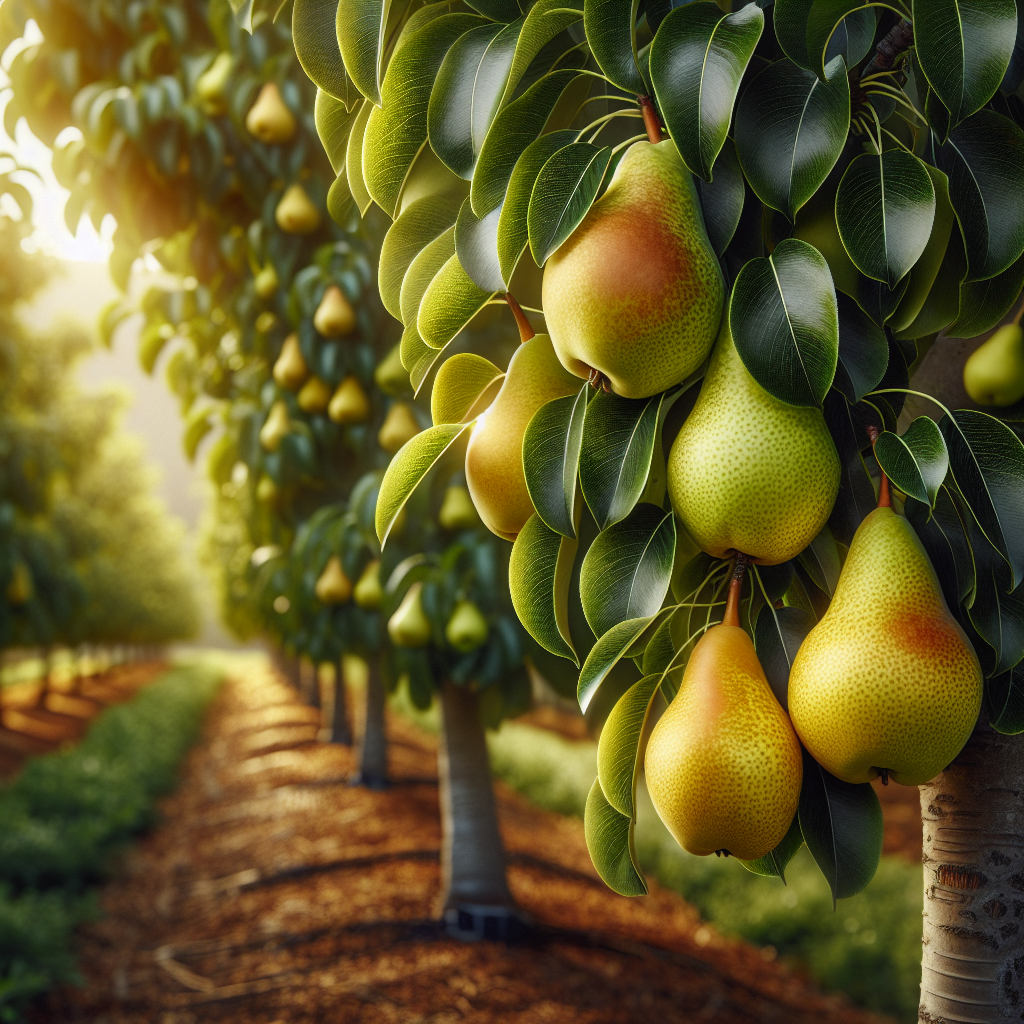
Introduction to Bartlett Pear
Among European pears, this cultivar is the benchmark by which many fresh-market pears are judged. Known as 'Williams Bon Chrétien' in parts of Europe and marketed widely as Bartlett in North America, it became one of the most commercially important pears because it combines strong flavor, attractive fruit shape, good canning quality, and relatively dependable bearing when matched with the right pollinizer and site.
The fruit is typically medium to large, bell-shaped, and green when immature, turning bright yellow at eating ripeness. Flesh is fine-grained, buttery when properly ripened, and highly aromatic with a distinctly floral, sweet profile. That eating quality is one reason this cultivar remains popular in home orchards and commercial plantings despite being more vulnerable than some modern cultivars to Fire Blight and bruising.
Commercially, it is used for fresh eating, poaching, drying, juice, and especially canning because the flesh holds shape well when harvested at the correct physiological maturity. From a grower perspective, the main strengths are market recognition, excellent flavor, and broad adaptability in temperate zones; the main weaknesses are disease sensitivity, a need for compatible pollination, and the fact that fruit is often harvested mature-green rather than tree-ripe. For broader species context, see Pear.
Historically, the cultivar traces back to England in the late 18th century, where it was associated with Williams Nursery. After being introduced to North America, it was propagated under the Bartlett name and became deeply embedded in orchard production, especially in western U.S. pear districts. Its long history matters because production systems, rootstock choices, and harvest protocols have been refined over generations; this is not a novelty pear but a cultivar with well-understood management.
Botanical Profile of Bartlett Pear
This tree belongs to the Rosaceae family and to the species Pyrus communis, the European pear. Unlike many Asian pears, which are typically crisp when ripe, this cultivar follows the classic European pear pattern: fruit is harvested mature but firm, then ripened off the tree to develop its signature melting texture.
Trees are moderately vigorous on standard rootstocks and somewhat more manageable on semi-dwarfing stocks. Growth habit is upright to upright-spreading, especially in youth, with strong scaffold development if trained early. Shoots can be vigorous, and if nitrogen is excessive or pruning is too severe, the canopy may produce rank, succulent growth that is highly attractive to Fire Blight.
Leaves are glossy green, ovate, and finely serrated, with a smooth surface that can make early insect pressure harder to spot unless scouting is systematic. Flowers are white, borne in clusters on spurs, and open in spring. Bloom timing is mid-season in most pear regions, but local climate can shift this by one to two weeks. Flowers are not reliably self-fertile, so cross-pollination with another compatible European pear is strongly recommended.
Fruiting occurs mainly on spurs formed on two-year and older wood. Well-managed trees can remain productive for decades, but spur systems need light renewal over time to prevent overcrowding and declining fruit size. Bartlett tends to produce heavily if conditions are favorable, and without thinning, crops can become excessive, reducing fruit size and increasing limb breakage risk.
Typical fruit characteristics include thin skin, a smooth exterior, pale lenticels, and green background color at harvest. As ripening advances, chlorophyll breaks down and the fruit becomes yellow, often with a light blush in sun-exposed positions. The neck is defined but not as elongated as some russeted pear types. Flesh contains stone cells typical of pears, but when grown under balanced water and nutrition these are not usually objectionable.
Depending on rootstock, tree size varies considerably. Standard trees may exceed 20 feet in height and spread, while semi-dwarf forms often remain in the 12-16 foot range with pruning. Rootstock selection also influences anchorage, precocity, disease tolerance, and soil adaptation, so naming the cultivar alone is not enough when planning an orchard.
Soil, pH, and Climate Requirements for Bartlett Pear
This cultivar performs best in deep, well-drained loam or sandy loam with moderate water-holding capacity and good aeration. Ideal effective rooting depth is at least 3 feet. Pears tolerate heavier soils somewhat better than peaches, but standing water is still dangerous. If water remains in the planting hole for more than 24 hours after heavy rain or irrigation, root stress and root disease risk rise sharply.
Target soil pH is 6.0 to 7.0, with an optimum near 6.2-6.8. Slightly alkaline soils can be tolerated better than by acid-loving fruit crops, but once pH rises above about 7.5, micronutrient deficiencies, especially iron chlorosis, become more likely. In high-pH calcareous soils, leaves may turn pale yellow while veins remain green, particularly on young terminal growth. Conversely, strongly acidic soils below pH 5.5 may reduce nutrient balance and root vigor unless amended.
Soil organic matter around 3-5% is ideal for moisture buffering and biological activity. Excessively rich, high-nitrogen soils can be counterproductive because they push vegetative growth at the expense of balanced cropping and increase Fire Blight susceptibility. Before planting, conduct a full soil test for pH, phosphorus, potassium, calcium, magnesium, cation exchange capacity, and organic matter.
Drainage is critical. Roots require oxygen, and saturated conditions deprive them of it. In poorly drained soils, trees may show weak extension growth, sparse foliage, marginal leaf scorch in summer, and increased susceptibility to canker organisms. If your site is marginal, plant on raised berms 12-18 inches high and 3-5 feet wide.
Climatically, Bartlett is best suited to cool-temperate to warm-temperate regions. It needs winter chill, generally around 800-1,500 chill hours depending on local interpretation and production system, to break dormancy properly and flower uniformly. Too little chill can cause erratic bloom, poor leaf-out, and reduced productivity.
Spring frost is a major concern because flowers and newly set fruitlets are vulnerable. Sites with cold-air drainage, such as gentle slopes rather than frost pockets, are preferable. During bloom, temperatures below about 28°F (-2.2°C) can damage open flowers; lower temperatures for sustained periods can devastate the crop.
Summer heat should be warm enough to mature the crop but not so extreme that sunburn and water stress become chronic. Daytime temperatures of 75-90°F (24-32°C) during the growing season are generally favorable if irrigation is adequate. Prolonged temperatures above 95°F (35°C), especially with hot winds and low humidity, can increase fruit sunburn, reduce cell expansion, and cause premature leaf stress.
Annual rainfall of 30-40 inches can support production if well distributed, but rainfall patterns matter more than totals. Dry summers require irrigation. Humid regions can grow Bartlett, but disease pressure, especially Fire Blight and foliar fungi, rises significantly. In wetter climates, canopy ventilation and conservative nitrogen management are essential. For deeper orchard soil management principles, see soil health strategies.
Step-by-Step Planting & Propagation
Most growers establish this cultivar using grafted nursery trees rather than seed propagation. Seedling-grown pears are genetically variable and will not come true to type. Purchase one-year whip trees or well-feathered two-year nursery stock on a rootstock suited to your soil, vigor goals, and disease pressure.
Choose a site with full sun, ideally 8 or more hours of direct light daily. Avoid low pockets where frost settles and sites exposed to constant high wind. Bartlett can tolerate some wind, but fruit rub, shoot breakage, and reduced pollinator activity become more likely on exposed sites.
Plant during dormancy, typically late winter to early spring in cold climates, or late autumn through winter in milder temperate regions where soil remains workable. Bare-root trees should be planted before bud break. Container trees can be planted more flexibly, but dormant-season planting still gives the best establishment.
Step 1: Prepare the site. Remove perennial weeds in at least a 3-foot radius. Grass competition is a common reason young pear trees establish slowly. If needed, rip compacted soil before planting. Do not over-amend the planting hole with rich compost, as roots may circle in the amended zone instead of moving into native soil.
Step 2: Soak bare-root trees for 2-6 hours before planting, but do not leave roots submerged for more than about 24 hours. Trim broken root ends cleanly.
Step 3: Dig a hole wide enough to spread roots naturally, usually 2-3 times the root spread, but only as deep as needed so the graft union remains 2-4 inches above final soil level. Planting too deep is a frequent and serious error; it can encourage scion rooting and weaken the intended rootstock effects.
Step 4: Backfill with native soil, firming gently to eliminate large air pockets. Water thoroughly to settle the soil. Do not pack excessively hard.
Step 5: Stake if the rootstock or site requires it. Dwarfing and some semi-dwarf systems benefit from permanent support; more vigorous rootstocks may only need temporary staking in windy areas.
Step 6: Head the tree at planting if it is an unbranched whip, usually to 30-36 inches to encourage scaffold formation. If feathered, select 3-5 well-spaced laterals with wide crotch angles.
Spacing depends on rootstock and training system. Standard trees may need 18-25 feet between trees and 20-25 feet between rows. Semi-dwarf trees often perform well at 12-16 feet in-row and 16-20 feet between rows. High-density systems can be tighter if rootstocks, trellis support, and pruning are matched carefully.
Propagation beyond purchasing nursery trees is generally by bench grafting or field budding onto pear-compatible rootstocks. Whip-and-tongue grafting in late winter is common for dormant scion wood. Commercial propagation requires sanitation and skill because disease can be spread through infected propagation material.
Pollination planning is part of planting, not an afterthought. A compatible European pear that blooms at a similar time should be within effective bee flight distance, ideally every second or third tree in a home orchard or in alternating rows or pollinizer intervals in commercial blocks. Some growers also use bouquet limbs of pollinizer cultivars grafted into the canopy.
Care & Maintenance regimes for Bartlett Pear
Young trees need consistent but not excessive moisture during establishment. In the first year, supply enough water to moisten soil 12-18 inches deep. In practical terms, that often means 5-10 gallons per watering for a newly planted tree, one to three times weekly depending on soil texture and weather. Sandy soils need more frequent, smaller irrigations; loams need deeper, less frequent watering.
The goal is evenly moist soil, not saturation. When soil at 4-6 inches depth feels cool and slightly moist but not sticky or smeary, moisture is usually in a good range. If the soil is dusty and dry at that depth, irrigation is overdue. If it is soupy, has a sour smell, or leaves a shiny film on roots, it is too wet. Aboveground signs of overwatering can mimic drought: pale leaves, poor shoot growth, and leaf drop despite wet soil.
Once established, mature trees benefit from deep irrigation during key stages: bloom through fruit set, early fruit enlargement, and the final swell before harvest. Water stress in the first 6-8 weeks after bloom reduces cell division and permanently limits fruit size. A rough target in dry climates is 1-2 inches of water per week from rainfall plus irrigation, adjusted for canopy size, evapotranspiration, and soil type.
Mulch with wood chips or other coarse organic material 2-4 inches deep, keeping it 4-6 inches away from the trunk to prevent collar rot and rodent habitat at the bark line. Mulch moderates temperature, improves infiltration, and reduces weed competition, which is especially important in the first five years.
Fertilization should be guided by soil and leaf analysis. In the absence of test data, young non-bearing trees often receive modest nitrogen in spring to promote canopy establishment, while bearing trees receive conservative nitrogen to avoid excess vigor. As a practical rule, annual extension growth of about 12-18 inches on young trees and 8-12 inches on bearing trees indicates a reasonably balanced nitrogen status. Significantly more suggests overfeeding; less may indicate nutrient limitation, root issues, or crop overload.
If using compost, apply in measured amounts rather than heavy annual piles. Over-application can raise salts, unbalance potassium, and push lush growth. Potassium is important for fruit sizing and quality, but excessive potassium can suppress magnesium uptake.
Training and pruning are central to productivity. Bartlett responds well to central leader or modified central leader systems. In the first years, prioritize wide scaffold angles of about 45-60 degrees. Limb spreaders or tying down shoots can help convert upright growth into fruitful wood. Narrow crotch angles split more easily under crop load and remain excessively vegetative.
Dormant pruning should remove dead, diseased, crossing, and overcrowded wood while preserving spur-bearing structure. Avoid severe heading cuts on vigorous trees because they stimulate watersprouts. Summer pruning can help control vigor and improve light penetration, but it should be moderate, especially in hot climates where sudden fruit exposure can cause sunburn.
Thin fruit if set is heavy. Ideally, space fruit about 6-8 inches apart along branches, leaving one fruit per cluster in most cases. Thinning improves size, color uniformity, return bloom, and limb safety. Thin early, within 4-6 weeks after bloom if possible.
Because this cultivar is not dependably self-fruitful, pollination management matters every year. Encourage bee activity by avoiding insecticide sprays during bloom and maintaining habitat plantings nearby. Companion insectary plants such as Thyme, Yarrow, and Clover can support beneficial insects and pollinators when managed so they do not compete heavily with the tree root zone.
Pests, Diseases & Organic Management
The most serious disease for many growers is Fire Blight, caused by Erwinia amylovora. This bacterial disease can infect blossoms, shoots, and limbs, making them appear scorched or blackened. Shoot tips often curl into a shepherd's crook. High-risk conditions include warm, humid bloom periods, lush nitrogen-driven growth, and hail or storm injury.
Organic Fire Blight management starts with prevention: choose an airy site, avoid excessive nitrogen, prune to maintain sunlight and airflow, and remove blighted shoots promptly during dry weather. Cuts should be made well below visible symptoms, often 8-12 inches or more beneath infected tissue, because bacteria can move beyond obvious discoloration. Disinfect tools between cuts when disease pressure is high. Copper products during dormant or delayed dormant periods may reduce inoculum, though overuse can russet fruit and injure tissues under some conditions.
Pear Scab can mark leaves and fruit with olive to dark lesions, especially in wet springs. Sanitation, canopy ventilation, and preventive organic fungicides such as sulfur or properly timed biologicals can reduce pressure. Leaf litter shredding and decomposition lower overwintering inoculum.
Pear Psylla is a key insect pest in many regions. Adults and nymphs suck sap and excrete honeydew, which leads to sooty mold and fruit contamination. Psylla can also weaken trees and contribute to disorder problems. Dormant oil applications help suppress overwintering adults and eggs. In-season control may include kaolin clay, horticultural oils, and conservation of beneficial predators such as lacewings, predatory bugs, and syrphid larvae.
Codling Moth and Oriental Fruit Moth may attack fruit depending on region. Pheromone traps help monitor flight timing. Bagging fruit in small plantings, removing dropped fruit, and using mating disruption in larger orchards are effective low-residue strategies.
Aphids can colonize tender growth, particularly if nitrogen is high. Strong water sprays, beneficial insects, and balanced fertility usually keep them below damaging levels. Mites may become problematic during hot, dusty weather or after disruptive broad-spectrum sprays; maintaining groundcover diversity and avoiding unnecessary pesticide use supports predatory Mites.
Scale Insects, Borers, and Leafrollers can also appear. Inspect trunks, scaffold crotches, and undersides of leaves regularly. Organic management depends on timing: dormant oils for scale, trunk protection and tree health for borer reduction, and Bacillus thuringiensis products for susceptible caterpillar stages.
Root diseases become more likely in poorly drained soils. If trees show chronic weakness, sparse canopy, and dieback despite adequate nutrition, inspect drainage first. No spray can compensate for unsuitable root-zone conditions.
Birds usually do less damage to pears than to cherries or berries, but pecking can occur near ripening. Wasps may become troublesome once fruit softens. Prompt harvest reduces losses.
Harvesting, Curing & Optimal Storage
This cultivar should generally be harvested mature-green, not left to fully ripen on the tree. If allowed to tree-ripen extensively, texture often becomes mealy or breaks down internally before achieving the best eating quality. The professional rule is to pick at physiological maturity and complete ripening off the tree.
Maturity indicators include a subtle lightening of background green color, full fruit size, easier separation from the spur when the pear is lifted and tilted horizontally, and seed color turning from pale to darker brown. Flesh pressure testing is the commercial standard, but home and small-scale growers can rely on the lift test plus calendar tracking from bloom and local experience.
Harvest carefully because Bartlett bruises easily. Cup the fruit in the hand, lift, and roll slightly upward rather than pulling downward. Keep the stem attached. Use padded picking bags or shallow crates, and avoid stacking too deeply.
Unlike some storage pears, Bartlett has a moderate storage life. For immediate ripening, hold fruit at room temperature around 65-70°F (18-21°C) for several days until the neck near the stem yields gently to pressure. Pear ripening is best judged at the neck rather than the body. When the neck softens slightly, the interior is usually approaching ideal buttery texture.
For short-term storage, refrigerate at 30-32°F (-1 to 0°C) with high relative humidity, ideally 90-95%. Under these conditions, sound fruit may store for several weeks to a few months depending on harvest maturity and handling quality. Lower humidity causes shriveling; warmer temperatures accelerate yellowing and softening.
Do not store damaged, insect-stung, or overripe fruit with clean lots. One compromised pear can accelerate spoilage in a small batch. Good air circulation is important, but avoid direct drafts that dehydrate fruit.
There is no true curing step in the way potatoes or onions are cured, but a controlled conditioning period can be useful. Fruit intended for fresh eating is often removed from cold storage and allowed to ripen over 3-7 days at room temperature. Fruit intended for processing can be ripened slightly less to preserve slicing quality.
For canning, harvest when mature but still quite firm. For fresh dessert use, ripen until the neck yields and aroma becomes noticeable. If fruit becomes soft at the base while the neck remains hard, ripening is uneven and storage conditions may have been suboptimal.
Companion Planting for Bartlett Pear
In orchard systems, companion planting works best when it supports pollination, beneficial insects, soil stability, and reduced mowing rather than when it competes heavily with tree roots. The most useful companions are generally low-growing insectary and groundcover plants planted outside the immediate 12-18 inch trunk zone.
Thyme is one of the best companions because it stays relatively low, flowers profusely, attracts pollinators and parasitoids, and does not usually become an aggressive nutrient competitor when kept out of the trunk flare area. It also tolerates the drier surface conditions common under drip-irrigated orchards.
Yarrow is valuable for attracting hoverflies, parasitic wasps, and predatory insects that help regulate Aphids and psylla-associated honeydew environments. Its deep roots can help improve soil structure, though it should be managed so it does not become overly dense around young trees.
Clover is widely used as a living groundcover in alleyways and orchard margins. It supports pollinators, moderates erosion, and can contribute biologically fixed nitrogen. However, that benefit cuts both ways: if clover growth is too lush near Bartlett trees, it can increase vigor indirectly and complicate Fire Blight management. Keep it mowed and concentrated between rows rather than right against trunks.
A useful design principle is to maintain a weed-free mulch ring directly under young trees, then place companion species just beyond that ring in strips or patches. This pattern reduces water competition while preserving ecological benefits. Avoid tall, shading plants or heavy feeders immediately adjacent to the root zone.
Also avoid companions that create humid, poorly ventilated understories in already wet climates. Dense, unmanaged vegetation can harbor rodents, reduce trunk drying, and increase disease pressure. In professional orchards, the best companion planting is disciplined, sparse, and intentional rather than ornamental chaos.
If you are integrating pears into a mixed-fruit planting, keep similar spray-free insectary companions near the block edge and pollinator pathways, while leaving adequate machinery access and airflow within the orchard itself.