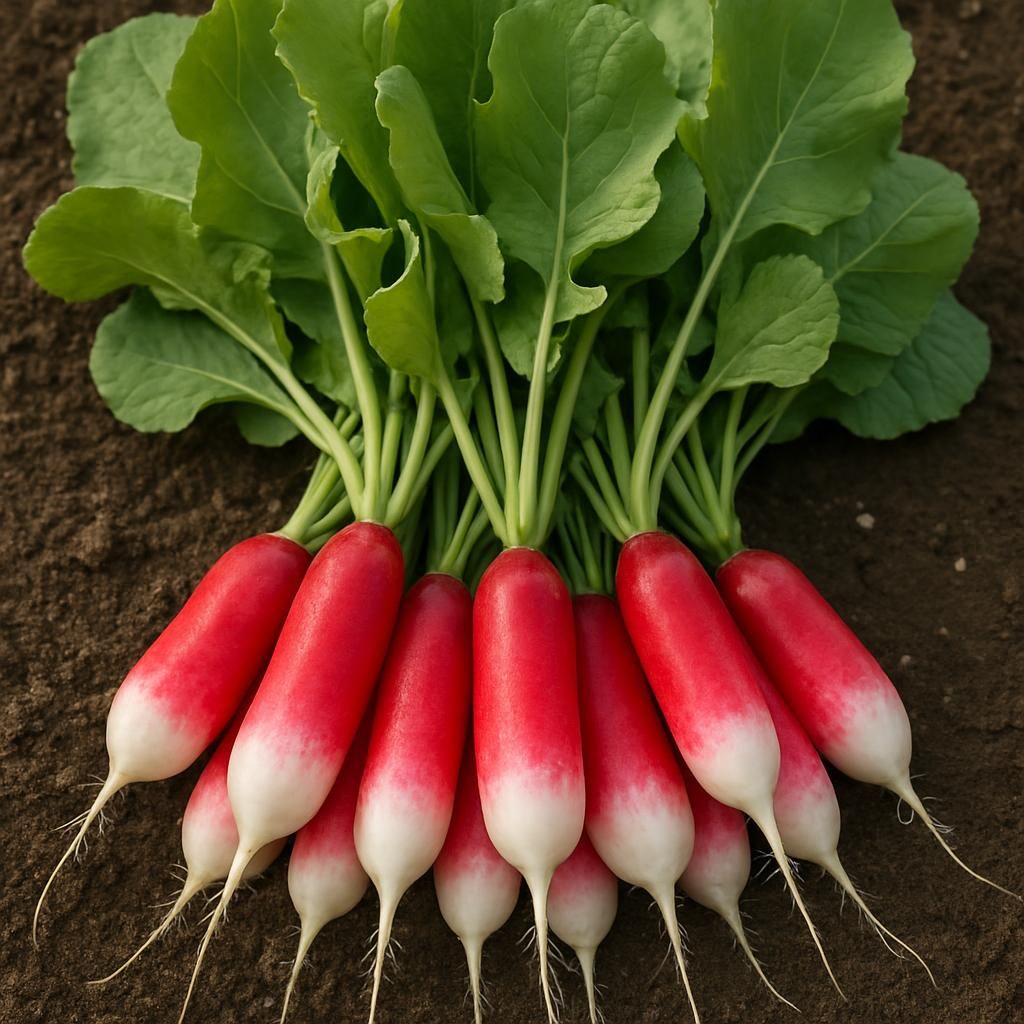
Introduction to Radish (French Breakfast)
French Breakfast radish (Raphanus sativus) is an elongated, cylindrical heirloom variety that matures in 25–30 days, making it one of the quickest cool-season crops available to growers. Its slender roots feature a bright scarlet upper portion that fades to a crisp white tip, delivering a mild, slightly peppery flavor with excellent crunch. Because of its rapid cycle and compact size, French Breakfast is a staple for succession planting, intercropping, and season extension in both small-scale and commercial operations.
Professional growers value French Breakfast radish for its uniform shape, reliable germination, and tolerance to light frosts. The variety performs equally well in raised beds, containers, and open-field production when soil conditions are managed correctly. Early spring and fall plantings consistently produce the highest-quality roots; summer heat often leads to pithiness and increased pungency.
This definitive guide covers every production stage—from soil science and climate optimization through harvest and storage—using data-driven tables and structured recommendations. Whether you manage a market garden or a home plot, the following sections provide actionable, field-tested practices for maximizing yield and quality of French Breakfast radish.
Botanical Profile of Radish (French Breakfast)
French Breakfast radish belongs to the Brassicaceae family and is botanically classified as an annual root crop. The plant develops a slender, 2–4 inch (5–10 cm) tapered root with smooth skin and a crisp interior. Foliage consists of deeply lobed, dark-green leaves arranged in a basal rosette; the leaves are edible and can be harvested young for microgreens or salads.
The root’s pigmentation is anthocyanin-driven, with red anthocyanins concentrated in the upper portion and white tissue at the tip. This coloration is genetically stable across most seed lines but can intensify under cool nighttime temperatures (50–55 °F / 10–13 °C). Flowering occurs if plants are vernalized or exposed to long days; the resulting siliques contain small, round, reddish-brown seeds.
French Breakfast radish exhibits a shallow fibrous root system that efficiently absorbs surface nutrients and moisture. Because the crop matures so quickly, it places minimal demand on soil fertility compared with longer-season brassicas such as Cabbage or Broccoli.
Soil, pH, and Climate Requirements for Radish (French Breakfast)
French Breakfast radish demands loose, well-drained soil free of stones or compaction to allow straight, uniform root development. Heavy clay or compacted soils cause forking and misshapen roots; amend such soils with aged compost or coarse sand prior to planting.
Ideal soil temperature for germination is 45–65 °F (7–18 °C). Air temperatures between 50–70 °F (10–21 °C) promote rapid vegetative growth and sweet flavor. Sustained temperatures above 80 °F (27 °C) accelerate bolting and increase pungency.
| Parameter | Ideal Range | Notes |
|---|---|---|
| Soil pH | 6.0–7.0 | Slightly acidic to neutral; avoid <5.8 |
| Soil Texture | Sandy loam to loam | High organic matter, well-drained |
| Soil Temperature (°F) | 45–65 germination; 50–70 growth | Use soil thermometer at 2-inch depth |
| Air Temperature (°F) | 50–70 daytime; 45–55 nighttime | Cool season crop; frost tolerant to 28 °F |
| Day Length | 10–14 hours | Long days promote bolting |
| Organic Matter | 3–5 % | Incorporate well-rotted compost |
| Drainage | Excellent | Raised beds or ridges in heavy soils |
Step-by-Step Planting & Propagation
Site Selection: Choose a location with full sun (minimum 6 hours) and good air circulation. Avoid areas with recent brassica crops to reduce disease carryover.
Soil Preparation: Till or fork soil to 8–10 inches. Remove stones and break up clods. Incorporate 1–2 inches of well-aged compost. Perform a soil test; adjust pH with agricultural lime if below 6.0.
Seedbed Creation: Create level beds 30–36 inches wide. On heavier soils, form 4–6 inch raised ridges to improve drainage and root shape.
Sowing: Direct seed ½ inch deep, 1 inch apart in rows 8–12 inches apart. For baby radishes, sow ½ inch apart. Cover lightly and firm soil for good seed-to-soil contact.
Irrigation at Planting: Water immediately after sowing to settle soil and initiate germination. Maintain even moisture until seedlings emerge (4–7 days).
Thinning: When seedlings reach 2 inches tall, thin to 2–3 inches apart for full-size roots. Thinnings can be used as microgreens.
Succession Planting: Sow new rows every 7–10 days from early spring until 4 weeks before expected summer heat, and again from late summer into early fall.
Container Culture: Use containers at least 6 inches deep with drainage holes. Fill with a light, well-draining potting mix amended with 20 % compost.
Care & Maintenance regimes for Radish (French Breakfast)
Consistent moisture and balanced nutrition are critical for tender, non-pithy roots. Over-fertilization, especially with nitrogen, produces excessive foliage at the expense of root quality.
| Growth Stage | Watering Schedule | Fertilizer Application | Pruning / Thinning |
|---|---|---|---|
| Pre-emergence | Light daily misting to keep surface moist | None | None |
| Seedling (0–10 days) | 0.5 inch every 2–3 days | None unless soil test shows deficiency | Thin to 1 inch when 2 inches tall |
| Vegetative (10–20 days) | 0.75–1 inch per week; maintain even moisture | Side-dress with low-nitrogen organic fertilizer (NPK 5-10-10) at 10 days | Thin to final 2–3 inch spacing |
| Root Bulking (20–28 days) | 1 inch per week; avoid water stress | No additional fertilizer needed | Remove any yellowing outer leaves |
| Pre-harvest | Reduce slightly 2 days before harvest | None | None |
Mulch with 1–2 inches of straw or shredded leaves after thinning to conserve moisture and suppress weeds. Hand-weed carefully to avoid damaging shallow roots. Avoid overhead irrigation late in the day to reduce foliar disease pressure.
Pests, Diseases & Organic Management
French Breakfast radish is susceptible to several common brassica pests and soil-borne pathogens. An integrated approach combining cultural, mechanical, and biological tactics provides the most sustainable control.
Major Pests
- Flea beetles: Adults create shot-hole damage on leaves. Use floating row covers from sowing until harvest; apply kaolin clay or spinosad as needed.
- Cabbage loopers and imported cabbageworm: Larvae defoliate plants. Scout weekly; release Trichogramma wasps or apply Bt (Bacillus thuringiensis) when larvae are small.
- Aphids: Cluster on undersides of leaves. Blast with water or release lady beetles; apply insecticidal soap for heavy infestations.
- Cutworms: Sever seedlings at soil line. Place collars around plants or apply beneficial nematodes to soil.
Major Diseases
- Alternaria leaf spot: Dark lesions with concentric rings. Remove infected leaves; rotate crops and avoid overhead watering.
- Downy mildew: Yellow upper-leaf lesions with fuzzy gray sporulation below. Improve air circulation; apply copper-based fungicides or potassium bicarbonate.
- Clubroot: Caused by Plasmodiophora brassicae; roots become swollen and deformed. Maintain soil pH above 7.0 and use resistant varieties in infested fields.
- Damping-off (Pythium and Rhizoctonia): Seedlings collapse. Use sterile media, avoid overwatering, and treat seeds with beneficial Trichoderma.
Scout fields twice weekly. Remove crop debris promptly after harvest to break pest and disease cycles. Avoid planting radish after other brassicas for at least two years.
Harvesting, Curing & Optimal Storage
French Breakfast radish reaches harvest readiness when roots are 2–4 inches long and shoulders are fully colored. Gently pull or lift roots with a garden fork to avoid breakage. Harvest in the cool morning hours when soil is moist.
Remove tops immediately after harvest, leaving ½ inch of stem. Rinse roots under cool running water to remove soil, then pat dry. Sort out any damaged or oversized roots.
Storage Conditions
- Short-term (refrigerator): Place roots in perforated plastic bags at 32–40 °F (0–4 °C) with 95 % relative humidity. Quality maintained for 7–14 days.
- Long-term: Not recommended for fresh market; roots become pithy after two weeks. For extended storage, consider pickling or fermenting.
- Greens: Store separately in a damp towel inside a breathable bag; use within 3–5 days.
Prompt cooling after harvest preserves sweetness and crispness. Avoid washing until just before use to minimize decay.
Companion Planting for Radish (French Breakfast)
Strategic companions improve radish quality, deter pests, and maximize bed space. French Breakfast radish matures so quickly that it can be sown between slower-growing crops.
Beneficial Companions
- Lettuce and Spinach: Provide light shade and reduce soil temperature; radish roots help break soil crust for lettuce seedlings.
- Cucumber and Zucchini: Radish acts as a trap crop for cucumber beetles; harvest radish before cucurbits shade them out.
- Carrot and Parsnip: Radish breaks soil crust, allowing slower carrot germination; different root depths minimize competition.
- Nasturtium and Marigold: Repel aphids and flea beetles; edible flowers add market value.
- Onion and Garlic: Mask radish scent from pests; alliums also improve soil microbial activity.
Avoid
- Other brassicas (cabbage, broccoli, turnip) in the same bed to reduce shared pest and disease pressure.
- Heavy feeders such as corn that compete for nutrients during the short radish cycle.
Interplant radish every 7–10 days between rows of slower vegetables for continuous harvest and efficient land use. After radish harvest, follow immediately with a nitrogen-fixing cover crop such as Clover to rebuild soil fertility.
Radish production integrates easily into diversified vegetable systems. For deeper insight into season-extension techniques and soil-health strategies that complement quick-root crops, read The Truth About Fall Garden Transitions for Small Farm Resilience.