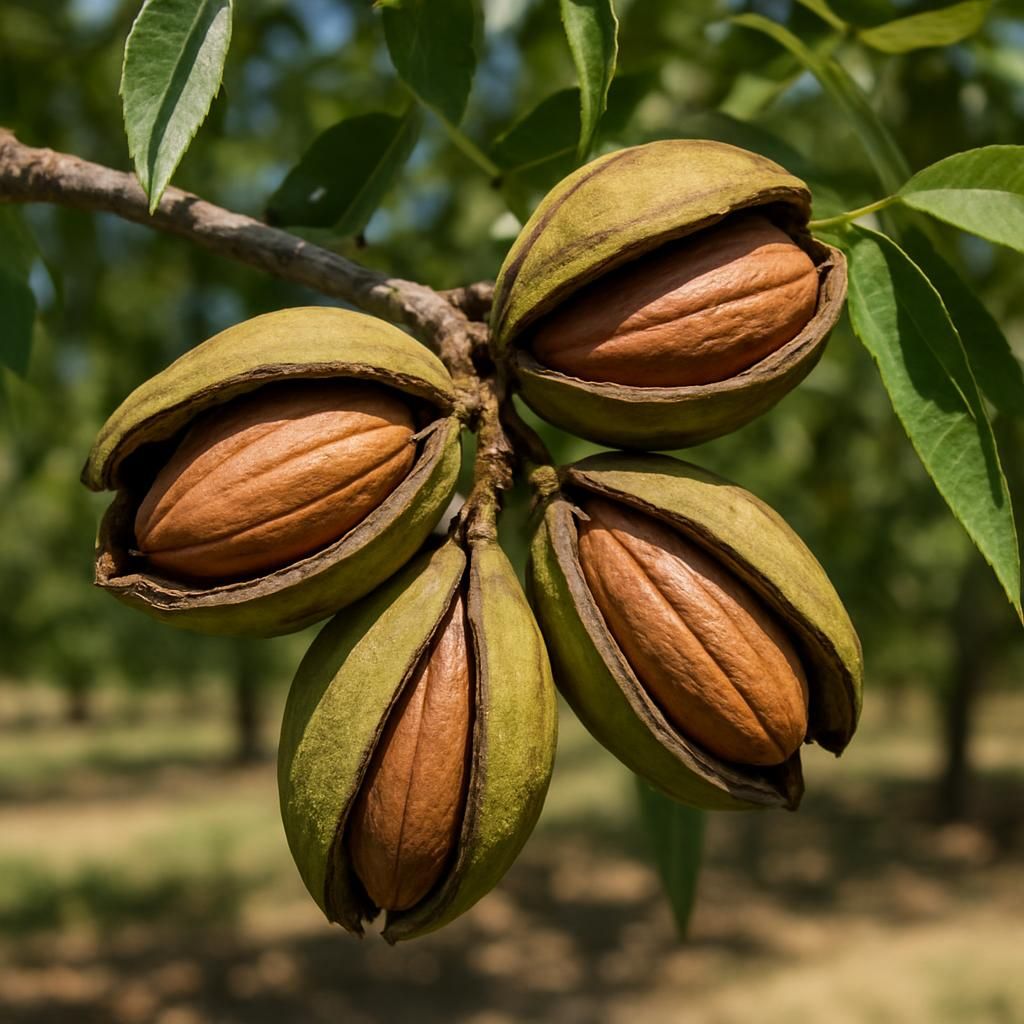
Introduction to Pecan (Elliott)
The Elliott pecan cultivar has earned a strong reputation among commercial and backyard growers for its early harvest window, thin shells, and high-quality kernels. Developed in Florida and released in the mid-20th century, Elliott combines precocity with reliable bearing, often producing commercial crops by year eight to ten. Its medium-size nuts average 70–80 per pound with kernel percentages frequently exceeding 55 percent, delivering bright, sweet meat that commands premium prices in fresh and confection markets. Because the trees remain relatively compact compared with older cultivars such as Stuart Pecan, Elliott fits modern high-density plantings and simplifies mechanical shaking and harvest. Growers also value its moderate scab resistance, which reduces fungicide inputs when integrated with sound cultural practices. Whether planted in the humid Southeast or irrigated Southwest, Elliott offers a practical balance of yield, quality, and manageable tree size.
Botanical Profile of Pecan (Elliott)
Elliott belongs to the Juglandaceae family and shares the same species as all commercial pecans, Carya illinoinensis. The tree is a large, deciduous hardwood that can reach 70–90 feet at maturity with a broad, oval canopy when given ample space. Leaves are alternate, pinnately compound, and typically contain 9–13 lanceolate leaflets that turn golden yellow in autumn. Like other pecans, Elliott is monoecious; male catkins and female flowers appear on the same tree but open at slightly different times, requiring cross-pollination from compatible cultivars such as Desirable Pecan or Pawnee Pecan. The fruit is a drupe-like nut enclosed in a four-valved husk that splits at maturity. Elliott nuts are oblong with smooth, thin shells that crack easily, exposing a high percentage of plump, light-colored kernels. The cultivar shows moderate alternate bearing, but consistent cultural care can stabilize annual production.
Soil, pH, and Climate Requirements for Pecan (Elliott)
Elliott performs best on deep, well-drained sandy loam to loam soils with good internal drainage yet adequate moisture-holding capacity. The cultivar tolerates a slightly wider pH range than many pecans but still demands careful management to avoid micronutrient deficiencies.
| Parameter | Ideal Range | Notes |
|---|---|---|
| Soil Texture | Sandy loam to loam | Avoid heavy clays and shallow hardpans |
| Soil Depth | ≥ 4 ft (1.2 m) | Allows deep taproot development |
| Soil pH | 6.0–7.0 | Adjust with lime or sulfur as needed |
| Drainage | Well-drained; water table > 6 ft | Raised beds or tile drainage if necessary |
| Salinity (EC) | < 2.0 dS/m | Sensitive to sodium and chloride |
| Growing Season | 180–220 frost-free days | Requires long, warm summers |
| Winter Chill | 400–600 hours below 45 °F (7 °C) | Adequate for bud break and flowering |
| Summer Temperature | Daytime 85–95 °F (29–35 °C) | Optimal photosynthesis and nut fill |
| Annual Rainfall | 30–50 inches (760–1270 mm) | Supplemental irrigation in dry periods |
Step-by-Step Planting & Propagation
Site selection is the first critical step. Choose an open area with full sun, protection from strong prevailing winds, and access to irrigation. Conduct soil tests at least six months before planting and amend according to the table above. Order certified, virus-indexed nursery trees of Elliott grafted onto recommended rootstocks such as ‘Giles’ or ‘Riverside’. Plant bare-root or container trees in late winter to early spring while dormant. Dig holes twice the width of the root ball and the same depth, setting the graft union 2–3 inches above final soil grade. Backfill with native soil, water thoroughly, and apply a 3–4 inch layer of organic mulch in a 3-foot ring, keeping mulch away from the trunk. Spacing for Elliott in commercial orchards is typically 30 × 30 ft or 35 × 35 ft; home plantings can use 25 × 25 ft if aggressive pruning is planned. Install drip or micro-sprinkler irrigation immediately and stake young trees against wind. Provide temporary shade screens during the first summer if temperatures exceed 100 °F. Propagation of true-to-type Elliott is achieved by patch budding or whip grafting onto seedling rootstocks in late summer; success rates above 85 percent are common when cambial alignment is precise and humidity is maintained.
Care & Maintenance regimes for Pecan (Elliott)
Consistent cultural care maximizes both yield and kernel quality while minimizing pest pressure.
| Practice | Timing | Rate / Method | Frequency |
|---|---|---|---|
| Irrigation | March–October | 1.0–1.5 inches/week during nut fill | Weekly via drip |
| Nitrogen (N) | March & June | 1–3 lb actual N/tree/year split applications | 2 applications |
| Zinc (Zn) | April & July | 1–2 lb ZnSO₄ per 100 gal foliar spray | 2–3 applications |
| Potassium (K) | October soil test guided | 0–3 lb K₂O/tree based on leaf analysis | Annual |
| Boron (B) | Pre-bloom & post-harvest | 0.5–1 lb Solubor/acre foliar | 1–2 applications |
| Pruning – Structural | Dormant season (Dec–Feb) | Remove crossing limbs, open center to light | Annual |
| Pruning – Hedging | After harvest or dormant | Side-hedge 6–8 ft wide alleys every 3–4 years | As needed |
| Mulch Renewal | Spring | 3–4 inches hardwood chips or compost | Annual |
| Cover Crop | Fall–Winter | Cereal rye or clover between rows | Annual |
Leaf tissue analysis in July guides all fertility adjustments. Maintain 60–70 percent canopy light penetration through selective thinning to reduce humidity and scab incidence.
Pests, Diseases & Organic Management
Elliott exhibits moderate resistance to pecan scab, yet humid seasons still require vigilance. Primary insect pests include pecan nut casebearer, hickory shuckworm, blackmargined aphid, and Black pecan aphids. Monitor with pheromone traps and degree-day models; release Trichogramma wasps and apply Bacillus thuringiensis or horticultural oil during crawler stages for organic control. Cultural practices such as sanitation, timely irrigation, and balanced nutrition reduce stress-related susceptibility. For scab, integrate resistant cultivars, remove fallen leaves, and apply copper-based or sulfur-based sprays only when scouting indicates threshold levels. Root rot and Phytophthora root rot are minimized by preventing soil saturation and using well-drained sites. Regular trunk inspection for borers and prompt removal of infested wood further protect orchard health.
Harvesting, Curing & Optimal Storage
Elliott nuts mature in early to mid-October across most southeastern regions. Shucks split naturally; mechanical shaking or pole harvesting is used once 75 percent of shucks have opened. Collect nuts promptly to avoid ground moisture and quality loss. Field-run moisture content is typically 20–30 percent; air-dry or forced-air cure at 70–80 °F with 50–60 percent relative humidity until kernel moisture reaches 4–5 percent. Store in-shell nuts at 32–40 °F and 65–70 percent RH for up to 12 months with minimal quality decline. Shelled kernels are best vacuum-packed or stored at 0 °F for long-term preservation. Monitor for storage pests such as Indian meal moth and maintain strict sanitation.
Companion Planting for Pecan (Elliott)
Inter-row plantings of Crimson Sweet Watermelon or Crimson Seedless Grapes provide additional revenue while the orchard canopy is developing. Leguminous cover crops such as Clover or Hairy vetch fix nitrogen and improve soil structure. Aromatic herbs including Rosemary and Thyme attract beneficial insects that prey on aphids and mites. Avoid planting Tomato or Potato nearby, as they can harbor shared pathogens. Tall windbreak species such as Bald Cypress or Loblolly Pine (if not already present) reduce wind damage and moderate orchard microclimate.