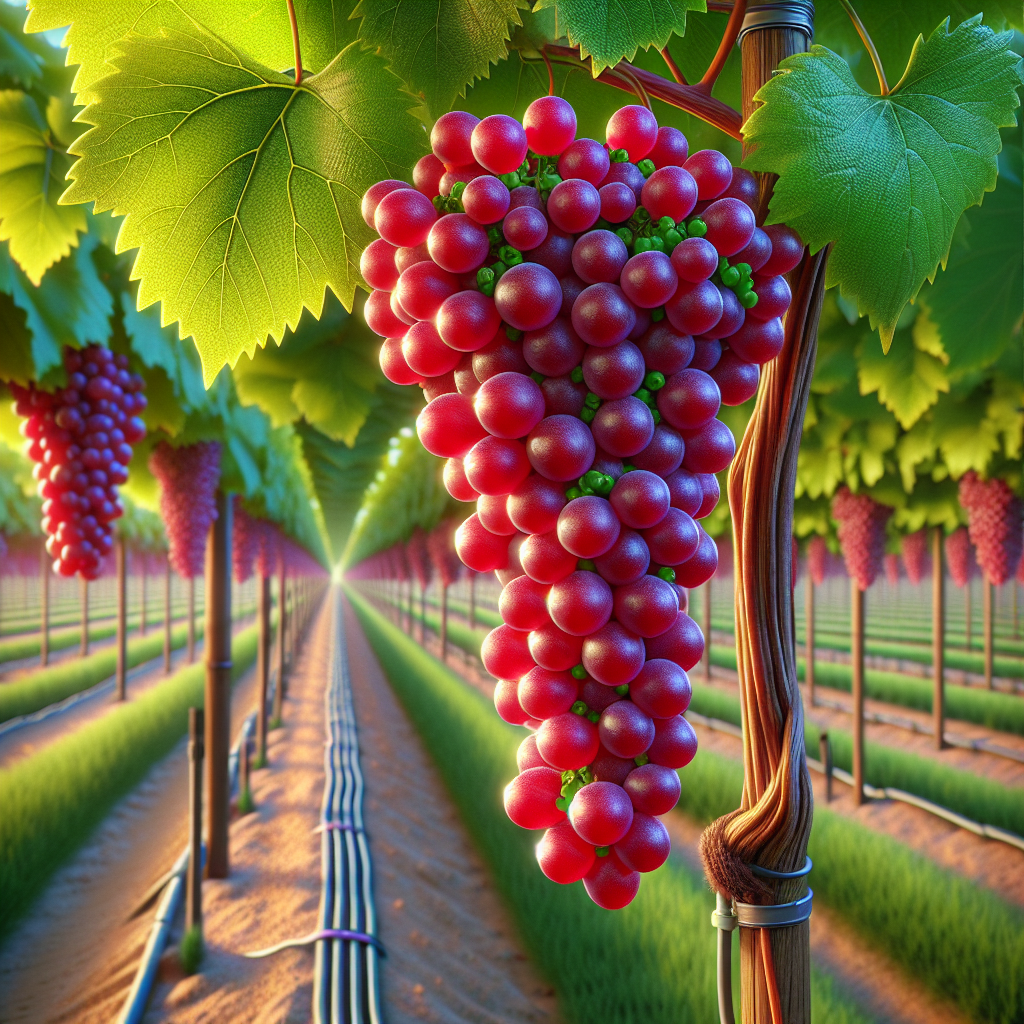
Introduction to Crimson Seedless Grapes
A premium late-ripening table grape, this cultivar was developed to fill an important harvest window after many early and midseason seedless varieties are finished. It is especially prized in commercial production for its attractive bright red to crimson skin, firm berry texture, seedlessness, and good postharvest keeping quality. In many markets it is considered one of the standard red seedless table grapes because the berries can remain crisp and visually appealing for extended periods under proper storage.
Compared with softer or earlier red seedless grapes, this variety tends to require more management to achieve uniform color, ideal berry size, and premium eating quality. It is not the easiest home-garden grape if neglected, but under disciplined pruning, canopy management, and irrigation control it can be exceptionally rewarding. Growers should think of it as a quality-driven cultivar rather than a plant-it-and-forget-it vine.
Its chief strengths are late maturity, good shelf life, resistance to berry shatter relative to some table grape cultivars, and a pleasant sweet flavor with mild acidity. Its main production challenges are delayed color development in warm nights, sensitivity to excessive vigor, and the need for thoughtful crop regulation. If you are new to grape culture, it helps to first understand broader grape basics. For growers interested in long-term fertility planning around perennial plantings, see soil health strategies.
Botanical Profile of Crimson Seedless Grapes
This cultivar belongs to the species Vitis vinifera, the European grapevine species that includes most classic wine grapes and many commercial table grapes. As a table grape, it is selected for berry size, skin appearance, crisp flesh, and transport durability rather than wine chemistry.
Botanically, the vine is a deciduous woody perennial climber with tendrils opposite the leaves. New shoots arise each spring from latent buds on one-year-old canes or from renewal spurs, depending on the training system. Leaves are generally medium to large, palmate, and moderately lobed. Flowers are small, greenish, and typically perfect, meaning they contain both male and female organs and do not require a separate pollinizer.
The fruit is borne in clusters on current-season shoots that arise from one-year-old wood. Because this variety is seedless, the berries develop without fully formed seeds, though small soft seed traces may occasionally be present. Commercial production often relies on plant growth regulators, especially gibberellic acid in some systems, to improve berry sizing and cluster architecture, though careful timing is essential and overuse can reduce color or firmness.
Crimson Seedless is known for medium to large conical clusters, often moderately compact if unmanaged. Berries are usually elongated-oval to slightly cylindrical, with medium-thick skins that contribute to durability. Flesh is characteristically firm and crisp rather than melting. The flavor is neutral to pleasantly sweet, making it broadly acceptable to fresh-market consumers.
In terms of phenology, this is a relatively late cultivar. Budbreak occurs in spring, flowering follows after adequate heat accumulation, fruit set leads to berry growth through early summer, veraison begins later than in earlier seedless grapes, and full maturity typically comes in late summer to autumn depending on latitude and climate. This lateness is a commercial asset, but it also means the crop can be exposed longer to late-summer pest pressure and weather events.
Soil, pH, and Climate Requirements for Crimson Seedless Grapes
This cultivar performs best in deep, well-drained soils with moderate water-holding capacity and good internal aeration. Ideal soils include sandy loam, gravelly loam, or silt loam with at least 1 to 1.5 meters of penetrable rooting depth. Heavy clay can work only if drainage is excellent and the site is tiled, mounded, or otherwise improved. In poorly drained ground, root systems lose oxygen, fine roots die back, vigor becomes erratic, and vines become more susceptible to root diseases and nutrient disorders.
Target soil pH is generally 6.0 to 7.2, with optimum nutrient availability often occurring between 6.3 and 6.8. Slightly alkaline soils can still support production, but iron chlorosis, zinc deficiency, and phosphorus tie-up become more likely above pH 7.5, particularly on calcareous sites. Acidic soils below pH 5.8 should be limed before planting to reduce aluminum stress and improve calcium and magnesium balance.
Salinity tolerance is only moderate. Electrical conductivity of the saturated paste extract should ideally remain below about 1.5 dS/m for premium table grape quality. Higher salinity can reduce shoot growth, scorch leaf margins, shrink berry size, and impair color. Chloride and sodium accumulation are especially damaging in arid irrigation-based systems.
Climatically, this is best suited to warm temperate to Mediterranean-type grape regions with hot days, low summer humidity, and a long frost-free season. It needs abundant sunlight for sugar accumulation and healthy canopy function, but unlike some darker wine grapes, it can struggle to color evenly when nights stay too warm late in the season. Regions with warm days and moderately cool nights after veraison tend to produce the best red pigmentation.
A good benchmark is 160 to 200 frost-free days, depending on rootstock, vine age, and local heat accumulation. Winter chilling is necessary for normal dormancy release, but this cultivar does not demand extreme cold. Winter minimums below about -15°C can damage canes and buds, while spring frost after budbreak can sharply reduce yield.
Wind exposure matters. Constant strong wind tears leaves, damages tendrils, desiccates young shoots, and can interfere with spray coverage. However, gentle air movement helps reduce fungal pressure by drying canopies. Avoid frost pockets, low wet spots, and shaded north-facing slopes in cool climates.
Soil moisture should be consistent but never waterlogged. During active growth, the root zone should remain evenly moist to a depth of roughly 30 to 60 cm, especially from bloom through berry sizing. A practical field test is to squeeze soil from 15 to 20 cm depth: it should form a weak ball that breaks easily rather than dusting apart or oozing. Overwatering signs include rank shoot growth, pale leaves, delayed berry color, diluted flavor, splitting in susceptible conditions, algae or moss around emitters, and persistently soggy soil more than 24 hours after irrigation. Underwatering signs include shortened internodes, tendril drying, dull leaf color, marginal leaf scorch, reduced berry size, and berry softening before full maturity.
Step-by-Step Planting & Propagation
Start with certified disease-free planting material from a reputable nursery. For most growers, grafted vines on appropriate rootstock are preferable to own-rooted vines, especially where Nematodes, calcareous soils, salinity, or phylloxera risk are concerns. Rootstock selection should match local soil conditions rather than follow generic recommendations.
Site preparation should begin at least one season before planting. Remove perennial weeds completely, rip compacted layers if present, and incorporate amendments based on a soil test. Pre-plant phosphorus and potassium are much easier to place effectively than post-plant corrections in a mature vineyard. If organic matter is below about 1.5%, incorporate well-finished compost, but avoid excessive nitrogen-rich manure that can stimulate overly vigorous juvenile growth.
Install the trellis before or immediately after planting. Crimson Seedless is commonly trained to systems that support good light interception and cluster exposure, such as a bilateral cordon on a wire trellis or more specialized table grape systems in commercial settings. Row orientation north-south often improves even sun distribution, though local wind and slope may justify another layout.
Plant dormant bare-root vines in late winter to early spring after severe frost danger has passed but before strong shoot elongation begins. In mild climates, planting during dormancy is ideal because roots can establish before heat stress. Container plants can be planted later, but they require more careful irrigation.
Spacing depends on vigor, rootstock, training system, and whether the planting is commercial or backyard. A common range is 6 to 8 feet between vines and 9 to 12 feet between rows for small-scale production. In high-vigor soils, wider spacing reduces shading and disease pressure.
Planting steps:
- Soak bare-root vines in clean water for 3 to 6 hours before planting, but do not leave them submerged overnight.
- Trim damaged roots and shorten excessively long roots only enough to fit the planting hole naturally.
- Dig a hole wide enough to spread roots without bending them upward.
- Set the vine so the graft union remains several inches above final soil grade.
- Backfill with native soil unless the soil is extremely poor; avoid creating a radically different amendment pocket that traps water.
- Water thoroughly to settle soil around roots.
- Cut the top back to 2 healthy buds if the nursery has not already done so.
- Install a training stake and tie the strongest shoot as it grows.
Propagation is generally done by hardwood cuttings or grafting in nursery systems, but home growers should not propagate from unknown vines due to virus risk. If propagating legally and locally, dormant cuttings 25 to 35 cm long from mature one-year-old wood can root under controlled conditions, though resulting own-rooted plants may be unsuitable in phylloxera-prone ground.
During the first year, the objective is establishment, not fruiting. Remove all flower clusters so the vine invests in trunk formation and root expansion. Train one strong shoot vertically to the fruiting wire and pinch competing shoots if necessary.
Care & Maintenance regimes for Crimson Seedless Grapes
Pruning is the central management task. This cultivar is often cane-pruned or spur-pruned depending on local experience, bud fruitfulness, and training system. In many table grape systems, growers retain enough fruitful wood to balance vigor without overcrowding the canopy. Overcropping weakens the vine and delays ripening; undercropping can cause excessive vegetative vigor and poor color.
During dormancy, remove dead, weak, tangled, and diseased wood first. Then establish a renewal structure with well-spaced one-year-old fruiting wood. In backyard systems, a mature vine may carry 20 to 40 buds depending on vine size and strength, but local adaptation matters. Always adjust bud load to pruning weight and previous season vigor.
Shoot thinning in spring improves light penetration and cluster spacing. Remove weak or doubled shoots early when they are 5 to 15 cm long. Aim for a canopy that allows dappled light and air movement rather than dense shade. Excessive shade reduces bud fruitfulness for the following year and slows red coloration.
Irrigation should be front-loaded early in the season, then carefully moderated as berries approach maturity. Drip irrigation is strongly preferred because it maintains even root-zone moisture without wetting the canopy. Young vines may need watering 1 to 3 times weekly in hot weather, depending on soil texture. Mature vines in loam soils often benefit from deep irrigation when the top 15 to 20 cm begins to dry, rather than daily shallow watering.
A practical moisture target is to prevent prolonged tension extremes in the main root zone. In sandy soils, irrigate before plants experience midday shoot tip wilting. In loams, allow slight drying between irrigations once berries begin coloring to improve flavor concentration and skin color, but do not induce severe stress. Severe late-season deficits can halt berry enlargement, toughen skins, and reduce pack-out.
Fertilization should follow leaf petiole analysis and soil testing, not guesswork. Nitrogen is usually the nutrient most commonly overapplied. Too much nitrogen produces long internodes, dense lateral growth, delayed lignification, soft berries, poor color, and greater susceptibility to mildew. Apply modest nitrogen in spring if vine growth is weak or tissue tests indicate deficiency. Split applications are safer than one heavy dose.
Potassium is important for sugar movement, berry filling, and vine water relations, but excessive potassium can antagonize magnesium uptake. Magnesium deficiency appears as interveinal chlorosis on older leaves, while zinc deficiency causes small leaves and short internodes. Foliar micronutrient sprays can correct some issues quickly, but underlying soil chemistry should still be addressed.
Canopy management is especially important for this variety. Strategic leaf removal around the fruit zone after fruit set can improve spray penetration, reduce bunch rot risk, and enhance color development. Do not overexpose clusters suddenly in very hot climates, as sunburn and bleaching can occur. A gradual, moderate exposure on the morning-sun side is usually safest.
Cluster thinning and berry management may be needed to achieve premium table quality. Remove weak, misshapen, or overly compact clusters early. In commercial systems, growers may trim cluster shoulders or tips to improve uniformity and reduce compactness. Where permitted and appropriate, gibberellic acid programs must be variety-specific and cautiously timed; misuse can reduce coloration and alter berry firmness.
Weed control should maintain a vegetation-free strip around the trunk during establishment. Mature vineyards can use managed alley cover crops, but avoid direct competition at the vine base. Organic mulches help conserve moisture but must be kept away from the trunk to reduce crown rot and rodent damage.
Pests, Diseases & Organic Management
This cultivar is susceptible to many of the same pests and diseases as other Vitis vinifera table grapes, especially in humid or poorly ventilated sites. Prevention through canopy openness, sanitation, irrigation discipline, and monitoring is more effective than reacting late.
Powdery mildew is often the most important disease. It appears as whitish fungal growth on leaves, shoots, and berries and can scar fruit, reduce photosynthesis, and split skins. Risk is highest in warm, dry climates with humid canopy microclimates. Organic control relies on early preventive sulfur applications, potassium bicarbonate, or biologically based fungicides, timed before visible outbreaks become severe. Avoid sulfur applications in very high heat to prevent leaf burn.
Downy mildew is more common where nights are humid and leaves stay wet. Yellow oil spots on leaves and white growth on the undersides are typical signs. Improve airflow, avoid overhead irrigation, and use copper-based organic products judiciously when infection periods are forecast.
Botrytis bunch rot can affect late-season table grapes, especially if clusters are compact, shaded, or damaged by insects. Open canopies, balanced nitrogen, careful handling, and removal of damaged fruit are essential. Cluster-zone leafing and avoiding excess late irrigation significantly reduce risk.
Trunk diseases such as Eutypa or Botryosphaeria cankers enter through pruning wounds. Prune during dry weather, remove infected wood well below dead tissue, sanitize tools between suspect vines, and protect large cuts where trunk diseases are common.
Insect pests may include Grape berry moth, Leafhoppers, Mealybugs, Thrips, and Mites. Mealybugs are especially concerning because they weaken vines and can vector grapevine viruses. Organic management includes mating disruption where available, conservation of beneficial insects, horticultural oils during dormant or delayed dormant periods, and targeted biological insecticides timed to vulnerable life stages.
Birds can devastate ripening fruit. Netting is the most reliable solution for quality table grapes. Reflective tape and noise devices offer only temporary relief. Wasps and yellowjackets also attack ripe berries, especially cracked or sunburned fruit, so sanitation and exclusion matter.
Nematodes may damage roots in sandy soils, causing weak growth and patchy vine performance. Prevention through resistant rootstocks is far superior to treatment after planting.
For organic production, build a practical integrated strategy:
- Prune for airflow and sunlight.
- Scout weekly from budbreak to harvest.
- Remove diseased clusters and mummified fruit.
- Keep irrigation off foliage.
- Avoid lush nitrogen-driven growth.
- Rotate approved organic sprays to reduce resistance pressure.
- Preserve beneficial habitat with insectary plants such as Yarrow and Thyme.
Harvesting, Curing & Optimal Storage
Harvest timing is critical because berry color alone does not always indicate full eating quality. This cultivar may develop partial red color before sugar and flavor fully mature, especially under uneven ripening conditions. Use a combination of visual assessment, taste, berry firmness, and soluble solids measurement.
For fresh market harvest, target berries that are uniformly colored, crisp, and sweet, commonly around 16 to 20 degrees Brix depending on market standard and local conditions. Taste should be clean and balanced, without harsh acidity or green herbaceous notes. Clusters should be dry at harvest; never pick when wet from dew, rain, or irrigation if fruit is destined for storage.
Use sharp harvest shears and handle clusters by the stem, not by squeezing berries. Remove damaged, sunburned, split, or diseased berries during harvest. Harvest during the cool part of the morning when field heat is low, but after surface moisture has dried.
Grapes are not cured in the same way as onions or sweet potatoes. Instead, they should be field-sorted and pre-cooled rapidly. Forced-air cooling to 0 to 1°C as soon as possible after harvest greatly extends shelf life. Relative humidity should be maintained around 90 to 95% to prevent stem desiccation and berry shrivel, but condensation must be avoided.
Under excellent storage conditions, clusters can hold for weeks, sometimes longer in commercial cold chains. Home growers can store them in perforated bags or shallow containers in the refrigerator, ideally just above freezing. Do not wash before storage; wash only before eating. Remove any decaying berries promptly because rot spreads quickly in enclosed containers.
Postharvest problems include rachis browning, berry shatter, shrivel, and decay. These are minimized by balanced irrigation before harvest, gentle handling, rapid cooling, and maintaining the cold chain. Overripe berries lose the signature crispness that makes this cultivar valuable, so delayed harvest for extra sweetness is not always beneficial.
Companion Planting for Crimson Seedless Grapes
In vineyards and garden plantings, companion planting should support pest balance, beneficial insect activity, soil protection, and traffic management rather than compete heavily with the vines. The most useful companions are low-growing or carefully managed species that do not shade trunks, steal excessive moisture from the root zone, or create humid tangles under the canopy.
Yarrow is one of the best companions because its flowers attract hoverflies, parasitic wasps, and predatory insects while tolerating relatively dry conditions once established. Thyme works well near row edges or in herb strips because it remains low, attracts pollinators and beneficials, and does not usually create serious competition if kept outside the immediate trunk zone. Clover can be used in alleyways as a living cover to reduce erosion, improve soil structure, and contribute some biologically fixed nitrogen, but it should be mowed and managed carefully so the vine row itself does not become overly competitive or humid.
Good companion strategies include:
- Keeping a 30 to 60 cm vegetation-free circle around young trunks.
- Using insectary strips in row middles rather than directly under vines.
- Mowing cover crops before seed set if self-sowing is undesirable.
- Avoiding tall annual vegetables that reduce airflow around clusters.
- Monitoring vole and rodent activity where dense groundcovers are used.
Poor companions are aggressive grasses directly beneath vines, thirsty sprawling crops, and any plantings that require frequent overhead irrigation. In table grape culture, fruit quality depends heavily on open canopies, dry fruit surfaces, and precise water control, so companions should always be subordinate to vine management rather than decorative additions.