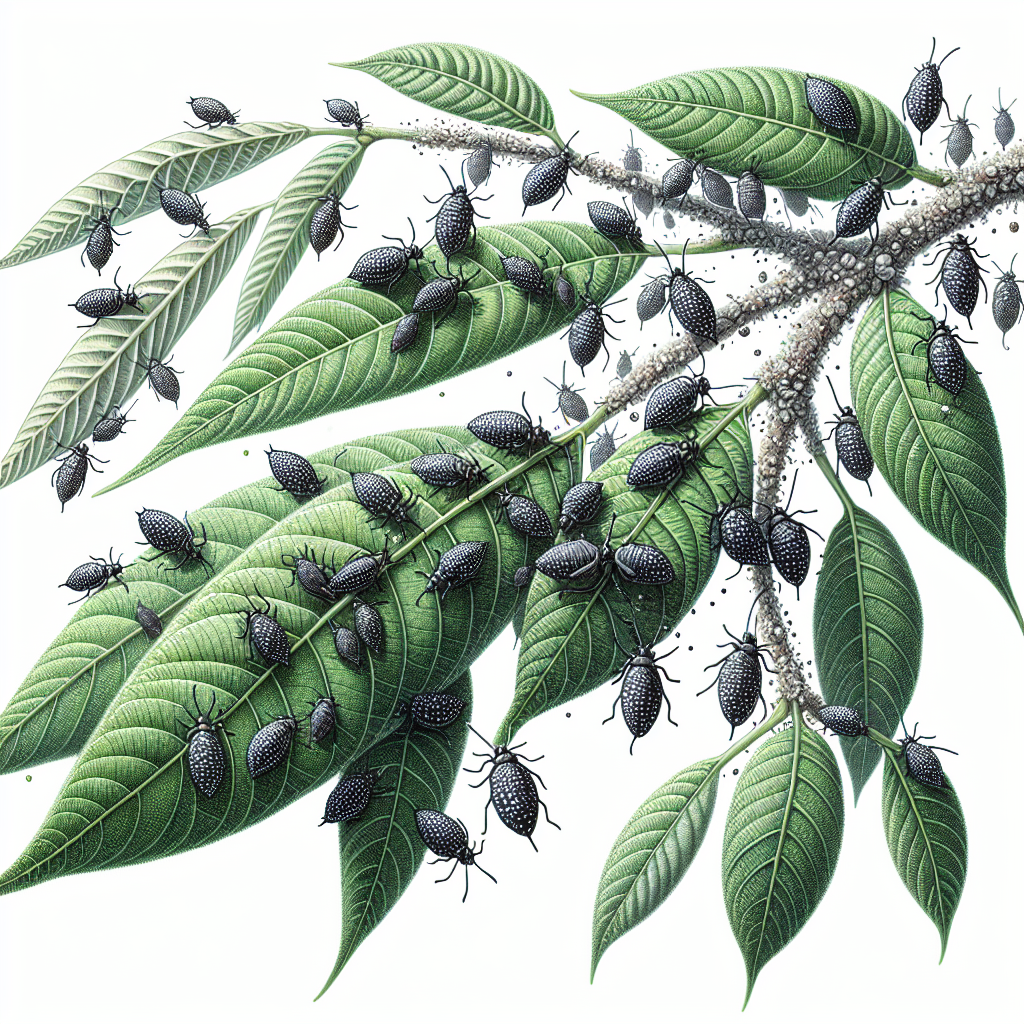
Introduction to Black pecan aphids
Black pecan aphids, scientifically known as Melanocallis caryaefoliae, represent one of the most persistent pests in pecan orchards across the southeastern United States, particularly in states like Georgia, Texas, and Oklahoma where pecan production dominates. These tiny, black to dark olive insects (1-2 mm long) colonize the undersides of leaves, sucking sap and excreting honeydew that fosters sooty mold growth. While not as notorious as yellow pecan aphids, black pecan aphids can cause significant defoliation, stunted growth, and yield reductions of up to 40% in severe infestations.
First identified in the early 1900s, these aphids thrive in warm, humid conditions typical of pecan-growing regions. They differ from other aphids by their pear-shaped bodies covered in a white, waxy coating that offers some protection against predators and sprays. Growers often overlook early infestations due to the aphids' inconspicuous location on leaf undersides, but timely intervention is crucial. This definitive guide equips pecan producers, from small-scale orchardists to commercial operations, with professional-grade diagnostics, lifecycle knowledge, and organic management plans to safeguard tree health and nut quality. Understanding black pecan aphid behavior is key to integrated pest management (IPM), reducing reliance on synthetic chemicals while maintaining profitability. For more on organic strategies, check this Spring Pest Patrol blog post.
Identifying Symptoms & Damage
Diagnosing black pecan aphid infestations starts with visual scouting. Look for clusters of small, black or dark greenish aphids (nymphs and adults) huddled on the lower leaf surfaces, especially along veins. A telltale sign is the shiny, sticky honeydew coating leaves and branches, often accompanied by black sooty mold (Capnodium spp.) that blocks photosynthesis. Early symptoms include leaf cupping or curling upward, giving foliage a crinkled appearance; severe cases lead to yellowing, bronzing, and premature leaf drop.
Damage escalates quickly: sap-feeding weakens trees, reducing vigor and nut fill. In mid-summer, heavy infestations cause 'June drop'—shedding of small nuts due to stress. Inspect terminals and midribs first, as aphids prefer tender new growth. Use a hand lens to confirm the waxy filaments distinguishing black pecan aphids from blackmargined aphid. Differentiate from nutrient deficiencies (e.g., iron chlorosis shows uniform yellowing without insects) or diseases like pecan scab (dark lesions on leaves/nuts). Thresholds for action: 20+ aphids per leaflet or 50% leaf coverage with honeydew. Regular monitoring from bud break through kernel fill prevents 70-90% of potential losses.
Lifecycle and Progression of Black pecan aphids
Black pecan aphids complete multiple generations (8-10) annually, syncing with pecan phenology. Overwinter as nymphs under old leaf scars or bark crevices. In spring (March-April), as buds swell, fundatrices (stem mothers) emerge, wingless and viviparous, producing 20-30 nymphs each over 2-3 weeks. Nymphs mature in 7-10 days at 75-85°F, feeding on expanding leaves.
Summer sees alates (winged forms) for dispersal, peaking June-July during nut set. Populations explode in hot, dry spells, with females birthing live young parthenogenetically—no males needed. Peak density hits August-September, coinciding with shell hardening; cooler fall temps slow reproduction. Unlike spider mites, no eggs—just continuous live birth. Full cycle: eggless, 10-14 days from birth to reproduction. Cold winters (<20°F) kill 90% overwinterers, but mild years allow carryover. Scouting aligns with growth stages: 75% budbreak, 50% leaf expansion, nut sizing.
Environmental Triggers & Risk Factors
Black pecan aphids flourish in 75-95°F with low wind, high humidity aiding honeydew persistence. Drought stress weakens pecans, making them prime targets—irrigated orchards see 50% less infestation. Excessive nitrogen promotes lush growth aphids love. Poor sanitation (unremoved debris) harbors overwinterers. Nearby hickory or walnut groves act as reservoirs. Risk spikes post-hail or leafminer damage exposing sap. Ants farming aphids (ants) worsen outbreaks by protecting them from predators. Monitor weather: >80°F days + <0.5 inches rain/week = alert. Susceptible varieties like Stuart pecan suffer more than Desirable. Soil pH >7.0 limits natural enemies.
Organic Control & Treatment Plans
Organic management emphasizes IPM: scout weekly, act at thresholds. Biological: Encourage ladybugs, lacewings, syrphid flies—release 1,000 lacewing eggs/acre if <20% predation. Fungal biopesticides like Beauveria bassiana (Botanigard) at 1 qt/acre, 7-day reapply. Cultural: Prune infested terminals pre-budbreak; irrigate to reduce stress; reflective mulches deter alates. Mechanical: High-volume water blasts (200 psi) dislodge 70% aphids weekly.
Organic Sprays: Insecticidal soap (M-Pede, 2% solution) + summer oil (SuffOil-X, 1 gal/100 gal) at dusk, 5-7 day intervals. Neem oil (Triact) suppresses 80% at 0.5% v/v. Pyrethrin (Pyganic EC 5.0) for outbreaks, but spares predators. Horticultural oil dormant sprays kill 95% overwinterers. Rotate modes: soap week 1, oil week 2. Avoid broad-spectrum. In walnut interplants, check for cross-attraction. Track efficacy: pre/post counts. Success stories show 85% control combining predators + soaps. For small farms, Soil Health Mastery blog aids resilience.
Preventing Black pecan aphids in the Future
Prevention beats cure: plant aphid-resistant cultivars like Pawnee or Ellis. Maintain orchard floors weed-free, disk in fall to bury debris. Balanced fertility—avoid N>100 lbs/acre. Introduce predatory mites (Anystis spp.) at 500/acre pre-spring. Companion planting with marigold or garlic repels via volatiles. Reflective barriers around young trees cut alate landing 60%. Scout grids: 1 tree/2 acres weekly, use sticky traps for alates. Winter sanitation: flail mow litter. IPM apps track degree-days (base 50°F). Long-term: diversify with almond buffers breaking host cycles. Annual dormant oils + spring soaps yield 90% prevention.
Crops Most Affected by Black pecan aphids
Primarily pecan (Carya illinoinensis), all varieties vulnerable but thin-shelled worst. Secondary: hickory (Carya spp.), occasional walnut. Rare on Stuart pecan vs. Desirable pecan. No significant impact on annuals like corn or soybeans. Focus protection on commercial pecans; backyard trees suffer most without scouting.