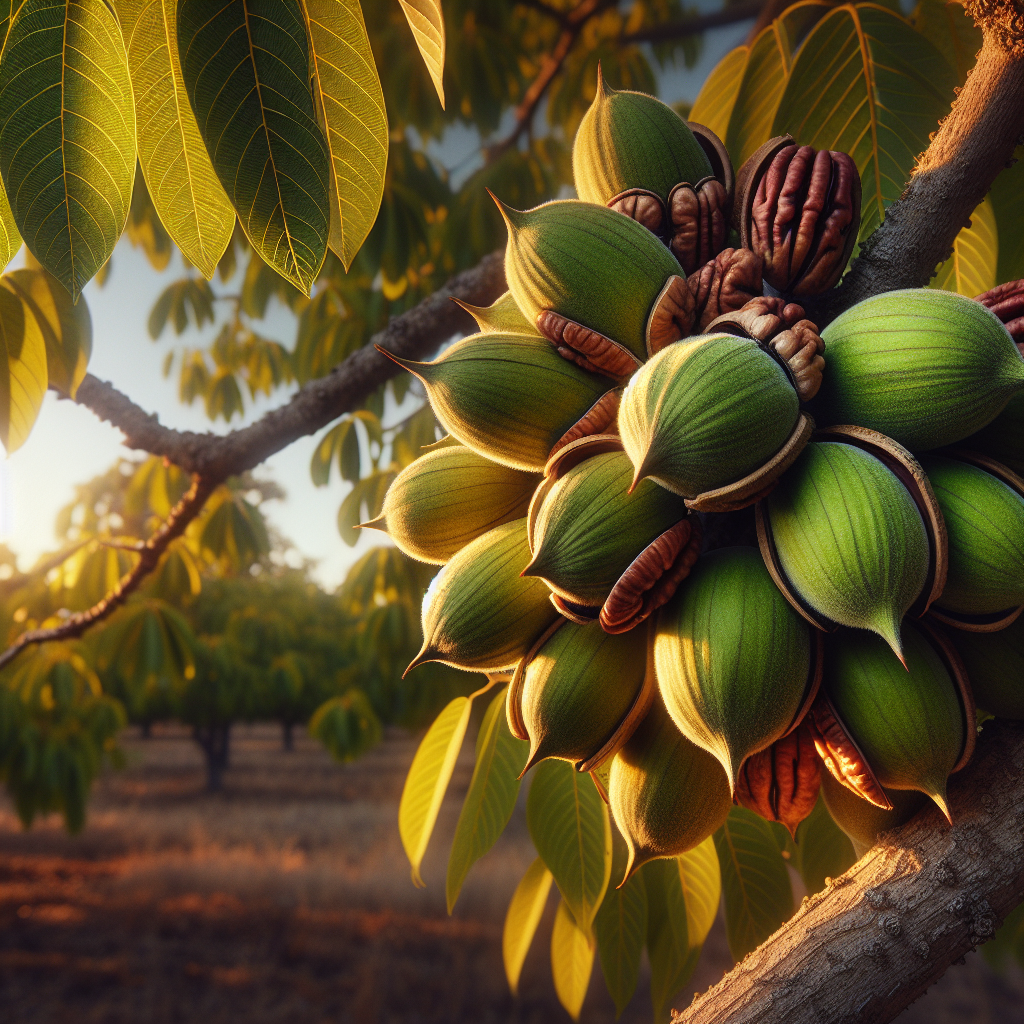
Introduction to Stuart Pecan
A landmark southern pecan cultivar, this variety has been grown for well over a century and remains one of the most recognized names in commercial and homestead pecan production. It originated in Mississippi in the late 19th century and became popular because it combined strong tree growth, broad adaptability, and a reputation for consistent cropping under varied conditions. In many older orchards, it was used not only for nut production but also as a structural orchard tree because of its vigor and longevity.
The nuts are medium to large, oval to oblong, with an attractive shell and kernels of good color when the crop matures under favorable conditions. Compared with more modern high-yielding cultivars, it is often considered less precocious, meaning it takes longer to come into significant bearing. However, its value persists because mature trees can be highly productive, the variety is a useful pollinizer, and it tolerates a range of soils better than many specialty nut cultivars.
For growers comparing orchard nut species, general background on pecan culture can be found in this pecan overview. Stuart is best suited to patient growers who want a long-lived tree, have room for a large canopy, and understand that the highest-quality crops come only when water, fertility, pollination, and disease management are all handled with precision.
Botanical Profile of Stuart Pecan
This cultivar belongs to the walnut family, Juglandaceae, and to the species Carya illinoinensis, a deciduous hardwood native to North America’s river-bottom ecosystems. Like other pecans, it is a monoecious wind-pollinated tree, producing separate male catkins and female flowers on the same plant. Even so, cross-pollination with another compatible cultivar is strongly recommended because flowering timing between pollen shed and stigma receptivity often does not overlap sufficiently within a single tree.
Stuart is generally classified as a Type II, or protogynous, pecan. That means female flowers tend to become receptive before the tree’s own pollen is shed. In practice, this makes it useful when paired with Type I cultivars that release pollen during Stuart’s pistillate bloom period. Without a compatible pollinizer nearby, you may get large, healthy-looking trees but disappointing nut set.
The tree itself is vigorous, upright when young, and eventually broad-spreading with age. On deep soils, mature height commonly reaches 70 to 100 feet, with canopy spread of 40 to 75 feet, though orchard training and spacing affect final form. Leaves are alternate, pinnately compound, usually with 9 to 17 lanceolate leaflets, and emerge after adequate spring warming. Bark becomes gray-brown and furrowed with age.
Nut characteristics are central to cultivar identity. Stuart typically produces nuts with moderate shell thickness, reasonably good cracking characteristics, and kernels that fill well when the tree receives steady moisture from late spring through kernel filling. Kernel percentage is often lower than newer elite cultivars, but quality remains marketable and desirable for shelling, roasting, and home use. If drought or nutrient imbalance occurs late in the season, kernels may be poorly filled, lightweight, or darkened.
A critical nuance is bearing age. Grafted Stuart trees may begin light production in about 6 to 8 years after planting, but economically meaningful yields often require 10 to 12 years, sometimes longer under suboptimal management. Seedling trees are much slower and are not recommended when true-to-type production matters.
Soil, pH, and Climate Requirements for Stuart Pecan
This cultivar performs best in deep, well-drained, fertile alluvial or loamy soils with strong internal drainage and substantial rooting depth. Pecans are not shallow-rooted orchard trees; they prefer at least 5 to 6 feet of penetrable soil, and in commercial settings the most productive sites often have even deeper profiles. Hardpans, compacted clay layers, or seasonal perched water tables sharply reduce vigor and increase stress susceptibility.
Ideal soil texture ranges from sandy loam to silt loam to clay loam, provided drainage remains excellent. Pure coarse sand dries too quickly and requires intensive irrigation management. Heavy poorly drained clay is a major risk because roots need oxygen; even 48 to 72 hours of saturated soil during active growth can damage feeder roots and predispose the tree to decline.
The preferred soil pH is about 6.0 to 6.8, with acceptable performance from roughly 5.8 to 7.2. Once pH rises significantly above 7.3, micronutrient problems, especially zinc deficiency, become much more likely. Zinc is one of the most important elements in pecan physiology. Deficient trees produce small, narrow, chlorotic leaves, shortened internodes, weak shoot growth, and rosetting at the terminals. On strongly alkaline soils, Stuart can survive but often never reaches its full cropping potential without recurring foliar nutrient correction.
Organic matter should ideally be above 2.5%, and higher is better if drainage is not sacrificed. The goal is a soil that holds moisture evenly but still exchanges air well. For orchard establishment, pre-plant soil testing should include pH, cation exchange capacity, phosphorus, potassium, calcium, magnesium, boron, and zinc. Leaf analysis becomes more informative once trees are established.
Climatically, Stuart is adapted to warm temperate to subtropical regions with long frost-free growing seasons. It is most successful where summers are hot, sunlight is abundant, and autumn remains warm enough for full shuck split and kernel development. It requires winter chilling for normal dormancy release, but not the extreme chill demands of many northern tree fruits. In practice, it is best in USDA zones 6b through 9, though local disease pressure, spring frost frequency, and growing season length matter more than zone alone.
Late spring frost is a significant hazard. Young shoots, catkins, and pistillate flowers can be damaged by temperatures below about 28 to 30°F once growth has begun. Trees may recover vegetatively, but the crop can be reduced dramatically. Conversely, extreme summer heat above 100°F is tolerated better than many fruit trees, provided soil moisture is adequate. Heat plus drought, however, leads to premature nut drop, poor kernel fill, and weak return bloom.
Annual rainfall of 40 to 60 inches is favorable, but rainfall distribution matters. Stuart is not a low-water tree if heavy cropping is expected. During nut sizing and kernel filling, the root zone should be kept consistently moist to a depth of 18 to 36 inches. A practical target is to avoid letting available soil water in the main root zone fall below roughly 40 to 50% depletion during the growing season. In home settings, that translates to deep irrigation rather than frequent shallow sprinkling.
Step-by-Step Planting & Propagation
Commercially and for serious home production, use grafted nursery trees, not seedlings. Seedling trees are genetically variable and may take well over a decade to bear. Grafted Stuart ensures known nut quality, flowering type, and tree habit.
Choose a site with full sun all day, excellent air movement, and enough space to support a very large canopy. Do not plant near septic fields, foundations, driveways, wells, or competing mature shade trees. Spacing depends on system. Traditional orchards often used 40 x 40 feet or wider. Modern long-term spacing for vigorous cultivars may run 35 to 45 feet between trees, with some growers thinning later if they begin with closer spacing.
Plant during dormancy, typically late fall through early spring, depending on climate and soil workability. In colder regions, late winter to early spring planting is safer. In milder southern locations, dormant season planting in late fall can allow root establishment before spring flush.
- Soil test first. Correct pH and major nutrient issues before planting. Lime is best incorporated months ahead if needed.
- Control perennial weeds. A clean planting strip 4 to 6 feet wide reduces competition for water and nutrients.
- Inspect roots. Bare-root trees should have moist, healthy roots with no desiccation, black rot, or severe circling. Trim broken root ends cleanly.
- Dig a broad hole, not an excessively deep one. The hole should be wide enough to spread roots naturally. Plant so the original nursery soil line sits at or slightly above the surrounding grade. Never bury the graft union.
- Backfill with native soil. Avoid heavily amending just the hole, which can create a bathtub effect and discourage outward root exploration.
- Water thoroughly after planting. Apply enough water to settle soil around roots and eliminate air pockets.
- Mulch carefully. Use 2 to 4 inches of wood chips or shredded bark over the root zone, but keep mulch 4 to 6 inches away from the trunk to prevent crown rot and rodent damage.
- Head the tree if appropriate. Many growers reduce top growth at planting to balance root loss, especially with bare-root stock. Follow nursery guidance for scaffold training.
Propagation by grafting is standard. Stuart is commonly propagated onto seedling pecan rootstocks using whip-and-tongue, bark graft, four-flap, or patch budding methods, depending on stock size and timing. Bench grafting and field topworking are both possible. Topworking older seedling trees to Stuart can be successful, but because Stuart itself is not the most precocious modern cultivar, many commercial growers now topwork older orchards to newer selections instead.
Young trees benefit from staking only if wind exposure is severe; over-staking can weaken trunk development. Install trunk guards where sunscald, herbicide drift, rabbits, or rodents are concerns.
Care & Maintenance regimes for Stuart Pecan
Water management is the single most important annual practice after site selection. Newly planted trees need deep, regular irrigation for the first 2 to 3 years while the root system expands. In the absence of soaking rainfall, apply enough water to moisten the top 18 to 24 inches of soil. On loam soils, that may mean 10 to 20 gallons per tree once or twice weekly during warm weather, adjusted for temperature, rainfall, and soil drainage. Sandy soils require more frequent applications; clay loams require less frequent but longer soak times.
The warning signs of underwatering include leaflets folding or losing luster by midafternoon, premature yellowing, nut drop in bearing trees, small nuts, poor kernel fill, and early shuck opening. The signs of overwatering are subtler but just as damaging: persistently wet soil with a sour odor, reduced shoot growth, pale foliage despite fertilization, algae or moss at the base, and in severe cases root dieback leading to wilting even when the soil is wet.
Mature bearing trees often require the equivalent of 1 to 2 inches of water per week during the active season, with the highest demand from late June through September in many pecan regions. Kernel filling is especially sensitive to moisture deficits. Drought at that stage produces poorly developed kernels, increased alternate bearing tendencies, and reduced return bloom the next year.
Fertilization should be based on leaf analysis taken from mid-summer compound leaves. Nitrogen drives growth and production, but excess nitrogen promotes overly lush foliage, can worsen some disease pressures, and may reduce nut quality if not balanced. Young nonbearing trees usually respond to split applications of nitrogen in spring and early summer. Bearing trees need a more calibrated program balancing nitrogen with potassium, zinc, and occasionally boron.
Zinc is routinely required in pecan culture, particularly on high-pH soils. Foliar zinc sprays are often applied multiple times from budbreak through early shoot expansion. If rosetting or small chlorotic leaves appear, do not assume nitrogen deficiency; zinc is frequently the limiting factor.
Training should focus on one strong central leader in the early years, with scaffold limbs spaced vertically to prevent narrow crotches and breakage later. Remove damaged, crossing, or low branches, but avoid excessive pruning because pecans store energy in permanent wood and over-pruning delays bearing. Mature trees need sanitation pruning more than heavy shaping.
Weed control around the drip zone is especially important during establishment. Grass competition can reduce young tree growth dramatically. Maintain a vegetation-free strip around each tree while encouraging managed cover between rows. Many growers use mowed sod alleyways with mulched or cultivated tree rows.
Alternate bearing can become pronounced if heavy crop years are followed by stress. To moderate it, maintain even irrigation, avoid nutrient extremes, control pests that damage foliage or nuts, and harvest promptly. Some orchardists also thin excessive crop loads indirectly through improved pollination balance and tree health, though direct fruit thinning is not practical in pecan production.
For broader orchard floor and fertility principles, see soil health tips.
Pests, Diseases & Organic Management
This cultivar is respected for adaptability but is not considered highly disease-proof. In humid pecan regions, Pecan Scab is often the primary limiting disease. Caused by Venturia effusa, it produces dark olive to black lesions on leaves, shoots, and especially shucks. Severe infection causes poor nut development, shuck sticktights, and major crop loss. Stuart has historically shown moderate tolerance in some locations, but under heavy disease pressure it should not be treated as resistant.
Good airflow, full sun, sanitation, and canopy management are foundational organic tactics. Avoid overcrowding, remove dead wood, and keep nitrogen balanced because lush dense canopies stay wet longer and favor infection. In high-rainfall districts, organically approved copper or biological programs may provide partial suppression, but timing is critical and coverage on large trees is difficult.
Other key diseases include Powdery Mildew, Downy Spot, Vein Spot, Liver Spot, Anthracnose, and Shuck Dieback complexes. Many of these become more severe when trees are nutritionally stressed or when air circulation is poor.
Among insects, Pecan Nut Casebearer, Aphids, Hickory Shuckworm, Pecan Weevil, Stink Bugs, and Leaf-feeding Caterpillars are important. Pecan Nut Casebearer larvae feed on young nuts soon after pollination, often causing clusters to abort. Aphids, especially Black Pecan Aphid, can cause angular chlorotic spots and early defoliation. Pecan Weevil is devastating where present because larvae develop inside the nut, rendering it unmarketable.
Organic management works best as an integrated system:
- Monitor with pheromone traps where applicable.
- Scout weekly during key phenological windows.
- Encourage beneficial insects with flowering border species and non-disruptive sprays.
- Destroy infested dropped nuts when feasible.
- Use trunk bands, sanitation, and orchard floor management to interrupt pest life cycles.
- Time kaolin clay, spinosad, or approved biologicals only when target stages are vulnerable and labels permit their use on pecan.
Birds and squirrels can also cause serious losses, especially in small plantings. Fast harvest after shuck split is often the only practical defense.
Physiological disorders deserve attention too. Poor kernel fill may be caused by drought, overcropping, low potassium, or inadequate leaf area from disease. Shuck decline and sticktight problems often reflect late-season stress rather than one single pathogen.
Harvesting, Curing & Optimal Storage
Harvest timing is determined by shuck split and natural nut release, not by calendar alone. Stuart typically matures in mid to late season, often from October into November depending on region. Nuts are ready when the green shuck turns brown, splits along the sutures, and the shell inside has reached full color. Delayed harvest invites weather staining, sprouting in wet conditions, insect entry, and wildlife losses.
For home orchards, collect nuts daily or every few days once drop begins. In larger orchards, trees are shaken and nuts swept or blown into windrows. Avoid leaving nuts on wet soil for extended periods because kernel quality declines quickly.
After harvest, remove remaining shuck material and separate floaters, lightweight nuts, and visibly damaged shells. Cure nuts by drying them in a single layer with strong air circulation at moderate temperature. A common target is to reduce kernel moisture to about 4 to 5% for long-term storage. In practical terms, properly cured pecans feel crisp, and kernels snap rather than bend limply.
Do not cure at excessive heat. Temperatures above about 95 to 100°F can reduce flavor quality and accelerate rancidity. Shade drying with fans or forced ambient air is safer than improvised high-heat methods.
For storage, unshelled nuts keep longest in cool, dry, insect-free conditions. At room temperature, quality declines within months, especially in warm humid climates. Refrigeration greatly extends shelf life, and freezing preserves kernel oils best. Shelled kernels should be packed in airtight containers because pecan oil readily absorbs odors and oxidizes when exposed to air, light, and warmth.
A properly handled crop should have bright kernel color, no musty smell, no bitter or paint-like rancid notes, and no dark internal insect feeding channels. When marketing, sort by size, shell integrity, fill, and kernel brightness.
Companion Planting for Stuart Pecan
Because this tree develops a huge canopy and a wide, competitive root system, companion planting should focus less on close interplanting and more on orchard-floor ecology. The best companions are species that support pollinators and beneficial insects, reduce erosion, and improve soil structure without aggressively competing with young trees.
Clover is one of the most useful companions in alleyways or outer root zones. It helps protect soil, supports beneficial insect activity when in bloom, and can contribute biologically fixed nitrogen to the system over time, though it should not be considered a substitute for a full fertility program in bearing orchards. Keep it mowed low near young trunks to reduce vole risk and water competition.
Yarrow works well on orchard margins because its flowers attract parasitic wasps, hoverflies, and predatory insects that support broader pest balance. It is drought tolerant once established and does not usually create dense shade or serious root competition.
Thyme can be used in smaller plantings or dry orchard edges as a low-growing aromatic groundcover. It is most suitable where irrigation is not excessive and can help reduce bare soil while attracting small pollinators.
Garlic is occasionally used in home-scale orchards around outer drip lines rather than directly at the trunk. It is not a magical repellent, but its compact growth habit can fit into diversified systems and it avoids the tall shading competition caused by annual grasses.
Avoid planting heavy feeders or tall annual row crops right up to young pecan trunks. Also avoid deep cultivation once trees are established, since feeder roots may extend well beyond the dripline. In mature orchards, a managed sod-legume system is usually more effective than densely mixed ornamental understories.