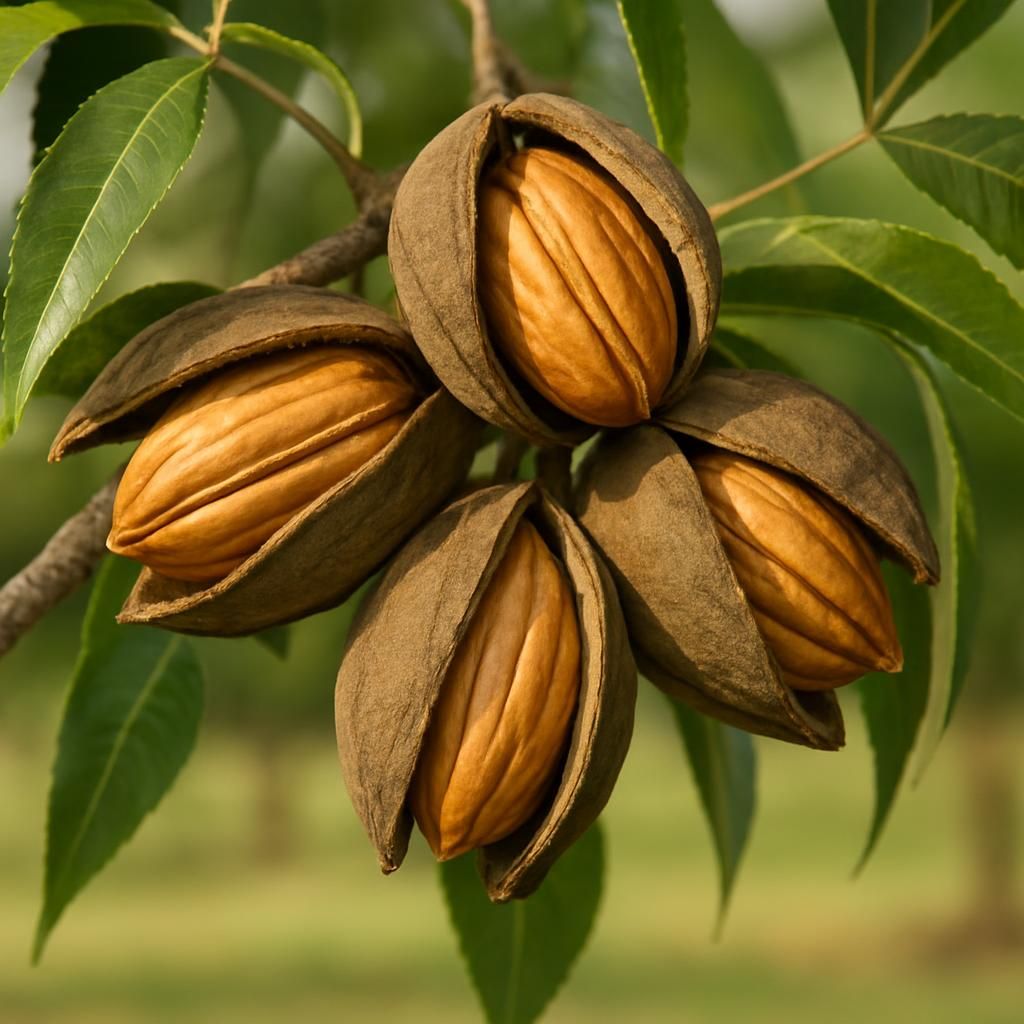
Introduction to Pecan (Caddo)
The Pecan (Caddo) cultivar is a compact, high-productivity selection developed by the USDA for improved disease resistance and consistent kernel quality. Released in 1963, Caddo has become a favorite among commercial and home growers seeking earlier harvests and reduced fungicide needs. Its medium-size nuts with thin shells and high kernel percentage deliver excellent market value while the tree's moderate vigor simplifies orchard management.
Caddo trees begin bearing at a relatively young age and maintain strong annual production when properly spaced and irrigated. The cultivar shows good resistance to pecan scab and moderate tolerance to other foliar diseases, making it suitable for both conventional and organic-leaning operations. Its early-season maturity also helps growers avoid late-season weather risks.
Whether planted as a primary orchard variety or as a pollinizer for later-maturing types, Caddo provides reliable returns with moderate care. This comprehensive guide details every aspect of successful cultivation from soil preparation to post-harvest handling.
Botanical Profile of Pecan (Caddo)
Caddo belongs to the Juglandaceae family and exhibits the classic pecan growth habit: a strong central leader with wide-spreading branches that form a broad, rounded canopy. Mature trees typically reach 60–80 feet in height with a 40–50 foot spread, though regular pruning can keep them smaller in high-density plantings.
Leaves are pinnately compound, 12–20 inches long, with 9–17 lanceolate leaflets. New growth emerges bronze-red before turning deep green. The tree is monoecious; male catkins appear on previous-season wood while female flowers form on current-season terminals. Caddo produces protandrous flowering, shedding pollen before pistillate receptivity, so compatible pollinizers such as Stuart Pecan or Desirable Pecan are recommended.
Nuts are medium (60–70 nuts per pound), oval, with smooth, thin shells that crack easily. Kernels are golden, plump, and average 55–60% of nut weight. The cultivar ripens in mid-September in USDA zones 7–9, approximately 10–14 days before the popular Stuart Pecan.
Soil, pH, and Climate Requirements for Pecan (Caddo)
Pecan (Caddo) thrives in deep, well-drained soils with good water-holding capacity. The tree is moderately drought tolerant once established but performs best with consistent moisture during nut fill. Avoid heavy clay or poorly drained sites that promote root diseases.
| Parameter | Ideal Range | Notes |
|---|---|---|
| Soil Type | Sandy loam to loam | Minimum 4–6 ft rooting depth |
| Soil pH | 6.0–7.0 | Below 5.5 increases zinc and manganese deficiency risk |
| Organic Matter | 2–4% | Improves moisture retention and fertility |
| Annual Rainfall | 30–50 inches | Supplemental irrigation recommended |
| Temperature Range | 0–95 °F | Protect young trees from late-spring frosts |
| Chill Hours | 400–800 hours below 45 °F | Ensures uniform bud break |
| USDA Hardiness Zones | 6b–9a | Caddo performs well across the southern pecan belt |
Site selection should prioritize full sun exposure (minimum 8 hours daily) and protection from strong prevailing winds. Slopes facing south or southeast warm earlier in spring and reduce frost pockets.
Step-by-Step Planting & Propagation
Site Preparation: Conduct soil tests 6–12 months before planting. Amend pH with lime if below 5.8. Incorporate 2–3 inches of compost and rip the soil to 18–24 inches where compaction exists.
Tree Selection: Choose 4–6 ft bare-root or container-grown trees with well-developed root systems and no visible disease. Grafted Caddo trees on recommended rootstocks such as 'Elliott' or 'Riverside' ensure true-to-type performance.
Spacing: Standard orchards use 40 × 40 ft or 35 × 40 ft layouts (27–35 trees/acre). High-density systems at 20 × 30 ft require more aggressive pruning and irrigation.
Planting Window: Plant dormant trees from December through February in zones 7–8. In zone 9, plant November–January. Soak bare-root trees 4–6 hours before planting.
Planting Depth: Set the graft union 2–3 inches above final soil grade. Backfill with native soil, tamp firmly, and water thoroughly to eliminate air pockets.
Initial Irrigation: Apply 5–10 gallons per tree immediately after planting. Maintain consistent moisture for the first two growing seasons.
Staking & Protection: Stake young trees and install trunk guards against rodents and sunscald. Mulch a 3–4 ft diameter circle with 3–4 inches of organic mulch, keeping material away from the trunk.
Care & Maintenance regimes for Pecan (Caddo)
Consistent cultural practices maximize yield and kernel quality while minimizing disease pressure.
| Practice | Schedule / Rate | Notes |
|---|---|---|
| Watering | 1–1.5 inches/week during nut fill (July–September) | Use drip or micro-sprinkler systems; avoid overhead irrigation |
| Fertilizer (N) | 50–100 lbs N/acre split March & June | Adjust based on leaf analysis; young trees receive 0.25–1 lb N/tree |
| Fertilizer (Zn) | 3–5 foliar applications of 1% ZnSO₄ from bud break | Critical for nut set; maintain leaf Zn > 60 ppm |
| Fertilizer (K, P) | Apply according to soil test every 2–3 years | Band 2–3 ft from trunk or fertigate |
| Pruning (Year 1–3) | Train central leader; remove competing branches | Summer tipping maintains shape |
| Pruning (Mature) | Remove 20–25% canopy in dormant season | Open center for light penetration; avoid heavy cuts after July |
| Mulching | Replenish 3–4 inch organic layer annually | Suppresses weeds and conserves moisture |
Monitor leaf nutrient levels each July. Target ranges: N 2.5–3.0%, P 0.14–0.30%, K 1.25–2.5%, Zn 50–100 ppm. Adjust programs accordingly.
Pests, Diseases & Organic Management
Caddo’s moderate scab resistance reduces fungicide needs, yet vigilance remains essential.
Major Pests
- Pecan nut casebearer: Monitor with pheromone traps; apply Bt or spinosad at 40–60% nut entry.
- Hickory shuckworm: Target larvae in shucks with approved insecticides or beneficial nematodes.
- Blackmargined aphid and Yellow pecan aphids: Encourage lady beetles; use insecticidal soap or neem oil for outbreaks.
- Stink bugs: Scout for kernel spotting; border sprays or kaolin clay reduce damage.
Key Diseases
- Pecan scab: Apply copper or sulfur-based fungicides at 2-week intervals from bud break through shell hardening if rainfall is frequent.
- Downy leaf spot and Vein spot: Remove fallen leaves; improve airflow through pruning.
- Root diseases: Prevent waterlogging; use well-drained sites and avoid over-irrigation.
Organic options include kaolin particle films, neem-based products, and beneficial insect releases. Maintain orchard sanitation by removing dropped nuts and leaf litter each winter.
Harvesting, Curing & Optimal Storage
Caddo nuts mature in mid-September when shucks begin to split and kernels reach 4–6% moisture. Mechanical shakers or hand harvesting onto tarps are both effective.
Harvest Steps
- Shake trees when 70–80% of shucks have opened.
- Collect nuts promptly to avoid ground moisture and wildlife.
- Remove shucks within 24 hours using a pecan cleaner or by hand.
Curing Spread nuts in a single layer on screens in a shaded, well-ventilated area at 70–80 °F for 7–14 days until kernel moisture drops below 4.5%. Stir daily for uniform drying.
Storage
- In-shell: 32–40 °F with 65–70% RH for up to 12 months.
- Shelled kernels: Vacuum-seal and freeze at 0 °F for 18–24 months; refrigerate for 4–6 months.
Maintain low oxygen and stable temperatures to preserve flavor and prevent rancidity.
Companion Planting for Pecan (Caddo)
Strategic companions improve soil fertility, attract beneficial insects, and reduce pest pressure.
Recommended Companions
- Clover or Hairy vetch as living mulch fix nitrogen and support predatory insects.
- Marigold and Nasturtium repel aphids and attract pollinators.
- Garlic and Onion deter rodents and certain insects when planted in understory strips.
- Sorghum windbreaks on orchard borders reduce wind damage and provide habitat for beneficials.
Avoid planting shallow-rooted crops such as Corn or Wheat directly under the drip line, as competition for water and nutrients can reduce pecan yields. Maintain a 10–15 ft weed-free strip along tree rows and mow alleyways regularly.
For additional guidance on organic soil strategies, see The Hidden Power of Mulching: 8 Organic Strategies to Transform Small Farm Soil.