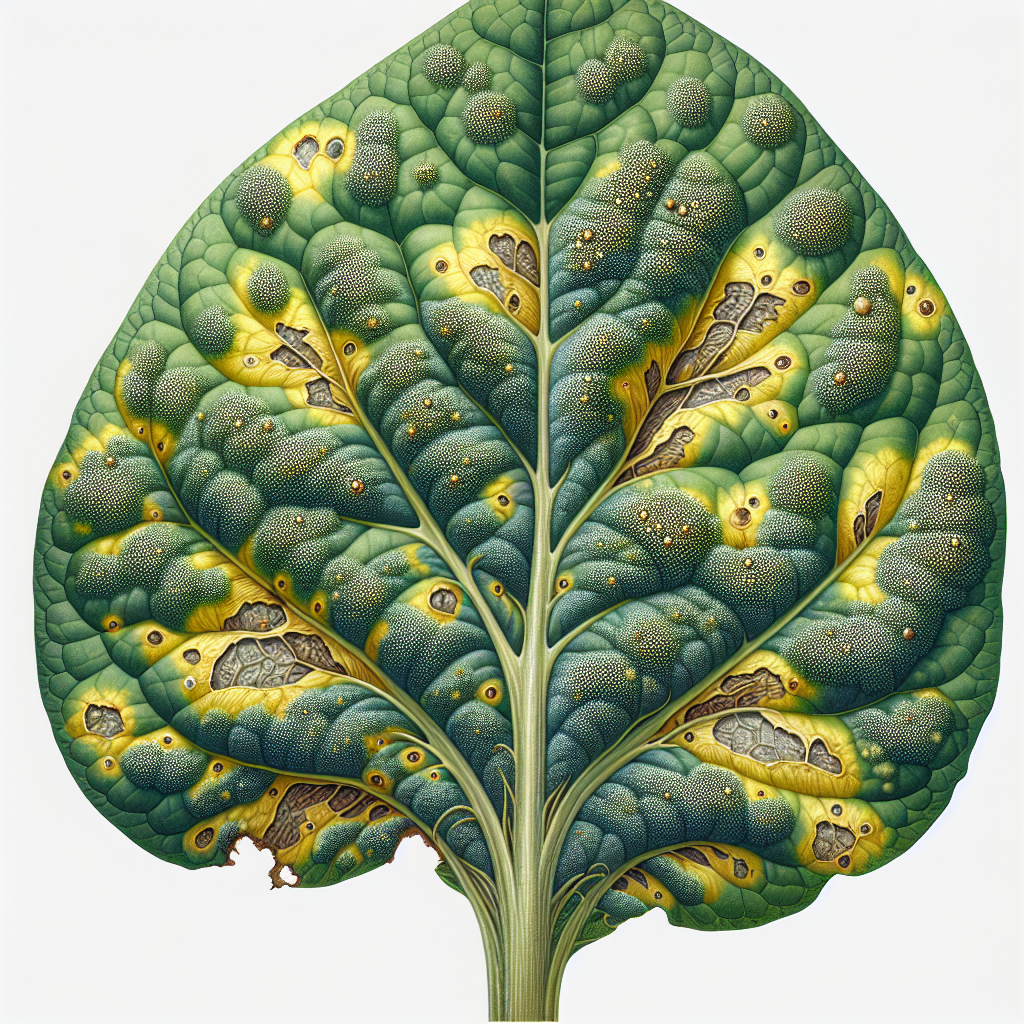
Introduction to downy leaf spot
Downy leaf spot represents one of the most pervasive foliar diseases in agriculture, caused by obligate biotrophic oomycetes from the genus Peronospora. Unlike true fungi, these pathogens are water mold-like organisms that require living host tissue and high humidity to infect and sporulate. First identified in the 19th century on crops like spinach and lettuce, downy leaf spot now impacts global production of brassicas, cucurbits, beets, and herbs, with economic losses exceeding millions annually in high-value salad greens alone.
This disease manifests as chlorotic spots on upper leaf surfaces with corresponding purplish-gray 'downy' mycelium underneath, distinguishing it from powdery mildew, which produces white powder on both sides. In severe outbreaks, leaves yellow, necrotize, and drop prematurely, compromising photosynthesis and marketable yield. Warm-season crops in temperate regions or cool-season crops in tropics are equally vulnerable, making proactive scouting and management essential for sustainable farming. Understanding its biology enables growers to integrate cultural, biological, and organic chemical controls effectively, minimizing reliance on synthetic fungicides.
Identifying Symptoms & Damage
Early detection hinges on recognizing subtle initial signs before widespread defoliation occurs. Symptoms begin as small, pale green to yellow angular spots (1-5 mm) on upper leaf surfaces, often vein-limited due to stomata-restricted pathogen entry. Lesions expand to 1 cm, turning necrotic with dark borders, while the adaxial (lower) surface develops a faint violet-gray fuzz—sporangiophores visible under 10x magnification or in morning dew.
In advanced stages, spots coalesce into blights covering 20-50% of foliage, with leaves wilting and abscising from the base up. On spinach, lesions are diamond-shaped; on lettuce, they form 'riding hood' distortions; beets show bull's-eye patterns. Secondary damage includes sunscald on exposed heads or fruits and increased susceptibility to Botrytis rot. Yield impacts vary: 30-70% lettuce head loss, 50% spinach tonnage reduction, and total crop failure in beets under prolonged wet weather.
Differentiate from Septoria leaf spot (smaller brown spots, no downy growth) or Alternaria leaf spot (concentric rings). Use a hand lens to confirm sporulation; lab diagnosis via PCR confirms Peronospora species. Damage escalates in dense canopies where humidity exceeds 90% for 6+ hours nightly.
Lifecycle and Progression of downy leaf spot
Peronospora lifecycle is hemicyclic, with asexual sporangia driving epidemics. Conidia (sporangiospores) germinate in free water at 10-20°C (50-68°F), entering via stomata within 4-6 hours. Inside, mycelium ramifies intercellularly, forming haustoria for nutrient uptake. After 3-5 days, sporangiophores emerge from stomata, releasing 100-500 conidia per lesion under cool, humid nights (>95% RH).
Oospores (sexual resting spores) form in senescing tissue under dry stress, surviving soil for 2-5 years as primary inoculum. Progression: inoculation → incubation (24-72 hrs) → sporulation (night 3-4) → new infections. A single cycle repeats every 5-7 days in optimal conditions, yielding 10+ generations per season. Airborne conidia travel 1-2 km, splashing shorter distances.
Systemic infections occur in young seedlings via seed or roots, leading to stunted, mottled plants. Cool days (15-22°C) and warm nights accelerate epidemics, unlike Phytophthora which prefers warmer soils.
Environmental Triggers & Risk Factors
Downy leaf spot epidemics correlate strongly with microclimate: leaf wetness duration >8 hours at 12-18°C optimum. High nitrogen fertility promotes succulent tissues ideal for infection. Overhead irrigation, dense planting (>30 cm rows for lettuce), and poor airflow in tunnels exacerbate humidity traps.
Risk spikes post-rainy spells or fog; avoid planting in low-lying frost pockets where dew lingers. Susceptible varieties like susceptible romaine lettuce amplify outbreaks. Crop debris harbors oospores; continuous monoculture exceeds 80% infection rates vs. 20% in rotations. Soil pH >7 reduces zoospore motility, while calcium-deficient soils weaken cell walls.
Monitor with weather stations: disease severity index = (hours wetness × mean temp 10-20°C). Threshold: 6+ hours wetness triggers protectant sprays.
Organic Control & Treatment Plans
Integrated organic management prioritizes exclusion, sanitation, and biorationals. Step 1: Cultural - Rotate 2-3 years out of host crops; rogue infected plants weekly; space for 20 cm airflow; morning irrigation to dry foliage by night. Flame or solarize debris post-harvest.
Step 2: Resistant Varieties - Select hybrids like 'Eruption' lettuce or 'Tyee' spinach (50% less susceptible). For beets, 'Bull's Blood' shows tolerance.
Step 3: Organic Fungicides - Apply OMRI-listed copper hydroxide (e.g., 1-2 lbs/acre) or potassium bicarbonate at 7-day intervals from first symptoms. Read our blog on Spring Pest Patrol for organic strategies. Neem oil + sulfur alternates reduce sporulation 70%. Bacillus subtilis (Serenade) colonizes leaves, outcompeting pathogens.
Step 4: Biologicals - Release Aphanocladium or Ampelomyces quisqualis mycoparasites early season. Potassium phosphite boosts SAR (systemic acquired resistance), applied as foliar drench.
Treatment Timeline: Scout twice weekly; at 1% incidence, spray copper + remove lesions; at 10%, strip infected rows. Efficacy: 85% control combining methods vs. 40% fungicide alone. For iceberg lettuce, integrate with downy mildew protocols.
Preventing downy leaf spot in the Future
Long-term prevention builds resilient systems. Site Selection: Choose well-drained slopes; install fans in high tunnels for <85% RH. Seed Health: Hot water treat (48°C/30 min) or index-free sources.
Forecasting: Use models like Downcast (UC IPM) integrating temp/RH for spray windows, saving 30% inputs. Cover Cropping: Mustard biofumigants suppress oospores 60%. Mulch with straw reduces splash.
Monitoring: Sticky traps for sporangia; apps track wetness hours. Annual soil tests guide balanced nutrition—avoid excess N. Quarantine new transplants 14 days. In polycultures, interplant with thyme or marigold for repellency. Success metric: <5% incidence via IPM.