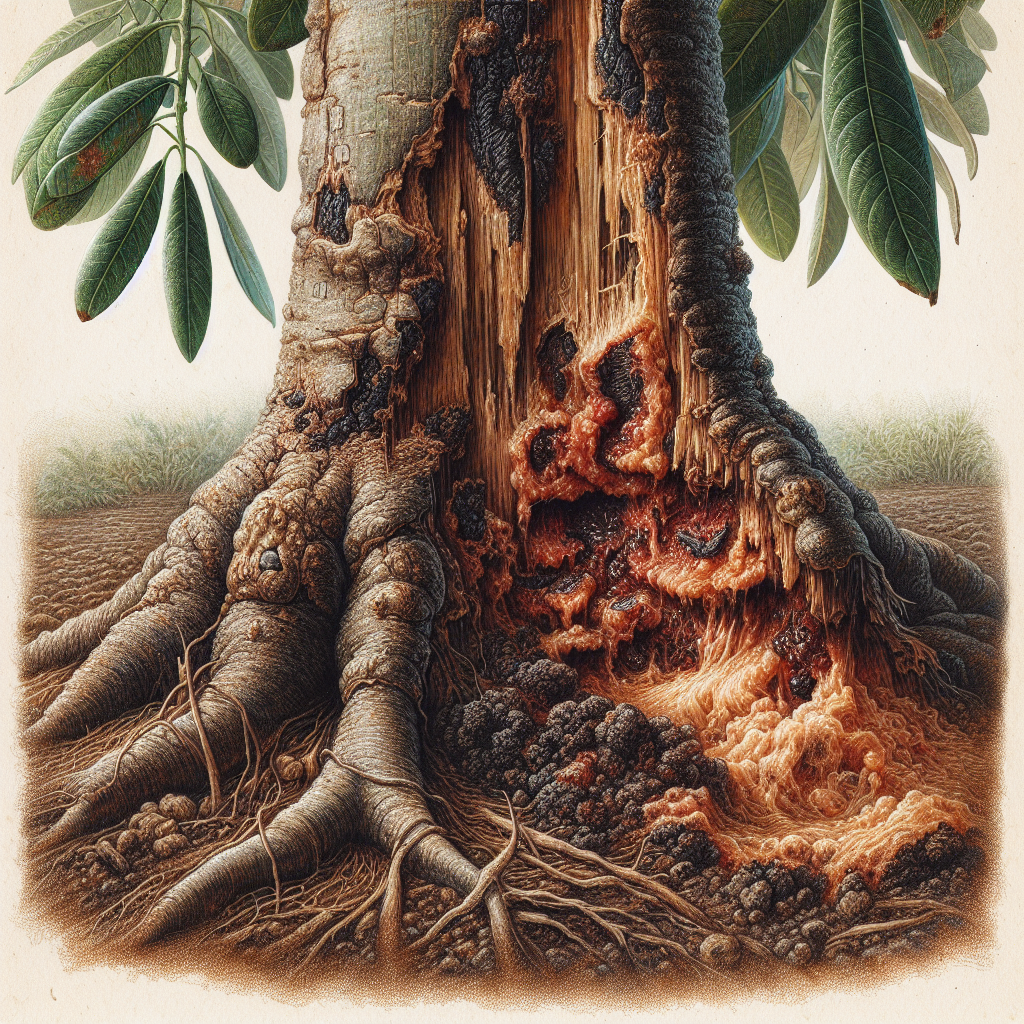
Introduction to Crown rot
Crown rot represents one of the most destructive soilborne diseases affecting a wide range of agricultural crops, particularly perennials and woody plants. This fungal infection targets the crown—the critical junction between roots and stems—where it causes tissue decay, girdling, and eventual plant collapse. Commonly caused by oomycetes like Phytophthora spp. (notably Phytophthora cinnamomi and Phytophthora parasitica) and true fungi such as Fusarium spp., Rhizoctonia solani, and occasionally Pythium spp., crown rot spreads via contaminated soil, water splash, and infected tools or plant material.
In agricultural settings, crown rot can lead to devastating losses, with infection rates exceeding 50% in susceptible crops under favorable conditions. Symptoms often mimic drought stress or root rot, leading to misdiagnosis and delayed intervention. Understanding this disease is crucial for farmers, as it persists in soil for years, making eradication challenging. Early detection and integrated management are key to minimizing economic impact. For small farms, proactive strategies outlined in this guide can save entire plantings. Learn more about Soil Health Mastery: 5 Proven Strategies for Small Farms to Build Fertile Ground Without Breaking the Bank to bolster defenses against such pathogens.
Identifying Symptoms & Damage
Recognizing crown rot early is essential for containment. Initial signs appear at the soil line: soft, water-soaked lesions on the crown and lower stem that progress to brown, sunken, necrotic areas. As the disease advances, the cortex sloughs off, exposing woody tissue with a reddish-brown discoloration. Affected plants exhibit sudden wilting of foliage, even with adequate moisture, followed by yellowing and leaf drop. Stems may show cankers or girdling, halting water and nutrient transport.
In cross-section, infected crowns reveal dark, decayed vascular tissue. Secondary symptoms include stunted growth, reduced yields, and plant death within weeks. In avocado trees, for instance, leaves turn chlorotic and sparse, with gum exudate at the soil line. Differentiate from collar rot by the crown focus versus higher stem lesions. Damage is most evident during warm, wet periods, with roots often showing secondary root rots. Economic losses stem from plant mortality (up to 80% in orchards) and reduced productivity in survivors. Inspect by gently scraping bark at the base; healthy tissue is firm and white, while infected is mushy and foul-smelling.
Lifecycle and Progression of Crown rot
Crown rot pathogens are soil inhabitants with complex lifecycles adapted to persistence. Phytophthora produces zoospores in saturated soils, motile structures that swim to host roots and crowns, initiating infection via wounds or natural openings. Mycelium then colonizes vascular tissues, producing chlamydospores for long-term survival (up to 10+ years). Fusarium and Rhizoctonia survive as sclerotia or dormant mycelium in soil organic matter, germinating under moisture and temperature triggers (20-30°C optimal).
Progression unfolds in phases: dormant survival, activation by host exudates, rapid colonization (2-7 days), symptom expression (wilting in 1-2 weeks), and sporulation for spread. Rain splash and irrigation disseminate spores up to 1 meter. In perennials like peach trees, chronic infections lead to recurring cankers. Unlike foliar diseases, crown rot evades aerial fungicides, emphasizing soil management. Disease cycles repeat annually in infested fields, amplified by crop debris.
Environmental Triggers & Risk Factors
Crown rot flourishes in poorly drained, heavy soils with high moisture retention. Optimal conditions include temperatures of 25-30°C and prolonged leaf wetness or flooding, promoting zoospore release. Over-irrigation, especially in clay soils, creates anaerobic zones ideal for pathogen activity. Risk factors encompass:
- Soil compaction and poor aeration: Limits oxygen, favoring anaerobes like Phytophthora.
- High organic matter without decomposition: Harbors sclerotia.
- Susceptible varieties: Hass Avocado and certain strawberry cultivars.
- Plant stress: Drought, nutrient deficiency, or root-knot nematodes wounding.
- Contaminated transplants: Introduces inoculum.
pH extremes (below 5.5 or above 7.5) exacerbate issues. In tropical regions, monsoon flooding spikes incidence. Learn how Why 80% of Small Farms Battle Weather Disasters - And How Hyper-Local AI Forecasts Can Save Your Harvest can predict these triggers.
Organic Control & Treatment Plans
No cure exists for advanced crown rot; focus on suppression and removal. Organic strategies include:
- Cultural Practices: Remove and destroy infected plants immediately, avoiding composting. Solarize soil (clear plastic, 4-6 weeks summer) to kill pathogens.
- Biological Controls: Apply Trichoderma harzianum or Bacillus subtilis drenches (e.g., RootShield, Serenade) to outcompete pathogens. Mycorrhizal fungi enhance root resilience.
- Organic Amendments: Incorporate mustard seed meal or brassica cover crops for biofumigation, releasing isothiocyanates toxic to fungi.
- Mulching: Use coarse organic mulch to improve drainage, avoiding fine compost near crowns.
- Resistant Rootstocks: For avocado, select Dusa or VC 801 varieties.
Integrated plans: Pre-plant soil tests for pathogens; rotate with non-hosts like onion. Drench with 70% alcohol solutions for tools. Monitor with bait tests. In peach orchards, trunk paints with phosphite (mono-potassium phosphite) boost defenses. Success rates reach 60-80% with early intervention.
Preventing Crown rot in the Future
Prevention trumps control. Key steps:
- Site Selection: Choose well-drained slopes; avoid low spots.
- Soil Management: Raised beds (12-18 inches), incorporate gypsum for sodic soils.
- Irrigation Optimization: Drip systems, avoiding overhead; schedule based on soil moisture probes.
- Sanitation: Sterilize tools, quarantine new plants.
- Crop Rotation: 3-5 years with grasses or clover.
- Resistant Varieties: Prioritize tolerant cultivars.
- Cover Cropping: Sudangrass or marigolds suppress nematodes and fungi.
Annual soil solarization and biofumigation reduce inoculum by 90%. Monitor Phytophthora root rot in high-risk areas.
Crops Most Affected by Crown rot
Crown rot strikes diverse crops, especially perennials:
| Crop | Susceptibility | Notes |
|---|---|---|
| Avocado (Hass, Fuerte) | High | Major issue in California, Florida; yield losses 30-50%. |
| Peach | High | Gummosis at crown; kills young trees. |
| Strawberry | Moderate-High | Patchy decline in beds. |
| Tomato | Moderate | Often with Fusarium. |
| Apple | Moderate | Orchard decline. |
| Mango | High | Tropical devastation. |
| Banana | Moderate | Crown and corm rot. |
| Pineapple | High | Phytophthora palmivora. |
| Eggplant | Moderate | Field crops. |
| Pepper | Moderate | Basal rot. |
Over 200 species affected; ornamentals like cyclamen common in nurseries. Focus prevention on high-value crops.