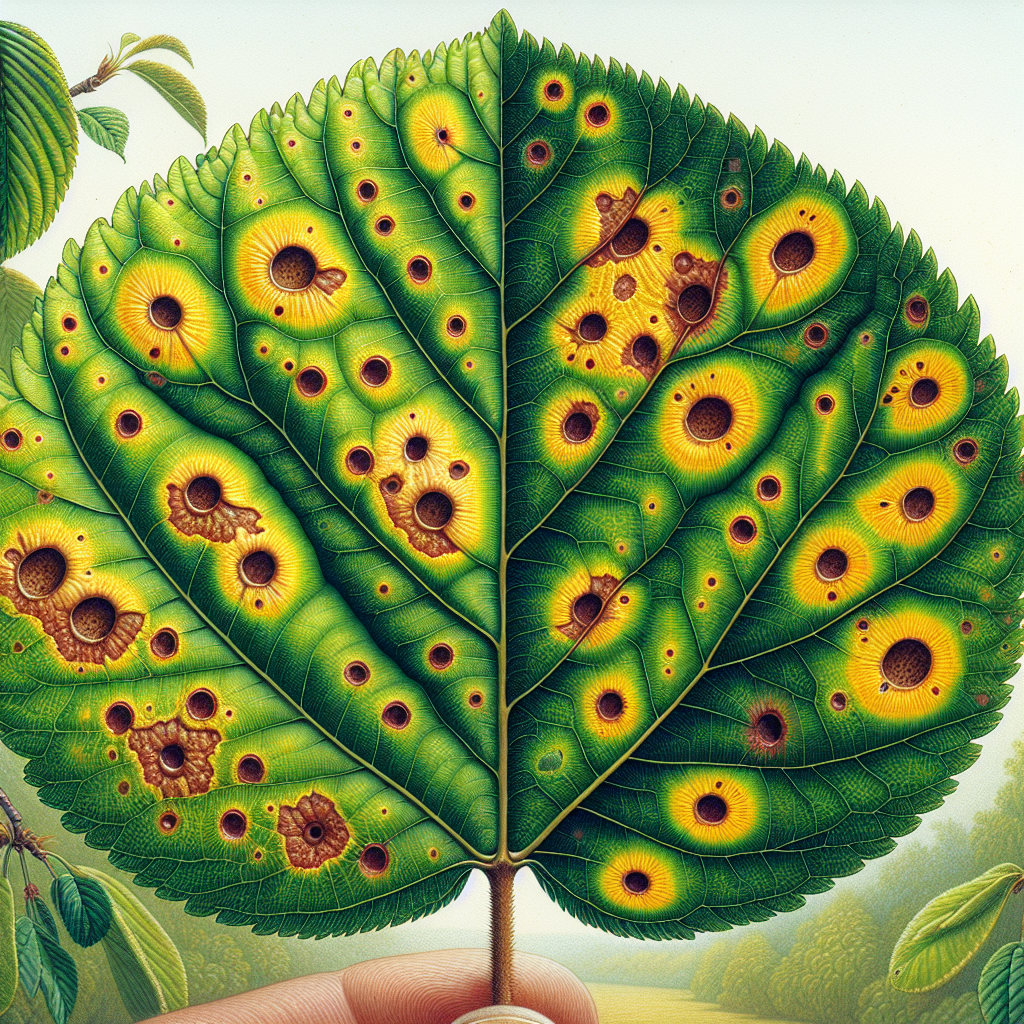
Introduction to Cherry leaf spot
Cherry leaf spot is one of the most destructive foliar diseases impacting Cherry orchards worldwide, particularly in regions with cool, wet springs and summers. Caused by the ascomycete fungus Blumeriella jaapii (syn. Coccomyces hiemalis), this pathogen thrives in high-humidity environments, leading to premature leaf drop, weakened trees, and significant yield losses of up to 50% in severe cases. First identified in the early 20th century, cherry leaf spot has become a primary concern for commercial growers and home gardeners alike, especially in the Pacific Northwest, Great Lakes region, and parts of Europe.
The disease cycles through multiple infections per season, starting with tiny purple flecks on young leaves that evolve into shot-hole lesions as centers fall out. Without intervention, repeated defoliation stresses trees, reducing photosynthesis, carbohydrate reserves, and fruit size the following year. Economic impacts are profound: in untreated orchards, losses can exceed $1,000 per acre annually due to poor fruit quality and tree decline. Early diagnosis and integrated management are crucial, as this disease mimics other leaf spot diseases like shot-hole or bacterial blight but requires specific fungicide timing.
Understanding cherry leaf spot's biology empowers growers to implement proactive strategies. This guide provides definitive diagnostic criteria, lifecycle details, organic treatments, and prevention tactics tailored for sustainable cherry production. For small farms, timely scouting paired with Soil Health Mastery: 5 Proven Strategies for Small Farms to Build Fertile Ground Without Breaking the Bank can enhance tree vigor and resilience against pathogens like B. jaapii.
Identifying Symptoms & Damage
Accurate identification of cherry leaf spot is essential to distinguish it from similar issues like Septoria leaf spot or Alternaria leaf spot. Initial symptoms appear 7-14 days after petal fall on the upper leaf surface as small, 1-2 mm purplish-red or brownish spots, often with a pale halo. These spots expand to 3-10 mm, developing a fringed, yellow margin and a tan-to-brown center that may drop out, creating a characteristic 'shot-hole' appearance.
By mid-summer, lower leaf surfaces show velvety, olive-green fungal sporulation under humid conditions—key for confirmation. Severely infected leaves yellow, curl, and drop prematurely, starting from the interior canopy. On fruit, rare superficial spotting occurs, but the primary damage is indirect: defoliation reduces tree vigor, leading to smaller Bing Cherry or Rainier Cherry fruits, delayed coloring, and increased susceptibility to powdery mildew.
Damage quantification reveals severity: 10-20% leaf loss is tolerable, but over 30% triggers yield declines of 20-40%. Scout weekly from bloom, using a 10x hand lens to spot acervuli (fungal fruiting bodies). Lab confirmation via PCR or microscopy detects B. jaapii conidia. Differentiate from bacterial spot (angular lesions, water-soaked) or anthracnose (dark, sunken fruit lesions). In Peach or Plum intercropped orchards, similar symptoms may confuse diagnosis, necessitating crop-specific checks.
Lifecycle and Progression of Cherry leaf spot
Blumeriella jaapii overwinters as apothecia in fallen infected leaves, releasing ascospores during spring rains when temperatures hit 10-20°C (50-68°F). Primary infections occur from pink bud to shuck split, with ascospores splashed to new leaves. Within 7-10 days under wet conditions (>9 hours leaf wetness), acervuli form, producing conidia for secondary cycles—up to 10-12 per season.
Progression peaks mid-June to August, with polycyclic epidemics driven by rain-splashed conidia. Apothecia mature in fall on leaf debris, ensuring overwintering. Lifecycle completes in 2-3 weeks per generation, favoring 15-25°C and prolonged wetness. In dry years, progression slows; humidity above 90% accelerates it. Understanding this enables precise fungicide timing: protect during ascospore release (bud swell to petal fall) and secondary spread (post-petal fall).
Environmental Triggers & Risk Factors
Cherry leaf spot epidemics hinge on prolonged leaf wetness (>48 hours cumulative), temperatures 12-24°C, and high rainfall (>25 mm/week). Overhead irrigation, dense canopies, and poor air circulation exacerbate spread. Risk soars in valleys with morning dew and evening fog, or after mild winters delaying leaf cleanup.
Susceptible varieties like Lambert or Van face higher risks than resistant ones like Gold. Poor nutrition (low potassium) or stresses from aphids weaken defenses. Soil pH >7.0 limits fungicide efficacy. Climate change extends wet periods, increasing outbreaks—growers in warming regions must adapt. Monitor with weather stations for 'infection periods' (wetness >9 hours at >10°C).
Organic Control & Treatment Plans
Organic management emphasizes sanitation, cultural practices, and OMRI-listed fungicides. Rake and destroy fallen leaves in fall (reduces inoculum 90%), mulch to bury debris, and prune for 20-30% canopy openness. Apply copper hydroxide (e.g., Cueva) or sulfur at 70% bloom, repeating every 10-14 days during wet periods—up to 6 applications/season.
Neem oil or potassium bicarbonate curbs secondary spread; Bacillus subtilis (Serenade) boosts ISR. Timing is critical: start at green tip, cover through shuck. Integrate with kaolin clay barriers. For outbreaks, strip-pick infected leaves. Rotate modes of action to prevent resistance. In trials, these yield 85-95% control vs. 20% untreated. Combine with compost teas for microbiome enhancement.
Preventing Cherry leaf spot in the Future
Long-term prevention builds resilient orchards. Plant resistant cultivars like Skeena or Santina near Apple blocks for diversity. Site selection: well-drained slopes with good airflow. Annual fall sanitation removes 95% inoculum. Balanced fertility (N-P-K 10-10-20) and drip irrigation minimize wetness.
Scout biweekly; use decision aids like NEWA models. Cover crops suppress splash dispersal. Prune post-harvest for renewal. Monitor Septoria as co-infection risk. Organic programs sustain yields; transition gradually from synthetics. Read Why Timing Kills Small Farm Profits - And How AI Task Scheduling Saves Your Harvests for spray optimization.
Crops Most Affected by Cherry leaf spot
Primarily sweet (Bing Cherry) and sour (Montmorency) cherries, with 100% susceptibility in humid zones. Minor hosts include black cherry (Prunus serotina) and occasionally Pear. Commercial impact hits Pacific Northwest (50% acreage affected), Michigan, Ontario. Home gardens suffer most without scouting. No crossover to Grapes or Strawberry, but rotation avoids stone fruits.