Introduction to Bacterial canker
Bacterial canker, caused by the pathogen Pseudomonas syringae pathovars such as pv. syringae, pv. morsprunorum, and others, represents one of the most serious diseases confronting stone fruit growers worldwide. This gram-negative bacterium infects woody plants, leading to canker formation on trunks, branches, and scaffolds, often resulting in significant yield losses and tree mortality. First identified in the early 20th century, bacterial canker has become a persistent threat in temperate climates, exacerbated by climate variability that increases wet spring periods ideal for infection.
The disease's impact is particularly devastating in commercial orchards of cherry, peach, and plum, where it can reduce fruit quality and quantity by up to 50% in severe outbreaks. Symptoms often mimic other issues like fungal cankers or environmental stress, making accurate diagnosis crucial. This guide provides professional-grade diagnostic criteria, lifecycle insights, and organic management strategies tailored for small farms and commercial operations. Early detection through vigilant scouting can limit spread, while integrated cultural practices form the backbone of long-term control. For small farms struggling with disease identification, tools like AI-powered plant diagnostics can revolutionize accuracy—check out Why Misidentifying Plants Costs Small Farms Thousands - And How AI Camera Diagnosis Fixes It Fast.
Understanding bacterial canker's biology is key to prevention. The bacterium is ubiquitous in soil, water, and plant debris, entering through wounds or natural openings like lenticels. Unlike fungal pathogens, it produces no spores but ooze-laden exudate that serves as a primary inoculum source. Infected trees exhibit systemic decline, with young trees most susceptible due to tender tissues. Global distribution spans North America, Europe, Asia, and Australia, with economic losses exceeding millions annually in fruit production regions.
Identifying Symptoms & Damage
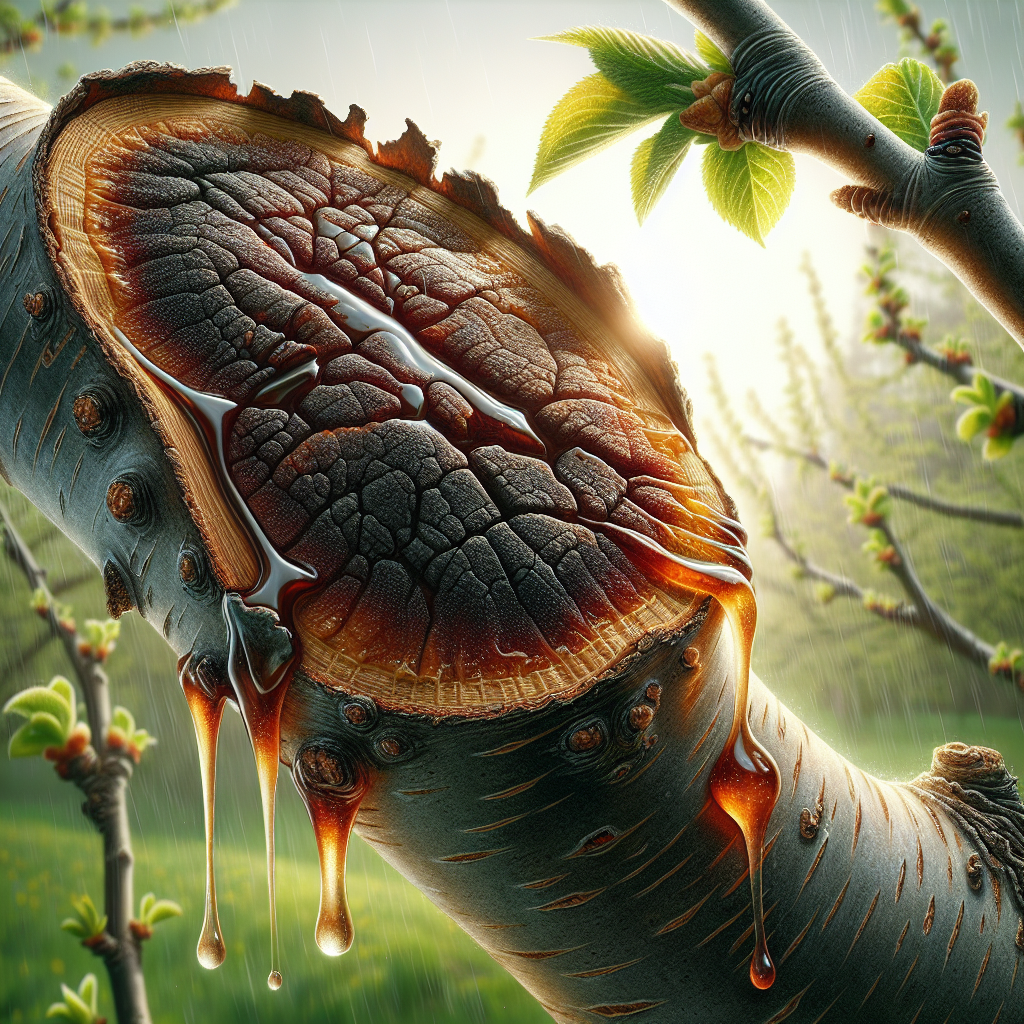
Diagnosing bacterial canker requires keen observation of distinctive symptoms progressing from subtle to severe. Initial signs appear in early spring as water-soaked lesions on twigs and branches, often at leaf scars or pruning wounds. These lesions turn dark brown to black, sunken, and elliptical, with characteristic amber-colored gum (gummosis) exuding from cracks. In advanced stages, cankers girdle branches, causing dieback above the lesion; bark cracks reveal discolored, necrotic cambium.
On trunks, cankers form at the graft union or soil line, leading to basal gummosis and tree instability. Foliar symptoms include wilting leaves with marginal necrosis, sometimes confused with fire blight. Fruit infections manifest as reddish-brown spots with gum pockets, rendering produce unmarketable. Differentiate from fungal cankers by the lack of sporulation and presence of bacterial ooze that smells foul when wet.
Damage quantification is critical: in cherry orchards, scaffold branch cankers can kill 20-30% of spurs, slashing yields. Peach trees show blossom blight, with infected flowers blackening and dropping. Use lab confirmation via isolation on King's B medium or PCR for P. syringae. Scouting tip: inspect during dormancy for sunken areas and gum streaks. Economic thresholds vary, but any girdling canker on scaffold branches warrants removal.
Lifecycle and Progression of Bacterial canker
Bacterial canker follows a polycyclic lifecycle synchronized with host phenology. The pathogen overwinters in cankers, lenticels, and bud scales as epiphytic populations. Spring rains splash bacteria into wounds from leaf scars or pruning cuts, with optimal infection at 15-20°C (59-68°F) and prolonged leaf wetness.
Entry occurs via natural openings or injuries; bacteria multiply in xylem, producing toxins that kill parenchyma. Systemic spread via vascular tissues leads to gummosis as a defense response. Summer quiescence precedes fall reactivation on stressed trees. Peak epidemics follow cool, wet springs followed by drought stress, amplifying tree susceptibility.
Progression stages: incubation (1-4 weeks), lesion expansion (girdling in 2-3 months), and chronic canker formation. In susceptible varieties like sweet cherry 'Bing', infection rates soar post-bloom. Bacteria disseminate via rain, wind, tools, and insects like aphids. Understanding this cycle informs spray timing: dormant copper applications target overwintering sites.
Environmental Triggers & Risk Factors
Bacterial canker thrives under specific conditions mimicking temperate orchard environments. Cool, wet springs (below 21°C/70°F with >10 hours leaf wetness) drive primary infections. High humidity and frost promote epiphytic buildup on buds. Poor air circulation in dense canopies traps moisture, elevating risk.
Soil factors include waterlogging, which stresses roots and facilitates trunk infections near graft unions. Nutrient imbalances, especially excess nitrogen, produce succulent tissues prone to wounding. Pruning during wet periods introduces inoculum via tools. Susceptible varieties like certain plum cultivars amplify outbreaks.
Climate change intensifies risks with erratic wet-dry cycles. Hail, frost cracks, and mechanical injuries from equipment create entry points. Integrated risk assessment involves monitoring weather data; hyper-local forecasts can predict outbreaks. Companion stressors like root rot compound damage.
Organic Control & Treatment Plans
Organic management emphasizes prevention over curative sprays, as no eradicants exist post-infection. Start with sanitation: remove and destroy cankers during dry periods, sterilizing tools with 10% bleach or 70% alcohol between cuts. Apply dormant copper hydroxide or fixed copper (e.g., Bordeaux mixture) at 2-4 kg/ha in late winter to suppress overwintering bacteria.
Biological controls include Bacillus subtilis or Streptomyces strains applied at bud swell, reducing epiphytes by 50-70%. Promote biocontrol with compost teas rich in antagonistic microbes. Wound dressings with latex paint deter reinfection. Nutrient management: balance NPK to avoid lush growth; foliar calcium strengthens cell walls.
Cultural tactics: space trees for airflow (4-6m), prune in dry weather, avoid overhead irrigation. For outbreaks, rogue severely infected trees. Organic success rates reach 80% with vigilant IPM. Monitor with AI pest patrols for early warnings, as in Spring Pest Patrol: Organic AI Strategies to Shield Your Crops from Common Invaders—adapt for diseases.
Step-by-step plan: 1) Scout weekly spring-fall. 2) Prune infected wood 10cm below canker. 3) Copper spray at green tip, petal fall. 4) Mulch to retain moisture without waterlogging. 5) Plant resistant rootstocks like Gisela for cherry.
Preventing Bacterial canker in the Future
Long-term prevention hinges on certified disease-free nursery stock and resistant varieties (e.g., 'Sweetheart' cherry, Mazzard rootstock). Site selection: well-drained soils, full sun, avoid low-lying frost pockets. Establish windbreaks to reduce desiccation cracks.
Annual practices: summer pruning to heal wounds before fall rains, irrigation scheduling to minimize wetness. Cover crops like clover improve soil health, boosting vigor. Quarantine new plantings. Resistance breeding programs yield tolerant scions; integrate with IPM.
Monitoring tech: weather stations trigger alerts for high-risk periods. Soil solarization pre-planting kills soil inoculum. Future-proofing involves diversifying crops, reducing monoculture risks. Consistent application yields 90% control efficacy.
Crops Most Affected by Bacterial canker
Primarily stone fruits: cherry (Prunus avium, 70% infection rates), peach (P. persica), plum (P. domestica), apricot, nectarine. Also almond, apple (minor), and ornamentals like Prunus spp. Cherry most economically impacted, followed by peach in California/Washington.
Regional hotspots: Pacific Northwest cherries, European plums. Yield losses: 20-100% depending on variety/weather. Other mentions: avoid confusion with citrus canker on unrelated crops.