Introduction to Armillaria
Armillaria root rot, commonly known as oak root fungus or shoestring root rot, represents one of the most devastating soilborne pathogens in agriculture and forestry. Caused by various species of the genus Armillaria, this fungus attacks the roots and lower trunk (collar) of trees and woody perennials, leading to progressive decline and eventual plant death. Unlike many foliar diseases, Armillaria is a primary pathogen that persists in soil for decades, making it notoriously difficult to eradicate once established.
The pathogen thrives in a wide range of climates but is particularly problematic in temperate regions with cool, moist soils. It infects over 1000 plant species, including many high-value crops like avocado, citrus, and stone fruits. Economic losses can reach millions annually in orchards, vineyards, and forests due to tree replacement costs, lost yields, and reduced land value. Early detection is crucial, as symptoms often mimic drought stress or other root issues like Phytophthora root rot.
This guide provides professional-grade diagnostic tools, lifecycle insights, and organic management strategies tailored for small farms and orchards. By understanding environmental triggers and implementing prevention, growers can minimize outbreaks and protect long-term productivity. Armillaria's resilience underscores the need for integrated approaches combining cultural, biological, and physical controls.
Identifying Symptoms & Damage
Diagnosing Armillaria requires careful inspection, as symptoms develop slowly and can be confused with environmental stress. Initial signs include stunted growth, yellowing foliage (chlorosis), and sparse canopy dieback starting from the top. Affected trees often exhibit premature leaf drop and reduced vigor, appearing drought-stressed even in moist conditions.
Key diagnostic features appear at the base:
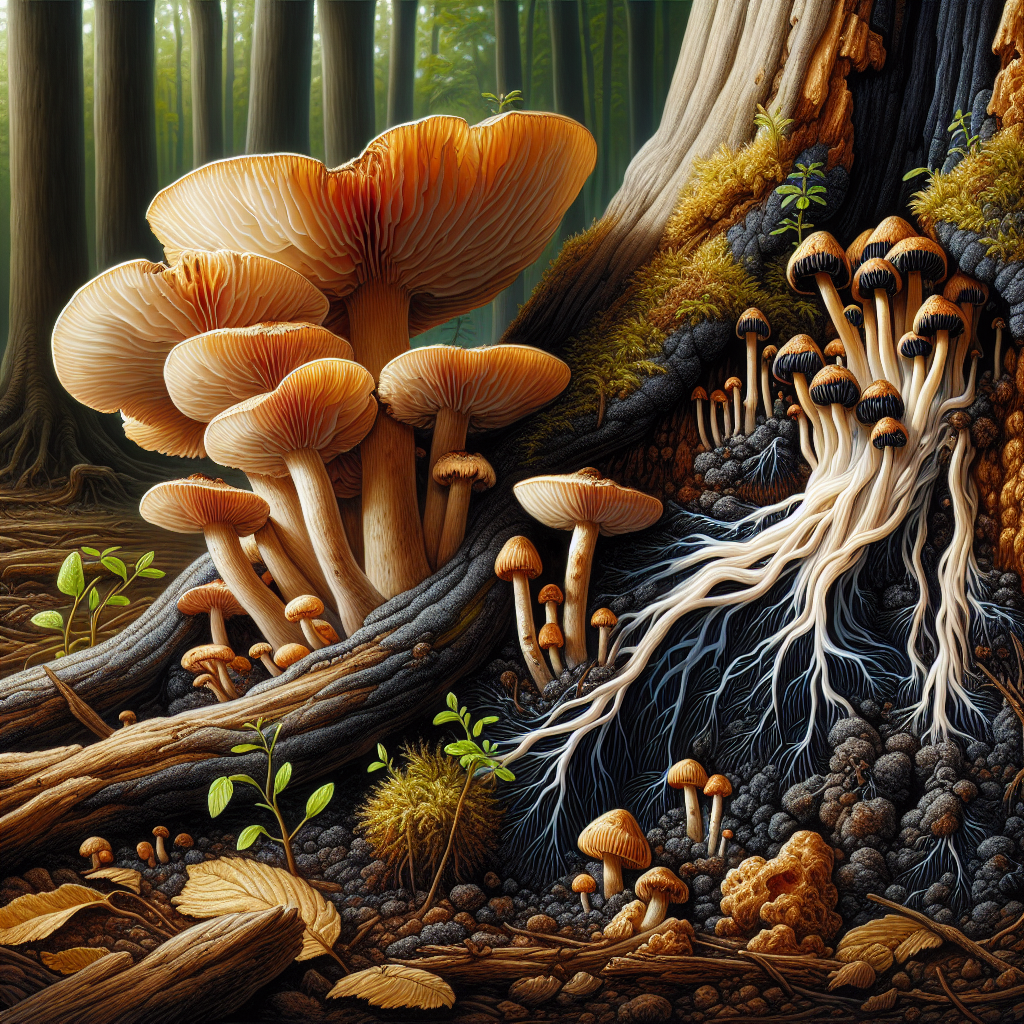
- White mycelial fans: Peel back bark at the soil line to reveal white, fan-shaped fungal mats between wood and bark. These are pathognomonic for Armillaria.
- Black rhizomorphs (shoestrings): Rope-like structures, 2-5 mm thick, black on the outside and white inside, spreading through soil from infected roots.
- Honey mushrooms: Clusters of small, honey-yellow to brown mushrooms (fruiting bodies) emerge at the tree base in fall or after rains. Caps have white gills and a ring on the stem.
- Root and wood decay: Excavate roots to find blackened, stringy roots with white mycelium. Wood shows cubical brown rot.
Damage progresses from feeder roots inward, girdling the collar and blocking water/nutrient uptake. In advanced stages, basal cankers ooze resin or gum, and trees topple in wind. Yield losses in crops like Hass Avocado can exceed 50% within 3-5 years of infection. Differentiate from root rot by the presence of rhizomorphs and mushrooms—absent in many other rots.
Conduct soil digs around suspect trees during wet seasons for confirmation. Lab tests (mycelial culturing) provide definitive ID, but field signs suffice for management.
Lifecycle and Progression of Armillaria
Armillaria's lifecycle is perennial and soil-based, enabling long-term survival without a host. The fungus persists as rhizomorphs and mycelium in decaying roots, remaining viable for 20-50+ years. Infection occurs via root contact with rhizomorphs or mycelium, penetrating wounds or natural openings.
Key stages:
- Dormancy: Mycelium colonizes dead roots, forming extensive mats.
- Spread: Rhizomorphs grow 1-3 meters/year through soil, seeking new hosts. They degrade organic matter en route.
- Infection: Enzymes break down root lignin/cellulose; mycelium invades vascular tissue.
- Colonization: White fans form under bark; tree girdles over 2-5 years.
- Fruiting: In autumn, mushrooms produce billions of basidiospores, but airborne spread is rare (inefficient). Primary dispersal is vegetative via rhizomorphs.
Progression varies by host: susceptible trees like apple decline in 1-3 years; tolerant ones linger 5-10 years. Wet springs favor rhizomorph growth; dry summers slow spread. Multiple species (e.g., A. mellea in hardwoods, A. ostoyae in conifers) show regional variations, but management is similar.
Environmental Triggers & Risk Factors
Armillaria exploits stressed hosts, thriving where roots are wounded or soils favor fungal growth. Primary triggers include:
- Soil moisture: Cool, wet soils (pH 5.5-7.0) promote rhizomorphs; drainage > saturation is key.
- Plant stress: Drought, flooding, overwatering, or mechanical injury (e.g., grading) weaken defenses.
- Site history: Planting over old stumps/orchards spreads via residual roots.
- Host susceptibility: Woody perennials > annuals; e.g., peach, cherry, Hass Avocado.
Risk factors: Heavy clay soils, mulch volcanoes (trapped moisture), shallow irrigation, and companion pests like root-knot nematodes that wound roots. Climate change intensifies outbreaks via erratic rains. Check Soil Health Mastery: 5 Proven Strategies for Small Farms to Build Fertile Ground Without Breaking the Bank for mitigation.
Organic Control & Treatment Plans
No cure exists for established Armillaria; focus on containment and host removal. Organic strategies emphasize cultural and biological tactics:
Immediate Actions:
- Remove infected plants: Excavate entire root system (2-3m radius) to 1m depth; chip/destroy debris (solarize or burn).
- Soil solarization: Cover infested soil with clear plastic (4-6 weeks summer) to kill surface mycelium.
Biological Controls:
- Trichoderma spp.: Apply biofungicides (e.g., RootShield) to compete with Armillaria.
- Mycorrhizal inoculants: Boost host resistance via beneficial fungi.
Cultural Treatments:
- Improve drainage: Install berms/tiles; avoid low spots.
- Mulch properly: 5-10cm organic mulch, kept 30cm from trunk.
- Water deeply/infrequently: Promote deep roots.
- Fertilize balanced: Avoid excess N; use compost teas.
Treatment Timeline:
| Stage | Action | Frequency |
|---|---|---|
| Early Detection | Monitor bases | Monthly |
| Confirmed Infection | Remove host | Immediate |
| Post-Removal | Solarize + biofungicide | Summer |
| Replanting | Resistant varieties + mycorrhizae | 1-2 years later |
For orchards, stump grinding + fumigation alternatives like mustard seed meal (biofumigant). Monitor adjacent trees quarterly. Success rates: 70-90% containment with prompt action.
Preventing Armillaria in the Future
Prevention outperforms control for this persistent foe. Key practices:
- Site selection: Avoid old orchard sites; test soil for rhizomorphs pre-planting.
- Resistant varieties: Choose tolerant rootstocks (e.g., for avocado, Dusa or VC%801).
- Planting protocols: Deep planting holes, no root wounds; amend with compost.
- Orchard hygiene: Remove stumps immediately; avoid soil compaction.
- Irrigation management: Drip systems; monitor soil moisture.
- Cover crops: Brassicas (mustard) as biofumigants; clover for suppression.
- Monitoring: Annual root digs in high-risk zones.
Long-term: Rotate to non-hosts (grasses) for 5+ years. Integrate with IPM, linking to Why 90% of Small Farms Fail at Pest Management - And 8 Organic Fixes That Actually Work. Resistant landscapes reduce incidence by 80%.
Crops Most Affected by Armillaria
Armillaria targets woody crops, causing billions in losses:
- Fruit Trees: Apple, peach, cherry, pear, plum—decline in 2-5 years.
- Citrus & Subtropicals: Orange, lemon, avocado, mango.
- Nuts: Almond, walnut, pecan.
- Vines: Grapes, kiwi.
- Forest/Ornamentals: Oaks, pines; also potato in highland areas.
Hass Avocado suffers basal cankers; apple shows rapid girdling. Annuals rarely affected due to shallow roots.