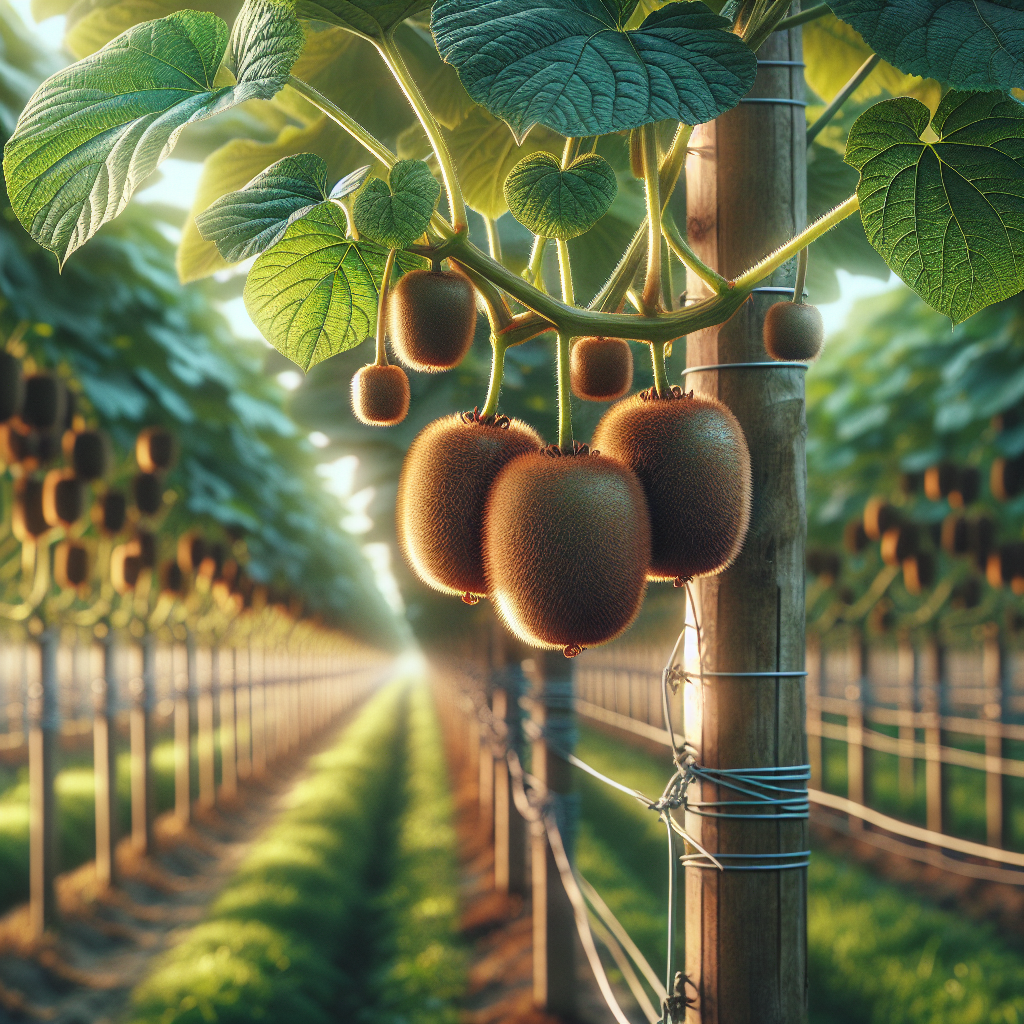
Introduction to Kiwi
Originating from East Asia and domesticated from Chinese gooseberry, kiwi became a globally important fruit after selection and commercialization in New Zealand, which helped popularize the name “kiwifruit.” The most widely grown commercial type is the fuzzy kiwi, Actinidia deliciosa, though growers should know that the broader kiwi group also includes A. chinensis (often yellow-fleshed kiwifruit) and several hardy kiwi species. For most field and garden growers, kiwi is not a small shrub or orchard tree but a powerful climbing vine with substantial annual growth, often extending several meters in one season under fertile, moist conditions.
That growth habit defines nearly every management decision. Kiwi requires a trellis system closer to grape production than tree fruit culture, but with even heavier wood and denser summer canopy. Vines are dioecious in most standard cultivars, meaning male and female flowers are borne on separate plants. A productive planting therefore depends on deliberate pollinizer placement, synchronized bloom, and active pollinator movement. When these basics are handled well, kiwi can become one of the highest-yielding perennial fruit crops per unit area.
Kiwi fruit is technically a berry. It combines high vitamin C, notable potassium, dietary fiber, and strong consumer demand, making it attractive for both fresh market and home-scale specialty production. However, it is not a forgiving crop for poorly drained soil, weak support structures, or neglected pruning. Growers who succeed with kiwi usually excel at site selection, winter and summer pruning, irrigation scheduling, and frost-risk management.
Botanical Profile of Kiwi
Actinidia deliciosa belongs to the family Actinidiaceae. It is a woody, twining, deciduous vine with large, nearly circular leaves, often 10-20 cm across, borne alternately on long petioles. Young shoots are vigorous and somewhat brittle when actively elongating, which is why careful tying and wind protection matter. Mature trunks can become thick, rope-like, and surprisingly heavy, especially in older plantings carrying full crops.
Flowers are creamy white to pale yellow, generally 2.5-5 cm wide, and appear on current-season shoots arising from one-year-old wood. This fruiting habit is crucial: kiwi cropping depends on preserving the right amount of productive one-year canes each dormant season. Female flowers possess functional ovaries and produce fruit, while male flowers mainly provide pollen. Because standard fuzzy kiwi is functionally dioecious, a planting without an appropriate male pollinizer may look vegetatively healthy but set little or no crop.
Fruit of A. deliciosa is oval to cylindrical, with brown fuzzy skin and bright green flesh surrounding a pale central core. The tiny black seeds are edible and distributed in radiating lines through the flesh. Commercial maturity is judged more by soluble solids development and dry matter accumulation than by external color change, because kiwi is typically harvested firm and ripened after harvest.
Several cultivar nuances matter. 'Hayward' remains the benchmark green-fleshed fuzzy kiwi in many regions because of fruit size, storage ability, and market familiarity. Common male pollinizers include 'Tomuri' and 'Matua', selected according to bloom timing compatibility. In warmer or niche markets, gold-fleshed kiwifruit from related species may be considered, but they often have slightly different disease sensitivities and climate fit. Hardy kiwi species are smaller-fruited and more cold-tolerant, but they are a different production model than standard fuzzy kiwi.
Kiwi vines can remain productive for decades if trunks and cordons are maintained, disease pressure is managed, and canopy renewal is consistent. Like grapes, they depend on strong annual pruning discipline rather than casual trimming.
Soil, pH, and Climate Requirements for Kiwi
Kiwi performs best in deep, fertile, well-drained loam or sandy loam rich in organic matter. The ideal rooting zone is at least 1-1.5 meters deep, free from hardpan, with good aeration and a stable moisture supply. Kiwi roots are fleshy and relatively sensitive to oxygen deprivation, so drainage is not optional. If water stands for even 24-48 hours around the root zone after heavy rain, root decline, Phytophthora infection, and chronic vine weakness become much more likely.
The preferred soil pH is generally 5.5-6.5, with acceptable performance around 5.0-7.0 depending on soil texture and nutrient balance. In alkaline soils above about pH 7.2, iron, manganese, and zinc deficiencies become more common, often showing as interveinal chlorosis on young leaves. In strongly acidic soils below pH 5.0, root growth may be restricted and calcium, magnesium, and phosphorus availability can become limiting. Before planting, a full soil test should guide lime, sulfur, compost, and base fertilizer decisions.
Organic matter is especially valuable because kiwi demands both moisture retention and aeration. A target of 3-5% organic matter in mineral soils is highly beneficial. Incorporate well-finished compost before planting, but avoid burying raw manure or uncomposted residues in the immediate root zone, as these can create anaerobic pockets or excessive salt levels.
Climate requirements are specific. Fuzzy kiwi is best adapted to mild temperate climates with enough winter chill for uniform budbreak but without extreme winter minima. Mature dormant vines can tolerate moderate winter cold, often around -10 to -12°C for short periods, but trunks, canes, and especially swelling buds become increasingly vulnerable as dormancy breaks. Spring frost is one of the biggest limiting factors. New shoots can be severely damaged around -1 to -2°C, and even light frost at the wrong stage may remove an entire crop.
Kiwi also dislikes intense heat combined with low humidity and water stress. Prolonged temperatures above 35°C can cause leaf scorch, poor fruit sizing, and sunburn, especially on exposed fruit after aggressive summer pruning. Ideal growing-season temperatures are often in the 24-30°C range, with cool nights supporting steady carbohydrate accumulation.
Wind protection is essential. Large leaves tear easily, young shoots break, and flowers can be damaged or pollinator activity reduced in windy sites. Shelterbelts or carefully designed windbreaks can improve establishment and fruit set dramatically, but they should not cast dense shade over the trellis.
Rainfall alone rarely provides reliable moisture in commercial-quality plantings. Kiwi generally benefits from 700-1200 mm annual water supply, but what matters most is distribution and drainage. During active canopy growth and fruit expansion, soil moisture should remain consistently moist, not saturated. In practical terms, the upper 20-30 cm of soil should feel cool and slightly moist to the touch, never powder-dry and never sticky or sour-smelling. Tensiometer targets often fall roughly in the 10-30 kPa range in loam soils during the main growing season; values consistently above that can indicate developing stress, while near-zero saturation after repeated irrigation suggests overwatering.
Step-by-Step Planting & Propagation
Start with certified, disease-free nursery plants of known sex and cultivar. Seed propagation is unsuitable for fruit production because seedlings vary genetically and may take longer to flower, with unpredictable male:female ratios. Commercial and serious orchard plantings rely on grafted, budded, or rooted clonal plants.
Choose a site with full sun, excellent air drainage, and no history of chronic waterlogging. Avoid low frost pockets. Prepare the land at least several months before planting by deep ripping if compaction is present, incorporating compost where appropriate, correcting pH based on test results, and installing drainage if necessary.
Build the trellis before planting or immediately afterward. Kiwi vines become heavy enough to destroy weak structures. A T-bar or pergola-type system is common. End posts must be strongly anchored, often substantially heavier than those used for many cane fruits. Wires should be high-tensile and capable of carrying mature cordons, seasonal growth, and a full crop load. A fruiting wire height of roughly 1.8-2.0 meters is common, though design varies by region and training system.
Plant during dormancy in late winter to early spring in cold climates, or during the cool season where winters are mild. Space vines according to vigor and trellis design; many plantings use about 4-6 meters between rows and 3-5 meters between vines, though intensive systems may differ. Male pollinizers are often placed at a ratio of about 1 male to 6-8 female vines, adjusted for cultivar bloom overlap, wind patterns, and pollinator activity.
At planting, dig a broad hole no deeper than the root ball. Set the vine so the crown sits at or slightly above finished soil level. Do not bury the trunk. Backfill with native soil unless extreme conditions justify amendment, then water thoroughly to settle air pockets. Apply an organic mulch 5-10 cm deep, keeping it at least 8-10 cm away from the trunk to prevent collar rot and rodent damage.
For training in year one, select the strongest shoot and tie it gently to a stake leading toward the fruiting wire. Remove competing shoots so energy goes into one straight trunk. Once the shoot reaches wire height, pinch or head it to encourage two lateral arms, one trained in each direction to form permanent cordons. Remove flowers in the establishment phase so the vine invests in framework rather than early fruit.
Propagation by hardwood cuttings is possible in some systems, especially for rootstock or clonal multiplication, but strike rates vary and sanitation is critical. Bench grafting or budding onto suitable root systems can also be used, particularly when replacing top growth or changing cultivars. Where bacterial diseases are a concern, source material hygiene is non-negotiable.
If you are refining soil-building before planting, the principles in soil health strategies are useful, especially for improving structure and organic matter ahead of a long-lived perennial crop.
Care & Maintenance regimes for Kiwi
Irrigation should be frequent enough to prevent stress but never so heavy that the root zone remains saturated. In the first two years, young vines need especially close monitoring because their root systems are still localized. Drip irrigation is preferred for precision and disease reduction. During warm weather, a young vine may need light, repeated irrigations to keep the root zone evenly moist. Mature vines in full canopy and crop may require substantial water during fruit enlargement, often several irrigations per week depending on soil type, evaporative demand, and mulching.
Watch the plant, not just the calendar. Early signs of water stress include slight midday leaf droop that does not recover by evening, reduced shoot extension, smaller new leaves, and poor fruit sizing. Signs of overwatering include persistent leaf yellowing, weak soft growth, sour-smelling soil, trunk collar decline, and roots that appear brown rather than cream-colored when inspected.
Nutrition should be based on soil and leaf analysis. Kiwi is a vigorous vine and responds strongly to nitrogen, but excessive nitrogen creates overly dense canopy, delayed fruit maturity, lower flower bud quality, and greater disease pressure. Apply nitrogen in split doses from budbreak into early summer, tapering off well before late season so growth can harden. Phosphorus and potassium should be adjusted according to test results; potassium is especially important for fruit development and vine balance. Calcium supports fruit quality and tissue strength, while boron can influence flowering and fruit set, but both deficiency and excess can be problematic. In kiwi, blind supplementation without analysis is risky.
Pruning is the core management task. During dormancy, remove fruited canes because they are less productive the following year, thin excess one-year wood, and retain well-placed replacement canes arising near the cordons. Productive fruiting canes are usually moderately vigorous and pencil-thick to slightly thicker, not excessively rank whips or weak spindly shoots. Tie retained canes evenly along the wire to distribute crop and light. Male vines require different pruning: they are managed to maximize flower production and pollen distribution rather than fruit load.
Summer pruning improves light penetration and air movement. Trim excessively long laterals, remove tangled shading growth, and keep alleyways open for spray access and pollinator movement. Do not overexpose fruit suddenly during intense heat, as sunburn can follow. The goal is filtered light and an airy canopy, not a stripped framework.
Flowering and pollination deserve special attention. Honeybees are the main pollinators in most plantings, but kiwi flowers are not always highly attractive relative to competing blooms. Many growers introduce beehives at bloom and avoid insecticidal materials during this period. Poor pollination causes misshapen fruit, low seed count, and smaller final size. In high-value systems, supplemental pollen application may be used.
Fruit thinning may be worthwhile if set is excessive or pollination uneven. Remove damaged, misshapen, or crowded fruit early so remaining fruit size more uniformly. Trunk protection, whitewash in high-sun regions, and rodent guards may be useful for young plantings.
Pests, Diseases & Organic Management
Kiwi pest complexes vary by region, but several recurring issues deserve planning. Scale insects can colonize canes and leaves, weakening vines and contaminating fruit. Mealybugs may hide in bark crevices and around fruit attachment points. Leafrollers and other Caterpillars can feed on foliage and scar fruit. In some areas, Spider mites increase during hot, dusty weather, causing stippling, bronzing, and reduced photosynthetic capacity.
Organic management begins with canopy and habitat management rather than rescue spraying. Maintain open canopies, control dust, avoid excess nitrogen, and scout weekly during active growth. Beneficial insects are more effective where broad-spectrum sprays are minimized. Horticultural oils in dormancy or low-risk periods can suppress scale and mite populations, but timing and temperature matter to avoid phytotoxicity.
The most serious diseases often involve root and cane health. Phytophthora root and crown rot is closely tied to poor drainage and overirrigation. Symptoms include weak shoot growth, small pale leaves, collapse in warm weather despite moist soil, bark darkening at the crown, and root necrosis. Prevention is far superior to treatment: choose well-drained sites, avoid trunk wetting, keep mulch off the crown, and never irrigate on a schedule that ignores soil moisture.
Bacterial canker, especially caused by Pseudomonas syringae pv. actinidiae in susceptible kiwi types, can devastate plantings. Symptoms may include leaf spotting, blossom blight, cane dieback, reddish exudates, and sudden collapse of shoots. Risk rises with contaminated planting material, pruning during wet conditions, frost wounds, and aggressive handling that damages tissues. Use certified clean stock, sanitize pruning tools, avoid unnecessary cuts during high-risk weather, and prune out infected material well below symptoms. Regional regulations may apply if this disease is present.
Botrytis can affect flowers and fruit, especially under humid, dense canopy conditions. Sooty molds may develop on honeydew from sap-feeding insects. Fruit rots become more common when harvest is delayed in wet weather or when damaged fruit is stored.
Organic disease management relies on integrated prevention: resistant or adapted cultivars where available, trellis ventilation, drip irrigation, removal of diseased wood, careful nitrogen control, and biologically or mineral-based protectants permitted in local production standards. Always confirm local registration and organic certification rules before using copper, sulfur, oils, or microbial products.
Harvesting, Curing & Optimal Storage
Kiwi is usually harvested mature but still firm. Unlike fruits that signal readiness by softening on the vine, kiwi requires maturity testing. The best indicators are cultivar-specific dry matter and soluble solids thresholds rather than external softness alone. For many green fuzzy kiwis, harvest begins when fruit has reached acceptable physiological maturity, seeds are fully dark, and soluble solids have climbed enough to support proper ripening after storage.
Harvest by hand, clipping or twisting carefully to avoid stem-end tears and skin abrasion. Fruit bruises more easily than it appears to when handled roughly. Pick only dry fruit if possible, because wet harvest conditions can increase storage rot risk. Field bins should be smooth, clean, and shaded.
There is no curing process in the sense used for onions or sweet potatoes. Instead, the postharvest focus is pre-cooling, grading, and controlled storage. Remove damaged, undersized, insect-scarred, or misshapen fruit. Cool fruit promptly after harvest to near 0°C where facilities allow. High relative humidity, typically 90-95%, helps prevent shrivel and weight loss.
Under excellent cold-storage conditions, mature fuzzy kiwi can store for several months. Ethylene management is critical because kiwi is highly sensitive to ethylene exposure. Do not store it near apples, bananas, or other high-ethylene fruit unless intentional ripening is desired. Ethylene triggers softening and shortens storage life dramatically.
For retail or home ripening, move firm fruit to room temperature. Placing kiwi near an ethylene-producing fruit such as banana can accelerate softening. Properly ripened kiwi yields slightly to gentle pressure, develops stronger aroma, and becomes juicier without turning watery or fermented. Overripe fruit feels excessively soft, may wrinkle, and loses acidity and storage quality.
Companion Planting for Kiwi
Because kiwi is a perennial trellised vine with shallow, sensitive feeder roots near the soil surface, companion planting should be designed more for ecosystem services than crowding the trunk zone with aggressive neighbors. The best companions are low-competition species that stabilize soil, attract pollinators and beneficial insects, suppress weeds, and improve trafficability between rows.
Beneath or adjacent to kiwi rows, low-growing clovers can function as living mulch if managed carefully so they do not compete excessively for water in dry periods. In alleyways, grasses mixed with legumes can reduce erosion and support machinery access, especially on slopes. Flowering insectary plants such as alyssum, phacelia, yarrow, dill, and fennel in dedicated strips can support beneficial insects, but place them where they do not interfere with airflow or create rodent habitat around trunks.
Avoid deep-rooted, highly competitive plants immediately within the vine row, especially species that rapidly colonize irrigation zones. Also avoid dense companion vegetation pressed against trunks, since humidity and bark contact can increase crown disease risk. Keep a vegetation-free strip or lightly mulched strip directly around the trunk while allowing managed cover further out.
Pollination support is one of the most valuable companion strategies. Since kiwi flowering can coincide with other attractive blooms, choose nearby flowering plants that support pollinator populations before and after kiwi bloom without outcompeting kiwi flowers at the exact peak bloom window. Sequential flowering strips on row edges often work better than mixed blooms directly under the vines.
Companion design should also respect nutrient and irrigation management. A lush understory may look healthy while quietly reducing fruit size by intercepting water and nitrogen. In dry climates, mow or suppress companion growth before peak summer demand. In humid climates, prioritize airflow and disease reduction over dense green cover. The ideal kiwi companion system is therefore dynamic: sparse near trunks, functional in alleys, and managed to support pollinators, soil structure, and erosion control without competing with the vine during flowering and fruit fill.