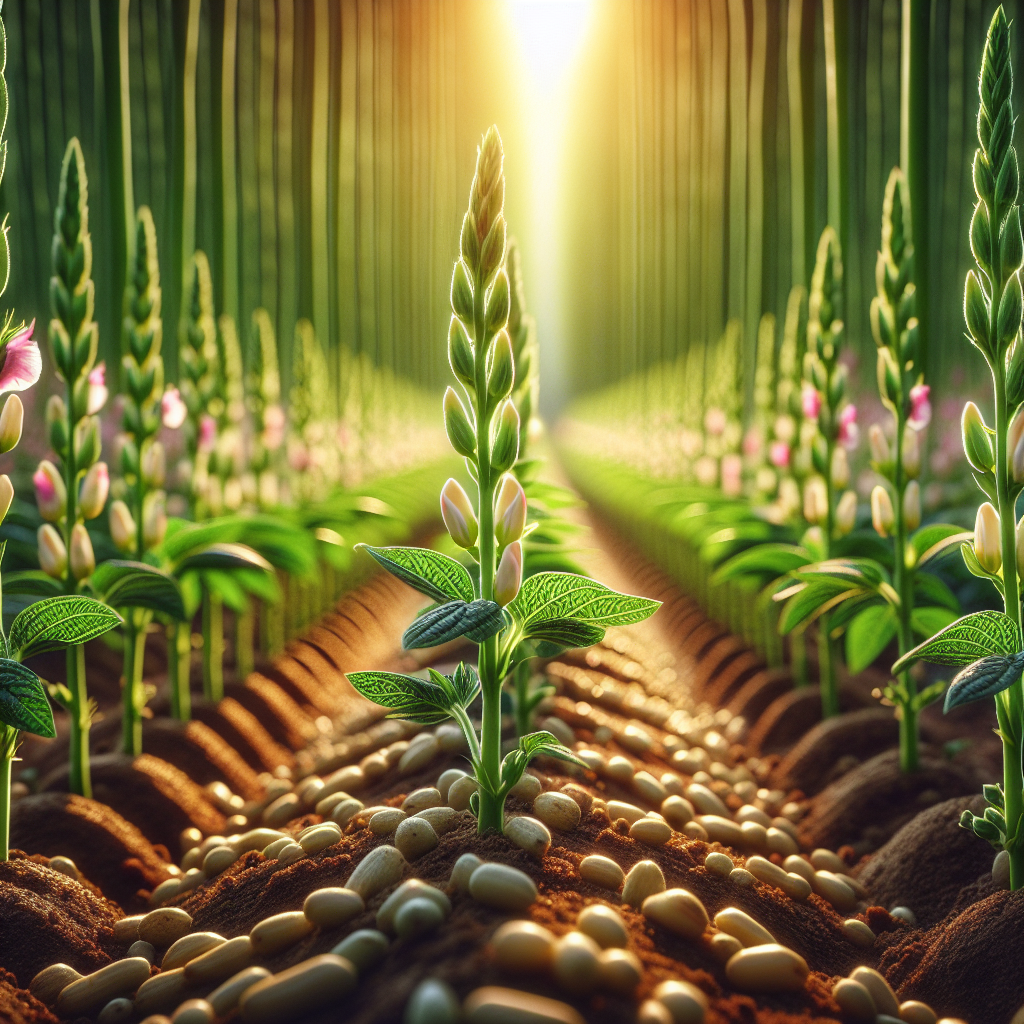
Introduction to Sesame
An ancient oilseed with roots stretching back thousands of years across Africa and South Asia, this crop remains indispensable in both subsistence and commercial agriculture because of its exceptional seed oil quality, long storage life, and ability to produce under relatively dry conditions. Its small seeds are rich in oil, protein, calcium, lignans such as sesamin and sesamolin, and are used whole, hulled, roasted, pressed for oil, or processed into pastes and confections.
From a production standpoint, it is often called a “survivor crop,” but that reputation can mislead new growers. While it tolerates heat and short dry spells better than many broadleaf annuals, high yields come only when establishment is excellent, weeds are controlled early, drainage is sharp, and rainfall or irrigation is timed to avoid prolonged saturation. In poorly drained fields, the same crop that withstands drought may fail quickly from root stress.
Sesame is especially useful in rotations where a warm-season broadleaf is needed after cereals. In diversified systems, it can follow crops such as Wheat provided volunteer grasses are controlled and the seedbed is fine and uniform. For broader fertility planning, field structure, and organic matter management, growers may also benefit from reading soil health strategies.
Botanical Profile of Sesame
This species belongs to the family Pedaliaceae and is typically grown as an annual. Plants are usually erect, ranging from about 60 cm to over 180 cm tall depending on cultivar, moisture, fertility, and planting density. The stem may be square to slightly ridged when young and becomes more rounded with age. Branching varies significantly by genotype: some cultivars are unbranched and adapted to dense planting and mechanical harvest, while others branch freely and are better suited to lower-input or hand-harvested systems.
Leaves are highly variable even on the same plant. Lower leaves may be broader and sometimes lobed, while upper leaves often become narrower and lance-shaped. Flowers are tubular, bell-like, and typically white, pink, or pale lavender. They are borne in leaf axils and are largely self-pollinated, though insect visitation can occur and modest outcrossing is possible.
The fruit is a capsule, often 2–8 cm long, divided internally into compartments holding numerous flat, oval seeds. Seed color ranges from white and cream to tan, brown, red, and black. Seed color does not always predict oil content, but market preference differs by region. White and cream seeds are commonly preferred for bakery and tahini markets, while black sesame is prized in many Asian food traditions.
A key agronomic distinction is between shattering and non-shattering types. Traditional landraces often shatter readily when capsules dry, releasing seed before or during harvest. Modern breeding has improved indehiscence in some cultivars, making harvest timing less risky. Still, even improved lines require attentive management because delayed cutting in hot, windy weather can cause heavy losses.
Rooting is usually dominated by a strong taproot with lateral branches. In loose, aerated soils, roots can penetrate deeply and help the plant endure intermittent moisture deficits. In compacted or waterlogged ground, root development is restricted, and plants become stunted, chlorotic, and more vulnerable to disease.
Soil, pH, and Climate Requirements for Sesame
The ideal soil is deep, well-drained, friable, and moderately fertile. Sandy loam to loam soils are generally preferred because they warm quickly, drain efficiently, and allow easy emergence of the tiny seed. Clay soils can be used if structure is good and surface crusting is minimized, but heavy clays with slow infiltration are risky, especially in regions with early-season storms.
Target soil pH is usually 5.5 to 7.5, with best nutrient availability commonly seen near 6.0 to 7.0. Sesame can tolerate slight alkalinity better than many vegetables, but strongly acidic soils often reduce vigor through aluminum toxicity, calcium deficiency, and poorer microbial activity. If pH falls below about 5.5, liming several months before planting is often justified.
Drainage is more critical than high fertility. Saturated soil for even 24–72 hours during early growth can result in wilting that resembles drought, followed by stem lesions, leaf yellowing, root browning, and plant collapse. The crop’s oxygen requirement in the root zone is high; it performs badly where perched water tables or compaction layers keep pore spaces full of water.
Temperature requirements are strict. Sesame is a true warm-season crop and should be planted only when soil temperatures at 5 cm depth are consistently at least 20°C, with faster, more uniform emergence closer to 25–30°C. Air temperatures below 15°C slow growth sharply, and frost can kill seedlings or damage maturing plants. The ideal growing range is roughly 25–35°C. Daytime heat above this range is tolerated if soil moisture is not excessive and the crop is otherwise healthy.
The crop needs a long, frost-free season, usually 90 to 150 days depending on variety and growing conditions. It is best adapted to semi-arid and subhumid tropical to warm temperate environments. Excessive humidity during flowering and capsule maturation raises disease pressure and can complicate harvest.
Rainfall needs are modest compared with many oilseeds, commonly around 300–600 mm over the crop cycle, but distribution matters more than totals. Moisture is most useful from sowing through establishment and again from branching to early capsule fill. Heavy rain during flowering can reduce pollinator activity, encourage foliar disease, and increase flower drop. Heavy rain near harvest can trigger regrowth, uneven ripening, and seed staining.
For irrigation scheduling, aim to keep the upper root zone lightly but consistently moist during germination, then allow the soil to cycle between irrigations without long periods of saturation. In practical terms, the top 2–3 cm should not bake into a crust during emergence. Later, the root zone can dry moderately between irrigations. If soil at 10–15 cm depth forms a weak ball in the hand that breaks apart easily, moisture is often in a suitable range. If it stays sticky, slick, and airless, irrigation is too frequent.
Step-by-Step Planting & Propagation
Propagation is by seed. Because the seed is very small, success depends more on precision than forceful seeding rates.
Choose a cultivar suited to your harvest system and climate. For hand harvest, traditional shattering types may still be grown, though risk is higher. For larger plantings, select varieties bred for more uniform maturity, reduced shattering, and consistent plant height.
Prepare a fine, firm seedbed. The surface should be level, free of clods, and lightly consolidated so seed does not fall too deeply. Sesame struggles to emerge through crusted, rough ground. Raised beds are valuable in heavier soils or rainy climates because they improve drainage and reduce seedling disease.
Control weeds before planting. Since seedlings are small and slow to dominate the canopy, stale seedbed techniques are highly effective. Irrigate lightly to germinate weeds, then terminate them shallowly before sowing.
Plant only into warm soil. Delay sowing until frost danger has passed and both soil and air temperatures are reliably warm. Planting too early often leads to patchy stands and weak seedlings that never fully recover.
Sow shallowly. Recommended seeding depth is typically 1 to 2 cm, with 0.5 to 1 cm preferred in heavy soils and up to 2 cm in lighter soils that dry quickly. Depth uniformity is critical; seed placed deeper than 2.5 cm often emerges poorly.
Space rows according to weeding and harvest method. Row spacing commonly ranges from 30 to 60 cm. Narrower rows close canopy faster and suppress weeds better, while wider rows allow mechanical cultivation. In-row spacing after thinning is often 5 to 15 cm. Final populations vary widely, but an overly dense stand can increase lodging and disease in more humid areas.
Thin promptly if broadcast or heavily seeded. Once seedlings reach a few true leaves, thin to a uniform stand. Crowded plants become tall and weak, and uneven spacing complicates harvest maturity.
Irrigate lightly after sowing if needed. Avoid heavy irrigation that causes crusting or buries seed. A gentle moisture pulse is better than a soaking event.
Transplanting is uncommon and usually uneconomical except in very small research or seed-saving plots, because seedlings resent root disturbance and direct seeding is more efficient.
Care & Maintenance regimes for Sesame
The first 3 to 5 weeks after emergence are the most important management window. During this period, the crop is vulnerable to weed competition, crusting, damping-off, and stand loss. Once plants are well established and temperatures remain warm, growth accelerates and management becomes simpler.
Water management should shift by growth stage. During germination and emergence, maintain steady surface moisture without saturation. A dry crust can trap seedlings belowground, causing a poor stand. During vegetative growth, irrigate only when the upper root zone has clearly begun to dry. Established sesame tolerates moderate water deficits better than most broadleaf annuals, but prolonged stress at flowering and early capsule set can sharply reduce yield.
Typical critical stages for water are branching, flower initiation, full bloom, and early capsule fill. If irrigation is limited, prioritize these stages rather than applying frequent light irrigations throughout the season. Stop or sharply reduce irrigation as capsules mature and lower leaves yellow. Late irrigation can delay maturity, increase disease, and reduce seed quality.
Signs of overwatering include pale green to yellow leaves despite moist soil, a slight downward curl or limpness that does not improve in the evening, stem darkening near the base, shallow rooting, and sudden wilt during warm afternoons even when the field is wet. This “wet wilt” often confuses growers into irrigating more, worsening the problem.
Nutrient needs are moderate. Sesame responds to balanced fertility but is not a heavy feeder like maize or many vegetables. Excess nitrogen encourages lush vegetative growth, delays maturity, and may increase lodging. A soil test should guide fertilizer programs, but general targets often include modest nitrogen, adequate phosphorus for root development, and sufficient potassium for stem strength and seed fill.
A practical fertility approach is:
- Apply most phosphorus and potassium before planting based on soil test.
- Apply a modest base rate of nitrogen at or before sowing.
- Top-dress remaining nitrogen at early branching or 3–5 weeks after emergence if crop color is light and rainfall or irrigation supports uptake.
Micronutrients matter in problem soils. Sulfur supports oilseed metabolism. Zinc may be limiting in calcareous soils, while boron deficiency can affect flowering and capsule set in some regions. Deficiencies should be confirmed analytically before correction.
Weed control is essential early and far less important later. Keep the field clean until plants are tall enough to shade the row zone. Two shallow cultivations or hand weedings during the first month are often decisive. Avoid deep cultivation that prunes roots and dries the profile.
Lodging risk rises with excessive nitrogen, overly dense planting, storm winds, and delayed harvest. Where lodging is a chronic issue, use shorter or more uniform cultivars, avoid late nitrogen, and maintain moderate plant populations.
Pests, Diseases & Organic Management
Sesame is often less pest-ridden than many vegetable crops, but local pressure can still be severe. Seedlings may be attacked by cutworms, grasshoppers, flea beetles, and leaf-feeding caterpillars. Later in the season, capsule borers, webworms, whiteflies, aphids, and jassids or leafhoppers may appear depending on region.
aphids and whiteflies damage plants directly by removing sap and indirectly by encouraging sooty mold on honeydew. Heavy infestations can reduce flowering and weaken seed fill. Organic management begins with avoiding excessive nitrogen, which produces soft, attractive growth. Border plantings of beneficial-attracting species such as Yarrow and trap or distractor species like Nasturtium can support predator activity in diversified systems.
For caterpillars and capsule-feeding larvae, scout twice weekly during flowering and capsule formation. Look for frass at capsule openings, webbing, bored buds, and shed flowers. Hand removal is possible in small plots; Bacillus thuringiensis products are more effective when applied against young larvae before they enter capsules.
Diseases are strongly linked to moisture and rotation history. The most important problems include damping-off, root rot, wilt complexes, Alternaria leaf spot, Cercospora leaf spot, powdery mildew, bacterial blight, and charcoal rot in hot, dry stress conditions. phyllody, caused by phytoplasma and transmitted by leafhoppers in some areas, produces green, malformed floral structures and no marketable seed.
Organic disease prevention relies on exclusion and environment management rather than rescue treatment:
- Use clean seed from healthy fields.
- Rotate 3 to 4 years away from sesame and other susceptible broadleaf hosts where disease pressure is known.
- Avoid low spots and poorly drained soils.
- Irrigate in the morning so foliage dries rapidly.
- Keep nitrogen moderate.
- Remove heavily infected residues if disease was severe.
Seed treatment with approved biologicals such as Trichoderma formulations can help suppress early seedling pathogens in some systems. Compost teas are inconsistent and should not substitute for drainage, sanitation, and rotation.
Birds can feed on drying capsules in small fields, and rodents may damage stored seed. Netting, timely harvest, and clean storage areas are the most reliable interventions.
Harvesting, Curing & Optimal Storage
Harvest timing depends heavily on cultivar. Traditional types are usually cut when the lower capsules and leaves begin to dry and yellow but before widespread capsule shatter begins. Upper capsules may still be slightly green. Plants are then tied into bundles or shocks and stood upright to complete drying so seeds finish curing inside the capsules.
Non-shattering or semi-indehiscent cultivars permit more direct harvest once most capsules have turned straw-colored and seed moisture has fallen sufficiently. In mechanized systems, uniform maturity is essential; uneven stands create major losses.
Key harvest indicators include:
- Lower leaves yellowing and dropping
- Stem color fading from lush green to pale green or straw
- Lower and middle capsules turning dry and firm
- Seeds reaching their mature color
- A rattling sound in drier capsules when shaken gently
If harvesting by hand, cut plants with a sickle or knife in the cool morning when shatter risk is lower. Bundle 10 to 20 stems and stand them upright on tarps or clean platforms in a dry, airy place protected from rain. As capsules open, seeds can be collected from beneath or by later threshing.
During curing, avoid direct wetting. Rain on cut bundles can cause mold, discoloration, and partial germination. Good airflow is more important than intense heat. Once dried, thresh gently, then winnow to remove chaff, dust, and immature seed.
Safe storage depends on dryness. For short-term storage, seed should generally be dried to about 8% moisture or lower. For longer storage in warm climates, 6% or less is safer. Seed that feels cool but not damp, flows freely, and cracks rather than crushes under firm bite pressure is often near a safe storage range, though a moisture meter is preferable for commercial handling.
Store in clean, insect-free containers or sacks in a cool, dry room with low relative humidity. Because sesame seed is oil-rich, it can go rancid if stored hot or exposed to repeated moisture cycling. Protect from rodents and insects, and avoid storing directly on concrete floors where condensation may occur.
Companion Planting for Sesame
In mixed small-farm systems, the best companions are those that either attract beneficial insects, improve field ecology, or coexist without casting heavy shade. Sesame needs full sun and dislikes crowding, so companions should be placed on borders, alternate strips, or row edges rather than allowed to overtop the crop.
Yarrow is one of the most useful companions because its umbels attract hoverflies, parasitic wasps, and other beneficial insects that help suppress aphids and small caterpillars. Thyme works well on dry borders and path edges, where its flowers support pollinators and beneficial insects without competing aggressively for water in deeper soil layers.
Nasturtium can function as a diversionary plant for sap-feeding pests in garden-scale systems, though it should be monitored so it does not become a reservoir of insects. Clover is best used as an off-season cover crop or managed living strip rather than a direct in-row companion; if allowed to compete heavily during establishment, it can reduce sesame vigor. Used thoughtfully, however, it helps protect soil structure and adds biologically fixed nitrogen for subsequent crops.
Avoid pairing sesame closely with tall, shading species or with crops requiring frequent irrigation. The crop performs best when air circulation is open, leaves dry quickly after rain or dew, and the root zone is never kept continuously wet.