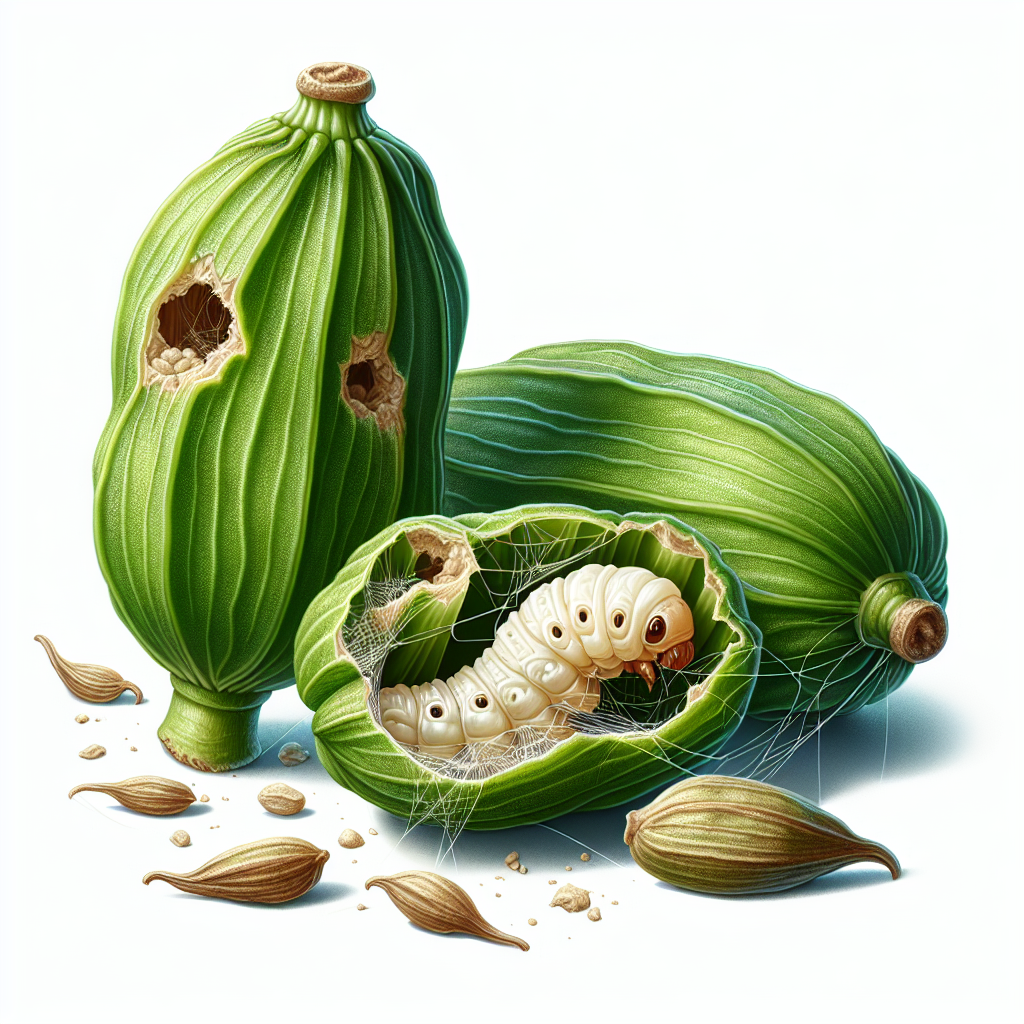
Introduction to capsule borers
Capsule borers, scientifically known as Conogethes punctiferalis (Lepidoptera: Crambidae) and related species, represent a major threat to agricultural productivity, particularly in tropical and subtropical regions. These pests are notorious for their larvae, which bore into the developing capsules, fruits, buds, and tender shoots of host plants, rendering them unsuitable for harvest. Native to Asia, capsule borers have spread widely, impacting smallholder farmers and commercial growers alike by causing up to 50-80% yield losses in severe infestations.
The adult moths are yellowish-brown with distinctive black spots on the forewings, measuring 20-30 mm in wingspan. Females lay eggs singly or in clusters on tender plant parts, hatching into creamy-white caterpillars that grow to 15-20 mm. These larvae are the primary damage agents, feeding internally and producing silken tunnels frass-filled tunnels plugged with silk and excreta. Understanding capsule borers is crucial for farmers growing susceptible crops, as timely intervention can preserve harvests. This guide provides comprehensive diagnostics, lifecycle insights, and organic management strategies optimized for sustainable farming. For related pests, see Fruit borers.
Capsule borers thrive in warm, humid climates, with multiple generations per year allowing rapid population buildups. Economic impacts are profound in spice crops like cardamom, where damaged capsules fetch low market prices. Integrated Pest Management (IPM) combining monitoring, cultural controls, and biological agents offers the most effective, eco-friendly defense. Dive deeper into Spring Pest Patrol: Organic AI Strategies to Shield Your Crops from Common Invaders for tech-enhanced scouting tips.
Identifying Symptoms & Damage
Recognizing capsule borer damage early is essential for effective control. Initial signs include small entry holes (1-2 mm) on flower buds, capsules, or young fruits, often surrounded by silk webbing and frass (insect droppings resembling sawdust). Affected parts wilt, dry up, and turn brown or black, with internal galleries visible upon dissection.
In advanced stages, entire capsules may drop prematurely, or boreholes appear on stems, leading to gummosis (oozing sap) and secondary infections from fungi like Alternaria. Larvae inside capsules feed on developing seeds, causing hollowing and weight loss—up to 70% in cardamom capsules. Differentiate from other borers by the characteristic frass plugs and the presence of live larvae (pinkish with dark heads) within.
Scout weekly during flowering and fruiting: shake plants over white paper to dislodge larvae or check 20-30 capsules per plant. Damage thresholds vary: 5-10% infested capsules warrant action in commercial fields. Symptoms mimic caterpillars or leaf-feeding caterpillars, but capsule borers target enclosed structures specifically. Use magnification for eggs (flat, yellowish) on undersides.
Yield impacts: In cotton, bored bolls fail to open properly; in soybean, pod damage reduces seed quality. Photosynthetic loss from shoot boring stunts growth. Accurate ID prevents misapplication of controls, saving costs.
Lifecycle and Progression of capsule borers
Capsule borers complete 4-6 generations annually, depending on temperature (optimum 25-30°C). Adults emerge at dusk, mate, and females oviposit 100-200 eggs over 3-5 days. Eggs hatch in 3-4 days into neonates that bore immediately.
Larval stage (15-25 days) has 5 instars: early ones mine leaves/shoots, later bore capsules. Full-grown larvae (20 mm) pupate in silken cocoons on leaves or soil, lasting 7-10 days. Total cycle: 30-45 days. Overwinter as diapausing pupae or larvae in crop debris.
Peak activity aligns with host flowering: monitor using pheromone traps (1-2 per hectare) capturing males for timing sprays/Bt applications. Progression: Eggs → Young larvae (surface feeders) → Mature borers (internal) → Pupae → Adults. Disrupt at larval stage for best control. High humidity prolongs larval survival; drought shortens cycles.
Environmental Triggers & Risk Factors
Warm temperatures (above 20°C) and humidity (>70% RH) accelerate development, with monsoons triggering outbreaks. Poor field sanitation—leaving infested debris—harbors pupae. Monocropping susceptible varieties heightens risk; intercropping with marigold repels via allelochemicals.
Soil type influences: heavy clays retain moisture favoring pupation. Nitrogen excess promotes tender growth, preferred by neonates. Nearby alternate hosts like maize or sunflower sustain populations. Climate change extends seasons, increasing generations. Risk peaks post-rainy season; scout after irrigation.
Weedy fields shelter adults; dense canopies trap humidity. Assess farm history: prior infestations signal vigilance.
Organic Control & Treatment Plans
Organic management emphasizes IPM: prevention first, then biological/cultural tactics.
Cultural Controls:
- Remove and destroy infested capsules weekly (handpicking >80% efficacy small scale).
- Deep plow post-harvest to expose pupae to predators/sun.
- Plant resistant varieties (e.g., IISR Vijetha cardamom).
- Trap crops like castor border rows divert borers.
Biological Controls:
- Release Trichogramma chilonis (egg parasitoid) @ 50,000/ha, 2-3 times during peak egglaying.
- Apply Bacillus thuringiensis (Bt) kurstaki (2-5 g/L) at young larval stage; 70-90% mortality.
- Conserve predators: birds, spiders, Telenomus wasps.
Botanicals:
- Neem oil (5 ml/L + soap) or azadirachtin 0.03% EC (2-3 ml/L), 7-10 day intervals; disrupts hormones.
- NSKE (5%) or garlic-chili extracts repel oviposition.
Mechanical: Pheromone traps (10-15/ha) + light traps for mass trapping.
Integrated Plan: Scout → Threshold (5% infestation) → Bt/neem → Release parasitoids → Monitor. Rotate with non-hosts like legumes. Avoid broad-spectrum sprays preserving beneficials. Efficacy: 85-95% with compliance.
Preventing capsule borers in the Future
Long-term prevention builds resilient systems:
- Crop rotation: 2-3 years away from hosts.
- Sanitation: Burn debris, weed borders.
- Barrier crops: Plant nasturtium or mustard.
- Timing: Synchronize planting to avoid peak moth flights.
- Mulching suppresses soil pupae.
- Enhance biodiversity: Flower strips for predators.
- Resistant cultivars + certified seeds.
- Regular monitoring apps for early warning.
Annual plans reduce incidence 70%. Combine with soil health practices from Soil Health Mastery: 5 Proven Strategies for Small Farms to Build Fertile Ground Without Breaking the Bank.
Crops Most Affected by capsule borers
Capsule borers attack 50+ hosts, prioritizing Solanaceae, Fabaceae, Malvaceae:
- Cardamom (major): 40-60% loss in capsules.
- Cotton: Boll damage reduces lint.
- Soybeans ([/wiki/soybeans]): Pod boring.
- Chili Pepper ([/wiki/chili-pepper]): Fruit/flower.
- Tomato ([/wiki/tomato]), eggplant, maize.
- Others: Guava, custard apple, mango ([/wiki/mango]).
Tropical focus; cardamom worst-hit in India/Kerala.