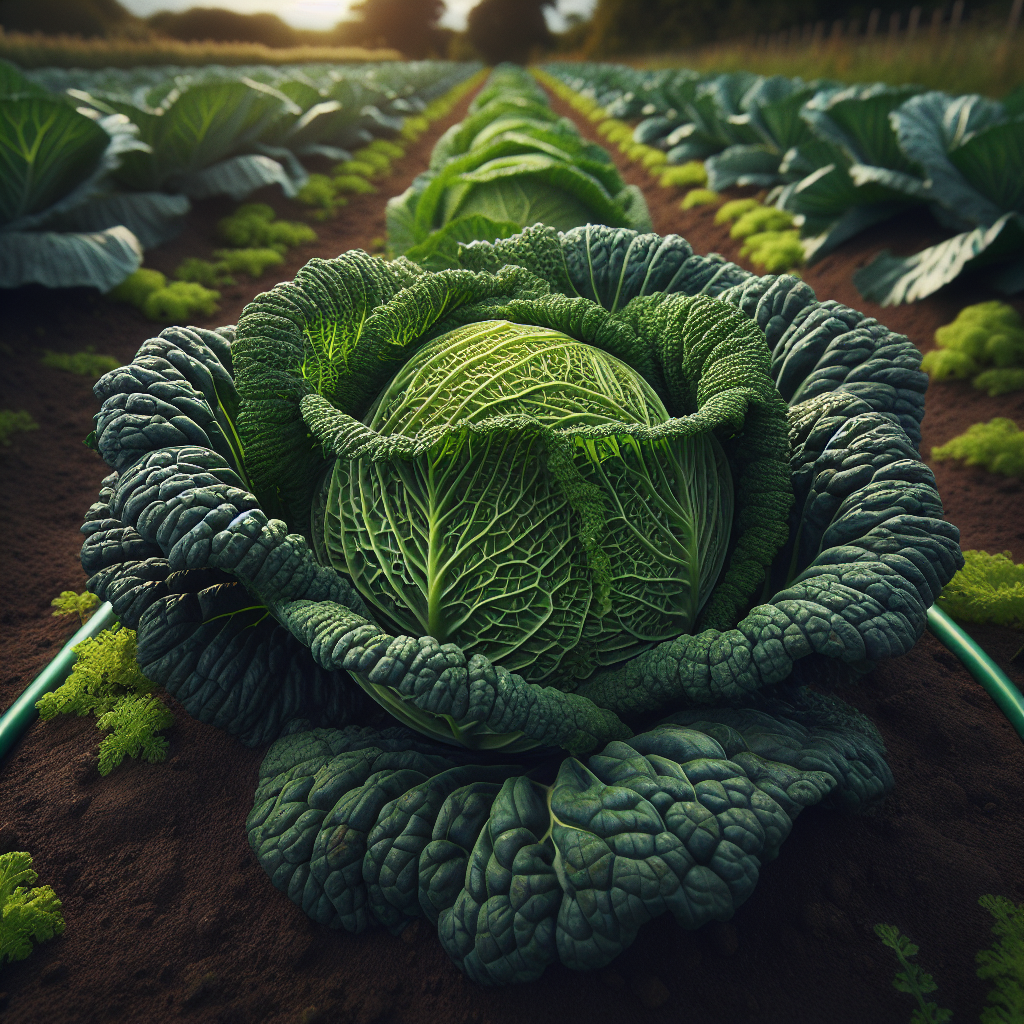
Introduction to Savoy Cabbage
Distinguished by its beautifully blistered, crinkled foliage and tender texture, this heirloom-type cabbage belongs to the capitata group of Brassica crops but is botanically classified as Brassica oleracea var. sabauda. It likely originated in the Savoy region straddling parts of modern France and Italy, and it has long been favored in European kitchen gardens for its delicate sweetness, excellent winter hardiness, and culinary versatility.
Compared with standard green heading cabbage, savoy types are typically more cold tolerant, less dense internally, and more flexible in the kitchen because the leaves soften readily when cooked yet remain pleasantly crisp raw. Many growers also value savoy for its field performance in autumn and early winter, when cool nights improve flavor by slowing growth and concentrating sugars. In regions with mild winters, it can serve as a main-season fall crop and hold in the field after maturity better than many warm-season vegetables.
From a production standpoint, savoy cabbage is best treated as a precision cool-season crop. The highest-quality heads develop when plants grow rapidly during the vegetative phase, then finish during consistently cool weather. Heat, water stress, and erratic fertility can lead to loose heads, tipburn, bitter flavor, splitting, or premature bolting. When properly managed, however, savoy is one of the most rewarding brassicas for market gardens, diversified farms, and serious home growers.
For broader brassica context, see our Cabbage guide. If you are planning mixed fall beds, the fall companion planting guide is also useful.
Botanical Profile of Savoy Cabbage
This crop is a biennial grown as an annual for its compact leafy head. In its first year, it forms a short stem with a rosette of broad leaves that gradually overlap and tighten into a rounded to slightly flattened head. If left to overwinter and exposed to sufficient vernalization, it enters the reproductive stage in year two, sending up a flowering stalk bearing yellow four-petaled flowers typical of the Brassicaceae family.
Savoy leaves are the defining morphological trait. They are strongly blistered or puckered, with pronounced venation and a soft, quilted appearance. Outer leaves are usually medium to dark green, while interior leaves range from pale green to yellow-green. Because of their textured surface and thinner lamina compared with some storage cabbages, the leaves are more delicate in handling but often more tender on the plate.
Typical maturity ranges from 75 to 110 days from transplant, depending on cultivar and season. Early cultivars may produce 1 to 2 kg heads, while main-season and storage selections can exceed 2.5 kg under fertile conditions. Common cultivar groups include early compact savoys for spring or short fall windows and larger drumhead or semi-round savoys for cool autumn finishing. Notable traits breeders select for include uniform head formation, cold tolerance, resistance to black rot or fusarium yellows, reduced splitting, and improved field holding.
Like other brassicas, root architecture is relatively shallow to moderate rather than deeply penetrating, with most active feeding roots concentrated in the top 20 to 30 cm of soil. That makes the crop highly responsive to surface moisture fluctuations, top-dressed fertility, and soil compaction. It also explains why even brief drought episodes can reduce head density or trigger physiological stress.
Soil, pH, and Climate Requirements for Savoy Cabbage
Best performance comes from deep, fertile, well-structured loam or clay-loam rich in organic matter. The ideal soil should hold moisture consistently without becoming waterlogged. A friable structure is essential: if the root zone crusts, puddles, or compacts easily after rain, head development slows and nutrient uptake becomes uneven.
The optimal pH range is 6.5 to 7.2. Savoy can tolerate slightly lower pH, but once soil drops below about 6.2, the risk of clubroot rises sharply and calcium availability may become less reliable. If a soil test shows acidity, apply agricultural lime well before planting, ideally several months ahead so pH can stabilize. Avoid over-liming above roughly 7.4, as this may reduce micronutrient availability, especially boron and manganese.
Nutritionally, this is a heavy feeder with high demand for nitrogen during vegetative growth, balanced phosphorus for root establishment, and strong potassium support for head quality, stress tolerance, and storage life. Calcium is crucial to prevent internal tipburn, and boron is needed in small but important amounts to reduce disorders such as hollow stem or internal browning. A professional approach is to rely on a pre-plant soil test rather than generic fertilization.
Climate matters enormously. Savoy cabbage performs best where daytime temperatures stay between 15 and 21°C and nights remain cool, ideally 7 to 13°C. Plants can survive light to moderate frosts once established, and mature heads often improve in flavor after repeated chilly nights. Short dips below freezing usually do little harm if plants were hardened gradually, though severe or prolonged freezes can damage wrapper leaves and reduce marketability.
Heat is the major limiting factor. Sustained temperatures above 27°C can slow growth, toughen leaves, encourage pests, and prevent proper heading. High heat during early development may also induce bolting in seedlings exposed to stress, especially if cold snaps were followed by rapid warming. In warm climates, schedule production for autumn through winter rather than spring into summer.
Soil moisture should remain evenly moist in the top 15 to 20 cm, roughly comparable to 60 to 80% of field capacity. In practical terms, a handful of soil squeezed from the root zone should feel cool and hold together lightly without releasing free water. If the soil is dusty at 5 cm depth by midday, plants are already under mild stress. If it feels sticky, smells sour, or stays saturated for more than 24 to 48 hours after irrigation, roots are being oxygen-starved. Overwatered plants often show dull blue-green leaves, slowed growth, yellowing lower foliage, and heightened disease pressure.
Step-by-Step Planting & Propagation
Propagation is almost always by seed. Direct sowing is possible in long, cool seasons, but transplanting is preferred for uniform spacing, reduced thinning labor, and better early weed control.
- Start seeds 4 to 6 weeks before the intended transplant date. Sow 0.5 to 1 cm deep in sterile seed-starting mix or plug trays.
- Maintain germination temperatures near 18 to 24°C. Seed usually emerges in 4 to 10 days.
- After emergence, reduce temperatures to about 12 to 18°C with strong light to produce sturdy, compact seedlings rather than elongated stems.
- Keep seedlings evenly moist but never saturated. Excess moisture in trays encourages damping-off and weak root systems.
- Begin light feeding after the first true leaves appear, using a dilute balanced fertilizer or a program based on soluble calcium nitrate plus balanced nutrients.
- Harden plants for 7 to 10 days before transplanting by gradually exposing them to outdoor conditions, cooler nights, and slightly reduced watering.
Transplant when seedlings have 4 to 6 true leaves and stocky stems, usually 10 to 15 cm tall. Avoid using oversized, root-bound transplants, as they establish slowly and may form smaller heads.
Spacing depends on target head size. For compact fresh-market heads, use 30 to 40 cm between plants in rows 45 to 60 cm apart. For larger main-crop savoys, space 45 to 60 cm between plants and 60 to 75 cm between rows. Tight spacing increases total yield per area but often reduces individual head size and airflow, which can elevate foliar disease risk.
Prepare beds thoroughly before transplanting. Incorporate well-finished compost at moderate rates if organic matter is low, but avoid raw manure immediately before planting because it can promote excessive soft growth and food safety concerns. Form raised beds in heavy soils or rainy climates to improve drainage and reduce root stress.
Transplant on a cloudy day or in late afternoon whenever possible. Set seedlings slightly deeper than they were in trays, firm soil gently around the root ball, and irrigate immediately to eliminate air pockets. If flea beetles, root maggots, or cabbage worms are common, install insect netting or floating row cover immediately after planting.
For succession planting, stagger sowings every 2 to 3 weeks during the local cool-season planting window. This is especially useful for growers aiming for extended harvest rather than one large flush.
Care & Maintenance regimes for Savoy Cabbage
Uniform growth is the central principle. Any interruption from drought, nutrient deficiency, compaction, or pest injury can reduce head quality.
Water deeply and consistently, aiming for about 25 to 40 mm per week from rain or irrigation under moderate conditions, and more in sandy soils or windy weather. During active head formation, moisture demand rises. Drip irrigation is preferred because it maintains steady root-zone moisture while keeping foliage dry. If overhead irrigation must be used, water early in the day so leaves dry quickly.
Signs of underwatering include midday wilting that persists into evening, slowed leaf expansion, tougher outer leaves, and heads that remain loose or undersized. Severe moisture fluctuations often cause sudden splitting when dry plants receive heavy irrigation or rainfall. Signs of overwatering include persistently wet soil, lower leaf yellowing, stunting, sour-smelling root zones, and increased black rot or soft rot problems.
Mulching with clean straw, chopped leaves, or composted organic matter helps buffer soil moisture and suppress weeds, but keep mulch a few centimeters away from the stem base to avoid rot and sheltering slugs.
Fertility should be staged. Apply most phosphorus and potassium pre-plant according to soil test. Split nitrogen applications are more efficient: one portion at bed preparation, a second side-dress 2 to 3 weeks after transplanting, and another at early head initiation if plants appear pale or growth is slowing. Excess late nitrogen can produce overly lush foliage and weaker storage quality, so taper applications once heads are filling well.
Watch carefully for calcium and boron issues. Calcium deficiency often appears as internal tipburn rather than obvious outer symptoms, especially during rapid growth in hot or erratic moisture conditions. Boron deficiency may lead to deformed growing points, corky tissues, or internal breakdown. These are best prevented through balanced soil management, not heavy emergency spraying.
Weed control is most important in the first month after transplanting, before the canopy closes. Shallow cultivation is preferable because roots are concentrated near the surface. Deep hoeing can prune roots and set plants back just when they should be bulking rapidly.
If heads become nearly mature before market or harvest and heavy rain is expected, some growers slightly twist plants or sever a few outer roots with a spade to slow water uptake and reduce splitting. This should be done cautiously and only near maturity.
Pests, Diseases & Organic Management
As a brassica, this crop attracts a predictable set of insects and pathogens. Prevention through exclusion, rotation, sanitation, and crop timing is more effective than reactive spraying.
The most common insect pests are imported cabbageworm, cabbage looper, diamondback moth, flea beetles, aphids, cutworms, and cabbage root maggots. Caterpillar feeding creates ragged holes and contaminates heads with frass. flea beetles are most damaging on young transplants, peppering leaves with many small shot-holes. aphids often hide in crinkled inner leaves, where they are difficult to wash out after harvest.
Organic management begins with floating row covers or insect mesh installed immediately after transplanting and sealed at the edges. This single practice can drastically reduce early damage from moths, flea beetles, and root fly adults. Rotate brassicas at least 3 years, preferably 4, away from the same ground to disrupt disease and root-maggot cycles.
Scout weekly, and twice weekly in warm spells. Check leaf undersides for egg clusters and small larvae. Hand removal works in small plantings. For larger areas, Bacillus thuringiensis var. kurstaki is highly effective against young caterpillars if applied before heavy feeding begins. Spinosad can also be effective but should be used carefully to minimize impact on beneficial insects.
aphids can often be suppressed with strong water sprays early, insecticidal soap, or neem-based products, but dense heads make coverage difficult. Avoid excessive nitrogen, which encourages lush aphid-prone growth. Encourage hoverflies, parasitic wasps, and lady beetles by maintaining flowering insectary borders nearby.
Major diseases include clubroot, black rot, downy mildew, alternaria leaf spot, fusarium yellows, wirestem, damping-off, and bacterial soft rot. clubroot is among the most destructive in acidic soils; infected plants wilt in heat despite moist soil, then reveal swollen, distorted roots. The best control is prevention: maintain pH near neutral, rotate out of brassicas for several years, improve drainage, and never move contaminated soil on tools or boots.
black rot causes yellow V-shaped lesions from leaf margins inward and darkened veins. It spreads easily in warm, wet conditions and can arrive on infected seed or transplants. Use clean seed, avoid overhead irrigation when possible, and remove crop residues promptly after harvest. downy mildew and alternaria are favored by prolonged leaf wetness and crowded canopies, so spacing and airflow matter.
Sanitation is critical. Remove severely infected plants instead of composting them unless composting temperatures are reliably high. Clean harvest knives, trays, and wash stations regularly. Avoid working in the crop when foliage is wet, since this spreads bacteria and fungal spores.
Harvesting, Curing & Optimal Storage
Harvest timing depends on cultivar, market preference, and season. Heads should feel firm when squeezed gently, though savoy naturally remains somewhat less rock-hard than many smooth green cabbages. Outer leaves should be well colored and healthy, and the head should have reached its expected size without beginning to split.
Use a sharp knife to cut the stem just below the head, leaving 2 to 4 wrapper leaves attached for protection during handling. Harvest during the cool part of the day whenever possible. In warm conditions, remove field heat quickly by moving heads into shade and then into cold storage.
Savoy does not require curing in the way onions, garlic, or winter squash do, but it benefits from brief drying of surface moisture before packing. Never store heads with free water trapped between leaves, as this encourages bacterial soft rot. If washing is necessary, dry thoroughly and cool promptly.
For best storage, maintain 0 to 1°C with 95 to 100% relative humidity. Under ideal conditions, sound heads can keep for 2 to 4 months, sometimes longer depending on cultivar and harvest maturity. Lower humidity leads to wilting and loss of crispness; higher temperatures speed yellowing, respiration, and decay. Good air circulation is important, but avoid direct airflow that desiccates wrapper leaves.
Store only undamaged, disease-free heads. Any with insect contamination, cracked stems, bruises, or soft spots should be used first. Ethylene sensitivity is moderate, so keep cabbage away from high-ethylene fruits when possible to preserve quality. In home storage, perforated bags in a very cold refrigerator work reasonably well for shorter periods.
Field storage is possible in mild climates. Mature heads can often stand through light frosts and short cold spells, but quality declines if freeze-thaw cycles repeatedly affect the wrapper leaves. In very cold regions, harvest before severe hard freezes unless using season extension structures.
Companion Planting for Savoy Cabbage
Useful companions are those that either deter pests, improve spatial efficiency, or attract beneficial insects without directly competing for the same root zone and nutrient profile. Strong choices include Onion, Garlic, Thyme, and Nasturtium.
Alliums such as onion and garlic are often used along brassica bed edges because their scent may help confuse some pests, and their upright growth habit makes efficient use of space. Thyme serves as a low-growing aromatic border that can attract beneficial insects when flowering while leaving the cabbage canopy largely undisturbed. Nasturtium is particularly useful as a trap and distraction plant in diversified gardens, drawing aphids and some caterpillar activity away from the main crop while also supporting pollinators and predatory insects.
Avoid pairing with heavy-feeding brassicas in tight spacing if your goal is maximum head size, because direct competition from crops like broccoli or cauliflower can reduce uniformity unless fertility and irrigation are excellent. Also be careful with sprawling companions that trap humidity around the heads, since reduced airflow increases disease pressure.
In practical field design, place companions on borders, alternating strips, or bed ends rather than crowding them directly between every plant. The most successful companion systems for this crop still prioritize spacing, airflow, scouting access, and easy harvest. Companion planting should support good agronomy, not replace it.