Introduction to Peanut (Virginia Jumbo)
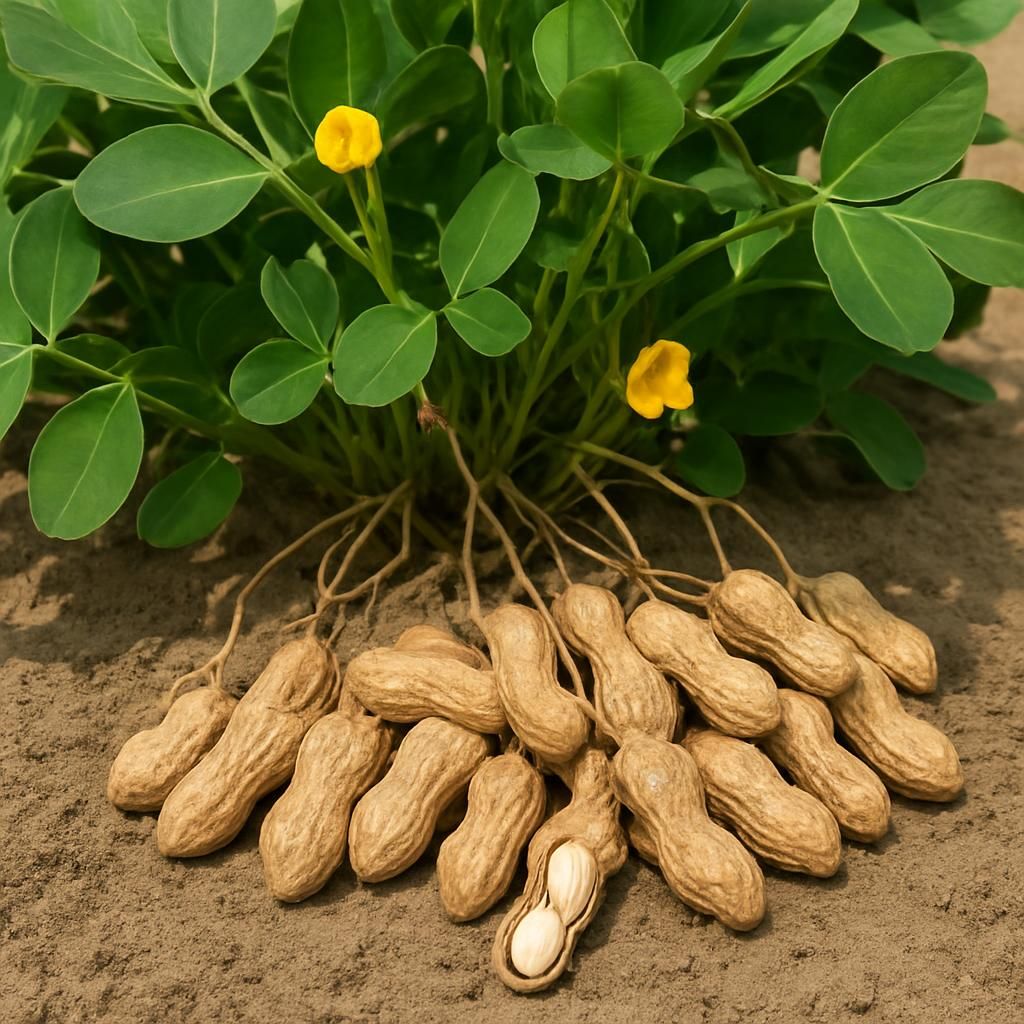
Virginia Jumbo peanuts (Arachis hypogaea) represent one of the most valuable large-kernel varieties grown for both fresh-market and processing industries. Known for their extra-large pods and bold, nutty flavor, these peanuts command premium prices in snack, confectionery, and seed markets. Virginia-type peanuts differ from Spanish and runner types by producing fewer but significantly larger pods, often with two to three seeds per pod. The variety thrives in well-drained sandy loam soils and requires a long, warm growing season typical of the southeastern and southwestern United States. Growers appreciate Virginia Jumbo for its relatively high shelling percentage and strong market demand.
Botanical Profile of Peanut (Virginia Jumbo)
Virginia Jumbo peanuts belong to the Fabaceae family and exhibit a unique geocarpic reproductive habit where flowers develop above ground while pods mature below the soil surface. The plant forms a low, spreading bush reaching 12–18 inches in height with a 24–36 inch spread. Leaves are pinnately compound with four leaflets, and the stems are typically hairy. Flowers are yellow-orange and self-pollinating, appearing approximately 30–40 days after planting. After fertilization, the peg (elongated ovary) penetrates the soil to form pods. Virginia Jumbo pods are notably large, often exceeding 1.5 inches in length, with thick shells and two to three large, oblong kernels. The kernels possess a high oil content (approximately 48–52%) and a rich flavor profile favored by roasters and snack manufacturers.
Soil, pH, and Climate Requirements for Peanut (Virginia Jumbo)
Virginia Jumbo peanuts demand well-drained, sandy loam or loamy sand soils with good aeration to allow peg penetration and pod development. Heavy clay soils restrict pod expansion and increase disease pressure. The crop performs best at soil pH 6.0–6.5. Ideal conditions are summarized below:
| Parameter | Ideal Range/Value | Notes |
|---|---|---|
| Soil Type | Sandy loam to loamy sand | Excellent drainage essential |
| Soil pH | 6.0–6.5 | Lime if below 5.8 |
| Soil Temperature | 65–70°F (18–21°C) at planting | Minimum 55°F (13°C) for germination |
| Air Temperature | 70–90°F (21–32°C) daytime | Frost sensitive at all growth stages |
| Growing Season Length | 140–160 frost-free days | Required for full pod maturity |
| Annual Rainfall | 20–40 inches (500–1000 mm) | Supplemental irrigation often needed |
| Elevation | Below 3,000 ft (900 m) | Higher elevations shorten season |
Step-by-Step Planting & Propagation
- Site Selection & Preparation: Choose fields with at least three years since the last peanut crop and excellent drainage. Perform deep tillage (8–10 inches) followed by disking to create a fine, level seedbed. Test soil and apply lime if pH is below 5.8.
- Seed Selection & Treatment: Use certified, treated Virginia Jumbo seed with at least 80% germination. Inoculate with Bradyrhizobium specific to peanuts if the field has no recent peanut history.
- Planting Window: Plant when soil temperature at 4-inch depth reaches a consistent 65°F (18°C), typically mid-April to early May in the Southeast.
- Planting Depth & Spacing: Sow seeds 1.5–2 inches deep. Use 36–38 inch row spacing and in-row spacing of 5–7 inches for Virginia Jumbo to allow adequate pod room.
- Seeding Rate: Target 4–5 seeds per foot of row (approximately 110–130 lb/acre depending on seed size).
- Irrigation at Planting: Apply 0.5–0.75 inches of water immediately after planting to ensure uniform emergence.
Care & Maintenance regimes for Peanut (Virginia Jumbo)
Virginia Jumbo peanuts require careful attention to moisture, fertility, and canopy management. The following table outlines recommended schedules:
| Growth Stage | Irrigation Frequency | Fertilizer Application | Pruning / Canopy Management |
|---|---|---|---|
| Pre-plant | None | 0-40-80 (N-P-K) + 0.5 lb boron/acre if soil test low | None |
| Emergence to Flowering (0–40 DAP) | 0.75–1.0 inch/week if rainfall insufficient | Side-dress 20–30 lb N at 30 DAP if deficiency symptoms appear | Scout for weeds; cultivate between rows |
| Flowering & Pegging (40–80 DAP) | Maintain 1.0–1.25 inches/week; avoid water stress | Foliar calcium (as gypsum) at 60 DAP (500–800 lb/acre) | Avoid excessive nitrogen; monitor for lodging |
| Pod Fill (80–120 DAP) | 1.25–1.5 inches/week; critical period | No additional N; maintain potassium if tissue tests low | Light cultivation only; cease by 90 DAP |
| Maturity (120–150 DAP) | Reduce to 0.5 inch/week 2 weeks before harvest | None | None |
Pests, Diseases & Organic Management
Major insect pests include cutworms, thrips, leafhoppers, and pod borers. Common diseases are leaf spot diseases, southern blight, root rot, and aflatoxin contamination. Implement a 3–4 year rotation with non-host crops such as corn, cotton, or wheat. Use resistant varieties when available and apply approved organic fungicides such as copper hydroxide or Bacillus subtilis at first sign of leaf spot. Beneficial nematodes and predatory beetles help suppress soil pests. Maintain field sanitation by removing volunteer plants and crop debris after harvest.
Harvesting, Curing & Optimal Storage
Virginia Jumbo peanuts reach maturity when 70–80% of pods show darkened inner hull color and kernels are firm. Use a digger-shaker-inverter to lift plants and invert windrows for rapid drying. Allow pods to field-cure for 3–7 days until moisture drops to 18–20%. Complete curing in forced-air dryers at 90–95°F (32–35°C) until kernel moisture reaches 10%. Store in breathable bags or bulk bins at 35–40°F (2–4°C) and 60–70% relative humidity. Monitor regularly for insect activity and maintain moisture below 9% to prevent mold and aflatoxin development.
Companion Planting for Peanut (Virginia Jumbo)
Peanuts fix atmospheric nitrogen and pair well with nitrogen-demanding crops. Recommended companions include corn, squash, and cucumber. Aromatic herbs such as thyme and rosemary help repel insect pests. Avoid planting near onion or garlic families, which can inhibit peanut growth. Interplanting with cowpeas or mung bean further enhances soil nitrogen and breaks pest cycles. For more companion strategies, see Summer Companion Planting: 10 Organic Pairings to Boost Small Farm Resilience.