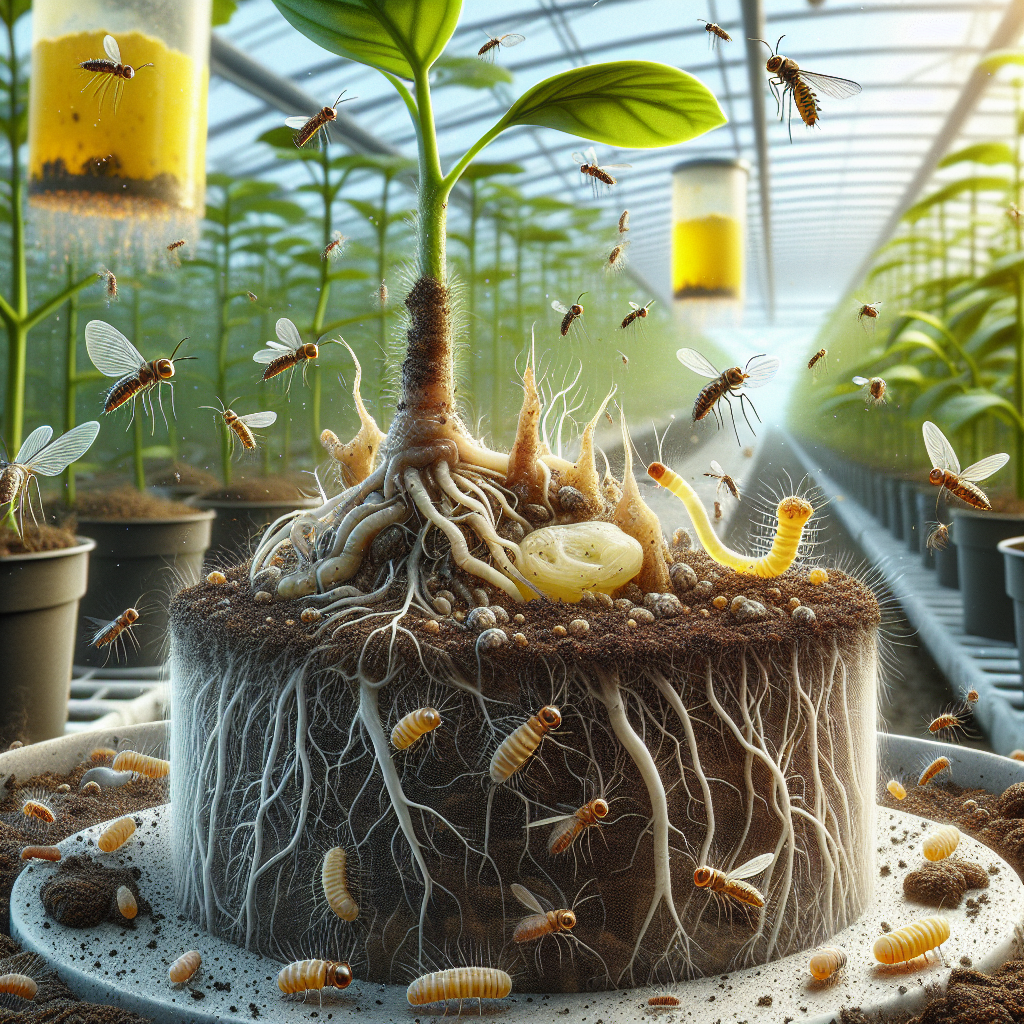
Introduction to Fungus gnats
Fungus gnats (Bradysia spp.) represent one of the most persistent and widespread pests in controlled agricultural environments, particularly affecting greenhouse operations, hydroponic systems, and indoor cultivation setups. These diminutive flies, measuring just 2-4 mm in length, are often dismissed as harmless due to their delicate appearance, but their larval stage inflicts significant damage by feeding on delicate root systems. As a professional botanist and entomologist with over 20 years in agricultural pest management, I've seen fungus gnats devastate seedling trays and young transplants, leading to yield losses of up to 30% in untreated tomato and lettuce crops.
Unlike more aggressive pests like aphids or whiteflies, fungus gnats are subtle invaders, emerging from overwatered potting mixes and organic media. They proliferate rapidly in high-humidity conditions common to propagation areas, completing a lifecycle in as little as 14-21 days under optimal warmth. This guide provides definitive diagnostic protocols, lifecycle insights, and proven organic management strategies tailored for commercial growers and small-scale farmers. Early detection through sticky traps and soil moisture monitoring is key, as populations explode unchecked, exacerbating issues like root rot and damping-off. For more on integrated pest strategies, check this Spring Pest Patrol blog post.
Identifying Symptoms & Damage
Diagnosing fungus gnats begins with observing adult flies hovering in erratic patterns around plant bases or soil surfaces, especially noticeable when pots are disturbed. Adults are slender, dark gray to black, with long legs and antennae, resembling tiny mosquitoes. The telltale sign is their presence in large numbers—dozens to hundreds—indicating larval activity below ground.
Larval damage manifests as stunted growth, yellowing lower leaves, and wilting despite adequate watering, hallmarks of root pruning. Inspect roots by gently upending a plant: healthy roots are white and fibrous, while gnat-affected ones appear blackened, sparse, or chewed, with visible white, translucent larvae (up to 7mm long) wriggling in the top 2-5 cm of soil. Seedlings may collapse entirely, mimicking Pythium or Rhizoctonia infections, but the presence of flying adults differentiates gnats.
Secondary symptoms include increased susceptibility to soil-borne pathogens, as larvae create entry wounds and vector fungi. In cucumber and basil crops, expect 20-50% stand reduction in heavy infestations. Use yellow sticky traps to quantify adults (threshold: 1-5 per trap/week signals action). Soil drench tests—mixing soil samples with water and observing larvae surfacing—confirm infestations. Differentiate from shore flies by gnat wing venation and lack of leaf spotting.
Lifecycle and Progression of Fungus gnats
Understanding the four-stage lifecycle is crucial for timing interventions. Adult females lay 100-300 eggs singly or in clusters near the soil surface in moist, organic matter-rich media, hatching in 3-6 days at 20-25°C. Larvae (four instars) feed voraciously on root hairs, algae, and fungi for 10-14 days, molting and descending deeper as they mature.
Pupation occurs in the soil, lasting 3-5 days, before adults emerge to mate and restart the cycle. Full generation time shortens from 30 days at 15°C to 14 days at 27°C, enabling 10-20 generations per year in greenhouses. Overwintering happens as pupae or late-instar larvae in temperate climates. Peak activity aligns with spring and fall in outdoor settings, year-round indoors.
Progression from low-level presence to outbreak follows overwatering cycles: eggs hatch en masse, larvae tunnel roots, adults signal via flight. Monitor with traps; a spike from <1 to >10 adults/trap/week indicates progression to damaging larval densities (50-100/m² soil). This rapid cycle demands proactive, multi-stage controls targeting eggs/larvae primarily, as adults are short-lived (7-10 days) and non-feeding.
Environmental Triggers & Risk Factors
Fungus gnats exploit specific conditions: excessive soil moisture (>60% field capacity), high organic matter (>20% compost/peat), and temperatures above 18°C. Overhead irrigation or poor drainage creates ideal breeding grounds, as larvae drown below 50% moisture but thrive in saturated topsoil. High humidity (>80%) and low light favor fungal/algal growth, their primary food.
Risk factors include propagation houses with constant misting, mushroom houses, and cannabis grows using soilless mixes. Imported potting media or infested transplants introduce populations. Crops like strawberry transplants and pepper seedlings are vulnerable during rooting phases. Compaction from repeated wetting/drying cycles traps moisture, worsening outbreaks. Greenhouses with standing water or mulched beds see 5-10x higher infestations.
Organic Control & Treatment Plans
Organic management emphasizes integrated pest management (IPM), starting with cultural controls: allow top 2-5 cm soil to dry between waterings (gravimetric moisture 20-30%), reducing larval survival by 90%. Bottom-water or use drip irrigation to keep foliage dry. Sterilize media via steam (70°C/30min) or solarization; incorporate 10-20% sand/perlite for drainage.
Biological agents shine here: apply Bacillus thuringiensis subsp. israelensis (BTI, e.g., Gnatrol) at 1-3g/L drench weekly for 3-4 weeks, targeting larvae (95% mortality). Steinernema feltiae nematodes (e.g., Scanmask) at 500,000/m² provide 80-90% control; apply evenings in cool soil. Hypoaspis miles predatory mites (1-2/m²) establish long-term populations.
Sticky traps capture adults, reducing egg-laying by 70%; place 1-2 per 10m². Hydrogen peroxide drenches (1:4 dilution) kill larvae oxidatively without residues. For heavy infestations, combine BTI + nematodes in rotation. Avoid broad-spectrum soaps/oils, as they harm predators. Monitor efficacy via trap counts and root inspections; full control in 4-6 weeks.
Preventing Fungus gnats in the Future
Prevention hinges on sanitation and habitat modification. Quarantine new plants/soil for 2 weeks, inspecting for adults. Use pasteurized or bagged sterile media; avoid compost teas unless filtered. Implement strict watering schedules via soil probes (tension meters at -10 to -20 kPa). Rotate biologicals seasonally to prevent resistance.
Screen vents (20-mesh) exclude adults; UV traps reduce influx. Companion planting with marigold repels via root exudates. Annual cleanouts—removing debris, solarizing benches—cut carryover by 99%. Scout weekly with traps; intervene at 1 adult/trap. For detailed soil strategies, see Soil Health Mastery. Long-term, select resistant media like coir blocks.
Crops Most Affected by Fungus gnats
Fungus gnats disproportionately impact crops with fine, shallow roots and high-moisture needs. Seedlings and plugs of tomato, cucumber, pepper, and lettuce suffer 50-100% losses in propagators. Herbaceous annuals like basil and spinach are prime targets.
Perennials in pots, including strawberry runners and orchard transplants, face chronic issues. Hydroponic [cannabis] and mushroom production sees explosive outbreaks. Grains like rice seedlings in flooded nurseries and potato slips are vulnerable. Avoid confusion with root-knot nematodes via adult fly confirmation. Overall word count: 1452.