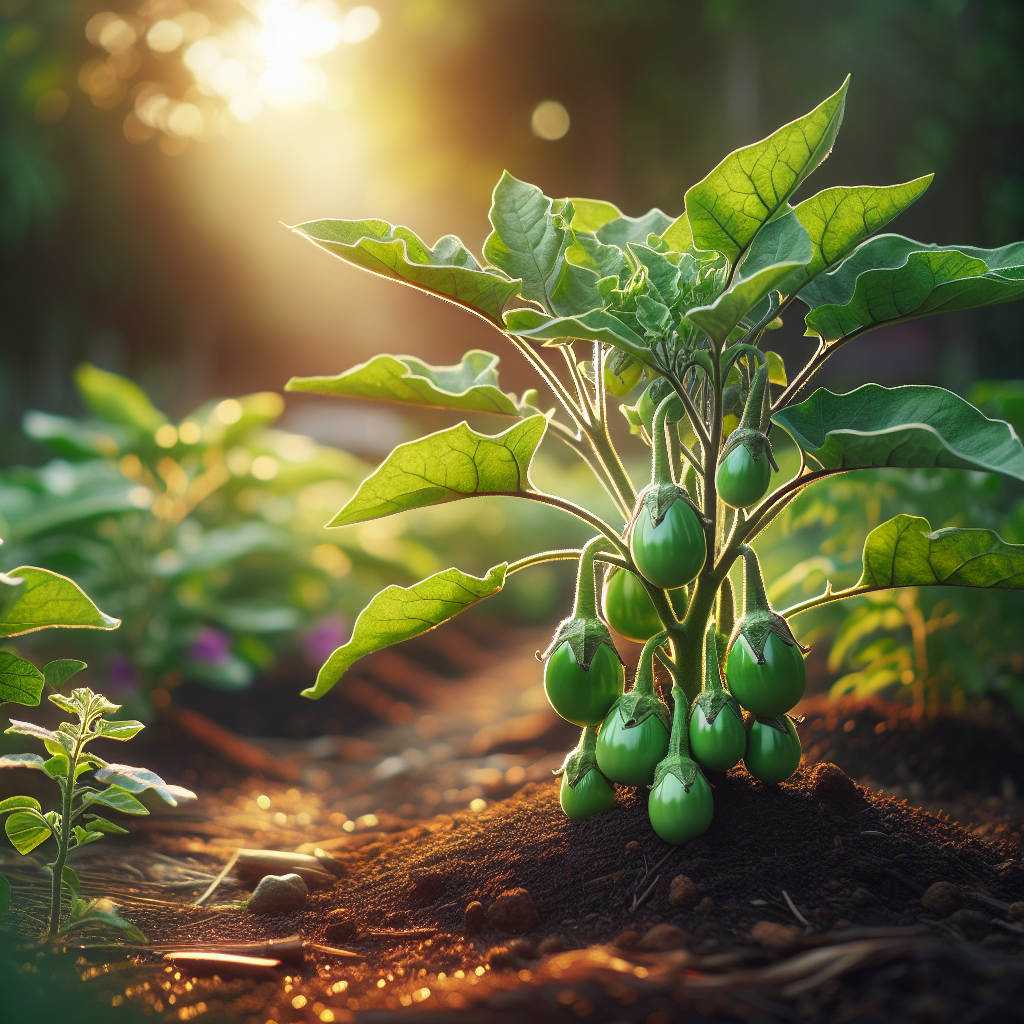
Introduction to Eggplant (Thai Green)
A distinctly Southeast Asian market type, this crop belongs to the same species as standard eggplant but differs in fruit shape, harvest stage, texture, and culinary use. Thai green selections are usually harvested when fruits are firm, glossy, pale to medium green, and seeded only lightly; if allowed to overmature, they lose tenderness quickly and develop tougher skin and more noticeable bitterness. In Thai, Lao, Khmer, and broader regional cuisines, these fruits are commonly used in green curry, relishes, grilled dishes, and mixed vegetable preparations where a crisp-tender texture is valued more than the soft, creamy flesh preferred in larger Mediterranean or globe types.
From a production standpoint, Thai green eggplant is often more forgiving in hot, humid weather than large-fruited European types, but it is less tolerant of cold soils and erratic irrigation. Growers who treat it like a tropical-fruited solanaceous crop rather than a generic garden vegetable generally achieve better results. It thrives when daytime temperatures remain consistently warm, root growth is never checked by compaction or waterlogging, and harvest is frequent. For growers familiar with Tomato, many cultural principles overlap, but Thai green eggplant typically demands even more heat for top performance and is slower to recover from cold stress.
In commercial and homestead settings alike, the key to success is steady, uninterrupted growth. Plants that experience alternating drought and saturation, nutrient swings, or prolonged temperatures below optimum often produce fewer flowers, more malformed fruit, and lower eating quality. When managed well, however, Thai green eggplant can produce continuously over a long warm season and is one of the highest-value specialty vegetables per square meter in warm climates.
Botanical Profile of Eggplant (Thai Green)
This crop is a tender perennial by biology but is grown as a warm-season annual in most production systems. It is a member of the Solanaceae family, alongside peppers, tomatoes, and potatoes. Thai green forms belong to Solanum melongena, though the exact cultivar group varies by seed source. Plants are typically bushy, upright to semi-spreading, and range from 60 to 120 cm tall under field conditions, sometimes larger in protected culture.
Leaves are broad, slightly lobed, and softly pubescent, giving plants a gray-green cast. Stems may be green to purple-tinged depending on line and environmental stress. Some Thai eggplants carry small spines on the calyx or stems, while others are nearly spineless; growers should check cultivar descriptions if hand-harvesting at scale. Flowers are star-shaped, usually light purple to violet, and are borne singly or in small clusters. Pollination is primarily self-fertile, but vibration from wind or insects improves fruit set.
Fruit characteristics are what separate Thai green types from other eggplants. Fruits are commonly round, slightly flattened, or oval, often 3 to 7 cm across at market stage, with glossy green skin that may remain uniformly green or show faint striping, white mottling, or darker shoulders depending on strain. Flesh is pale, dense, and less spongy than many large-fruited eggplants. Seeds should be soft and immature at ideal harvest. If fruits begin dulling in color, enlarging excessively, or hardening internally, they are already moving past prime culinary quality.
Physiologically, eggplant is one of the most heat-loving crops in the vegetable garden. Root uptake slows sharply in cool soils, pollen viability falls in temperature extremes, and the plant performs best when its canopy can photosynthesize under bright light without suffering moisture stress. Thai green selections, especially those adapted to tropical production, usually hold flowers and fruit better in hot weather than some Italian or globe types, making them particularly valuable in humid summers.
Soil, pH, and Climate Requirements for Eggplant (Thai Green)
This crop requires deep, fertile, well-drained soil with high biological activity and excellent tilth. The ideal texture is a sandy loam to silty loam rich in stable organic matter. Heavy clay can be used successfully only if drainage is improved with raised beds, compost incorporation, and avoidance of over-irrigation. Shallow, compacted, or poorly aerated soils stunt root systems, delay flowering, and make plants much more vulnerable to Bacterial wilt and root disease.
The preferred soil pH is 5.8 to 6.8, with an optimum near 6.2 to 6.5. Below about 5.5, nutrient imbalances become more likely, especially calcium and magnesium issues, while above 7.0 iron, manganese, and phosphorus availability may decline. Before planting, professional growers should base amendments on a soil test. As a rule of thumb, incorporate 3 to 5 kg of mature compost per square meter or the field equivalent, but avoid raw manure shortly before transplanting because excessive soluble nitrogen can promote lush foliage at the expense of early fruiting.
Thai green eggplant needs warm conditions throughout its life cycle. Ideal germination occurs at 27 to 32°C. Best vegetative growth occurs around 24 to 32°C days and 20 to 26°C nights. Growth slows below 18°C, flowers may abort below roughly 16°C night temperatures, and chilling injury can occur when plants are exposed to temperatures under 10 to 12°C for extended periods. Frost will kill the crop.
In terms of moisture, aim for evenly moist but never saturated soil. A useful target is about 60 to 80% of field capacity in the root zone. In practical terms, soil at 10 to 15 cm depth should feel cool and slightly moist and hold together when squeezed, but it should not release water or stay sticky for days. Chronic overwatering causes yellowing lower leaves, dull plant color, reduced vigor, edema, and eventual root decline. Drought stress first appears as midday leaf droop that fails to recover fully by evening, followed by blossom drop, bitter fruit, and tough skin.
Full sun is non-negotiable for high yields. The crop should receive at least 8 hours of direct sun daily, with 10 or more hours ideal. In tropical lowlands, very light afternoon shade may reduce heat scorch on young transplants, but mature plants generally perform best in open exposure with good air movement.
For larger-scale soil management, crop rotation is essential. Do not plant after other solanaceous crops such as peppers, potatoes, or eggplants for at least 2 to 3 years where possible. This reduces carryover of wilt pathogens, nematodes, and flea beetle pressure. Good background reading on long-term bed fertility can be found in soil health strategies.
Step-by-Step Planting & Propagation
Propagation is almost always by seed. Direct seeding is possible only in very warm regions with long seasons, but transplant production is strongly preferred because germination is faster and more uniform under controlled warmth, and early weed competition is reduced.
- Start seed 6 to 8 weeks before final transplanting. Use a sterile, fine-textured seed-starting medium with good drainage and modest nutrient charge.
- Sow seeds 0.5 to 1 cm deep in trays, plug cells, or small pots. Maintain medium temperature at 27 to 30°C for fastest germination. At these temperatures, emergence often occurs in 5 to 10 days; in cooler conditions it may take 2 weeks or more.
- After emergence, provide very bright light and keep seedlings warm. Day temperatures of 24 to 28°C and night temperatures of 20 to 22°C produce sturdy plants.
- Water seedlings lightly but consistently. The medium should remain moist, not waterlogged. If algae or fungus gnats appear, the surface is staying too wet.
- Begin dilute feeding once the first true leaves expand. Use a balanced soluble fertilizer at one-quarter to one-half strength weekly, or a low-salt organic liquid feed. Avoid overfeeding nitrogen, which creates tall, weak seedlings.
- Pot up if roots fill the cell before outdoor conditions are ready. Eggplant dislikes root binding; circling roots reduce field establishment.
- Harden off gradually over 7 to 10 days, but do not expose seedlings to cold winds or temperatures below about 16°C.
- Transplant only when soil temperatures are reliably above 18°C and nights are warm. Waiting an extra week often outperforms planting too early.
Spacing depends on production intensity and cultivar vigor. In home gardens, 45 to 60 cm between plants and 75 to 100 cm between rows works well. In field production, closer in-row spacing can increase early yield, but air movement must remain adequate to reduce disease pressure. Raised beds with plastic mulch are especially effective in marginal climates because they warm soil, suppress weeds, and stabilize moisture.
At transplanting, set plants at the same depth they grew in the tray or pot. Unlike tomatoes, eggplant does not benefit significantly from deep stem burial. Water transplants in thoroughly to settle soil around the roots. If sun is intense, temporary shade cloth for 2 to 3 days can reduce transplant shock.
Mulching after establishment is highly beneficial. Organic mulches such as straw or shredded leaves moderate soil temperature and reduce splash-borne disease, but they should be applied once soil is already warm. In commercial systems, black plastic mulch is often superior for earliness and weed suppression.
Care & Maintenance regimes for Eggplant (Thai Green)
The highest yields come from managing Thai green eggplant as a steady-feed, steady-moisture crop. It is less tolerant of neglect than folklore suggests. Once plants begin flowering, any interruption in water or nutrient supply shows up quickly as blossom drop, misshapen fruit, or a gap in harvest.
Irrigation should be deep and regular. Young transplants need frequent but moderate watering until rooted in, usually every 2 to 4 days depending on soil and weather. Once established, most plantings perform well with the equivalent of 25 to 40 mm of water per week, increasing to 40 to 50 mm during peak fruiting in hot conditions. Sandy soils may require smaller, more frequent applications; heavier soils need less frequent but deeper irrigation. Drip irrigation is strongly preferred because it keeps foliage dry and maintains uniform root-zone moisture.
A practical field test is to inspect soil 10 to 15 cm deep before irrigating. If it is dry and crumbly and will not form a weak ball in the hand, water is needed. If the top looks dry but the lower root zone is still moist, delay irrigation. Persistent sogginess, a sour smell, or slow drainage after watering indicates excessive water and poor aeration.
Nutrient management should balance early vegetative growth with reproductive performance. Before planting, incorporate compost and a balanced base fertilizer. A general professional target in medium-fertility soils is moderate nitrogen with ample phosphorus and especially potassium, which supports flowering and fruit quality. Split nitrogen applications are safer than a single heavy dose. Side-dress 3 to 4 weeks after transplanting and again at first heavy fruit set. Organic growers often use composted poultry manure, fish hydrolysate, feather meal, or blended organic vegetable fertilizers, but rates should be adjusted to soil test results.
Calcium availability matters for cell strength and fruit quality, but the usual issue is not lack of calcium in soil; it is erratic moisture limiting uptake. Keep watering even to reduce blossom-end disorders and internal tissue collapse. Magnesium deficiency shows as interveinal chlorosis on older leaves, while nitrogen excess produces dark, lush foliage with delayed flowering.
Staking or light support is advisable, especially in fertile soils where plants branch heavily. A single stake with soft ties, or a Florida weave adaptation on beds, prevents branches from snapping under fruit load and keeps fruit cleaner. Remove only damaged or heavily diseased leaves; aggressive pruning is usually unnecessary and can reduce total yield.
Weed control is critical during the first 4 to 6 weeks after transplanting. Eggplant is not highly competitive when young. Shallow cultivation is best because roots are relatively close to the surface. Once plants canopy over and mulch is in place, weed pressure drops significantly.
In protected culture or humid climates, flower set may improve with airflow and light plant shaking during bloom. Excessive humidity can make pollen sticky and reduce self-pollination efficiency.
Pests, Diseases & Organic Management
Flea beetles are among the most damaging early pests, especially on seedlings and fresh transplants. They create numerous small shot holes in leaves and can severely stunt young plants. Floating row cover applied immediately after transplanting is highly effective, provided plants are covered before infestation. Remove covers at flowering if pollinator activity is needed or temperatures become excessive.
Aphids colonize shoot tips and leaf undersides, causing curling and honeydew accumulation. Whiteflies are more common in protected or tropical environments and can build rapidly in hot weather. Spider mites flourish under heat and drought stress, producing stippling and fine webbing. Thrips may scar leaves and flowers and can vector viruses. Broad mites, though microscopic, can deform new growth and cause bronzing.
Fruit and shoot borers are major pests in some Asian production regions. Larvae tunnel into shoots and fruits, causing wilting branch tips and unmarketable fruit. Prompt removal of infested shoots and fruits, field sanitation, pheromone trapping where available, and exclusion netting are core organic tactics.
Common diseases include Bacterial wilt, Verticillium wilt, Fusarium wilt, Damping-off in seedlings, Phomopsis blight and fruit rot, Cercospora leaf spot, Powdery mildew, and various viral diseases including Mosaic complexes. Bacterial wilt is especially serious in warm, wet soils and causes sudden irreversible wilting even when soil moisture is adequate. Cutting the stem may reveal bacterial streaming. There is no curative treatment; rogue affected plants immediately and avoid replanting solanaceous crops in infested ground.
Organic disease management begins before planting: use pathogen-free seed, sterile propagation media, wide rotation, excellent drainage, and sanitized tools. Keep foliage dry when possible, avoid working plants when wet, and maintain balanced fertility. Overly lush canopies hold humidity and worsen disease spread.
For chewing insects, neem-based products, spinosad, and Bacillus thuringiensis may be appropriate depending on the target pest, but timing matters. Apply at dusk to protect beneficial insects and always follow label directions. Insecticidal soap can suppress Aphids and Whiteflies if coverage is thorough. Predatory mites and lacewings can help in biologically managed systems. Trap crops and flowering insectary strips may reduce pest pressure, especially where landscapes support beneficial populations.
Sanitation is one of the most underrated tools. Remove overripe fruit, dropped debris, and infested plant parts at least weekly. End-of-season residue should be destroyed or composted hot, not left in place if disease was present.
Harvesting, Curing & Optimal Storage
Thai green eggplant should be harvested immature but fully sized for its cultivar. The fruit surface should be bright and glossy, the skin taut, and the flesh still crisp-tender. Depending on the strain, harvest may begin 60 to 85 days after transplanting, sometimes earlier in very warm conditions. Frequent picking every 2 to 4 days stimulates continued flowering and prevents fruit from becoming seedy.
Use pruners or a sharp knife rather than pulling fruit by hand, especially on spiny or brittle-stemmed plants. Leave a short calyx and stem attached. Handle gently; although smaller than globe eggplants, Thai fruits bruise and scar easily, which reduces marketability.
Signs of overmaturity include loss of gloss, enlarged size beyond the usual market stage, hard seeds, slightly dull or yellowing skin, and more bitter flavor. Fruits intended for premium culinary use should be harvested before these changes occur.
Unlike onions or garlic, eggplant is not cured in the classic dry-storage sense. Instead, postharvest handling focuses on rapid removal of field heat and prevention of chilling injury. The best storage range is about 10 to 12°C with 90 to 95% relative humidity. Below 10°C, pitting, browning, seed darkening, and rapid quality loss may develop. At warmer room temperatures, fruits dehydrate and dull quickly.
Under ideal conditions, storage life is usually 7 to 10 days, occasionally up to 2 weeks for very fresh, carefully handled fruit. However, Thai green eggplants are best sold or used quickly because their quality is tied closely to freshness. Keep them away from ethylene-producing fruits such as bananas and apples in storage areas when possible, as ethylene can accelerate senescence.
For market growers, harvest in the cool morning, keep fruit shaded, and pack in shallow crates no more than a few layers deep. Washing is optional unless fruit is visibly dirty; if washed, dry promptly to reduce surface disease risk.
Companion Planting for Eggplant (Thai Green)
Companion planting is most useful here when it solves a real agronomic problem: pest distraction, beneficial insect support, ground shading, or spatial efficiency. The best companions are those that do not compete aggressively for light and nutrients during establishment.
Thai Basil is one of the most practical companions for this crop. It thrives in similar heat, attracts pollinators and beneficial insects when allowed to flower, and fits well along bed edges or between wider-spaced plants. Basil also supports a diversified harvest system where culinary pairing matters.
Onion and Garlic are useful nearby alliums because they occupy different root and canopy zones and may help confuse some insect pests through their strong aroma, though they are not a cure-all. They should not be crowded directly against eggplant stems; give each crop its own root space.
Low, quick crops such as lettuce can be used early in the season before eggplant closes canopy, but they are not ideal in peak summer heat where Thai green eggplant performs best. Avoid pairing with heavy feeders that compete strongly, or with crops that increase shading around the canopy. Also avoid repeatedly planting eggplant adjacent to other solanaceous crops if local pest and disease pressure is already high.
The companion strategy should always support the main crop rather than complicate management. In commercial beds, simple combinations usually outperform complex polycultures: one flowering herb, one allium border, and good sanitation. For broader planning concepts, see companion planting guide.