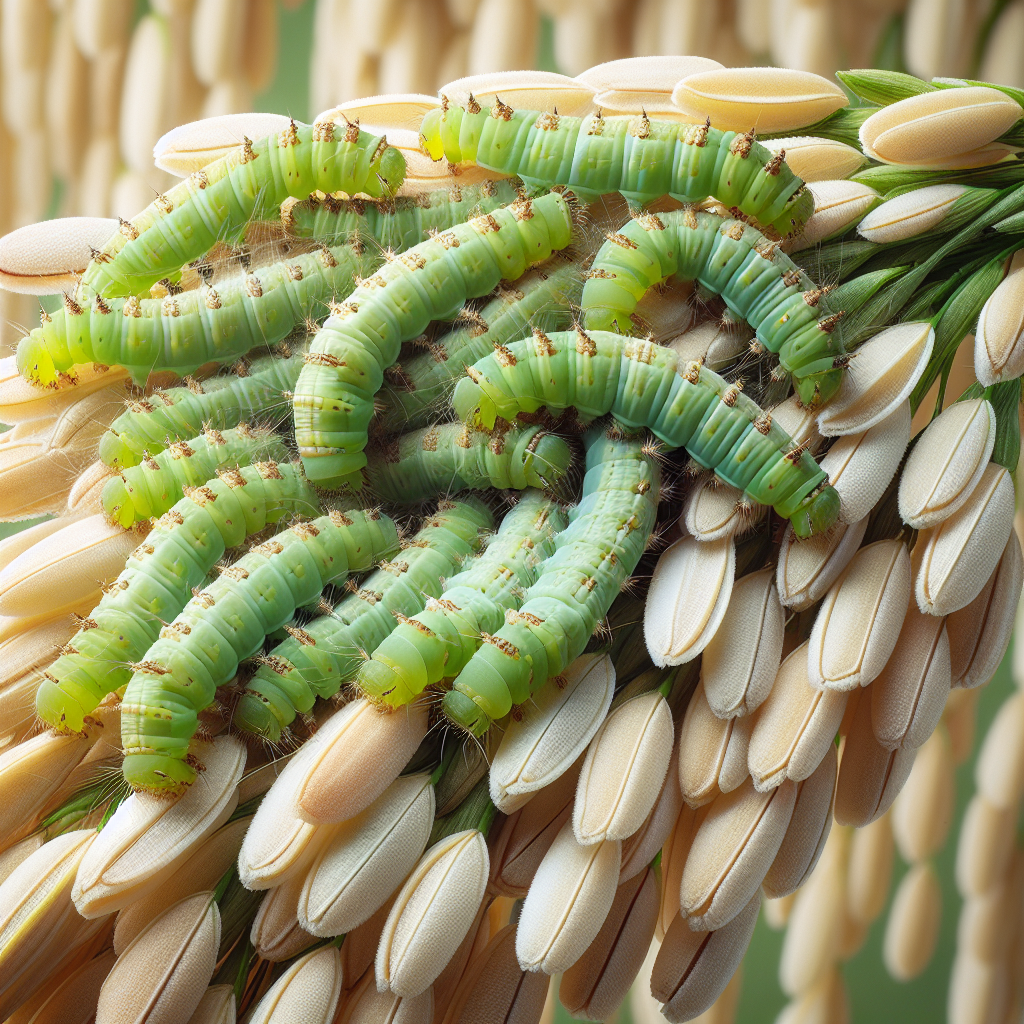
Introduction to earhead caterpillars
Earhead caterpillars represent a significant threat to cereal grain production worldwide, particularly in tropical and subtropical regions where rice, wheat, and sorghum are staple crops. These pests, primarily larvae of moths from genera such as Helicoverpa spp., Spodoptera spp., and Chilo spp., infest the reproductive structures—known as earheads or panicles—during critical grain-filling stages. A single infestation can devastate yields by 20-60%, turning promising harvests into chaff-filled losses for smallholder farmers.
Understanding earhead caterpillars is crucial for timely intervention. Native to Asia, Africa, and parts of Europe, they've spread globally via trade, adapting to diverse climates. Unlike foliar caterpillars, these specialize in head-feeding, tunneling into florets and grains, making detection challenging until damage is evident. This guide provides professional diagnostics, lifecycle insights, and proven organic strategies to safeguard your fields. For small farms battling timing issues, check this insightful post on Why Timing Kills Small Farm Profits - And How AI Task Scheduling Saves Your Harvests.
Farmers often confuse them with head-feeding caterpillars or earhead-feeding caterpillars, but precise identification enables targeted control. Early scouting during booting to heading stages prevents economic disasters, preserving grain quality and quantity.
Identifying Symptoms & Damage
Spotting earhead caterpillar damage requires vigilant field walks during flowering. Initial signs include small entry holes on glumes, surrounded by caterpillar frass—dark, pellet-like droppings resembling coffee grounds. Affected earheads appear silvery or webbed, with clipped grains dangling or dropping prematurely.
Diagnostic Checklist:
- Larval Presence: Greenish to brownish caterpillars, 10-30mm long, with dark heads and longitudinal stripes. They bore into rachis, feeding internally.
- Panicle Discoloration: Earheads turn whitish-gray, with 30-70% grains chomped or hollowed.
- Secondary Signs: Sooty mold from honeydew, bird damage to weakened heads, or grain mold exacerbating losses.
- Differentiation: Unlike armyworms, they don't defoliate; vs. stem borers, damage is head-specific.
Yield impact scales with infestation: light (10-20% loss) shows sparse grains; severe (>50%) renders earheads barren. Scout 20-30 hills per acre weekly, shaking panicles over white paper to dislodge larvae. Economic threshold: 5-10% infested earheads triggers action. Pair with Spring Pest Patrol: Organic AI Strategies to Shield Your Crops from Common Invaders for tech-enhanced monitoring.
Lifecycle and Progression of earhead caterpillars
Earhead caterpillars complete 4-8 generations yearly, synced with crop phenology. Adult moths (20-30mm wingspan, mottled brown) emerge at dusk, laying 200-1000 eggs singly on earheads over 3-5 nights.
Stage-by-Stage Breakdown:
- Egg (2-4 days): Tiny, ribbed spheres, cream-white, hatching in warm conditions (>25°C).
- Larva (10-20 days): Six instars; early ones skeletonize glumes, later bore grains. Peak damage at 3rd-5th instar.
- Pupa (5-10 days): In soil or debris, reddish-brown, non-feeding.
- Adult (5-10 days): Nocturnal, nectar-feeding, dispersing up to 50km.
Full cycle: 25-45 days at 28-32°C, slowing below 20°C. Overwinter as pupae in soil. Progression accelerates in irrigated fields, with multiple flushes during rainy seasons. Monitor with pheromone traps (10-15/acre) for moth peaks, correlating to booting stage vulnerability.
Environmental Triggers & Risk Factors
Warm, humid conditions (25-35°C, 70-90% RH) trigger outbreaks, especially post-monsoon. Risk spikes in continuous rice-corn rotations, harboring alternate hosts like millets or weeds.
Key Triggers:
- Climate: High night temps (>22°C) boost egg hatch; droughts stress plants, increasing susceptibility.
- Agronomics: Late nitrogen top-dress favors lush panicles; dense planting (>40 hills/m²) hinders scouting.
- Weeds/Volunteers: Barnyard grass hosts early instars.
- Preceding Pests: Aphids or leafhoppers indicate vulnerability.
Fields near rivers or with poor drainage face 2-3x higher incidence. Climate change extends seasons, per IPM studies.
Organic Control & Treatment Plans
Integrated organic management emphasizes prevention over cures, achieving 70-90% control.
Immediate Actions:
- Handpicking: Remove larvae from 10-20% infested heads daily at dawn.
- Bt Sprays: Apply Bacillus thuringiensis (e.g., 1-2g/L) at egg hatch, 3 applications 5-7 days apart. Targets gut, safe for beneficials.
- Neem Formulations: Azadirachtin 0.03% (2-5ml/L) disrupts feeding/molting; add soap for adhesion.
Biologicals: Release Trichogramma wasps (40,000/acre) for parasitism; conserve predators like ladybugs.
Treatment Schedule:
| Infestation Level | Action | Frequency |
|---|---|---|
| Light (<10%) | Scout + Bt | Weekly |
| Moderate (10-25%) | Bt + Neem | 5-day intervals |
| Severe (>25%) | All + Destroy heads | Daily |
Avoid broad-spectrum; rotate modes to prevent resistance. For misidentification pitfalls, see Why Misidentifying Plants Costs Small Farms Thousands - And How AI Camera Diagnosis Fixes It Fast.
Preventing earhead caterpillars in the Future
Long-term prevention builds resilient systems:
- Cultural: Early planting evades peaks; interplant with marigold as trap crop.
- Sanitation: Deep plow post-harvest buries pupae; flood fields 15-20 days kills soil stages.
- Varieties: Resistant hybrids like DRR Dhan 44 for rice.
- IPM Tools: Pheromone traps, yellow sticky cards; release NPV virus.
- Soil Health: Balanced NPK reduces susceptibility.
Rotate with legumes (chickpeas); mulch residues. Monitor via apps for hyper-local forecasts.
Crops Most Affected by earhead caterpillars
Primary hosts: rice (80% losses in Asia), sorghum, pearl millet, wheat, barley, maize. Secondary: sugarcane, finger millet. In rice, IR36 varieties suffer most; sorghum heads during grainfill. Global impact: $1B+ annual losses. Differentiate from corn earworm in maize.