Introduction to Pearl Millet
One of the oldest domesticated cereals, this crop has sustained farming communities for thousands of years in some of the harshest agricultural landscapes on earth. Archaeological evidence places its domestication in the Sahel region of West Africa, after which it spread eastward into India and across dry tropical farming systems. Its enduring value lies in resilience: it can produce grain where many other cereals fail, especially under erratic rainfall, high temperatures, low organic matter, and coarse-textured soils.
In practical farming terms, it is a dual-purpose crop. Depending on cultivar and management, it may be grown for grain, green forage, hay, silage, stover, grazing, bird feed, or cover cropping. Compared with corn, it generally tolerates heat and water stress better, though its total yield potential under high-input irrigation is usually lower. It is especially valuable in low-input systems because it responds to fertility when available, yet still gives useful production when fertility is modest.
The crop’s grain is rich in energy, contains useful protein, and is naturally gluten-free. In many traditional food systems it is ground into flour for flatbreads, porridges, steamed foods, and fermented preparations. Modern interest has also risen because of its nutritional profile, climate resilience, and role in regenerative dryland agriculture. For broader soil-building context in low-rainfall fields, see soil health strategies.
Botanical Profile of Pearl Millet
This species belongs to the grass family Poaceae and is taxonomically placed as Pennisetum glaucum, though some literature also uses Cenchrus americanus following reclassification. It is a warm-season annual C4 grass, which explains much of its efficiency under high light intensity, elevated temperatures, and limited water. C4 photosynthesis allows better water-use efficiency than many cool-season cereals.
Plants typically range from 1 to 4 meters tall depending on cultivar, fertility, planting density, and water availability. Grain types are often shorter and more uniform, while forage types may be taller and more leafy. The root system is fibrous and vigorous, capable of penetrating deeply into light soils when compaction is absent. This deep exploratory rooting is one reason the crop can recover from short dry spells better than shallow-rooted cereals.
Leaves are long, linear, and often bluish-green to medium green, sometimes with a waxy bloom that reduces water loss. Stems are solid to pithy and can tiller, though the degree of tillering depends strongly on spacing and nutrient status. Wide spacing and moderate populations encourage more tillers per plant; dense stands favor single main culms and more uniform maturity.
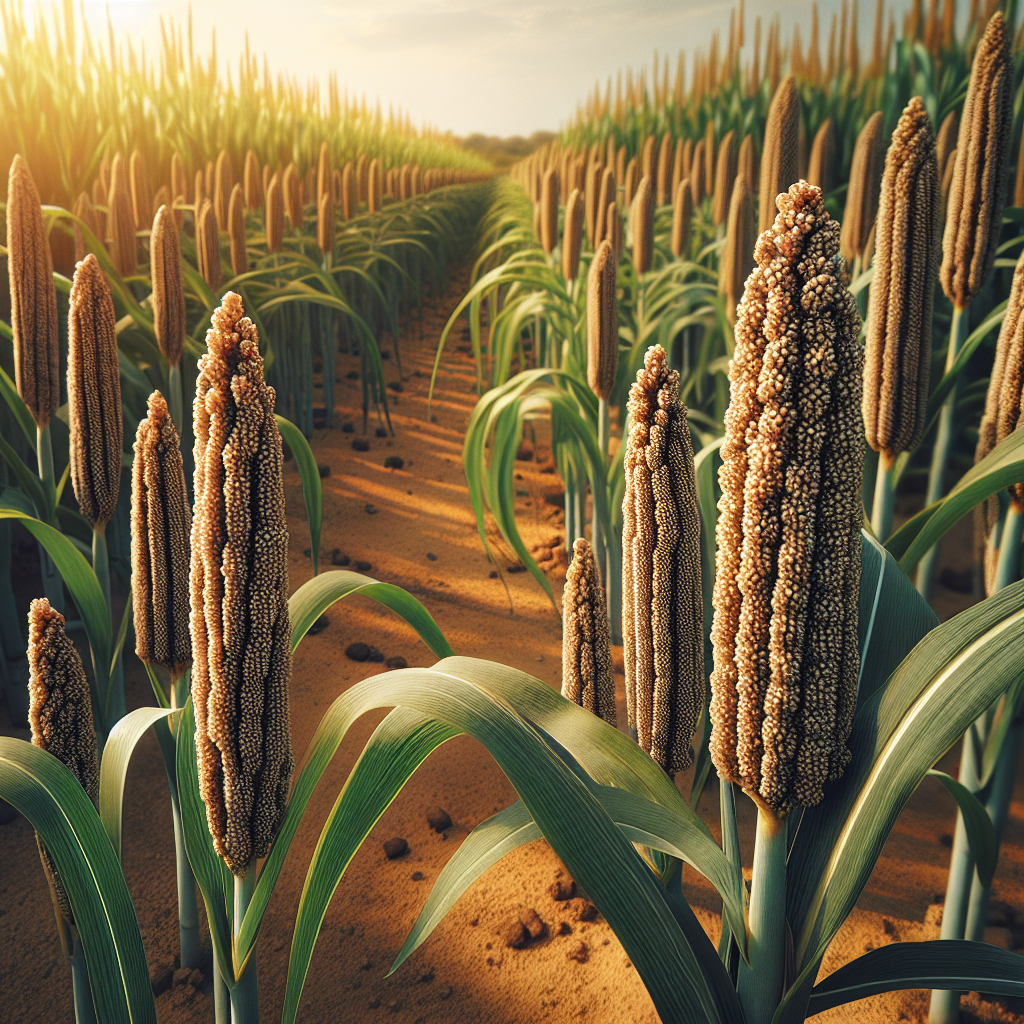
The inflorescence is a dense terminal panicle, often cylindrical to club-shaped, 10 to 40 cm long. Seed color varies by cultivar and may be gray, cream, yellow, brown, purple, or slate-colored. Grain size is smaller than many other cereals, and the seed is enclosed less tightly than in some millets, making threshing relatively manageable with proper drying.
Pearl millet is usually protogynous, meaning stigmas often emerge before anthers shed pollen. This encourages cross-pollination, so genetic diversity within local landraces can be high. Farmers saving seed should therefore isolate seed fields from other flowering stands if varietal purity matters. Hybrid cultivars are widely used in commercial systems because of their vigor, uniformity, and higher yield, but saved seed from hybrids will not breed true.
Cultivars are commonly grouped into grain, forage, dual-purpose, and dwarf or photoperiod-sensitive types. Grain hybrids are selected for compact heads, synchronous maturity, and strong standability. Forage pearl millet is often chosen for rapid biomass accumulation, fine stems, and multiple cut potential. Some traditional landraces excel under severe stress but mature less uniformly than improved varieties.
Soil, pH, and Climate Requirements for Pearl Millet
This crop performs best in well-drained sandy loams to light loams, but one of its major strengths is its ability to produce on soils too poor, hot, or drought-prone for many staples. It tolerates sandy soils exceptionally well provided there is some base fertility and enough moisture for establishment. It also grows on moderately heavier soils, but prolonged waterlogging is highly damaging because roots need oxygen and seedlings are particularly sensitive to saturated conditions.
An ideal soil pH is about 5.5 to 7.5. It tolerates mild acidity better than some cereals and can perform in slightly alkaline soils as long as micronutrient lock-up is not severe. Strongly acidic soils below pH 5.0 may reduce nutrient uptake, especially phosphorus, calcium, and magnesium. Very alkaline soils above about pH 8.0 can induce zinc or iron deficiency, seen as pale striping or general chlorosis in younger leaves.
Good drainage matters more than perfect texture. If water stands after rain for more than 24 to 48 hours, expect poor root respiration, yellowing, stunting, and greater disease risk. In heavy clay fields, raised beds or ridges are often preferable to flat planting. In coarse sands, adding compost or well-decomposed manure improves water-holding capacity and nutrient retention.
Temperature is critical. Seed germination is best when soil temperatures are consistently above 18 to 20°C, with ideal early growth occurring in air temperatures of 25 to 35°C. It can survive very hot conditions exceeding 40°C once established, although flowering during extreme heat and hot dry winds may reduce seed set in some cultivars. Frost is lethal. Even light frost can kill seedlings or halt grain filling.
Rainfall needs depend on purpose and duration of the cultivar. Grain production can be achieved in areas receiving roughly 250 to 600 mm of seasonal rainfall, while high forage yields generally require more moisture or supplemental irrigation. The most sensitive periods for moisture stress are establishment, tillering to stem elongation, and especially booting through grain fill. Early drought can reduce plant population; midseason drought shortens plants and limits head size; late drought causes poor grain filling and shriveled seed.
Full sun is essential. Shaded stands become spindly, lodge more easily, and produce smaller heads. Wind tolerance is generally good, but excessive nitrogen combined with irrigation can produce lush, weak stems prone to lodging.
Step-by-Step Planting & Propagation
Propagation is by seed. Use clean, high-germination seed from a reliable source, especially if growing for grain. Seed older than two or three seasons may still germinate, but vigor usually declines unless it has been stored cool and dry.
Prepare the field to a fine, firm seedbed. The seed is small, so cloddy soil creates uneven planting depth and patchy emergence. A stale seedbed approach can be useful in weedy fields: irrigate lightly or wait for an early rain, allow weeds to germinate, then make a shallow final cultivation before sowing.
Incorporate organic matter if available. A moderate dressing of mature compost improves soil structure, especially in sand. Avoid fresh manure immediately before planting because it can stimulate weed flushes and create uneven nitrogen release.
Correct major nutrient deficiencies before sowing. Phosphorus is particularly important for root establishment, while modest starter nitrogen helps early canopy development. If soil tests are unavailable, a balanced pre-plant fertility program is safer than heavy nitrogen alone.
Sow only when the soil is warm and there is reliable moisture. In rainfed systems, this usually means immediately after the first effective rains that wet the top 10 to 15 cm of soil. Planting too early into dry topsoil leads to staggered emergence and weak stands.
Plant shallow. Recommended seeding depth is generally 1.5 to 3 cm in medium soils and up to about 4 cm in sandy soils if surface moisture is limited. Deeper sowing delays emergence and can exhaust seedlings before they reach light.
Space according to purpose. For grain, rows of 45 to 75 cm and within-row spacing of 10 to 20 cm are common, targeting roughly 80,000 to 180,000 plants per hectare depending on rainfall and cultivar. Lower rainfall areas benefit from wider spacing and lower populations to reduce competition for moisture. For forage, narrower rows and higher seed rates create finer stems and denser biomass.
Firm the seedbed after sowing if soil is loose. Good seed-to-soil contact is essential for rapid, even imbibition.
Thin or gap-fill early if emergence is uneven. The ideal time is when seedlings have 2 to 3 true leaves. Delayed thinning wastes moisture and nutrients.
Transplanting is uncommon and usually uneconomical except in research plots or specialty seed production. Direct seeding is the standard commercial practice.
Under irrigation, apply enough water after sowing to moisten the top 10 to 15 cm, then wait until seedlings emerge before irrigating again unless cRusting threatens emergence. Surface cRusting in silty soils can be a serious problem; a very light irrigation may soften the surface, but avoid saturating cool soils.
Care & Maintenance regimes for Pearl Millet
Stand establishment is the most important management window. Once plants are 15 to 25 cm tall, they become substantially more resilient. During the first three weeks, keep the root zone consistently moist but never saturated. As a field rule, the top 5 cm of soil should not remain powder-dry for more than a few days during emergence, yet the seed zone should not stay muddy or airless. Overwatered seedlings often show yellowing, slow growth, and in severe cases collapse from damping-off or root suffocation.
After establishment, irrigation strategy should shift from frequent shallow watering to deeper, less frequent applications. The goal is to encourage deeper rooting into the top 30 to 60 cm of soil. In sandy soils, this may still mean relatively frequent irrigation because water drains fast, but each event should wet the profile rather than just the surface. Signs of under-watering include leaf rolling during morning hours, a dull gray-green cast, reduced tillering, and shortened internodes. Brief midday leaf rolling can be normal in extreme heat, but leaves should recover by evening. If they remain curled overnight, stress is significant.
Critical moisture periods are booting, heading, flowering, and early grain fill. Water deficits then can sharply reduce yield even if the crop looked vigorous earlier. Conversely, excessive irrigation late in the season can delay maturity, increase lodging, and promote foliar disease.
Nutrient demand is moderate. Pearl millet is efficient, but it responds strongly to added fertility where soils are depleted. Nitrogen drives leaf area, tillering, panicle size, and protein content, yet too much at once can cause soft growth and lodging. Split nitrogen is better than a single heavy application: apply a base dose at planting and a side-dress when plants are 20 to 35 cm tall or just before rapid stem elongation. Phosphorus supports rooting and early vigor. Potassium improves stress tolerance and stalk strength, especially in lighter soils.
Micronutrients can matter more than growers expect in alkaline or highly weathered soils. Zinc deficiency often appears as pale bands or striping on younger leaves and stunted growth; sulfur deficiency causes general yellowing of newer tissue; iron issues are more common in calcareous soils. Tissue testing during active vegetative growth can correct hidden hunger before flowering.
Weed control is vital in the first 30 to 40 days. After canopy closure, the crop competes well. Use shallow cultivation early to avoid root pruning. Mulching is less common in broadacre systems but can be useful in garden-scale or small-plot production. A clean start is especially important because slow early growth under cool conditions gives weeds an advantage.
In high-fertility or irrigated fields, lodging management becomes relevant. Avoid excessive nitrogen, prevent prolonged saturation, and select shorter grain cultivars if storms are common. Dense stands in rich soil may lodge before grain maturity, complicating harvest and increasing mold risk.
For forage production, harvest timing determines quality. Young vegetative growth is highly digestible, but there is a nitrate accumulation risk if heavily fertilized plants experience drought, cloudy weather, or sudden growth checks. After drought-breaking rains, allow several sunny days of active growth before grazing or cutting. In some situations, prussic acid risk is lower than in sorghum, which is one reason growers sometimes favor millet in summer forage programs; see our Sorghum guide for comparison.
Pests, Diseases & Organic Management
Pearl millet is relatively tough, but no cereal is pest-free. Bird damage is often the most conspicuous issue in small plantings, especially from heading through ripening. Netting, reflective tape, timed scare tactics, or synchronized planting across a neighborhood can reduce concentrated losses. Small, isolated plots suffer the worst damage because they act like feeding magnets.
Shoot fly, Stem borers, Armyworms, Grasshoppers, and Headworms can all attack depending on region. Shoot fly injury in seedlings causes deadhearts, where the central whorl dies and can be pulled out easily. Stem borers tunnel inside stalks, weakening plants and reducing head formation. Armyworms and Grasshoppers skeletonize leaves or defoliate rapidly under outbreak conditions.
Organic management starts with habitat and timing. Early sowing into warm, moist soils helps plants outgrow vulnerable stages quickly. Crop rotation, destruction of infested residues, and avoiding continuous cereal monoculture reduce pest carryover. Mixed plantings with legumes or flowering insectary strips near, but not shading, the crop can support beneficial predators and parasitoids. Border trap areas may intercept Grasshoppers in some systems.
Diseases include Downy mildew, Rust, Smut, Ergot, Leaf blights, and Charcoal rot. Downy mildew is one of the most economically serious in susceptible cultivars. Symptoms include chlorotic streaking, stunting, malformed heads, and a downy growth on leaf undersides under humid conditions. Resistant cultivars and seed treatment are the foundation of control. Smuts replace normal grain with dark fungal masses, while Ergot contaminates heads with toxic sclerotia and sticky exudates that can interfere with harvest and feed safety.
Leaf diseases increase with dense canopies, prolonged leaf wetness, and excessive late nitrogen. Organic suppression relies on airflow, residue management, crop rotation, and resistant genetics rather than rescue treatments. If irrigation is used, avoid frequent overhead watering during late afternoon or evening, which prolongs wet foliage overnight.
Root and stalk problems are usually aggravated by stress. Charcoal rot and other stalk rots are worse when flowering plants face severe drought followed by heat. Balanced fertility, steady growth, and avoiding overpopulation reduce risk.
Seed health matters. Use clean seed from low-disease fields. In seed-saving systems, rogue out diseased off-types before flowering if possible. Never save seed from plants showing severe Downy mildew, Smut, or abnormal panicles.
Harvesting, Curing & Optimal Storage
Harvest timing depends on end use. For green forage, cut before stems become coarse, usually from late vegetative to early boot stage for premium quality. For hay, harvest before full heading if quality is the priority, but ensure stems can dry adequately. For silage, a more advanced stage is acceptable as long as moisture is suitable for fermentation.
For grain, harvest when heads are fully developed and seeds are hard, typically when panicles lose most green color and grains cannot be dented easily with a fingernail. Physiological maturity is often reached when the grain has maximum dry matter, but field drying is still needed for safe storage. Do not delay too long in humid or bird-prone areas, because shattering, molding, weathering, and predation losses rise quickly.
In small plots, heads may be cut individually with sickles or shears and dried on tarps, racks, or well-ventilated platforms. In field-scale systems, plants may be cut, windrowed, or directly combined depending on uniformity and equipment. Uneven maturity is common in tillering stands, so some growers accept a compromise harvest date or make two passes.
Drying is critical. Grain intended for storage should generally be dried to around 12% moisture or lower, and even drier in warm, humid climates if storage conditions are poor. If grain feels cool and tough, it is often still too wet. Properly dried grain is hard, free-flowing, and resists thumbnail indentation. Heads dried before threshing should be protected from dew, rainfall, and soil contact to avoid fungal contamination.
Thresh gently enough to avoid cracking seed but thoroughly enough to remove grain from the panicle. Clean out chaff, immature seed, and dust because fines attract pests and hold moisture. For seed saving, choose heads from healthy, true-to-type plants with good size, uniform maturity, and no disease symptoms.
Store grain in clean, dry, insect-proof containers or bins. Hermetic storage works well where bruchids, grain moths, or weevils are a concern. Keep storage temperatures as cool as possible and relative humidity low. Regularly inspect for hot spots, condensation, insects, or moldy odors. Once spoilage begins, quality declines rapidly and toxins may develop.
Stover can also be valuable. Dry stalks and leaves make useful livestock feed, mulch, or bedding, but quality depends on harvest timing and weathering. If storing fodder, bale or stack only when adequately dry to prevent heating and mold.
Companion Planting for Pearl Millet
This crop is most often grown in field associations rather than classic kitchen-garden companion schemes. The best companions are species that complement its upright habit, drought tolerance, and nutrient use while avoiding excessive shade or direct competition during establishment.
Black Eyed Peas are among the best partners in dryland systems. They help occupy lower canopy space, contribute biologically fixed nitrogen over time, and provide a second harvest stream. Their spreading growth can also modestly suppress weeds between rows if planted at a balanced density.
Peanuts work well in sandy, warm soils where both crops thrive. Because peanuts remain low to the ground, they make good use of space beneath the millet canopy while helping protect soil from surface cRusting and erosion. Keep row spacing generous enough that the millet does not over-shade pegging peanuts.
Pigeon pea is an excellent intercrop in longer warm seasons. It grows more slowly at first, allowing millet to establish and mature before pigeon pea fully occupies vertical space. This combination is widely used in semi-arid agriculture for risk spreading, soil improvement, and diversified food production.
Sesame can also pair effectively where humidity is not excessive. Both crops like heat and relatively modest water, and they can be arranged in alternating rows to diversify insect pressure and market options.
When designing an intercrop, reduce the normal monocrop population of each species rather than sowing both at full density. Crowding causes thin stems, reduced head size, and moisture stress. In dry climates, wider rows are safer than dense mixes. Also consider harvest logistics: choose companions whose maturity windows and plant architecture will not make cutting, drying, or threshing the millet unnecessarily difficult.