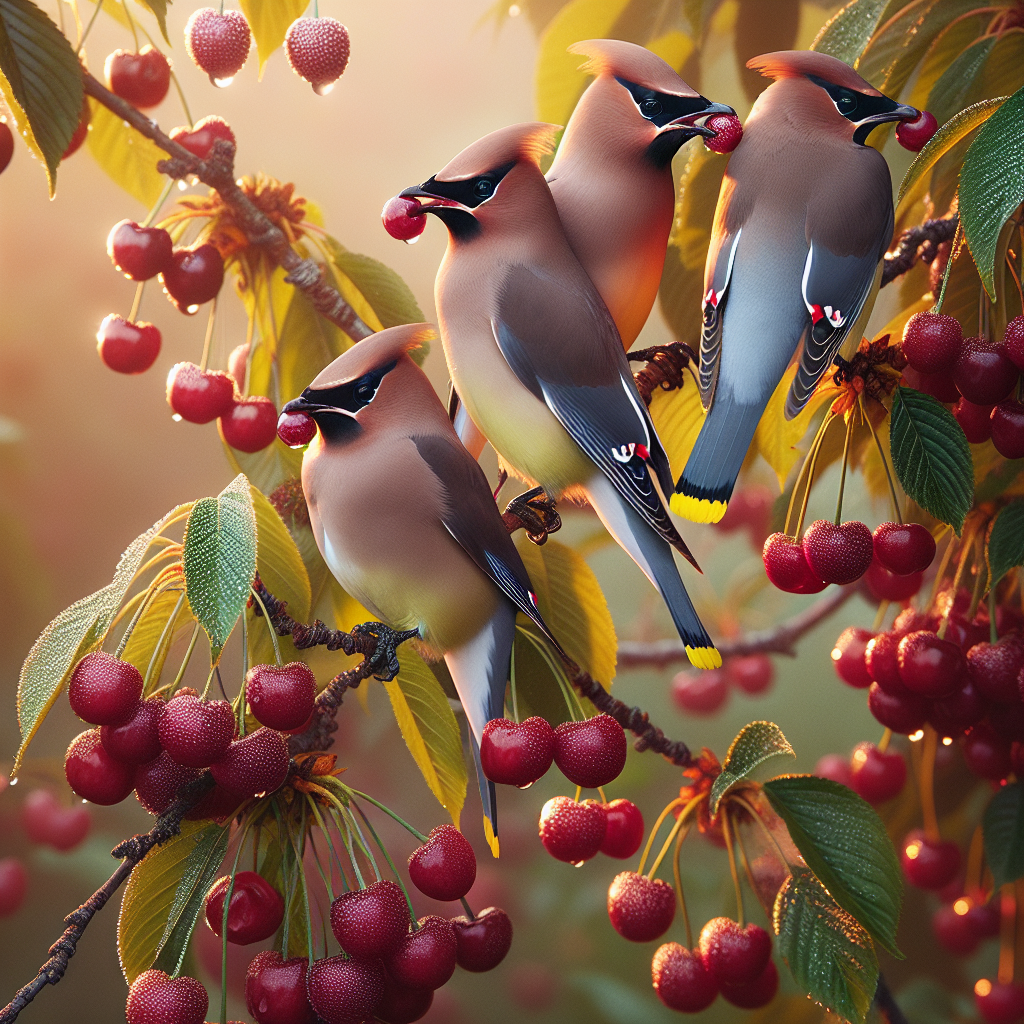
Introduction to Cedar waxwings
Cedar waxwings (Bombycilla cedrorum) are striking North American songbirds known for their sleek brown plumage, black mask-like eye stripes, bright yellow tail tips, and small red wax-like wing tips that give them their name. While beautiful and beneficial for consuming insects during breeding seasons, they become major agricultural pests during migration when massive flocks target ripening fruits. These nomadic birds travel in large groups of 20 to hundreds, descending on orchards and vineyards with voracious appetites, capable of consuming up to 600 berries per bird per day. In commercial fruit production, cedar waxwing damage can lead to 20-80% crop losses in vulnerable varieties like cherry, grapes, and blueberry if unmanaged.
Growers from British Columbia to the southeastern U.S. report sudden raids where flocks strip trees bare in hours, leaving behind half-eaten fruits that spoil quickly and attract secondary pests like birds or fruit flies. Unlike insects, cedar waxwings are protected under the Migratory Bird Treaty Act, prohibiting lethal control methods. This guide provides diagnostic tools, lifecycle insights, organic management strategies, and prevention tactics tailored for small farms and orchards. Early scouting and integrated deterrence are key to protecting yields while complying with wildlife laws. For more on bird pest pressures, see our comprehensive Spring Pest Patrol.
Identifying Symptoms & Damage
Cedar waxwing damage is unmistakable once flocks arrive, characterized by precise pecking that removes entire berries or large portions of fruit flesh. Look for:
- Missing or partially eaten fruits: Cleanly plucked berries with stems intact, often leaving calyces (the green star-shaped base) on the branch. Unlike rodents or mammals, there's no tearing or gnawing.
- Droppings under trees: Abundant white, splattered bird feces mixed with fruit pulp and seeds, staining leaves and ground. Fresh droppings are liquidy from high fruit sugar intake.
- Flock sightings: Sleek brown birds with crested heads, white undertail coverts, and yellow tails perched in rows on branches, passing fruits beak-to-beak in social feeding.
- Rapid defoliation patterns: Entire branches or tree sides stripped in 1-2 days, progressing from outer canopy inward. Damage peaks at color change (veraison) when fruits soften.
Scout at dawn and dusk when flocks are most active. Use binoculars to confirm species—distinguish from robins (thicker orange breasts) or starlings (iridescent black). Secondary signs include sooty mold from droppings (sooty mold) and increased yellowjackets attracted to fermenting fruit. Yield estimates drop sharply: a single flock of 100 birds can consume 60,000 cherries daily. Document damage with photos for insurance claims and track flock size/movement for predictive management.
Lifecycle and Progression of Cedar waxwings
Understanding cedar waxwing biology is crucial for timing interventions. These birds don't build large nests like robins; they are highly nomadic, breeding late spring to early fall.
- Eggs and Nestlings (April-June): Females lay 3-5 pale blue eggs in open cup nests of grass and lichen, often in orchard edges. Nestlings fledge in 12-18 days, fed insects initially.
- Juvenile Dispersal (July-August): Young birds join flocks, shifting to fruit-heavy diets. This coincides with early berry ripening.
- Migration Waves (September-November): Peak pest phase. Northern populations migrate south, stopping at fruit sources. Flocks balloon to 1,000+ birds, staying 1-7 days per site.
- Winter Roosts (December-March): Southern flocks target hollies, junipers, and ornamentals, less agricultural impact.
One-year lifespans mean constant influx of naive juveniles. Progression: Scout pre-veraison (color change), escalate deterrents at first sightings. Flocks move unpredictably with weather fronts, hitting crops in sequence from north to south. Monitor eBird.org for local sightings to predict arrivals 3-5 days ahead.
Environmental Triggers & Risk Factors
Cedar waxwings thrive in fragmented landscapes with abundant fruit. Key triggers include:
- Ripening fruit availability: Primary attractant. Early-maturing varieties like Bing Cherry or Duke Blueberry at high risk.
- Weather patterns: Cool, wet falls delay ripening, synchronizing with migration peaks. Drought-stressed trees produce sweeter fruits, drawing flocks faster.
- Habitat proximity: Orchards near wild berry patches (dogwoods, serviceberries) or urban fruit trees amplify pressure. Unharvested backyard apple trees serve as reservoirs.
- Flock dynamics: Post-breeding nomadism leads to 'superflocks' following berry blooms. Climate change extends migration windows, increasing overlap with harvests.
High-risk sites: Small farms <10 acres, organic operations without netting, and regions like Pacific Northwest, Great Lakes, and Mid-Atlantic. Poor sanitation (unpicked drops) worsens infestations, as does companion planting with attractants like elderberry. Mitigate by harvesting early or nettings.
Organic Control & Treatment Plans
Lethal methods are illegal; focus on deterrence. Integrated plans combine cultural, physical, and sensory tactics:
- Netting (Gold Standard): Bird netting over entire canopies or row covers. Install pre-veraison; costs $0.50-$2/ft² but recovers ROI via 90% loss prevention. Overlap edges 2ft, secure with clips.
- Visual Deterrents: Reflective tape, Mylar balloons, pie tins on strings. Move daily to prevent habituation. Add predator decoys (owls, hawks) rotated weekly.
- Auditory Repellents: Propane cannons (1-5/min), electronic bird callers mimicking predators. Dawn/dusk activation; neighbor coordination avoids noise complaints.
- Avian Lasers: Green laser pointers (532nm) sweep flocks at night. Effective up to 2 acres, non-habituation.
- Cultural Practices: Early harvest at firm-ripe stage; strip-pick outer canopy first. Thin clusters to reduce appeal. Plant resistant varieties or intercrop with repellents like hot peppers.
Step-by-Step Plan:
- Week 1 pre-arrival: Net high-value blocks, install reflectors.
- At sighting: Activate cannons/lasers, flare guns with screechers.
- Daily: Patrol, harvest ripe fruit, remove drops to break feast-and-flee cycle. Monitor efficacy; combine 3+ methods for 85-95% control. For AI-enhanced scouting, check Why Misidentifying Plants Costs Small Farms Thousands.
Preventing Cedar waxwings in the Future
Long-term strategies build resilience:
- Site Design: Plant berries away from flyways; use hedgerows of thorny blackberry as barriers.
- Variety Selection: Choose late-ripening cultivars like Rainier Cherry or firm-fleshed Honeycrisp Apple.
- Sanitation: Promptly harvest and destroy drops; mulch to deter ground-foraging.
- Diversion Orchards: Maintain off-site fruit patches (mulberries) to lure flocks away.
- Tech Integration: Drones for scouting, AI apps for migration alerts. Participate in cooperative scaring programs.
- Habitat Modification: Remove wild hosts; encourage predators like merlins.
Annual planning reduces future pressure by 70%. Track regional patterns via cooperative extension services.
Crops Most Affected by Cedar waxwings
Cedar waxwings target small, soft, dark fruits during ripening:
| Crop | Vulnerability | Peak Damage Window |
|---|---|---|
| Cherry | High (90% losses possible) | Late June-August |
| Grapes | High | Veraison (Aug-Oct) |
| Blueberry | High | July-Sept |
| Strawberry | Moderate | Late spring |
| Raspberry | Moderate | Summer |
| [Serviceberry] | High (wild host) | June |
| Apple | Low-moderate | Late summer |
Serviceberries and hollies act as sentinels; monitor first. Small farms prioritize netting top three. Total U.S. losses exceed $50M annually.