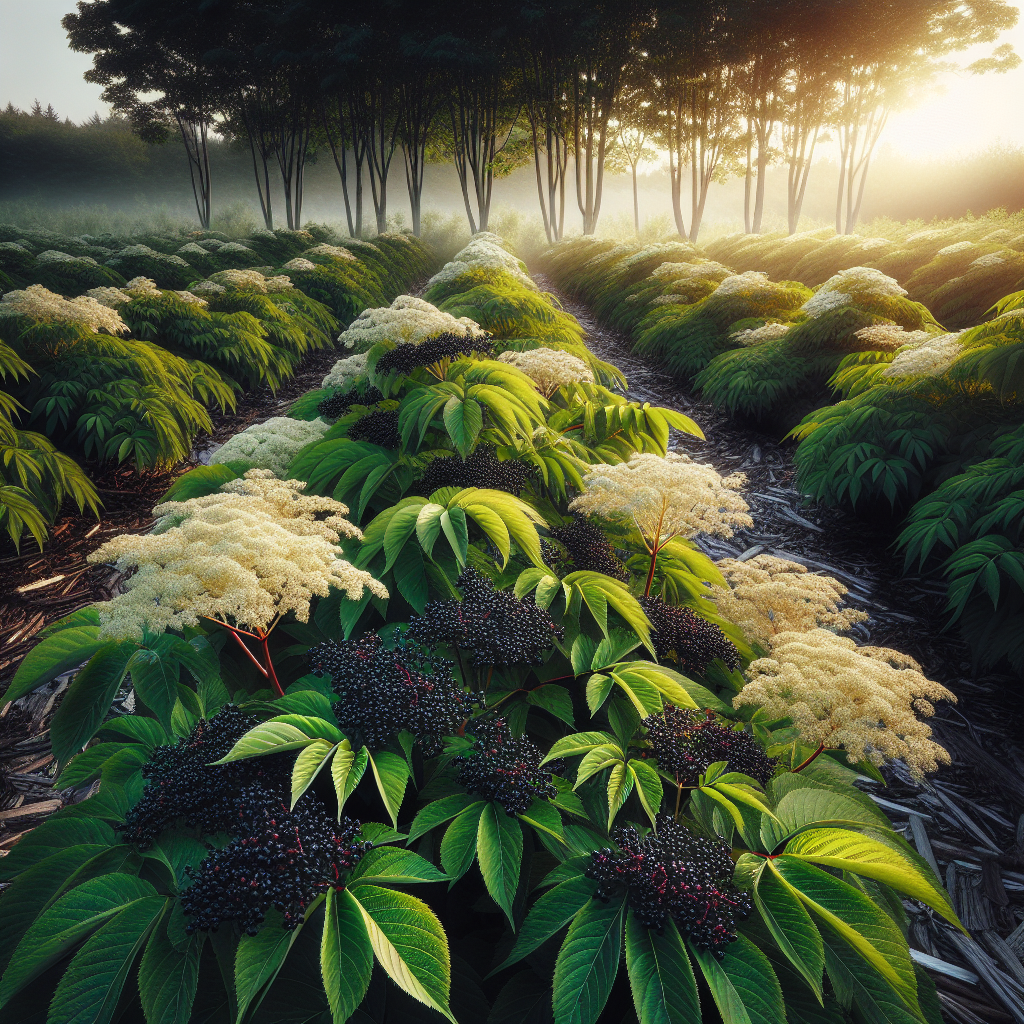
Introduction to Elderberry (American)
American elderberry is one of North America's most useful native fruiting shrubs, valued both as a farm crop and as an ecological workhorse. Botanically often listed as Sambucus canadensis and sometimes treated as Sambucus nigra subsp. canadensis, it forms multistemmed thickets, produces broad flat-topped cymes of creamy white blossoms, and ripens clusters of small, dark berries with exceptionally high anthocyanin content. Unlike many small fruit crops, it tolerates periodic wet feet better than drought, making it a strong option for low areas, riparian edges, rain gardens, and diversified berry plantings.
For growers, the crop sits in an interesting middle ground between wild-harvest tradition and modern specialty agriculture. American elderberry has long been used by Indigenous communities and rural households for food, dye, and medicine. Today it is grown commercially for juice, concentrates, dried fruit ingredients, floral products, and value-added processing. The fruit is not usually eaten raw in quantity because of its astringency and because raw seeds, stems, and unripe fruit contain cyanogenic glycosides that are reduced by proper cooking and processing.
The plant is forgiving in establishment compared with more acid-demanding berry crops such as Blueberry, but commercial success still depends on cultivar choice, pruning system, pollination planning, irrigation, and timely harvest. For broader orchard soil preparation principles, see soil health strategies.
Botanical Profile of Elderberry (American)
This species is a deciduous suckering shrub, usually maturing 1.8-4 meters tall and wide depending on cultivar, fertility, moisture, and pruning intensity. It naturally produces many basal canes, similar in management concept to cane fruits, though structurally it behaves more like a woody shrub. Leaves are opposite, pinnately compound, typically with 5-11 serrated leaflets. New spring growth is vigorous and soft, later maturing into pithy woody stems.
The inflorescences are broad terminal cymes, often 10-25 cm across, blooming in late spring to early summer depending on region. Flowers are insect-pollinated and highly attractive to beneficial insects, native pollinators, hoverflies, and predatory wasps. Fruit develops as drupelike berries in hanging clusters, changing from green to red-purple and finally to deep purple-black when fully ripe. Uniform maturity within a cluster is uncommon, so harvest timing matters.
Roots are relatively shallow and fibrous, with much of the active feeding zone concentrated in the upper 20-40 cm of soil. This explains why elderberry responds strongly to mulch, compost, and consistent soil moisture, and why it suffers when planted into compacted, droughty, gravelly, or highly competitive sod.
American elderberry is generally self-fruitful to a degree, but cross-pollination between two or more genetically distinct cultivars almost always improves berry set, cluster size, and total yield. Common commercial cultivars include Adams, Johns, York, Nova, Bob Gordon, Wyldewood, Ranch, and Scotia. Bob Gordon is known for pendant fruit clusters that may reduce bird feeding somewhat and for good processing quality. Wyldewood is productive and widely planted in commercial systems. York tends to produce larger berries and vigorous plants. Local adaptation matters, especially for flowering time, winter survival, and disease pressure.
A key botanical nuance is the distinction between American elderberry and ornamental or European elder types. Growers seeking fruit production should source named fruiting selections of American elderberry rather than random ornamental sambucus cultivars, which may prioritize foliage color over yield.
Soil, pH, and Climate Requirements for Elderberry (American)
American elderberry performs best in deep, fertile, moisture-retentive loam or silty loam with abundant organic matter. Ideal soils are well supplied with calcium and potassium, moderately aerated, and able to hold steady moisture without prolonged stagnant saturation. Although the plant tolerates heavier soils better than many berry crops, chronic anaerobic conditions still damage roots, especially in warm weather. In practice, that means a site can be seasonally moist or occasionally flooded for short periods, but should not remain waterlogged for weeks during active growth.
Target soil pH is about 5.5-6.5, with acceptable performance up to roughly 7.0 if micronutrients remain available. Below pH 5.2, nutrient imbalance and weak growth become more likely; above pH 7.2, iron and manganese deficiency may show as interveinal chlorosis on young leaves. Before planting, a full soil test should guide lime, phosphorus, potassium, and boron applications. Elderberry is not as intolerant of pH drift as blueberry, but a balanced root zone still makes a major difference in cane vigor and cluster fill.
Organic matter of 4-6% or higher is especially helpful. Incorporating 5-10 cm of well-finished compost across the row zone before planting improves tilth, moisture-holding capacity, and microbial activity. Avoid fresh manure, which can push excessive nitrogen, salt injury, and lush disease-prone growth.
Climatically, American elderberry is best suited to temperate regions with cold winters and warm summers. It is commonly reliable in USDA zones 3-9 depending on cultivar and microclimate. Winter chill is not usually limiting across most temperate areas, and the plant is notably cold hardy when fully dormant. However, early spring warm spells followed by hard frost can damage emerging shoots or flowers in some locations.
Full sun is preferred for commercial yield and best sugar development. A minimum of 6 hours of direct sun is workable, but 8 or more hours is better. In partial shade, plants often stretch, flowering is reduced, disease pressure can increase because leaves stay damp longer, and fruit quality may be weaker.
Moisture is the most misunderstood requirement. Elderberry is not an aquatic plant, but it is far less drought tolerant than many woody fruit crops. During establishment and fruit fill, aim to keep soil evenly moist in the top 15-25 cm. As a field reference, soil should feel cool and slightly cohesive when squeezed, not dusty and not greasy. If a hand-squeezed sample forms a weak ball that breaks apart easily with a tap, moisture is usually near ideal. Drought stress appears first as slowed shoot extension, dull or slightly folded leaves in the afternoon, reduced berry size, and premature fruit shrivel. Overwatering symptoms include persistently yellow lower leaves, soft rank growth, sour-smelling soil, and poor cane maturation.
Wind exposure also matters. Strong wind during flowering can reduce pollinator activity and physically damage tender shoots. Shelterbelts or strategic planting near wind moderation features can improve consistency, provided airflow is not so restricted that humidity-driven foliar diseases increase.
Step-by-Step Planting & Propagation
Start with dormant bare-root plants, rooted cuttings, or container-grown stock from a reputable nursery. Named cultivars are strongly preferred over wild-dug plants because they provide predictable ripening window, berry chemistry, and yield.
Choose the site carefully. Select full sun, fertile soil, and reliable access to irrigation. Avoid droughty knolls, severe frost pockets, and places where perennial weeds like quackgrass or bindweed dominate.
Prepare the planting strip. Eliminate perennial weeds 6-8 weeks before planting. Create a weed-free strip at least 1-1.5 meters wide. Incorporate compost and amendments according to soil test results. On heavy wet soil, form a low raised bed 15-25 cm high to improve aeration while still conserving moisture.
Plan spacing. For backyard or small diversified farms, space plants 1.8-2.4 meters apart within rows and 3-4 meters between rows. High-vigor cultivars on fertile moist ground may need wider spacing. Tighter spacing increases early canopy closure but raises pruning demand and disease risk.
Use more than one cultivar. Plant at least two compatible cultivars intermingled or in adjacent rows for better cross-pollination. Alternating every 2-4 plants is often more effective than isolating an entire block by cultivar.
Plant while dormant or in cool weather. Early spring is ideal in cold climates. Fall planting can work in mild winter regions if roots establish before hard freezes.
Set plants at proper depth. Place bare-root plants with roots spread naturally and crowns at or slightly deeper than nursery depth, often 2-5 cm deeper to encourage basal shoot formation. Backfill firmly to eliminate air pockets.
Water in thoroughly. Give each plant enough water to settle soil through the full root zone. A slow soak is better than a brief splash.
Mulch immediately. Apply 5-10 cm of wood chips, shredded bark, leaf mold, or weed-free straw, keeping mulch a few centimeters away from the stems. Mulch suppresses weeds and stabilizes root-zone moisture.
Head back if needed. Weak or damaged top growth can be cut back after planting to balance root loss and stimulate new cane growth.
Propagation is straightforward. Hardwood cuttings are the most common method: take pencil-thick dormant wood in late winter, 20-25 cm long, with at least 2-3 nodes. Insert so one node remains above the surface in a propagation bed or pots with moist medium. Softwood cuttings also root readily under mist. Suckers can be divided from established stools, but this is more variable and may spread disease if parent stock is not clean.
Elderberry can be grown from seed, but this is mainly for breeding, conservation, or hedgerow projects because seedlings are genetically variable and slower to bear uniformly.
Care & Maintenance regimes for Elderberry (American)
During the first year, establishment is the priority. Keep weeds out of the row completely or nearly so. Elderberry does not compete well with grass at the root zone. A clean mulched strip plus drip irrigation is one of the highest-return management choices you can make.
Water deeply enough to moisten the active root zone, generally 20-30 cm, then allow slight surface drying before watering again. In most temperate field settings, this translates to roughly 25-40 mm of water per week from rainfall plus irrigation, with the higher end needed on sandy soils or during heat. Increase irrigation during bloom through fruit fill. Avoid frequent shallow irrigation, which encourages surface rooting and instability during dry spells.
Nitrogen management should be moderate, not excessive. Young plantings often benefit from 30-60 g of actual nitrogen per plant per year split into 2 applications, one at budbreak and one after active shoot expansion begins. Mature plantings may need the equivalent of 45-90 kg actual nitrogen per hectare depending on vigor, leaf analysis, organic matter, and pruning severity. Too little nitrogen gives short shoots, pale leaves, and weak cluster development. Too much causes soft lush canes, delayed hardening, and more Aphids and foliar disease.
Phosphorus and potassium should be maintained from soil test recommendations. Potassium is especially important for fruiting shrubs because it influences sugar movement, cane strength, and fruit size. Leaf tissue analysis in midsummer can refine the fertility program over time.
Pruning determines productivity. Elderberry fruits heavily on new shoots arising from one-, two-, and sometimes three-year-old wood depending on cultivar and system. The simplest home-garden system is renewal pruning: remove dead, weak, broken, and oldest canes annually, keeping 6-10 strong canes of mixed age per plant. Commercial systems often remove all canes to near ground level every late winter for easier harvest and uniform ripening, but this can delay harvest timing in some regions and may reduce total yield depending on cultivar. Another common system retains the most productive one- and two-year canes while removing canes older than three years. The best system depends on labor model, machine access, and cultivar behavior.
Suckers beyond the intended row width should be mowed or cut out annually. If left unmanaged, elderberry forms broad colonies that are excellent for habitat but harder to harvest.
Flower removal in year one is often beneficial. Letting very young plants carry a full crop can slow root and cane establishment. On small plantings, pinch off early bloom clusters the first season to invest in structure.
Mulch should be replenished yearly as it decomposes. Keep total mulch depth below about 10-12 cm on heavy soils to avoid excessive crown moisture and vole habitat.
Pests, Diseases & Organic Management
American elderberry is generally resilient, but several problems can reduce yield or fruit quality if ignored. Integrated organic management begins with airflow, sanitation, cultivar selection, and bird protection rather than rescue spraying.
Common insect pests include Aphids, Elder shoot borers, Cane borers, Spider mites in hot dry conditions, and Japanese beetles in some regions. Aphids often build on tender spring growth when nitrogen is high; they can distort tips and leave honeydew. Strong beneficial insect presence usually keeps them in check, especially where flowering insectary plants such as Yarrow and Thyme are nearby. If populations surge, a firm water spray or insecticidal soap can suppress colonies, but spray late in the day and avoid open bloom.
Borers are more serious because they tunnel into shoots and can cause sudden wilting of individual canes. Look for wilted tips, entry holes, and frass. Prune and destroy affected canes below the damaged section as soon as symptoms appear.
Japanese beetles skeletonize foliage and sometimes feed on flowers and fruit. Hand removal, exclusion netting on small plots, and habitat support for predators can reduce pressure. Avoid broad-spectrum insecticides that disrupt beneficial insect balance.
Birds are arguably the most economically important pest at ripening. Cedar waxwings, Robins, Starlings, and Blackbirds can strip plantings quickly. Netting remains the most reliable organic tool. Install it before berries fully color; waiting until damage starts is usually too late.
Disease issues include Powdery mildew, Leaf spots, Cankers, Root rots in chronically waterlogged soils, and occasional Botrytis on senescing blooms or fruit clusters in wet weather. Powdery mildew appears as whitish surface growth on leaves, especially in humid plantings with poor airflow. It is often cosmetic unless severe, but heavy infection reduces photosynthesis and weakens canes. Manage with spacing, pruning, balanced nitrogen, and sulfur or biological fungicides where permitted and needed.
Leaf spot diseases usually intensify late in the season. Sanitation helps: remove heavily infected canes during dormant pruning, maintain mulch to reduce soil splash, and avoid overhead irrigation where practical.
Cankers and dieback are often linked to winter injury, mechanical damage, or stressed plants. Always cut to healthy tissue and sanitize tools between suspect plants.
Root disease risk rises when soil remains saturated and oxygen-deprived. This is one reason moisture-retentive does not mean swampy. If plants repeatedly yellow, stall, and collapse in warm wet periods, improve drainage or re-site future plantings.
Deer browsing can be severe on young shoots. Fencing is the most dependable solution. Rabbits may chew young stems in winter; guards or fencing help where pressure is high.
Harvesting, Curing & Optimal Storage
Harvest timing depends on intended use, but berries should be fully colored and physiologically ripe before picking. Clusters are harvested whole, not berry by berry. A ripe cluster shows nearly all berries dark purple-black with little or no green remaining, and juice stains readily when fruit is crushed. Partially ripe clusters produce lower color, lower sugar, and more herbaceous flavors.
Typical harvest season ranges from midsummer to early fall depending on climate and cultivar. Because ripening is not perfectly uniform, plan on 2-3 pickings for some plantings. Harvest in the cool morning after dew dries but before afternoon heat softens fruit.
Use sharp pruners to clip entire cymes into shallow lugs. Handle gently; berries detach easily when overripe, and deep containers crush bottom fruit. Keep fruit shaded immediately after picking.
A practical postharvest benchmark is to move harvested clusters to cooling within 1-2 hours whenever possible. Rapid precooling to about 0-4°C preserves color and reduces microbial growth. Fresh clusters are highly perishable and are usually processed quickly rather than marketed for long fresh storage.
Destemming can be done by hand, with berry rakes, or after partial freezing to make separation easier. Remove all green berries, thick stems, leaves, and debris, because nonfruit tissues contain more cyanogenic compounds and can impair flavor.
There is no curing process in the way one would cure onions or garlic. Instead, proper postharvest handling focuses on cleaning, destemming, chilling, and rapid processing. For short-term storage, keep cleaned berries at 0-2°C with high relative humidity and process within a few days. For longer storage, freeze immediately in a single layer before bagging, or freeze clusters first and destem later. Frozen elderberries keep quality for 8-12 months if held solidly frozen.
Flowers can also be harvested for cordials, teas, and fritters. Pick flower heads just after opening, when aroma is strongest and before browning. Do not overharvest flowers if fruit production is the main goal.
A food safety note matters here: ripe cooked berries are the standard edible product. Unripe fruit, leaves, bark, roots, and substantial stem material should not be consumed.
Companion Planting for Elderberry (American)
Companion planting around elderberry should support pollination, biological control, soil cover, and weed suppression without creating aggressive root competition. Because elderberry roots are shallow and moisture-loving, the best companions are usually low-growing insectary herbs or controlled living mulches kept outside the immediate crown zone.
Yarrow is one of the best companions because its long bloom period attracts hoverflies, parasitic wasps, and predatory insects that help suppress Aphids and other soft-bodied pests. It is drought tolerant once established, so place it at the edge of the row rather than directly at the drip line where it could compete for water in dry periods.
Thyme works well in sunny plantings and on row edges, especially where growers want a low aromatic groundcover that draws pollinators and beneficial insects while not shading the base of the shrubs. It is best on well-drained berm shoulders rather than the wettest inner root zone.
Clover can be used as a managed alley or inter-row cover crop. It contributes nitrogen biologically, protects soil structure, and improves trafficability if mowed regularly. Keep it out of the immediate planting strip during establishment years, because young elderberry plants can lose vigor if forced to compete with a living mulch too soon.
Nasturtium is useful in diversified garden-scale systems as a pollinator attractor and distraction plant for some pest species. It is less relevant in commercial machine-managed rows but can be helpful at row ends or mixed edible landscapes.
Avoid planting large, aggressive, or highly thirsty crops directly beneath elderberries. Tall annuals that shade the canopy reduce flowering and fruit quality, while dense sod right up to the crown suppresses growth. Think of companions as support species around the elderberry system, not plants jammed into the same root space.