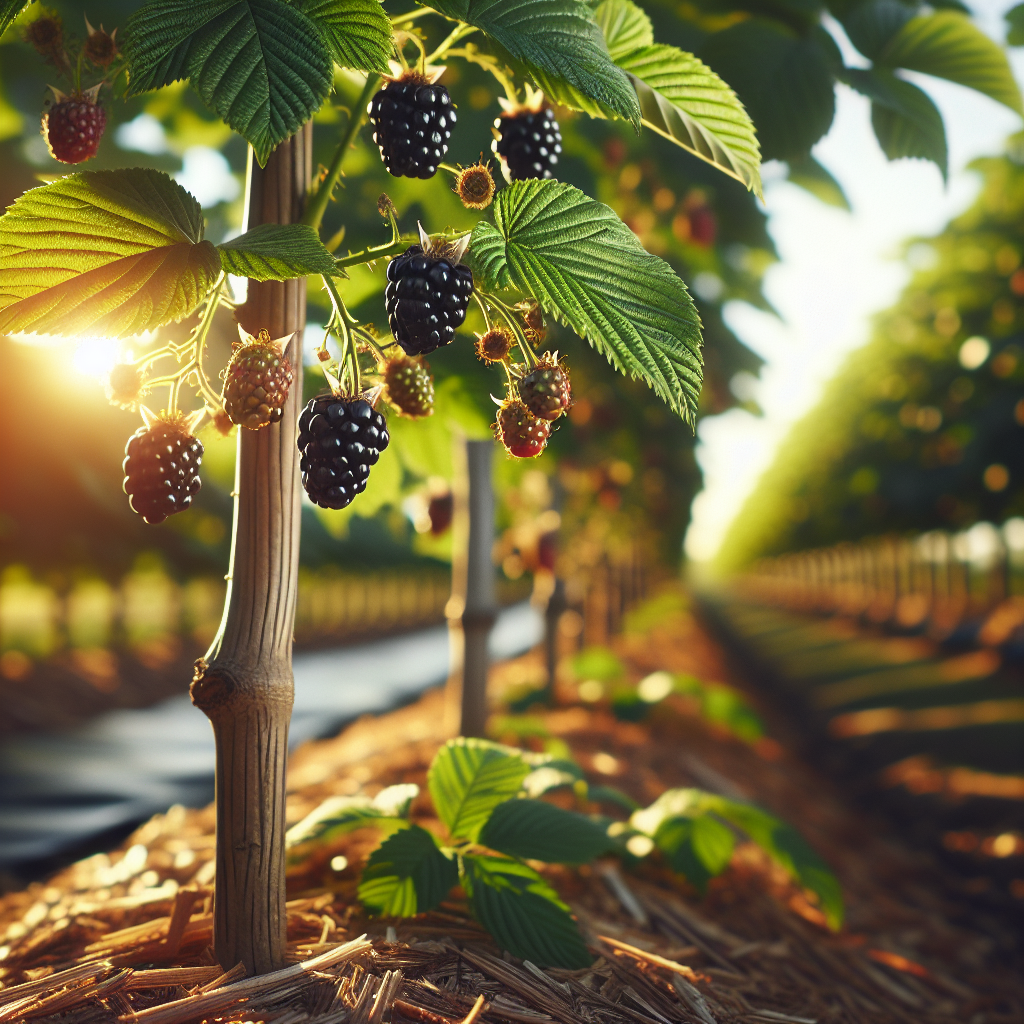
Introduction to Blackberry
Blackberries are among the most rewarding cane fruits for home gardeners, market growers, and diversified farms because they combine perennial root systems with annual cane turnover, allowing the planting to become more productive after establishment while still being regularly renewed. The crop belongs to a complex group of Rubus species and hybrids, and modern blackberries differ widely in growth habit, thorniness, chill requirement, berry firmness, flavor profile, and harvest season.
Historically, wild blackberries were gathered throughout Europe, Asia, and North America long before formal cultivation. Breeding programs later transformed the crop from a thorny hedgerow fruit into highly productive thornless cultivars suitable for trellised systems and commercial shipping. Today, growers can choose erect, semi-erect, trailing, and primocane-fruiting blackberries, each with different pruning and support needs. That distinction matters more than many beginners realize: most blackberry failures come not from poor fertility, but from using the wrong training method for the cultivar.
Blackberries are perennial below ground but biennial above ground in most types. The root crown and root system persist for many years, while individual canes live for two seasons: first-year vegetative canes are called primocanes, and second-year fruiting canes are called floricanes. After fruiting, floricanes die and must be removed. Understanding this cycle is the foundation of good management.
In culinary use, blackberries are exceptionally versatile. They can be sold fresh, frozen, dried, juiced, fermented, or processed into jams, syrups, wines, and desserts. Their dark pigmentation reflects high anthocyanin content, making them attractive in health-focused markets. For growers considering mixed berry production, comparing management habits with Raspberry can be useful, especially because disease carryover and trellising principles overlap.
Botanical Profile of Blackberry
Blackberry is usually classified under the Rubus fruticosus aggregate because cultivated forms derive from numerous closely related species and hybrids rather than a single simple species. It belongs to the family Rosaceae, which also includes apple, pear, strawberry, peach, and rose. Botanically, the blackberry fruit is not a true berry but an aggregate fruit made up of many drupelets attached to a receptacle that remains inside the fruit when picked.
Key botanical and horticultural features include:
- Growth habit: Erect, semi-erect, trailing, or primocane-fruiting.
- Canes: Usually green to reddish in the first year, becoming woody in the second. Thornless types have reduced or absent prickles but may still produce occasional spines on vigorous basal growth.
- Leaves: Alternate, compound, commonly with three or five leaflets, serrated margins, and a slightly rough surface.
- Flowers: White to pale pink, five-petaled, insect-pollinated, borne on second-year floricanes in traditional cultivars and on current-season primocanes in primocane-fruiting types.
- Fruit development: Individual drupelets enlarge after pollination; incomplete pollination can lead to misshapen berries.
- Roots: Fibrous with a perennial crown; blackberries generally do not tolerate prolonged waterlogging because fine feeder roots lose oxygen quickly.
Cultivars vary substantially. Erect blackberries such as many Arkansas releases are more self-supporting and often easier for smaller growers. Semi-erect types usually require a robust trellis and can produce large, high-quality fruit. Trailing blackberries, common in milder climates, often offer outstanding flavor but demand disciplined tying and pruning. Primocane-fruiting blackberries can crop on current-season canes, extending harvest windows and simplifying pruning in some climates.
Blackberries are generally self-fertile, so a single cultivar can produce fruit without a pollinizer. However, bee activity markedly improves fruit set, drupelet fill, and berry shape. Cool, rainy bloom periods often reduce marketable yield even when the plants appear healthy.
Soil, pH, and Climate Requirements for Blackberry
Blackberries perform best in deep, well-drained, moderately fertile soils rich in organic matter. The ideal soil texture is sandy loam to loam, though clay loams can work if internal drainage is improved with raised beds, organic matter incorporation, and careful irrigation. Shallow, compacted, or chronically wet sites are poor choices because blackberry roots need oxygen as much as moisture.
The preferred soil pH is 5.5 to 6.5, with an ideal target near 6.0 to 6.3. Below pH 5.2, nutrient availability may become unbalanced and aluminum or manganese toxicity can limit root growth. Above pH 6.8, iron and manganese deficiencies become more common, especially on calcareous soils, showing as interveinal chlorosis on younger leaves. Soil testing should be done several months before planting so lime or sulfur can be incorporated uniformly.
For best establishment, soil organic matter should be at least 3-5%. Organic matter improves moisture retention while preserving pore space, which is essential for root health. Blackberry roots prefer consistently moist soil, not saturated soil. A practical moisture target is about 60-80% of field capacity through active growth and fruit fill. In the field, this means the top 10-15 cm of soil should feel cool and slightly moist, not dusty dry and not sticky or anaerobic-smelling. If you squeeze a handful of soil, it should hold together lightly but break apart easily. Overwatered blackberry soil smells sour, compacts underfoot, and often produces pale foliage, weak cane growth, and root decline.
Climatically, blackberries are best suited to temperate to warm-temperate regions. Most cultivars need full sun for maximum sugar accumulation and cane strength, ideally 8 or more hours of direct sunlight daily. In very hot inland areas, light afternoon shade can reduce sunscald on fruit, but too much shade decreases flower bud formation and increases disease pressure.
Temperature considerations are cultivar-specific:
- Winter chill: Many blackberries need a modest chill period to break dormancy properly, though requirements vary widely.
- Cold injury: Some thornless and trailing cultivars are damaged below about -10 to -15°C (14 to 5°F), while hardier erect types tolerate colder winters.
- Heat stress: Sustained temperatures above 32-35°C (90-95°F) during ripening can soften fruit, reduce shelf life, and increase sunburn.
- Frost sensitivity: Open flowers and newly set fruit are vulnerable to spring frost. A site with good air drainage is critical.
Avoid planting where tomatoes, potatoes, peppers, eggplants, or old brambles recently grew, as these may share soilborne disease complexes and verticillium risk. Broad principles of soil improvement discussed in soil health strategies are especially relevant before establishing a long-lived berry block.
Step-by-Step Planting & Propagation
Start with certified disease-free nursery plants. This is non-negotiable for commercial-quality blackberry production because viruses, cane blight organisms, and crown gall can enter the planting on infected stock and persist for years.
1. Select the right cultivar and growth habit.
Choose based on winter minimums, summer heat, desired fruiting season, fresh-market versus processing use, thornless preference, and whether you want floricane-only or primocane-fruiting production. This single decision determines your trellis, pruning schedule, and long-term labor demand.
2. Prepare the site 3-12 months ahead.
Remove perennial weeds completely, especially bindweed, bermudagrass, quackgrass, dock, and thistle. Deep-rooted perennial weeds become extremely difficult to control once blackberries are planted. Subsoil or rip compacted layers if drainage is restricted. Incorporate compost only if it is mature and low in salts; excessive raw organic inputs can create nitrogen immobilization or root burn.
3. Build beds if needed.
In heavier soils or rainy climates, form raised beds 20-30 cm high and 60-90 cm wide. Raised beds improve oxygenation and reduce crown rot risk.
4. Install irrigation before planting.
Drip irrigation is strongly preferred. One or two drip lines per row are common, depending on soil texture. Sandy soils benefit from closer emitter spacing and more frequent cycles; loams need longer but less frequent irrigation.
5. Plant during dormancy or early spring.
Bare-root plants are usually set in late winter to early spring while dormant. Container plants can be planted later, but avoid peak heat unless irrigation is excellent.
6. Spacing.
Typical in-row spacing is:
- Erect types: 0.6-1.0 m between plants
- Semi-erect types: 1.5-2.5 m between plants
- Trailing types: 2.0-3.0 m between plants
Row spacing commonly ranges from 2.5-3.5 m, depending on machinery, airflow needs, and trellis design.
7. Planting depth.
Set plants so the crown is at or just slightly below the final soil level, generally 2-4 cm deeper than in the nursery for bare-root stock. Spread roots naturally; do not cram them into a narrow hole. Water immediately to settle soil around roots.
8. Initial cutback.
After planting, cut canes back to 15-25 cm if recommended for the planting stock type. This reduces transpiration stress and encourages strong new cane emergence from the crown.
9. Mulch.
Apply 5-8 cm of clean straw, leaf mold, pine bark, or wood chips, keeping mulch a few centimeters away from the crown to reduce rot risk. Mulch stabilizes moisture, suppresses weeds, and moderates root-zone temperature.
Propagation is usually by tip layering, root cuttings, suckers, or tissue-cultured plants, depending on type. Trailing and semi-erect blackberries often root readily when cane tips are buried in late summer. Erect blackberries may be propagated from root cuttings. For varietal integrity and disease prevention, commercial growers should avoid casual propagation from unknown plants.
Care & Maintenance regimes for Blackberry
First-year care should focus on establishment, root expansion, and cane framework rather than maximum yield. Remove flowers from weak new plantings if plant vigor is poor. Strong establishment in year one determines productivity in years two through six.
Irrigation management is critical. Blackberry water demand rises sharply from rapid spring growth through harvest. A mature planting often needs about 25-40 mm of water per week, increasing in sandy soils, windy sites, or hot conditions. During bloom and fruit swell, avoid moisture stress because drought at this stage causes small berries, poor drupelet fill, and crumbly fruit texture. Yet overirrigation is equally harmful. Signs of underwatering include dull or folded leaves by midday, undersized berries, poor cane elongation, and dry soil below the mulch. Signs of overwatering include persistent leaf yellowing, soft lush growth, weak root anchorage, cane dieback from the base, and fruit with bland flavor and poor shelf life.
A practical schedule with drip irrigation is to wet the root zone to 20-30 cm deep in young plantings and 30-45 cm in mature plantings, then allow the upper few centimeters to re-aerate before the next cycle. Sandy soils may require short daily irrigation during heat, while loams often perform better with deeper watering two to three times weekly.
Fertilization should be based on soil and leaf analysis, but general practice is to apply nitrogen modestly in spring after growth starts. Excess nitrogen produces rank canes, delayed hardening, softer fruit, and greater disease pressure. Young plantings may receive split applications totaling roughly 20-40 g actual N per plant per season, while mature fields are commonly managed by area-based rates. Potassium is especially important for fruit fill and cane vigor. Calcium supports firmness, while magnesium may need supplementation in acidic sandy soils. Avoid chloride-heavy fertilizer where salt sensitivity is a concern.
Trellising and training depend on blackberry type:
- Erect types: Often supported by a simple two-wire trellis. Summer tipping of primocanes at 0.9-1.2 m encourages lateral branching.
- Semi-erect types: Need sturdy trellises. Primocanes are tipped at 1.2-1.5 m and laterals shortened in winter.
- Trailing types: Canes are tied to wires, often separating primocanes from floricanes to ease harvest and pruning.
- Primocane-fruiting types: Can be mowed annually for a single late crop or managed for dual crops where climate allows.
Pruning is the defining maintenance task. Remove spent floricanes immediately after harvest by cutting them at ground level and taking them out of the planting. Do not leave dead canes standing; they harbor inoculum and obstruct airflow. During dormant pruning, thin primocanes to the strongest canes, usually 4-8 canes per crown or per linear section, depending on vigor and system. Shorten laterals to maintain a manageable fruiting zone and improve berry size.
Weed control should be meticulous. Blackberry roots are shallow in the upper soil profile, so hoeing deeply near crowns can cause damage. Mulch, landscape fabric in row strips, hand weeding, and shallow mechanical control are preferred. Uncontrolled weeds compete strongly for nitrogen and water, especially in new plantings.
Pests, Diseases & Organic Management
Blackberries can be highly productive, but they are not carefree. Pest and disease pressure depends strongly on climate, canopy density, sanitation, cultivar selection, and surrounding vegetation.
Common insect and mite issues include aphids, spider mites, Japanese beetles, thrips, cane borers, sap beetles, and spotted wing drosophila. aphids can also vector viruses. spider mites often flare in hot, dusty conditions, causing stippled leaves and reduced photosynthesis. spotted wing drosophila is especially serious because it lays eggs in ripening fruit, causing soft collapse and rapid market loss.
Organic management priorities include:
- Frequent harvesting to reduce overripe fruit in the field
- Removing cull fruit and wild bramble hosts nearby
- Maintaining open canopies for airflow and spray penetration
- Using exclusion netting where practical for high-value plantings
- Encouraging beneficials by avoiding broad-spectrum insecticides
- Monitoring with traps and regular scouting at least weekly during ripening
Major diseases include anthracnose, cane blight, spur blight, Botrytis fruit rot, orange rust, crown gall, phytophthora root rot, powdery mildew, and numerous viruses. Disease diagnosis is easier when symptoms are linked to plant part and season:
- anthracnose: Small purple lesions on young canes that enlarge into gray-centered spots.
- cane blight/spur blight: Dieback associated with wounds or weakened tissue; pruning injuries can be entry points.
- Botrytis: Gray mold on blossoms and fruit, favored by wet bloom and dense canopies.
- orange rust: Bright orange pustules on leaf undersides; infected plants become weak and unproductive and should be removed.
- phytophthora root rot: Common in saturated soils; plants decline gradually, often with poor vigor and sudden collapse during warm weather.
- viruses: Cause stunting, mosaic, crumbly fruit, and low vigor; prevention is far easier than cure.
The best organic disease program is preventive, not reactive:
- Plant certified clean stock.
- Use resistant or tolerant cultivars whenever available.
- Select well-drained sites with full sun and airflow.
- Remove and destroy fruited floricanes promptly.
- Keep rows narrow to reduce humidity.
- Avoid overhead irrigation, especially during bloom and ripening.
- Sanitize pruners between suspect plants.
- Remove symptomatic plants when systemic diseases are suspected.
Copper and sulfur products may have a place in organic systems, but timing and cultivar sensitivity matter; always test cautiously because foliage burn can occur, especially in hot weather.
Birds, deer, and rabbits may also become major losses. Bird netting is often the most reliable solution for fresh-market production. Deer browsing on new canes can severely reduce next year’s crop.
Harvesting, Curing & Optimal Storage
Blackberries do not continue to sweeten after picking, so harvest maturity is essential. Fruit should be fully colored, glossy to slightly dull depending on cultivar, plump, and easy to detach with a gentle pull. Red-black transitional fruit is under-ripe and will be tart. Overripe berries become soft, leak juice, and collapse rapidly.
Harvest every 1-3 days in warm weather. Morning harvest after dew has dried but before the heat of midday usually gives the best shelf life. Fruit picked when hot has higher respiration and softens faster. Handle berries gently and harvest directly into final containers when possible to reduce compression injury.
Unlike curing crops such as onions or garlic, blackberries are not cured in the traditional sense. Instead, they require rapid field heat removal. Cool fruit to 0-2°C (32-36°F) as quickly as possible, ideally within a few hours of harvest. Relative humidity should be high, around 90-95%, to reduce shriveling, but condensation on fruit surfaces should be minimized because free moisture favors decay.
Storage life is short:
- At room temperature: often less than 1 day at peak ripeness
- Under ideal refrigeration: usually 2-5 days for high-quality fresh fruit
- Exceptional firm cultivars under excellent handling may hold slightly longer
Do not wash berries until just before use unless they are being processed immediately. Washing before storage increases breakdown. For processing, freezing is excellent: spread dry berries in a single layer, freeze, then pack into moisture-proof bags. This preserves shape better than freezing in a deep mass while warm.
For best flavor, harvest when berries are fully black and aromatic, but for shipping, pick just slightly firmer. Fresh-market quality is judged by berry size uniformity, dry clean calyx scar, firm texture, absence of red drupelet reversion, and freedom from mold or leaking juice.
Companion Planting for Blackberry
Companion planting around blackberries should be approached as a system of ecological support rather than folklore. Because blackberries are perennial, thorny, and often trellised, companions should improve pollination, weed suppression, biodiversity, or soil cover without competing aggressively for water and nutrients.
Good companions include low-growing insectary and groundcover plants such as alyssum, yarrow, clover in managed alleys, chives, and certain mints grown carefully in containers or controlled strips. Flowering herbs can attract hoverflies, lacewings, parasitic wasps, and pollinators, which help with both fruit set and pest balance. White clover in row middles can reduce erosion and provide nitrogen cycling, though it should not be allowed to encroach on the crown zone where competition becomes significant.
Alliums such as garlic and chives are often used near berry plantings because their scent may help disrupt some pest activity and they occupy little vertical space. However, keep the immediate root zone around young blackberries competition-free for the first one to two years.
Avoid companion plants that create dense shade, hold excessive humidity around canes, or share serious diseases. Solanaceous crops such as tomato, pepper, and potato are poor neighbors in rotations because they can overlap in disease issues and complicate sanitation. Aggressive rhizomatous herbs or sprawling vines should also be avoided because they interfere with harvest and cane renewal.
The most effective blackberry companion strategy is often this combination: a weed-free mulched in-row strip, flowering beneficial plants at row ends or alley margins, and mowed cover crops between rows. This setup improves access, drainage, beneficial insect habitat, and long-term soil structure without sacrificing cane vigor or berry quality.