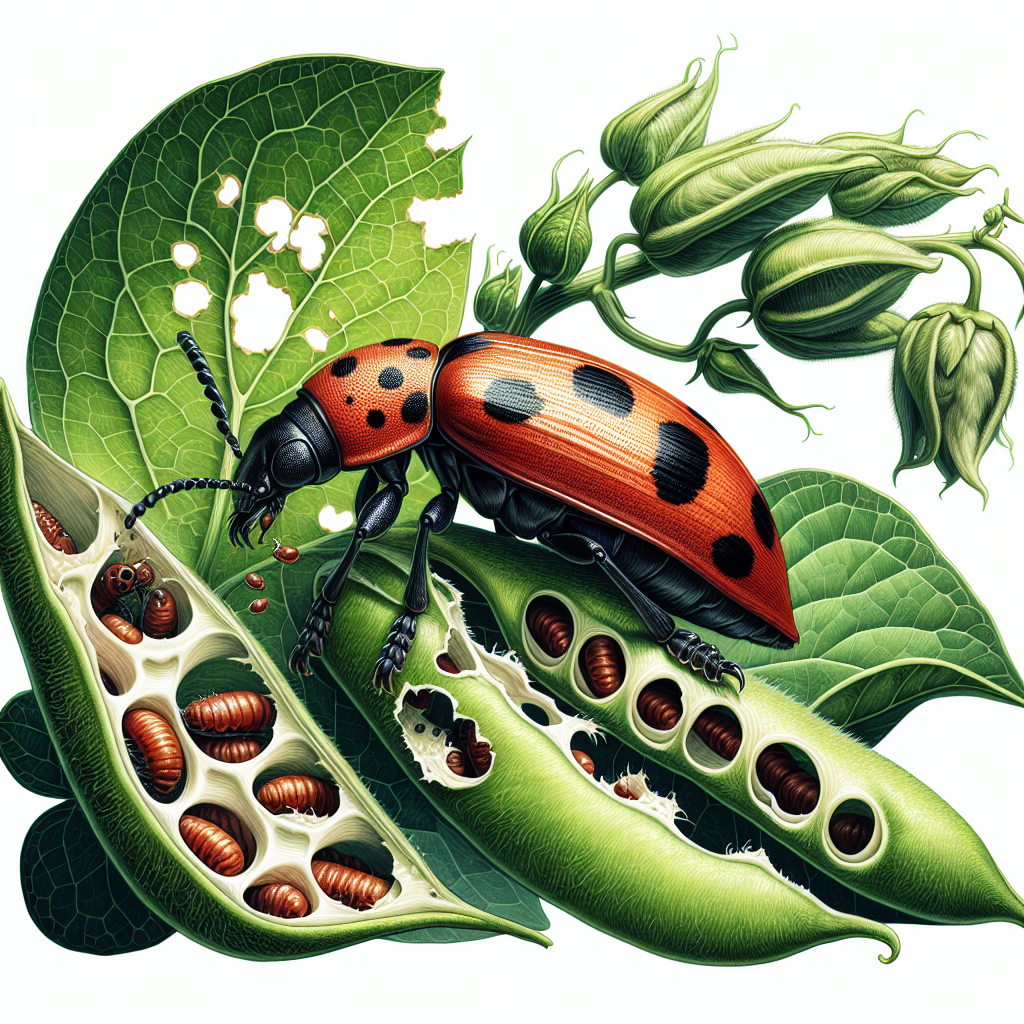
Introduction to Bean beetles
Bean beetles represent a group of coleopteran pests that pose serious threats to legume crops, particularly beans, peas, and related pulses. The primary culprits include the bean weevil (Acanthoscelides obtectus), a seed-infesting bruchid, and the bean leaf beetle (Cerotoma trifurcata), known for defoliation and pod damage. These pests thrive in warm climates and can devastate both field and storage crops, with global economic losses estimated in millions annually. Understanding their biology is crucial for farmers growing Blue Lake Bush Bean, Kentucky Wonder Pole Bean, or soybeans. Early detection and integrated management are key to protecting yields. This definitive guide covers identification, lifecycle, triggers, organic treatments, prevention, and affected crops, empowering growers with professional-grade strategies.
Identifying Symptoms & Damage
Bean beetles inflict distinct damage patterns across plant stages. Adult bean leaf beetles are red to orange with black spots and legs, measuring 5-7 mm, while seed beetles are smaller (2-4 mm) with rounded bodies and patterned elytra. Look for:
- Foliage Damage: Irregular holes in leaves, often with shot-hole appearance from leaf beetle feeding. Severe defoliation can strip plants bare, reducing photosynthesis by 30-40%.
- Pod Damage: Chewed pods with entry holes; larvae tunnel inside, causing seeds to shrivel or rot. Infested pods may drop prematurely.
- Seed Infestation: Post-harvest, seed beetles lay eggs in beans; larvae bore into seeds, leaving frass and creating emergence holes (1-2 mm). Infested seeds show powdery interiors and fail to germinate.
- Secondary Signs: Sticky honeydew from associated aphids, sooty mold, and stunted plants. Differentiate from Mexican bean beetle (larvae are spiny) or flea beetles (smaller jumps). Use a 10x hand lens to spot eggs (white, clustered) or larvae (cream-colored, legless).
Scout weekly from seedling stage, shaking plants over white paper to detect adults. Threshold: 20% defoliation or 1 beetle per 3 plants triggers action. Accurate diagnosis prevents confusion with diseases like bean rust or common bacterial blight.
Lifecycle and Progression of Bean beetles
Bean beetles undergo complete metamorphosis with four stages: egg, larva, pupa, adult. Lifecycle varies by species and temperature (optimal 25-30°C).
- Eggs: Females lay 50-100 tiny white eggs on pods, leaves, or seeds. Hatching in 5-10 days.
- Larvae: Legless grubs bore into plant tissue, feeding for 2-4 weeks. Seed beetle larvae develop inside beans; leaf beetle larvae pupate in soil.
- Pupa: 5-7 days in silken cocoons within damaged tissue or soil.
- Adults: Emerge to feed and reproduce, living 2-4 weeks. Multiple generations (3-6) per season in tropics.
Overwinter as diapausing adults or late larvae in crop debris. Progression accelerates in humid, warm conditions; cooler temps extend to 8-10 weeks. Monitor with traps to predict peaks. Compare to Bruchids, which are strictly seed pests. Breaking the cycle at larval stage is most effective.
Environmental Triggers & Risk Factors
Bean beetles proliferate under specific conditions:
- Temperature: 20-35°C ideal; populations explode above 25°C.
- Humidity: 60-80% RH favors egg hatch and larval survival.
- Crop Factors: Dense planting, late-maturing varieties, and volunteer plants harbor pests. Poor sanitation leaves overwintering sites.
- Soil and Weeds: Weedy fields with legumes like cowpeas act as reservoirs. Drought-stressed plants are more susceptible.
- Regional Risks: Prevalent in Americas, Africa, Asia; migrate via infested seeds or equipment.
Risk spikes post-rainy season or near corn fields, where beetles alternate hosts. Companion crops like marigold reduce incidence. Check Spring Pest Patrol: Organic AI Strategies to Shield Your Crops from Common Invaders for predictive tools. Avoid monocultures of susceptible varieties.
Organic Control & Treatment Plans
Organic management emphasizes IPM: prevention, monitoring, and targeted interventions.
- Cultural Controls (40% efficacy): Rotate with non-legumes (e.g., wheat, corn) for 2-3 years. Till soil post-harvest to expose pupae. Plant early-maturing varieties.
- Physical Barriers: Row covers exclude adults. Trap crops like cowpeas divert pests.
- Biological Agents: Release predatory beetles or parasitoids (e.g., Dinarmus basalis). Encourage ladybugs via flowering borders.
- Botanicals: Neem oil (0.5%) or pyrethrum sprays weekly at early infestation. Kaolin clay coats plants repellently.
- Storage Management: Solarize seeds (heat to 50°C for 1 hour) or diatomaceous earth in bins. Hermetic bags kill larvae via CO2 buildup.
Treatment Plan:
- Week 1: Scout, remove infested pods.
- Week 2-4: Apply neem + BT for larvae; yellow sticky traps for adults.
- Monitor: Reduce to <5% damage.
Combine with Soil Health Mastery: 5 Proven Strategies for Small Farms to Build Fertile Ground Without Breaking the Bank for resilient plants. Avoid broad-spectrum sprays to preserve predators.
Preventing Bean beetles in the Future
Long-term prevention builds resilient systems:
- Crop Rotation: 3-year cycle away from legumes.
- Resistant Varieties: Choose 'Sierra' or 'Black Magic' beans.
- Sanitation: Destroy residues, clean equipment.
- Monitoring: Pheromone traps, regular scouting.
- Habitat Management: Mulch to disrupt soil pupae; interplant nasturtium as trap crop.
- Seed Treatment: Hot water dip (55°C, 10 min) or biofumigants.
Integrated with weather monitoring, prevention cuts populations 70-90%. Educate on Why Companion Planting Feels Like Guesswork for Small Farms - And How AI Makes It Foolproof for optimized pairings.
Crops Most Affected by Bean beetles
Primarily legumes:
- Bush and pole beans (e.g., Blue Lake Bush Bean, Kentucky Wonder).
- Soybeans, chickpeas, peas, lima beans.
- Pulses like lentils, kidney beans, pinto beans.
- Storage losses in dry beans, cowpeas.
Secondary: Cowpeas, mung beans. Yields drop 20-80% without control. Protect these staples for food security.