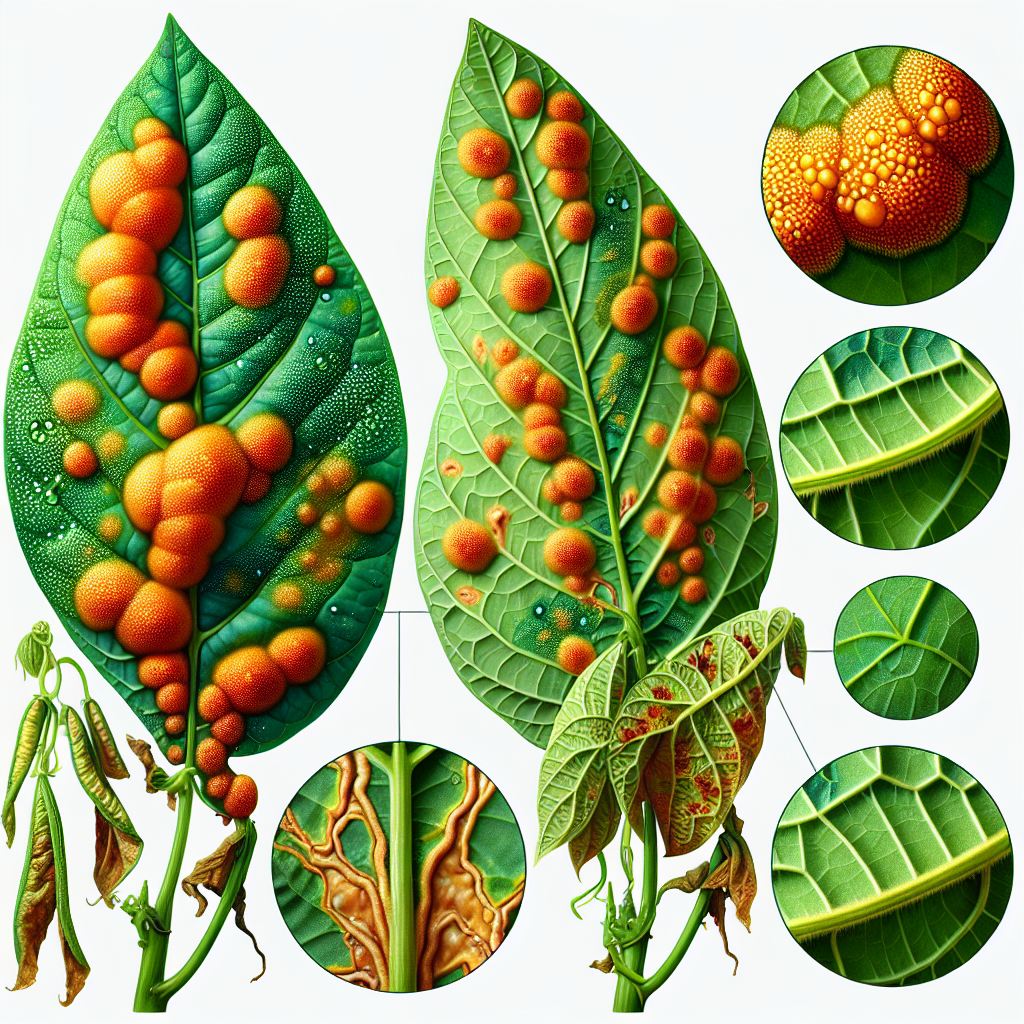
Introduction to Bean rust
Bean rust, scientifically known as Uromyces appendiculatus (synonyms include Uromyces phaseoli), stands as one of the most pervasive and economically damaging foliar diseases affecting bean crops worldwide. This obligate parasitic fungus targets primarily Phaseolus species, including common bean (Phaseolus vulgaris), but can also infect related legumes like runner beans and lima beans. First identified in the 19th century, bean rust has plagued agriculture across temperate and tropical regions, causing annual global losses estimated in millions of dollars due to reduced photosynthesis, pod deformation, and plant death.
The disease manifests as raised, rust-colored pustules that erupt from leaf surfaces, releasing infectious spores that spread via wind and splashing water. In severe epidemics, entire fields can yellow and defoliate within weeks, compromising bean production for dry beans, snap beans, and green beans alike. Understanding bean rust is crucial for legume growers, as it not only impacts yield but also seed quality, making infected plants unsuitable for replanting. This guide provides comprehensive diagnostics, lifecycle insights, and proven management strategies to safeguard your bean harvest. For related legume issues, see Soybeans cultivation tips.
Early detection is key; symptoms often appear 7-10 days after infection during warm, wet weather. Without intervention, secondary infections amplify, turning isolated spots into field-wide devastation. Growers in high-risk areas like the U.S. Midwest, Latin America, and East Africa report rust as a top constraint, often necessitating integrated approaches combining resistance, sanitation, and organics.
Identifying Symptoms & Damage
Bean rust symptoms begin subtly on the underside of lower leaves, progressing to upper surfaces and other plant parts. Initial signs include small, chlorotic (yellow) flecks that evolve into circular to oval, brick-red or cinnamon-brown pustules measuring 0.5-2 mm in diameter. These pustules contain urediniospores, the primary infectious stage, appearing velvety under magnification. As infection advances, pustules coalesce, causing leaf yellowing, necrosis, and premature drop. Stems develop elongated rust streaks, while pods show sunken, reddish lesions that distort seeds and reduce marketability.
Damage severity correlates with infection timing: early-season attacks stunt growth, mid-season defoliation slashes pod set by 50-70%, and late infections blemish pods, downgrading fresh market value. Yield losses range from 20% in mild cases to 90-100% in epidemics, with dry bean weight plummeting due to shriveled seeds. Differentiate from lookalikes like Alternaria leaf spot, which produces darker, zonate lesions without pustules, or common bacterial blight, featuring water-soaked halos.
Diagnostic tips: Use a 10x hand lens to confirm bicellular urediniospores (kidney-shaped, echinulate). Scrape pustules onto white paper; orange spore dust confirms rust. In cool climates, telia (black, wintering structures) form on debris. Systemic effects include stunted plants with sparse foliage, mimicking nutrient deficiencies but with distinct pustules. Scout weekly from vegetative stages, noting higher incidence on crowded, irrigated fields.
Lifecycle and Progression of Bean rust
Uromyces appendiculatus follows a complex lifecycle with up to five spore stages, though in beans, it's typically microcyclic, producing only urediniospores. Infection starts when windblown urediniospores (produced abundantly, up to 500,000 per pustule) land on wet bean leaves. Germination occurs optimally at 18-24°C (64-75°F) with free water for 6-8 hours. Hyphae penetrate stomata within 24 hours, incubating 7-14 days before new pustules erupt.
Each pustule cycle repeats every 10-14 days under ideal conditions, generating billions of spores per plant. In temperate zones, teliospores overwinter in plant debris, germinating in spring to produce basidiospores infecting nearby barberry (Berberis vulgaris), the alternate host—though rare in bean pathosystems. Aeciospores from barberry rarely reach beans, making urediniospores the epidemic driver. Progression accelerates post-flowering, with polycyclic spread fueled by rain splatter and convection currents up to miles away.
Lifecycle bottlenecks include dry spells (>3 days) halting spore germination and temperatures >30°C (86°F) killing spores. In tropics, year-round survival occurs via volunteer plants and debris. Understanding this enables timed interventions, like fungicide applications at first pustules.
Environmental Triggers & Risk Factors
Bean rust epidemics hinge on the 'rust triangle': susceptible host, virulent pathogen, and conducive environment. Optimal conditions: 15-25°C (59-77°F) daytime, >90% relative humidity, leaf wetness >6 hours nightly, and moderate winds for dispersal. Heavy dew, overhead irrigation, and dense canopies exacerbate outbreaks, as spores splash upward from soil.
Risk factors include planting susceptible varieties like 'Black Turtle' without rotation, high nitrogen fostering succulent growth, and fields near overwintering debris or Soybeans (common co-host). Poor airflow from narrow rows (<45 cm) traps moisture, while acidic soils (pH <6) stress plants, reducing resistance. Regional hotspots: humid subtropics (Florida, Brazil) see 2-3 cycles/season; continental climates risk explosive spring outbreaks post-rain. Climate change extends seasons, with warmer nights boosting spore viability. Monitor forecasts; prolonged leaf wetness >72 hours predicts severe progression.
Organic Control & Treatment Plans
Organic management integrates cultural, biological, and approved fungicides. Step 1: Cultural Controls - Scout early, rogue infected plants, and prune for airflow. Apply compost teas to boost microbiome resilience.
Step 2: Biologicals - Bacillus subtilis or Trichoderma harzianum suppress via competition; apply weekly at 10^9 CFU/L from first symptoms.
Step 3: Organic Fungicides - Sulfur (OMRI-listed, 3-5 kg/ha) every 7-10 days, 3 applications max. Copper hydroxide (e.g., Bordeaux mix) at 2-3 L/ha, avoiding phytotoxicity >28°C. Potassium bicarbonate (2-5 kg/ha) disrupts spore germination.
Treatment Timeline: At 1% severity, apply sulfur + biological; repeat at 10% incidence. Rotate modes of action. For powdery mildew confusion, note rust's pustules. Efficacy: 70-85% reduction in resistant systems. Check Spring Pest Patrol for scouting tips.
Preventing Bean rust in the Future
Prevention outperforms cure: Select resistant varieties like 'Sierra, 'Viva' (hypersensitive response), or 'Don Timoteo'. Rotate with non-hosts (e.g., corn, 2-3 years). Destroy debris post-harvest via tillage or flaming. Space rows 60-75 cm, plants 10-15 cm for ventilation. Mulch suppresses soil splash; drip irrigate to minimize wetness.
Seed certification ensures clean starts; solarize soil pre-planting. Intercrop with marigold for trap cropping. Monitor with sticky traps for spore counts. Long-term: Breed multilines mixing resistances. In high-risk zones, early planting evades peak spore periods. Integrated plans yield 20-40% higher than reactive controls.
Crops Most Affected by Bean rust
Primary host: Common bean (Phaseolus vulgaris)—bush, pole, snap, dry types. Secondary: Runner bean (P. coccineus), lima/hyacinth bean (P. lunatus), tepary bean (P. acutifolius). Rare on fava (fava bean), adzuki (adzuki bean), mung ([mung bean](/wiki/mung bean)). No infection on soybean despite family ties. Global impact: 80% of commercial bean acreage at risk; worst in humid tropics/subtropics.