Introduction to Bruchids
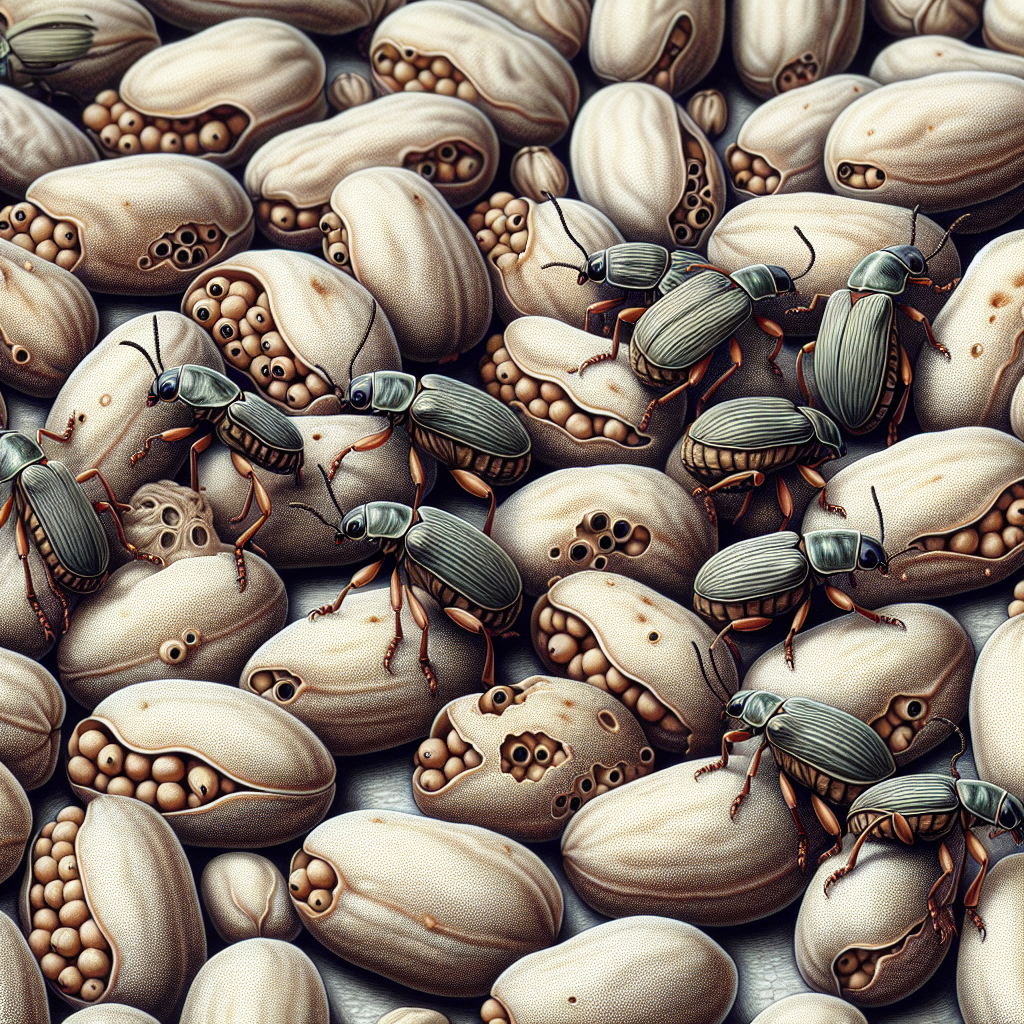
Bruchids, belonging to the family Bruchidae, are a group of small beetles notorious for infesting legumes and pulses, both in the field and during storage. Often called bean weevils, cowpea weevils, or seed beetles, species like the cowpea weevil (Callosobruchus maculatus), adzuki bean weevil (Callosobruchus chinensis), and Mexican bean weevil (Zabrotes subfasciatus) target dry seeds of crops such as chickpeas, lentils, peas, soybeans, and various beans. These pests are cosmopolitan, thriving in warm climates and causing up to 100% loss in untreated stored grains in tropical and subtropical regions.
Adult bruchids are 2-4 mm long, with rounded bodies, long legs, and characteristic humped thoraxes. Females lay eggs on seed surfaces, and larvae bore inside, feeding on the cotyledon and rendering seeds unfit for consumption or planting. Unlike weevils (Curculionidae), bruchids do not have elongated snouts, but their damage is equally devastating for smallholder farmers and commercial agriculture. Global trade exacerbates spread, with infested seeds easily transported across borders. For more on Spring Pest Patrol: Organic AI Strategies to Shield Your Crops from Common Invaders, check this resource. Understanding bruchid biology is crucial for timely intervention, as populations explode rapidly under favorable conditions.
Identifying Symptoms & Damage
Bruchid infestations are often undetected until advanced stages, as larvae develop internally. Key symptoms include tiny emergence holes (1-2 mm diameter) on seed surfaces, resembling pinpricks, often with frass (insect waste) around them. Infested seeds may show powdery residue, discoloration, or shriveling, and rattled contents when shaken due to hollowed interiors. Adults may be visible crawling on stored grains, but damage is primarily larval.
In the field, pods of legumes like peas or chickpeas may appear normal until harvest, when internal feeding reduces seed weight by 20-50%. Severe infestations lead to webbing, mold growth from moisture, and secondary issues like storage beetles. Differentiate from other pests: bruchid holes are neat and round, unlike irregular chewing from bean leaf beetles. Use a magnifying glass or float test—infested seeds sink due to reduced density. Economic thresholds vary: 1-2% infested seeds warrant action in storage to prevent exponential spread (one female lays 50-100 eggs).
Damage quantification: Larvae consume 10-90% of seed mass, depending on species and host. In soybeans, cowpea weevils reduce germination by 80%. Monitor monthly in storage using Berlese funnels or seed sieving. Early symptoms like egg clusters (white, flattened) on pods signal field infestations.
Lifecycle and Progression of Bruchids
Bruchids undergo complete metamorphosis: egg, larva, pupa, adult. Lifecycle spans 3-6 weeks at 25-35°C, with 4-10 generations per year in tropics. Females oviposit 20-150 eggs singly or in clusters on dry pods or seeds, gluing them with a pedicel. Eggs hatch in 4-7 days into legless larvae that chew into seeds, passing through 4 instars (10-20 days), feeding on endosperm.
Pupation occurs inside the seed (3-5 days), with adults emerging through characteristic 'T'-shaped exit holes. Adults are short-lived (7-15 days), non-feeding or minimally so, focused on reproduction. Diapause occurs in some species under cool, dry conditions, enabling survival in storage for months. Temperature optima: 28-32°C; development halts below 15°C or above 40°C. Humidity >60% accelerates hatching.
Progression: Field phase—oviposition on maturing pods; post-harvest explosion in bags/silos. One infested kg can yield 10,000 adults in 2 months. Monitor with pheromone traps for adults. Lifecycle knowledge informs controls like timing harvests before peak oviposition.
Environmental Triggers & Risk Factors
Warm temperatures (25-35°C) and humidity (60-80%) are primary triggers, favoring rapid development in tropical storage. Poor sanitation—leaving infested debris in fields—attracts females. Risk factors include late harvesting allowing pod oviposition, mixed storage of susceptible crops like lentils and peas, and inadequate drying (seeds >12% moisture invite bruchids).
Global trade spreads via contaminated seeds; regions like sub-Saharan Africa see 30-50% losses yearly. Crop residues, volunteer plants, and nearby wild legumes serve as reservoirs. High-density planting increases field pressure. Drought-stressed crops produce smaller seeds, more vulnerable. Compounding risks: soybean aphid outbreaks weaken plants, facilitating bruchids. Climate change extends seasons, boosting generations.
Organic Control & Treatment Plans
Integrated Pest Management (IPM) emphasizes non-chemical strategies. Sanitation: Clean storage areas, remove debris, use fine-mesh screens. Physical controls: Solarization (spread seeds in sun 2-3 days at 50°C kills eggs/larvae); hermetic bags (PICS) reduce oxygen, suffocating pests (95% mortality in 3 days). Temperature: Heat to 55°C for 30 min or freeze at -18°C for 3 days.
Biological: Introduce parasitoids like Anisopteromalus calandrae or Dinarmus basalis (80% parasitism rates). Botanicals: Neem oil (azadirachtin) at 5% coats seeds, repels 70-90%; diatomaceous earth (DE) at 1-2% abrades exoskeletons. Essential oils (clove, thyme) deter oviposition. Traps: Pheromone lures for monitoring.
Treatment plan:
- Inspect at harvest; discard >5% infested.
- Dry to <10% moisture.
- Treat with DE/neem mix.
- Store in hermetic containers.
- Monitor biweekly; fumigate if needed (e.g., phosphine, but organic alternatives preferred). Field: Early harvest, pod bagging, intercropping with marigold. Yields increase 20-40% with IPM.
Preventing Bruchids in the Future
Prevention outperforms cure. Use certified, pest-free seeds; rotate crops avoiding legumes consecutively. Harvest early, before pod maturity. Dry immediately to 9-10% moisture using solar dryers. Store in raised platforms, metal silos, or polypropylene bags; avoid gunny sacks.
Varietal resistance: Choose bruchid-tolerant cultivars like 'Blackeye' cowpeas or ICPL varieties of chickpeas. Hermetic storage (e.g., GrainPro liners) prevents 100% infestations indefinitely. Field sanitation: Deep plow residues to bury pupae. Monitor with delta traps. Educate on IPM via farmer field schools. Long-term: Breed resistant varieties, integrate with aphids management for synergy. Annual losses drop 80% with vigilance.
Crops Most Affected by Bruchids
Bruchids primarily target Fabaceae: cowpea (most susceptible, 50-100% loss), mung bean, black gram, chickpeas, pigeon pea, lentils, peas, soybeans, adzuki, kidney, navy beans. Lesser: peanuts, faba beans. Field crops like pigeon pea suffer pod infestations; storage hits all dry pulses. Emerging threats to quinoa and amaranth seeds. In Asia/Africa, cowpea weevil dominates; Americas favor bean weevils on pinto bean. Protect high-value like kabuli chickpeas first.