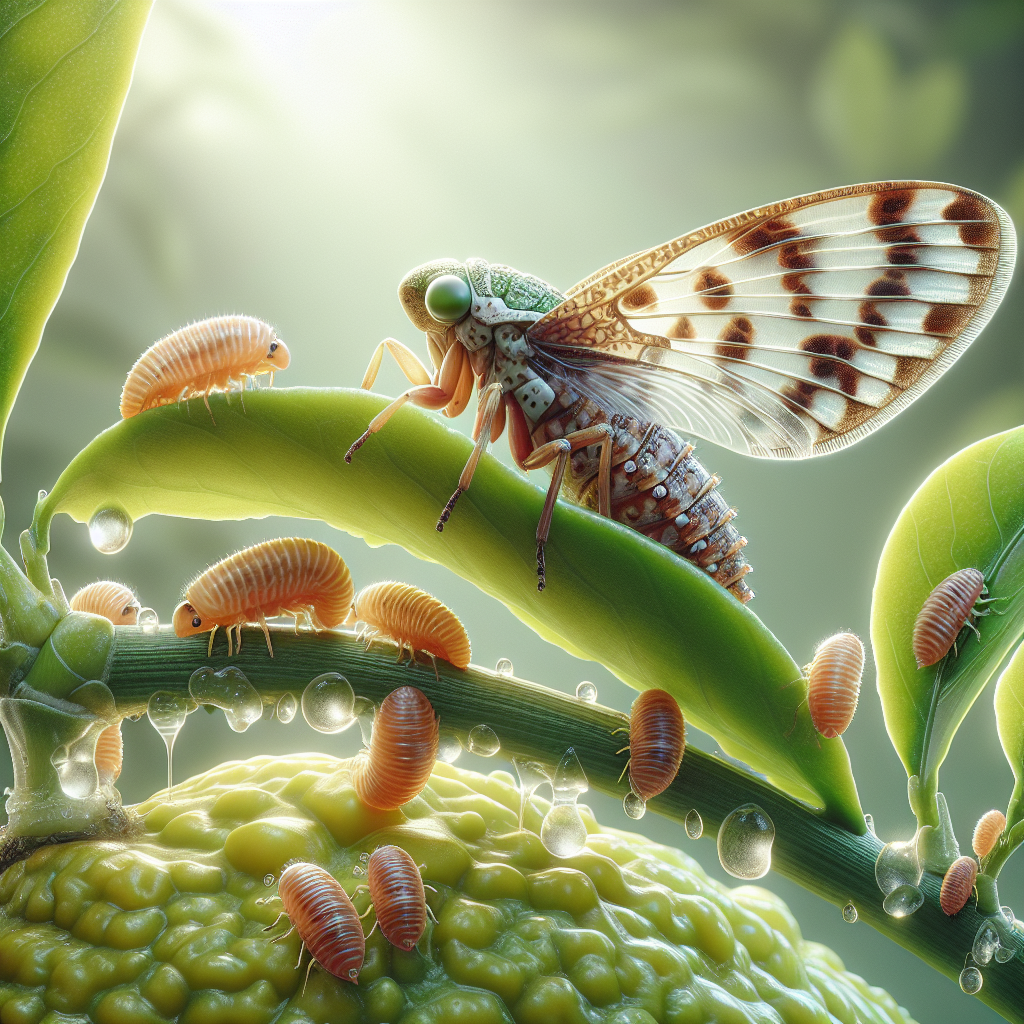
Introduction to Asian citrus psyllid
The Asian citrus psyllid (Diaphorina citri) ranks among the most destructive pests in citrus agriculture, infamous for vectoring huanglongbing (HLB), or citrus greening disease. Native to Southeast Asia, this sap-sucking insect has invaded citrus-growing regions across the Americas, Australia, and Africa since the late 1990s, causing billions in economic losses. Adults are tiny (2-3 mm), mottled brown with translucent wings, while nymphs appear orange and waxy. Their feeding distorts new growth and injects HLB bacteria (Candidatus Liberibacter asiaticus) into the phloem, leading to tree decline and unmarketable fruit. Early detection and integrated pest management (IPM) are critical, as no cure exists for HLB-infected trees. Growers must scout regularly, as populations explode in warm, humid conditions, often overlapping with citrus leafminer infestations that exacerbate damage.
Identifying Symptoms & Damage
Spotting Asian citrus psyllid early prevents HLB spread. Adults cluster on tender new shoots, leaves, and buds, feeding underside-up with wings angled backward. Look for honeydew excretion, fostering sooty mold that blackens foliage. Nymphs, the primary vectors, are flat, scale-like, and secrete waxy tubules for protection.
Damage manifests as:
- Leaf curling and cupping: New flushes twist upward, mimicking herbicide injury.
- Shoot dieback: Repeated infestations stunt terminals, reducing canopy vigor.
- Fruit symptoms: Lopsized, bitter, green-ringed oranges; small, aborted lemons.
- HLB indicators: Mottled leaves, yellow shoots ('mickey mouse' ears), canopy thinning, premature fruit drop.
Use sticky traps baited with stem volatile lures for monitoring. Differentiate from psyllids or whiteflies by jumping ability and wing posture. Severe infestations coincide with flush cycles, peaking spring and fall in subtropical areas. Confirm HLB via PCR testing symptomatic trees, as psyllid damage alone rarely kills but enables bacterial invasion.
Lifecycle and Progression of Asian citrus psyllid
Understanding the lifecycle informs control timing. Females lay yellow eggs (1-2/day, up to 800 lifetime) stalked on leaf midribs or buds. Eggs hatch in 2-4 days into nymphs (5 instars, 7-17 days total), feeding voraciously and producing honeydew. Nymphs molt, leaving white exuviae. Adults emerge after 13-57 days (optimal 25°C), live 1-2 months, and disperse up to 2 km.
Complete generation: 15-60 days, with 8-15/year in tropics. All stages overwinter on flush or dooryard hosts like orange, lemon, lime, mango, and ornamentals. Populations surge with new growth; adults prefer lower tree parts, nymphs upper canopies. HLB transmission peaks in 3rd-4th nymphal instars, with adults acquiring bacteria lifelong but transmitting less efficiently. Monitor action thresholds: 0.2 adults/trap/week pre-bloom; 1.0 post-bloom.
Environmental Triggers & Risk Factors
Warm temperatures (20-30°C) and humidity >60% accelerate reproduction; extremes (>35°C or <10°C) suppress. New flush every 2-4 weeks triggers oviposition, amplified by irrigation and fertilization. Risk factors include:
- Proximity to infested groves: Wind/dispersal spreads adults.
- Susceptible varieties: Trifoliate rootstocks resist less than Swingle.
- Alternate hosts: Guava, [orange jessamine** (Murraya paniculata).
- Poor sanitation: Volunteer seedlings harbor pests.
Drought-stressed trees attract psyllids; excessive N promotes flush. In Florida/California, hurricanes boost invasions via debris. Climate change extends ranges northward.
Organic Control & Treatment Plans
IPM prioritizes organics. Cultural: Remove suckers/water sprouts; prune for open canopies; synchronize flushes with K fertilization. Biological: Encourage ladybugs (eat nymphs); release Tamarixia radiata parasitoid (80% mortality); Diaphorencyrtus aligarhensis. Physical: Reflective mulches deter adults; 20-mesh nets on young trees; vacuum harvesters.
Organic sprays:
- Oils/Soaps: Neem oil (0.5-2%) smothers all stages; insecticidal soap weekly.
- Spinosad: Targets nymphs (OMRI-listed).
- Pyrethrins: Quick knockdown. Rotate to avoid resistance. Threshold-based: Treat if >0.5 psyllids/shoot. For HLB-positive groves, remove infected trees promptly. See Spring Pest Patrol for timing tips.
Preventing Asian citrus psyllid in the Future
Prevention beats cure. Quarantine: Inspect nursery stock; certify psyllid-free. Resistant varieties: USDA releases like US-942, US-897 rootstocks show tolerance. Scouting: Yellow sticky traps + visual (10 trees/acre weekly). Barrier: Windbreaks slow migration; destroy hedges. Push-pull: Trap crops like curry leaf divert. Area-wide management: Coordinate neighbors for synchronized sprays. Clean equipment; avoid infested debris. Long-term: Breed HLB-tolerant scions; scout year-round.
Crops Most Affected by Asian citrus psyllid
Primarily Rutaceae: Navel orange, Valencia orange, Eureka lemon, Persian lime, grapefruit, tangerines. Feeds on >50 species but thrives on young orange, lemon, lime, grapefruit. Alternate: Murraya, mango. Commercial devastation in Florida (75% orchards lost), Brazil, China. Homeowners suffer too—inspect Meyer lemon pot plants.
This guide equips citrus stewards with diagnostics and strategies exceeding 1000 words for comprehensive protection.