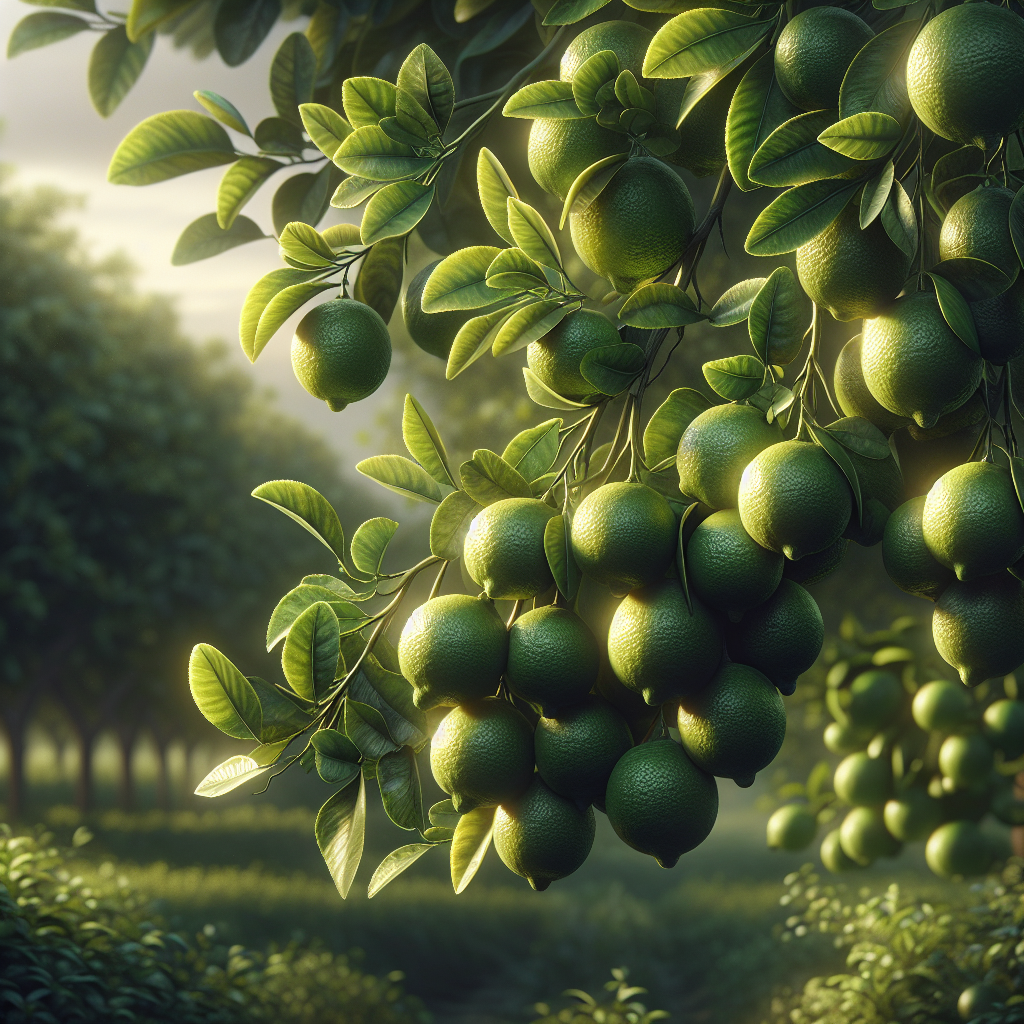
Introduction to Lime
Lime is one of the most commercially and culinarily important citrus crops in the world, prized for its sharp acidity, floral-oily rind, and broad use in beverages, cooking, preserves, and fresh markets. In practical growing terms, “lime” commonly refers to two major groups: the small, highly aromatic Key or Mexican lime (Citrus aurantiifolia) and the larger, nearly seedless Persian or Tahiti lime (Citrus latifolia). These differ in cold tolerance, thorniness, fruit size, canopy habit, and market preference, so growers should identify the intended type before planting.
Historically, limes spread from Southeast Asia through the Middle East into the Mediterranean and later the Americas via trade routes and colonial agriculture. They became indispensable in tropical and subtropical food systems because the trees can flower multiple times per year under favorable conditions and because the fruit stores and transports better than many softer tropical fruits. Commercially, Persian lime dominates export markets due to larger fruit, fewer seeds, and easier handling, while Key lime remains highly valued for concentrated aroma and specialty culinary use.
For growers, lime offers the advantage of a relatively compact evergreen canopy, high-value fresh fruit, and adaptability to orchard, homestead, or container systems. The crop is not forgiving of poor drainage, prolonged cold, or chronic nutrient imbalance. Good lime culture is less about one dramatic intervention and more about disciplined management: stable soil moisture, proper root-zone aeration, regular micronutrient feeding, sanitation, and careful canopy monitoring.
If you also grow other citrus, compare habits with Orange, since irrigation scheduling, micronutrient demand, and pruning philosophy are similar in broad terms, though limes are often more sensitive to cold and rind damage.
Botanical Profile of Lime
Lime belongs to the family Rutaceae, the citrus family, and is an evergreen woody perennial. Trees usually range from 2 to 5 meters in home settings, though orchard trees may grow larger if left unpruned. Growth habit depends heavily on rootstock, cultivar, pruning intensity, and local climate. Mexican lime tends to be more twiggy and thorny, with smaller leaves and fruit, while Persian lime is generally more vigorous, less thorny, and produces larger, oval fruit.
Leaves are simple, glossy, and aromatic due to the presence of oil glands. New flush emerges tender and pale green to bronze, hardening off into darker mature foliage. Citrus flowering is influenced by stress cycles, temperature patterns, and moisture dynamics. In many warm regions, lime can produce several bloom flushes annually, though one or two major flowering periods often dominate. Flowers are white, fragrant, and insect-attractive, though some fruit set can occur without heavy cross-pollination depending on the cultivar.
The root system is relatively shallow and concentrated in the upper soil profile, often with many feeder roots in the top 30 to 60 cm where moisture and oxygen are balanced. This is a crucial management point: because roots are shallow, lime suffers quickly from both drought stress and waterlogging. A tree may wilt in dry conditions not because roots are deep and inaccessible, but because its active feeder roots occupy a narrow soil zone that can dry rapidly.
Fruit is technically a hesperidium, the typical citrus berry type. Harvest maturity does not always coincide with full yellow coloration. Most fresh-market limes are harvested physiologically mature but still green to light green, especially Persian limes, which are traded based on size, juice content, peel smoothness, and external color. Key limes are often allowed to yellow further for home use because aroma intensifies, though acidity gradually softens.
Botanically, many lime types are complex hybrids or selections within a broader citrus ancestry. This matters because disease tolerance, vigor, and salinity response can vary significantly among named cultivars and rootstock combinations. In professional production, rootstock choice is often as important as scion choice for managing soil constraints, vigor, and disease pressure.
Soil, pH, and Climate Requirements for Lime
Lime performs best in well-drained, moderately fertile soils with high oxygen availability in the root zone. Sandy loams to loamy soils are ideal, but trees can also perform in heavier soils if planted on raised beds or mounds and if drainage is actively managed. The single most important soil rule is this: do not allow standing water around the root crown. Even 48 to 72 hours of saturated conditions in warm soil can trigger feeder-root death, Phytophthora infection, leaf yellowing, fruit drop, and long-term canopy decline.
Optimal soil pH is generally 6.0 to 7.0, with acceptable performance from about 5.5 to 7.5 depending on rootstock. At pH above 7.5, iron, zinc, and manganese deficiencies become common, especially on calcareous or high-bicarbonate soils. These deficiencies often appear as interveinal chlorosis on young leaves: the veins remain greener while the tissue between turns pale yellow. At very low pH, root stress and nutrient imbalance can also reduce growth.
Before planting, aim for a soil organic matter level that improves structure without creating a soggy, peat-heavy planting pit. Well-finished compost incorporated across a broad area is better than filling a narrow hole with rich organic material surrounded by native clay, which can create a perched water zone. A friable, aerated soil profile is more valuable than excessive fertility.
Temperature strongly influences lime success. Ideal production occurs where average warm-season temperatures stay between 23 and 32°C. Growth slows noticeably below about 15°C, and many lime types suffer leaf burn, twig injury, or fruit damage near freezing. Mexican lime is especially frost-sensitive; Persian lime is only slightly more tolerant. Mature trees may survive a brief light frost, but flowers, tender flush, and fruit are damaged well before wood is killed.
Lime prefers full sun, ideally 8 or more hours daily. Shading reduces flowering intensity, weakens canopy density, increases humidity retention, and can worsen fungal pressure. In very hot inland regions above 38°C, afternoon heat may cause fruit sunburn and leaf curl, especially if irrigation is inconsistent. In such climates, reflective mulches, white trunk paint, and windbreak design can reduce stress.
Rainfall requirements vary with soil type and evaporative demand, but a mature orchard often needs the equivalent of 900 to 1,500 mm of water annually from rainfall plus irrigation. The key is distribution. A month of heavy rain followed by six weeks of drought produces poorer results than steady root-zone moisture. For practical management, maintain soil moisture in the active root zone at a lightly moist condition, not wet and not powder-dry. If squeezed soil from 15 cm depth forms a weak ball that crumbles easily, that is often close to ideal. If it smears, glistens, or smells sour, it is too wet.
In windy sites, limes benefit from shelter. Strong wind scars fruit, tears young flush, dries blossoms, and can distort canopy architecture. Permanent windbreaks should be placed far enough away not to compete heavily for water and nutrients.
For broader root-zone fertility principles, see soil health strategies.
Step-by-Step Planting & Propagation
Most professional lime trees are propagated by budding or grafting onto selected rootstocks rather than grown from seed. Seedling trees are variable, often slower to bear, and may not match the parent fruit quality. Grafted trees provide more predictable vigor, disease response, canopy size, and soil adaptation.
Step 1: Choose the right cultivar and rootstock combination. For humid tropics and specialty flavor, Mexican lime is attractive but more disease- and cold-sensitive. For export-style or fresh-market production, Persian lime is generally preferred. Match the rootstock to soil conditions: some handle salinity better, others tolerate calcareous soils or certain root diseases more effectively.
Step 2: Select a planting site with full sun and drainage. If the site puddles after rain, do not plant at grade. Build a mound 30 to 50 cm high and at least 1 meter across. This raises the root crown, improves oxygen diffusion, and reduces collar rot risk.
Step 3: Test soil before planting. Confirm pH, salinity, and basic nutrient status. Citrus is moderately sensitive to salinity; high soluble salts can reduce water uptake, scorch leaf margins, and suppress fruit size.
Step 4: Prepare the ground broadly, not just the hole. Loosen compacted soil in a wide circle if possible. Avoid digging a deep, narrow pit in heavy soil because it can function like a basin. The planting hole should be only as deep as the root ball and two to three times as wide.
Step 5: Plant slightly high. Set the tree so the top of the root ball sits 2 to 5 cm above the surrounding finished soil grade. Never bury the graft union. A buried union encourages scion rooting and increases disease vulnerability.
Step 6: Backfill with native soil. Do not heavily amend the hole itself. Light watering during backfilling settles soil around roots without compacting it excessively.
Step 7: Irrigate immediately and mulch correctly. Apply water thoroughly after planting to eliminate air pockets. Then add 5 to 8 cm of coarse organic mulch over the root zone, keeping it 15 to 20 cm away from the trunk. Mulch touching the trunk traps moisture and promotes fungal infection.
Step 8: Stake only if necessary. In windy locations, use soft ties and remove supports once anchorage develops. Over-staking weakens trunk taper.
Spacing depends on system and vigor. Home garden trees may be placed 4 to 6 meters apart. Commercial orchards may use tighter spacing with pruning support. Overcrowding eventually reduces light penetration and fruit quality.
Propagation by air layering or cuttings is possible but less common commercially because rooted own-root trees may have different vigor and disease performance than grafted trees. Budding onto rootstock in active growth remains the professional standard.
Care & Maintenance regimes for Lime
Irrigation should be frequent enough to maintain active growth without saturating the root zone. Newly planted trees often need watering two to three times weekly in sandy soils during warm weather, or once every 5 to 7 days in heavier soils, adjusted for rain. Mature trees benefit from deeper, less frequent irrigation, but exact timing depends on evapotranspiration, soil texture, and canopy load.
A practical guide is to wet the top 30 to 60 cm of soil where most feeder roots are active, then allow partial drying before the next irrigation. Signs of underwatering include dull, folded, or slightly curled leaves during the morning, fruit drop, reduced flush, and small, thick-rinded fruit. Signs of overwatering include persistent leaf yellowing, soft weak flush, leaf drop without obvious wilting, sour-smelling soil, algae or moss near the trunk, and dieback of fine twigs despite moist ground.
Fertilization should be split into several small applications through the growing season rather than one heavy dose. Young trees need regular nitrogen to build canopy, while bearing trees require a balanced program including nitrogen, potassium, calcium, magnesium, sulfur, and essential micronutrients such as zinc, manganese, iron, and boron. Excess nitrogen pushes lush vegetative growth at the expense of fruit quality and can make the tree more attractive to Aphids and leafminers.
As a broad professional framework, apply fertilizer 3 to 6 times annually in frost-free climates, with rates scaled by tree age and expected crop load. Young nonbearing trees may receive modest nitrogen every 6 to 8 weeks during active growth. Mature bearing trees typically receive most nutrition from pre-bloom through fruit sizing. Potassium is particularly important for juice content, fruit size, and overall stress tolerance.
Micronutrient management is critical in lime. Foliar sprays of zinc and manganese are often useful where deficiencies recur. Iron chlorosis on alkaline soils usually responds better to chelated iron soil drenches than to foliar iron alone. Boron should be used cautiously: too little reduces flowering and fruit set, but too much can become toxic.
Pruning should be light and strategic. Remove dead wood, crossing shoots, rootstock suckers, and branches that drag on the ground. Maintain a canopy shape that admits filtered light and allows air movement without opening the tree so severely that interior limbs are sunburned. Major structural pruning is best done after harvest or before strong growth begins, avoiding periods of extreme heat or cold. Limes fruit on relatively young wood, so aggressive pruning can reduce the next crop.
Weed control is especially important in the first 2 to 3 years. Grasses and aggressive weeds compete strongly with shallow citrus roots. Maintain a weed-free circle around the trunk, ideally at least 1 meter wide for young trees and wider as they mature. Mulch, shallow hand weeding, and careful mechanical cultivation are preferable to deep cultivation, which damages feeder roots.
Fruit thinning is usually not required in backyard systems, but heavily set young trees may benefit from reducing crop load so branch structure and canopy development are not compromised. On immature trees, letting too much fruit mature can permanently slow framework establishment.
In containers, lime requires even more discipline. Use a sharply draining citrus mix, ensure excellent drainage holes, and irrigate when the upper few centimeters are dry but before the root ball becomes fully dry. Container trees often need more frequent feeding and more vigilant micronutrient correction.
Pests, Diseases & Organic Management
Lime is vulnerable to a wide range of pests, especially where warm temperatures permit continuous flushing. Citrus leafminer attacks tender new growth, creating serpentine mines and distorted leaves. It is most damaging on young trees where repeated flush injury slows establishment. Avoid forcing constant lush growth with excess nitrogen, and time horticultural oil or organic-compatible controls to very young flush if pressure is high.
Aphids, Scales, Mealybugs, and Whiteflies feed on sap and excrete honeydew, which encourages sooty mold. While sooty mold rarely infects tissue directly, it reduces photosynthesis and downgrades fruit appearance. Ant control is often essential because ants protect these pests from natural enemies. Sticky barriers on trunks, orchard sanitation, and encouragement of predators such as lady beetles and lacewings improve control.
Spider mites become more troublesome in hot, dusty conditions and can cause stippling, bronzing, and leaf drop. Dust suppression, adequate irrigation, and avoidance of unnecessary broad-spectrum pesticides support beneficial mite populations.
Fruit flies may attack ripening or damaged fruit in some regions. Timely harvest, sanitation of dropped fruit, and traps are important components of integrated management.
Among diseases, Phytophthora root rot and Gummosis are major threats in poorly drained soils. Symptoms include bark cracking near the crown, gummy exudate, yellowing leaves, reduced vigor, and root decline. The best organic management is prevention: raised planting, dry trunk collars, proper irrigation, and sanitary tools.
Citrus canker, Greasy spot, Melanose, Anthracnose, and various post-harvest rots can affect foliage and fruit depending on climate. Humid, rainy regions face the greatest pressure. Good airflow, timely pruning, sanitation, and copper-based sprays where locally permitted are common components of organic or low-synthetic programs.
Huanglongbing (citrus greening) is the most serious modern citrus disease in many production areas. It is spread by psyllids and causes blotchy mottled leaves, misshapen bitter fruit, twig dieback, and progressive decline. There is no simple curative treatment. Regional compliance, clean nursery stock, vector control, and rapid removal of infected trees are essential in affected areas.
Organic management works best as a system rather than a rescue tactic. Start with disease-free trees, balanced nutrition, excellent drainage, sanitation of prunings and fallen fruit, trunk protection from injury, beneficial insect conservation, and regular scouting at flush, flowering, and fruit-set stages. Weekly inspection of new growth, undersides of leaves, and fruit stems catches most problems early enough for low-impact intervention.
Harvesting, Curing & Optimal Storage
Lime harvest timing depends on cultivar, market, and intended use. Persian limes are usually harvested when fruit reach full size, feel heavy for their size, and show a glossy deep green to slightly lighter green skin. If left too long, they yellow, soften, and lose the premium fresh-market appearance, though they remain usable. Mexican limes may be harvested green for commerce or more yellow-green for home use when aroma is strongest.
Juice content is a better maturity indicator than color alone. Mature fruit should have well-developed internal segments, abundant juice, and characteristic aroma. Immature fruit feels dense but often yields less juice and may shrivel quickly after harvest.
Harvest carefully to avoid stem-end tearing and rind abrasion. Clippers are preferable to pulling by hand, especially for fresh-market fruit. Harvest during the cooler part of the day when possible. Wet harvesting increases spread of some pathogens and leaves fruit more vulnerable to storage problems.
Field handling matters greatly because lime peel bruises and scars easily. Use shallow picking bags or lined bins, avoid overfilling containers, and keep fruit shaded immediately after harvest. Wash only if necessary, and ensure fruit dries quickly after cleaning.
Unlike crops that require true curing, lime is generally conditioned rather than cured. Post-harvest management focuses on removing field heat, reducing moisture loss, minimizing decay, and preserving rind color. Store at cool but not chilling temperatures. A practical range for many limes is around 8 to 12°C with 85 to 90% relative humidity, though exact targets vary by cultivar and market duration. Temperatures that are too low can induce chilling injury, seen as rind pitting, discoloration, and increased decay after removal from storage.
At room temperature, limes may keep for 1 to 2 weeks depending on maturity and humidity. Under good cold storage, marketable life may extend to 3 to 6 weeks. Fruit should be inspected regularly and decayed specimens removed promptly. For home storage, refrigeration in a breathable bag helps reduce water loss without trapping excess condensation.
Do not store damaged fruit with sound fruit. Even minor punctures or stem-end injuries become entry points for mold organisms. Waxing is sometimes used commercially to reduce dehydration and improve appearance, but air exchange and sanitation remain essential.
Companion Planting for Lime
Companion planting around lime should be approached with orchard logic rather than casual garden folklore. The goal is not to crowd the root zone with random species, but to create a biologically active, low-competition understory that supports pollinators, beneficial insects, soil cover, and moisture moderation.
Useful companions include low-growing flowering herbs and insectary plants such as alyssum, dill, coriander, and basil in zones beyond the immediate trunk area. These can attract parasitoid wasps, hoverflies, and other beneficials that help suppress Aphids and soft-bodied pests. Leguminous cover crops may also be valuable between rows or in wider orchard alleys, improving soil structure and adding biologically cycled nitrogen when managed correctly.
Keep all companions at least 30 to 60 cm away from the trunk of young trees, and farther if they are vigorous. The area immediately around the trunk should stay weed-free and dry enough to prevent collar disease. Avoid dense plantings that trap humidity under the canopy or require frequent irrigation that keeps citrus roots too wet.
Good companion candidates are shallow, manageable, and easy to cut back. Poor companions are tall, thirsty, invasive, or disease-sharing species that crowd the canopy and compete for nutrients. Heavy feeders planted directly over the lime root zone can noticeably reduce fruit size and tree vigor.
In mixed home orchards, lime pairs well spatially with other warm-climate fruit trees if sun exposure and airflow are preserved. Pollinator strips at row edges are often more effective than planting directly under the canopy. If designing a diversified planting, prioritize access for pruning, harvesting, mulching, and pest scouting over ornamental density.
For more system-level ideas, review this companion planting guide.