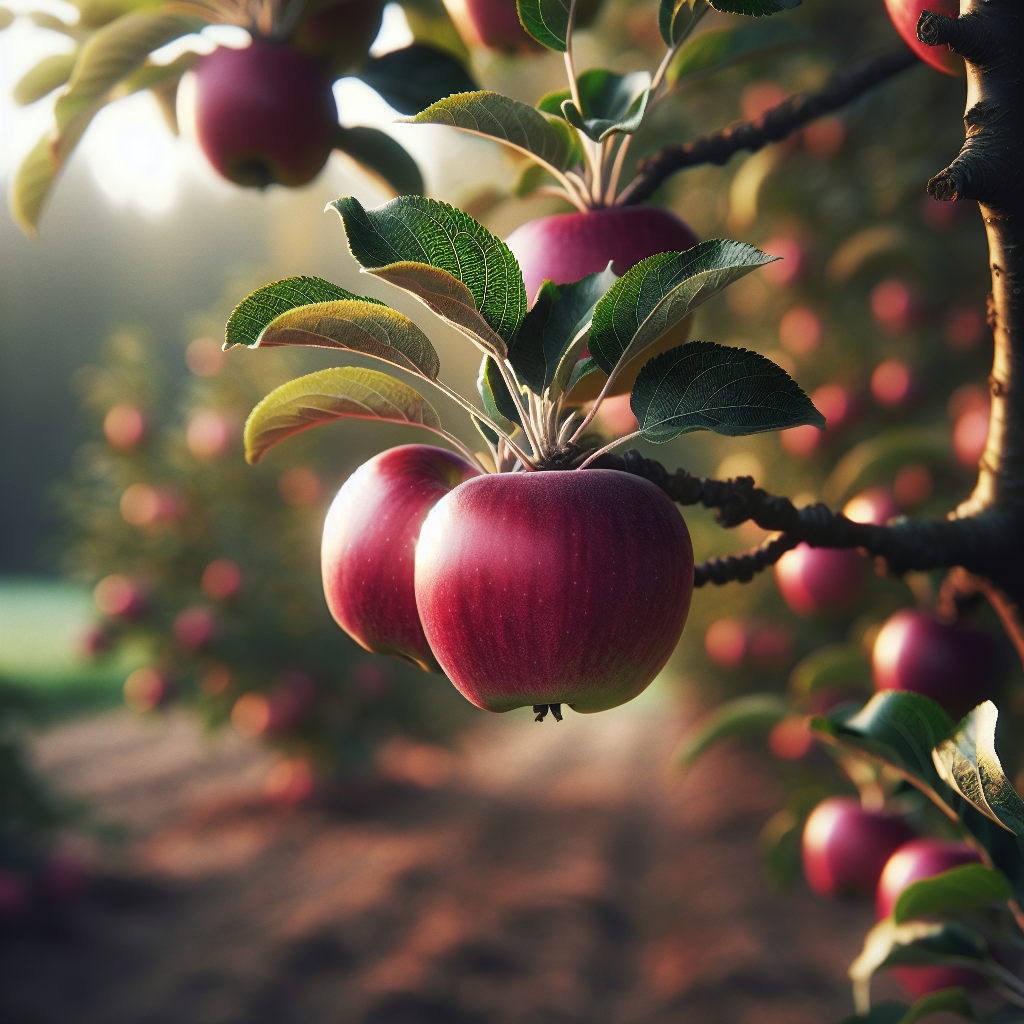
Introduction to Winesap Apple
An old American heirloom, this cultivar has been grown for well over two centuries and is widely associated with the Mid-Atlantic and Appalachian regions of the United States. It became popular because it combines several traits commercial and homestead growers both value: dependable productivity under the right conditions, a rich vinous flavor that intensifies in storage, firm flesh, and strong postharvest keeping ability.
The fruit is typically medium-sized, round to slightly conic, with dark red to maroon skin and occasional striping over a yellow-green background. Its flavor is the defining feature: aromatic, briskly tart at harvest, then fuller, spicier, and more complex after several weeks of storage. That combination makes it useful not only for fresh use but also for baking, sauce, and hard cider blending. For a broader species-level reference, see our Apple guide.
From a production standpoint, this is not the easiest apple for absolute beginners, but it rewards attentive growers. Trees can be vigorous, long-lived, and productive, yet they need good site selection, a compatible pollinizer, annual canopy management, and monitoring for common apple diseases. In hot summer climates, the fruit develops good color if nights cool adequately. In colder regions, the tree benefits from winter hardiness typical of many old American apples, though frost timing in spring still matters.
Botanical Profile of Winesap Apple
This cultivar belongs to the rose family, Rosaceae, and like other cultivated apples it is generally propagated by grafting onto rootstocks rather than grown true from seed. Seedling offspring are genetically variable and will not reliably reproduce Winesap fruit quality, growth habit, or bearing characteristics.
Growth habit is typically upright to spreading with moderate to strong vigor depending on rootstock, soil fertility, and pruning style. On semi-dwarf rootstock, mature height often ranges from 12 to 18 feet, while standard rootstocks can produce much larger trees reaching 20 to 30 feet or more. Spur development is moderate, and fruiting occurs on spurs and short lateral shoots developed on older wood.
Bloom time is usually mid-season, though exact timing depends on climate and spring temperatures. It is not reliably self-fertile, so pollen from another compatible apple flowering at the same time is strongly recommended. Good pollination directly affects fruit set, shape, and final yield.
Fruit characteristics include dense, crisp to firm flesh, cream to yellowish interior color, and notable acidity balanced by sugars. Brix can vary with site and season, but well-ripened fruit often has a concentrated flavor rather than a mild sweetness. The skin is fairly thick compared with some dessert cultivars, which contributes to its storage life. The tree is also known to produce apples that hold texture better than softer early-season cultivars.
A notable horticultural nuance is that Winesap has also given rise to strains and related selections, including Stayman, which was selected as a seedling of Winesap and shares some flavor and management similarities. Traditional orchardists have long valued Winesap-type apples as dual-purpose fruit because they bridge dessert and processing uses better than many single-purpose cultivars.
Soil, pH, and Climate Requirements for Winesap Apple
This cultivar performs best in deep, well-drained loam or sandy loam with good aeration and moderate water-holding capacity. Ideal soil depth is at least 24 to 36 inches so roots can establish beyond the planting hole. Heavy clay can be used if drainage is improved and the site is not prone to standing winter water, but chronically wet soils are a major risk because apple roots need oxygen. If water remains in a test hole for more than 24 hours after heavy irrigation or rain, drainage is likely inadequate.
The preferred soil pH is 6.0 to 6.8, with 6.2 to 6.5 often being the sweet spot for nutrient availability. Below pH 5.8, calcium, magnesium, and phosphorus may become less available and aluminum toxicity risk can increase. Above pH 7.0, iron, manganese, and zinc deficiencies become more likely, especially in calcareous soils. A pre-plant soil test should guide lime or sulfur applications. Lime is best incorporated several months before planting because pH correction is gradual.
Winesap grows best in temperate climates with clear winter chilling and warm but not excessively humid summers. Most apple cultivars, including this one, need substantial chilling during dormancy, generally in the range of 700 to 1,000 chill hours, though local performance varies. Regions with insufficient winter chill often produce uneven bloom, weak leaf-out, and poor fruit set.
The ideal climate includes:
- Cold winter dormancy without extreme trunk injury
- Frost-free conditions during bloom or at least reduced frost exposure through site placement
- Summer daytime temperatures around 70 to 85°F (21 to 29°C)
- Cool nights late in the season to improve color and flavor
- Moderate air movement to reduce disease pressure
Slope position matters. A gentle slope is better than a frost pocket because cold air drains downhill. Avoid low basins where spring frosts collect. Full sun is essential; 8 or more hours of direct sunlight supports flower bud formation, red color development, and stronger spur productivity.
Wind can be beneficial when light and consistent because it dries foliage, but strong prevailing winds can reduce pollinator activity, cause limb rubbing, and increase water stress. In exposed sites, a porous windbreak placed at a distance is better than a dense barrier that creates turbulence.
Step-by-Step Planting & Propagation
Start with a grafted tree from a reputable nursery. Choose certified disease-free stock on a rootstock suited to your goals:
- M.111 for drought tolerance, anchorage, and semi-standard vigor
- M.7 for semi-dwarf size with moderate support needs
- Bud.9 or M.9 for high-density systems, earlier bearing, and permanent staking
- MM.106 where conditions are appropriate, though it is less suitable for poorly drained soils
Plant bare-root trees in late winter to early spring while dormant, as soon as the ground is workable. Container-grown trees can be planted later, but dormant-season establishment is usually superior.
Step 1: Prepare the site. Remove perennial weeds in a 3- to 4-foot diameter circle. Grass competition is one of the most common causes of weak establishment. If using compost, apply only modestly and mix lightly into the surface rather than creating a rich pocket that discourages outward rooting.
Step 2: Dig correctly. Make a hole two to three times as wide as the root spread but only as deep as the root system. The final planting depth is critical: the graft union should remain 2 to 4 inches above the finished soil line, especially on dwarfing rootstocks, to prevent scion rooting.
Step 3: Inspect and trim roots. Soak bare roots for 1 to 4 hours before planting if they have dried slightly. Prune only broken, dead, or badly kinked roots. Spread roots naturally over a firm soil cone in the hole.
Step 4: Backfill with native soil. Do not heavily amend the hole with peat or high-nitrogen manure. Firm soil gently as you fill to eliminate large air pockets, then water deeply to settle the root zone.
Step 5: Water in thoroughly. After planting, apply enough water to moisten the soil 12 to 18 inches deep. In most soils this means 3 to 5 gallons for a bare-root dwarf tree and more for larger stock. The goal is even moisture, not saturation.
Step 6: Mulch properly. Apply 2 to 4 inches of wood chips or shredded bark in a donut shape, keeping mulch 3 to 6 inches away from the trunk. Mulch moderates soil temperature, reduces moisture loss, and suppresses weeds, but piled mulch against bark encourages rot and vole damage.
Step 7: Head the tree if needed. Many young whips are cut back at planting to 30 to 36 inches to encourage scaffold formation. Feathered trees may need selective branch retention instead.
Step 8: Install support and protection. Dwarf trees need staking at planting. Use trunk guards in areas with rabbit, vole, or sunscald risk.
Propagation is almost always by bench grafting or budding. Whip-and-tongue grafting onto dormant rootstock in late winter is common for nursery production. T-budding in summer is also widely used. Home growers can topwork existing trees if they want to add a compatible pollinizer branch. If pollination is a concern, nearby crabapples or another mid-blooming apple cultivar can improve set.
Spacing depends on rootstock and training system:
- Dwarf: 8 to 12 feet apart
- Semi-dwarf: 12 to 18 feet apart
- Standard: 20 to 30 feet apart
- Row spacing: 12 to 18 feet for intensive systems, wider for standard orchards
Care & Maintenance regimes for Winesap Apple
Water management should be deliberate rather than casual. Young trees need consistently moist, oxygenated soil during the first 2 to 3 years. As a practical target, maintain moisture in the upper 8 to 12 inches without allowing the root zone to remain waterlogged. In loam soils, that often means 1 to 1.5 inches of water per week from rain or irrigation during active growth, adjusted for heat, wind, and soil type.
Signs the tree needs water include dull, slightly drooping young leaves by midday that do not recover by evening, dry crumbly soil below the mulch, reduced shoot growth, and premature fruit drop. Signs of overwatering include persistently wet soil, yellowing leaves beginning on lower or inner canopy tissue, weak pale growth, algae or fungal growth around the base, and a sour smell in saturated soil. Water deeply and less frequently rather than shallow daily sprinkling.
Nutrition should be based on soil and leaf analysis whenever possible. Young non-bearing trees benefit from moderate nitrogen to promote scaffold development, but excessive nitrogen creates lush, disease-prone shoots and delays fruiting. Mature bearing trees usually need less nitrogen than growers assume. A rough annual benchmark for young trees is 0.05 to 0.1 pound of actual nitrogen per year of tree age, up to the onset of regular bearing, but local soil fertility may require much less.
Calcium is especially important for fruit quality and storage life. Low calcium contributes to bitter pit, internal breakdown, and softer fruit. In soils with marginal calcium or erratic moisture, foliar calcium sprays during fruit development are often useful. Consistent soil moisture is equally important because calcium moves with water in the transpiration stream.
Pruning is essential. Use a central leader or modified central leader system for best light distribution. In the first years, select 3 to 5 well-spaced scaffold branches with wide crotch angles around 45 to 60 degrees. Narrow crotches are structurally weak and prone to splitting under crop load.
Dormant pruning goals include:
- Maintaining a strong leader
- Removing crossing, shaded, diseased, or inward-growing wood
- Renewing fruiting wood gradually
- Preventing excessive height
- Preserving light penetration into the lower canopy
Summer pruning can help reduce vigor, improve light, and enhance color, but should be modest to avoid sunburn on suddenly exposed fruit.
Fruit thinning is one of the most important professional practices. Apple trees often set too much fruit, leading to small apples, biennial bearing, limb breakage, and weaker return bloom. Thin clusters within a few weeks after petal fall, aiming for one fruit per cluster and spacing remaining fruit about 6 to 8 inches apart along a branch. This improves size, color, sugar accumulation, and next year's flower bud formation.
Keep a weed-free strip beneath the canopy at least 3 feet wide for young trees and wider for mature trees if possible. Sod competition reduces growth significantly, especially on dwarf rootstocks. For orchard floor management ideas, the principles in Soil health tips can be adapted well to apple systems.
Pests, Diseases & Organic Management
Like many heirloom apples, this cultivar can be affected by the common disease complex of humid temperate orchards. Disease pressure varies greatly by region, rainfall, canopy density, and sanitation.
Apple scab causes olive-brown lesions on leaves and dark, corky spots on fruit. It thrives in prolonged spring leaf wetness. Organic control relies on sanitation, resistant pollinizers where possible, open pruning, and protectant sprays such as sulfur or lime sulfur timed from green tip through early cover periods.
Cedar-apple rust can be serious where junipers are nearby. Orange lesions on leaves reduce tree vigor and heavy infection can affect fruit quality. Reduce nearby alternate hosts where practical and maintain spray protection in susceptible regions.
Fire blight is a bacterial disease favored by warm, wet bloom periods and overly lush nitrogen-fed growth. Symptoms include blackened blossom clusters, shepherd's-crook shoot tips, and cankers. Prune out strikes 8 to 12 inches below visible symptoms during dry weather, disinfecting tools between cuts when pressure is high. Avoid heavy spring nitrogen and avoid pruning during highly susceptible bloom conditions unless necessary.
Powdery mildew appears as white growth on young shoots and leaves, especially in dry conditions with humid nights. Remove infected shoot tips during dormant and early season pruning.
Black rot, Bitter rot, and Sooty blotch/Flyspeck may affect fruit, especially in warm humid summers and neglected canopies. Fruit mummies and dead wood should be removed because they harbor inoculum.
Major insect pests include Codling moth, Apple maggot, Plum curculio, Aphids, Scale, Mites, and Borers. Organic management works best through integrated practices rather than one product.
A professional organic strategy includes:
- Dormant oil before bud break for Scale, mite eggs, and aphid suppression
- Trunk sanitation and loose bark removal where Borers shelter
- Kaolin clay during key egg-laying windows for Plum curculio and other pests
- Pheromone traps to monitor Codling moth flight
- Bagging selected fruit on small plantings after thinning
- Timed use of granulosis virus or spinosad where permitted and appropriate
- Fallen fruit removal every 1 to 2 weeks to break pest cycles
- Encouraging beneficial insects through flowering understory plants
Aphids often build on succulent shoot tips. Strong populations cause curled leaves and honeydew. In many orchards, predators such as lacewings, hoverflies, and parasitic wasps help if broad-spectrum sprays are avoided. Mites increase under dusty, stressed conditions, so irrigation balance and orchard hygiene matter.
Rodents and Deer are also major threats. Voles girdle trunks beneath mulch in winter, while Deer browse young shoots and rub bark. Keep mulch pulled back, use guards, and fence where pressure is significant.
Harvesting, Curing & Optimal Storage
This is generally a late-season apple. Harvest timing varies by region, but fruit is often ready in mid to late autumn. Unlike soft summer apples, Winesap improves after harvest if picked at the right stage and stored correctly.
Maturity indicators include full background color shift from green toward yellow-green, characteristic deep red overcolor, brown seed coloration, easier separation when the apple is lifted and twisted, and developed flavor rather than raw starchiness. Starch-iodine tests can help commercial growers fine-tune picking windows.
Pick carefully by lifting and rolling the fruit upward so the stem stays attached. Do not pull straight down. Stem punctures from rough handling reduce storability and create entry points for rot. Harvest during dry conditions if possible, and never stack fruit deeply in the field while warm.
A short conditioning period can improve eating quality. Fruit may taste sharply tart right off the tree but mellows after a few weeks in cool storage. This is not curing in the sweet potato sense; rather, it is postharvest ripening and flavor integration.
For best storage:
- Sort out bruised, insect-damaged, or diseased fruit
- Cool fruit quickly after harvest
- Store at 30 to 32°F (-1 to 0°C) if possible
- Maintain relative humidity around 90 to 95%
- Ensure air circulation without direct dehydrating drafts
- Separate from strong ethylene-sensitive vegetables if mixed storage is used
At cellar temperatures of 35 to 40°F, fruit may still keep for several months, though texture loss is faster. In a household refrigerator crisper, perforated bags or ventilated containers help maintain humidity. Check fruit regularly and remove any that begin to soften or rot.
Fruit intended for cider can be held briefly to allow flavor concentration, but rotten fruit should never be included. For baking, slightly stored fruit often performs better than just-harvested fruit because its sugar-acid balance is more rounded.
Companion Planting for Winesap Apple
Companion planting around apple trees should support pollination, beneficial insect activity, soil cover, and orchard sanitation without creating dense, humid vegetation against the trunk. The best companions are low-growing, manageable species that do not compete aggressively for water in the root flare zone.
Thyme is excellent beneath or near orchard rows because it stays relatively low, attracts pollinators when blooming, and tolerates some foot traffic and dry spells once established. Yarrow is valuable at the orchard margin for attracting predatory wasps, hoverflies, and other beneficial insects, though it should be managed so it does not become weedy. Clover works well in alleyways or outer dripline zones as a living mulch and nitrogen-contributing cover, but it should not be allowed to compete tightly with newly planted trees. Nasturtium can help draw Aphids and support beneficial insect diversity in mixed garden-orchard systems.
Keep the first 8 to 12 inches around the trunk free of living groundcover to reduce bark moisture, vole habitat, and crown disease risk. In commercial-style plantings, companion species are often best placed in alleyways, row middles, or outer root zones rather than directly against the trunk.
Avoid tall, dense companion plants that shade lower limbs, restrict airflow, or complicate harvest. Also avoid species requiring heavy irrigation near the trunk, since persistently damp bark and root-zone saturation create disease problems.
When designed well, companion planting in apple systems is less about crowding plants together and more about ecological zoning: a clean trunk zone, a mulched root zone, and a biologically active outer orchard floor that supports pollinators and natural enemies while maintaining access for pruning, thinning, and harvest.