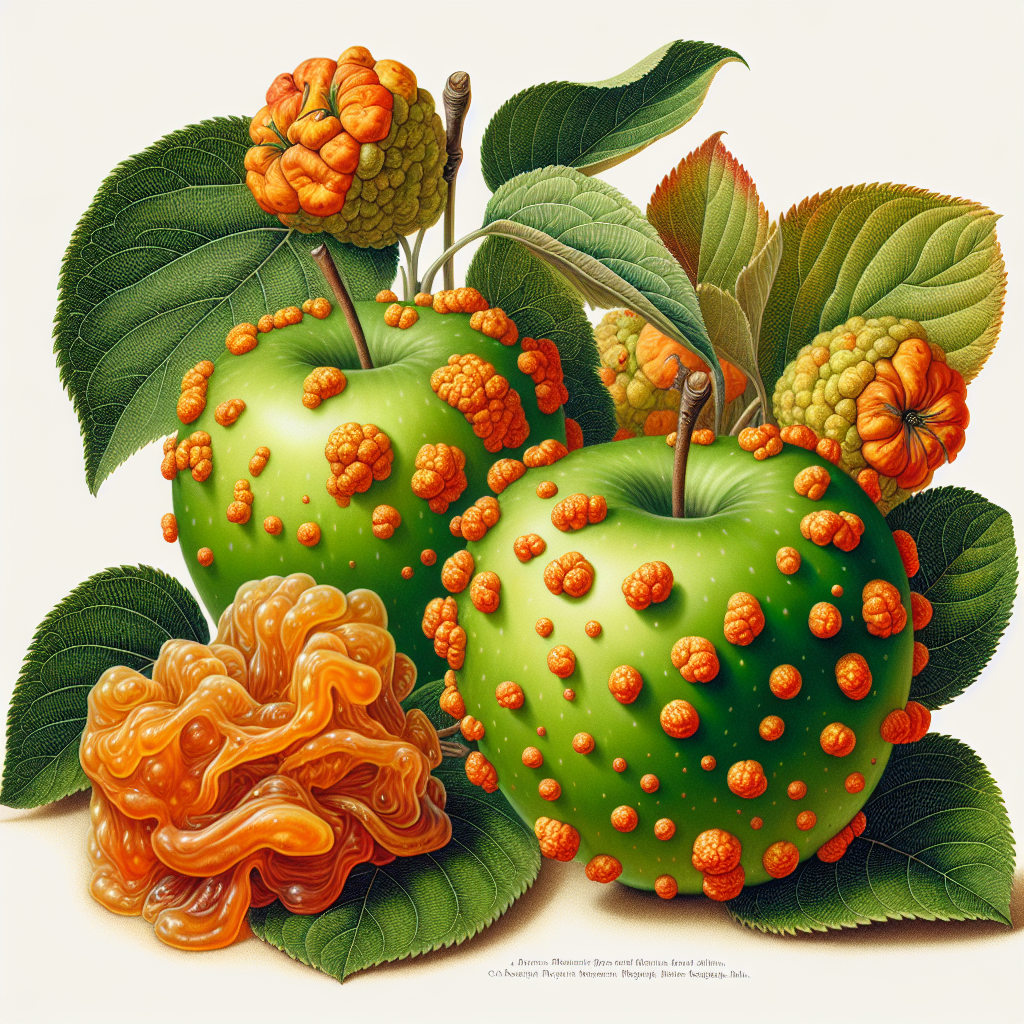
Introduction to cedar-apple rust
Cedar-apple rust, scientifically known as Gymnosporangium juniperi-virginianae, stands as one of the most pervasive fungal diseases threatening apple production across North America. This heteroecious rust fungus completes its complex lifecycle alternating between two vastly different hosts: members of the juniper family (e.g., eastern red cedar, Juniperus virginiana) and Rosaceous plants, primarily apples (Malus spp.), crabapples, hawthorns, and related species. First identified in the early 20th century, it has since become a hallmark challenge for orchardists, backyard gardeners, and commercial growers alike.
The disease manifests dramatically during wet springs, when gelatinous orange telial horns erupt from cedar galls, releasing vast quantities of basidiospores that waft through the air to infect nearby apple trees. On apples, it produces bright yellow-orange aecial spots that mar leaves, twigs, and—most devastatingly—fruit, leading to premature defoliation, weakened trees, and deformed, unmarketable harvests. Yield losses can exceed 50% in severe outbreaks, with secondary effects like increased susceptibility to fire blight and other pathogens compounding the damage.
Understanding cedar-apple rust is crucial for sustainable apple cultivation. This guide delivers definitive diagnostic criteria, lifecycle insights, environmental risk factors, organic management strategies, prevention protocols, and a breakdown of affected crops. Whether managing a small homestead orchard or a commercial block of Gala apple or Honeycrisp apple, proactive measures can safeguard your investment. For small farms battling timing-sensitive diseases, tools like those in Why Timing Kills Small Farm Profits - And How AI Task Scheduling Saves Your Harvests can optimize spray schedules and monitoring.
Identifying Symptoms & Damage
Accurate diagnosis begins with recognizing cedar-apple rust's signature symptoms, which differ markedly between hosts. On cedar hosts, the disease initiates with small, olive-green to brown galls on branches or twigs in early spring. These galls, up to golf-ball size, swell with moisture and extrude 1-2 inch gelatinous, bright orange telial horns during rainy periods from April to June. These horns are diagnostic—no other common cedar disease produces such vivid, finger-like spore masses. Spent horns dry to a reddish-brown crust, persisting through summer.
On apple trees, primary infections appear 7-10 days after spore exposure as pale yellow spots on upper leaf surfaces, roughly 1/8 to 1/4 inch in diameter. These spots deepen to orange, developing fringed margins as cup-shaped aecial pustules rupture through the epidermis, releasing copious orange aeciospores. Leaves may yellow and drop prematurely, with severe defoliation weakening trees and reducing next season's fruit set by up to 80%.
Fruit infections are particularly destructive: yellowish spots on developing apples enlarge to 1/2 inch, encircled by velvety orange spore masses. These blemishes render fruit cull-grade, with deep cortical lesions causing cracking and rot susceptibility. Twigs show spindle-shaped, sunken cankers with orange aecia, potentially girdling branches. Differentiate from apple scab (dark olive lesions), powdery mildew (white powdery growth), or Alternaria leaf spot (brown necrotic spots without aecia) via microscopy—rust aeciospores are binucleate with hyaline walls.
Damage quantification reveals economic impacts: a single untreated tree can lose 30-50% photosynthetic capacity from defoliation, curtailing growth and vigor. Commercial blocks of susceptible varieties like Golden Delicious apple may see 20-100% fruit cull, driving losses of $1,000+ per acre. Early scouting during pink bud stage is essential; use a 10x hand lens to confirm aecia.
Lifecycle and Progression of cedar-apple rust
Cedar-apple rust's five-spore-stage lifecycle epitomizes fungal adaptation, spanning two years across dual hosts. It overwinters in cedar galls as telia. Spring rains (above 50°F) trigger meiosis, producing basidiospores from teliospores. These wind-dispersed spores (up to 1/2 mile, rarely farther) require 9-12 hours leaf wetness to germinate on apples, infecting through stomata during bloom to petal fall.
Within 10-21 days, infected apple tissues produce aecia, erupting orange aeciospores from May to July. These dicaryotic spores reinfect nearby cedars, penetrating young needles or twigs. Mycelium hibernates, forming galls by fall. Galls mature the following spring, restarting the cycle. Optimal infection window: 46-67°F with >9 hours wetness; basidiospore viability drops sharply above 75°F.
Progression accelerates in humid microclimates. Year 1: cedar gall formation. Year 2: telial horns → apple infection → aecial production → new cedar infections. Multiple cycles per season possible in mild climates. Disease gradients peak within 200 yards of cedar sources, underscoring spatial management.
Environmental Triggers & Risk Factors
Wet springs drive epidemics: prolonged leaf wetness (>12 hours at 55-65°F) during apple susceptibility (tight cluster to petal fall) maximizes basidiospore deposition. High humidity (>85%) and moderate temperatures (50-70°F) favor germination; drought or heat (>80°F) suppresses outbreaks. Landscape features amplify risk: low-lying orchards with poor air drainage trap moisture, while dense cedar hedges within 1/4 mile serve as massive spore reservoirs.
Susceptibility factors include non-resistant cultivars (Red Delicious apple, Granny Smith apple), excessive nitrogen promoting succulent growth, and dense canopies limiting spray penetration. Young trees (<5 years) suffer higher defoliation. Regional patterns show heaviest incidence in Midwest and Northeast U.S., where cedar-apple overlaps with apple belts. Climate change may extend wet periods, intensifying pressure.
Organic Control & Treatment Plans
Organic management integrates sanitation, biology, and OMRI-listed fungicides. Sanitation (priority): Remove and destroy cedar galls before horn formation (March-April); one mature gall produces millions of spores. Prune apple galls/mummified fruit post-harvest. Maintain 1/4-mile buffer from wild cedars; plant resistant junipers like 'Grey Owl'.
Biologicals: Apply Bacillus subtilis (Serenade) or Burkholderia spp. (Vive) at green tip through petal fall, 7-14 day intervals. These compete for space and induce resistance. Fungicides: Sulfur (80% wettable, 5-10 lbs/100 gal) or potassium bicarbonate at 2-3 lbs/100 gal, timed for 90% basidiospore catch (use traps). Copper (e.g., Cueva) pre-bloom only, avoiding phytotoxicity. Rotate modes of action; limit sulfur to <30 lbs/acre/season.
Treatment Timeline:
- Dormant: Prune cedars.
- Green tip: First sulfur.
- Tight cluster to bloom: Peak sprays (every 7 days wet).
- Petal fall: Final apps. Monitor with spore traps; halt at 1st cover. Efficacy: 70-90% with 6-8 timely sprays. Integrate with apple IPM, scouting weekly.
Preventing cedar-apple rust in the Future
Long-term prevention hinges on host resistance and landscape engineering. Plant resistant apples: Enterprise, Freedom, Liberty, or William's Pride (0-20% infection vs. 80%+ susceptible). Crabapples like 'Snowdrift' or 'Adams' tolerate low levels. Eradicate wild cedars within 1 mile; replace with non-host evergreens.
Cultural practices: Space trees 20-25 ft for airflow; prune annually for open canopy. Avoid overhead irrigation; mulch to retain moisture without wetting foliage. Site selection: elevate orchards, south-facing slopes for drying. Soil test and balance fertility—avoid excess N. Annual scouting and early intervention prevent buildup. For small farms, Why Misidentifying Plants Costs Small Farms Thousands - And How AI Camera Diagnosis Fixes It Fast aids rapid symptom ID.
Crops Most Affected by cedar-apple rust
Primary host: Apple (all cultivars, especially Fuji apple, Gala apple, Honeycrisp apple). Secondary: Crabapple, hawthorn, quince, pear (Bartlett pear, Bosc pear). Cedar hosts: Eastern red cedar, Rocky Mountain juniper. Rare: Serviceberry, chokeberry. Commercial impact greatest on apple (80% U.S. orchards affected annually); ornamental crabapples suffer aesthetic damage. No field crops like corn or wheat affected.