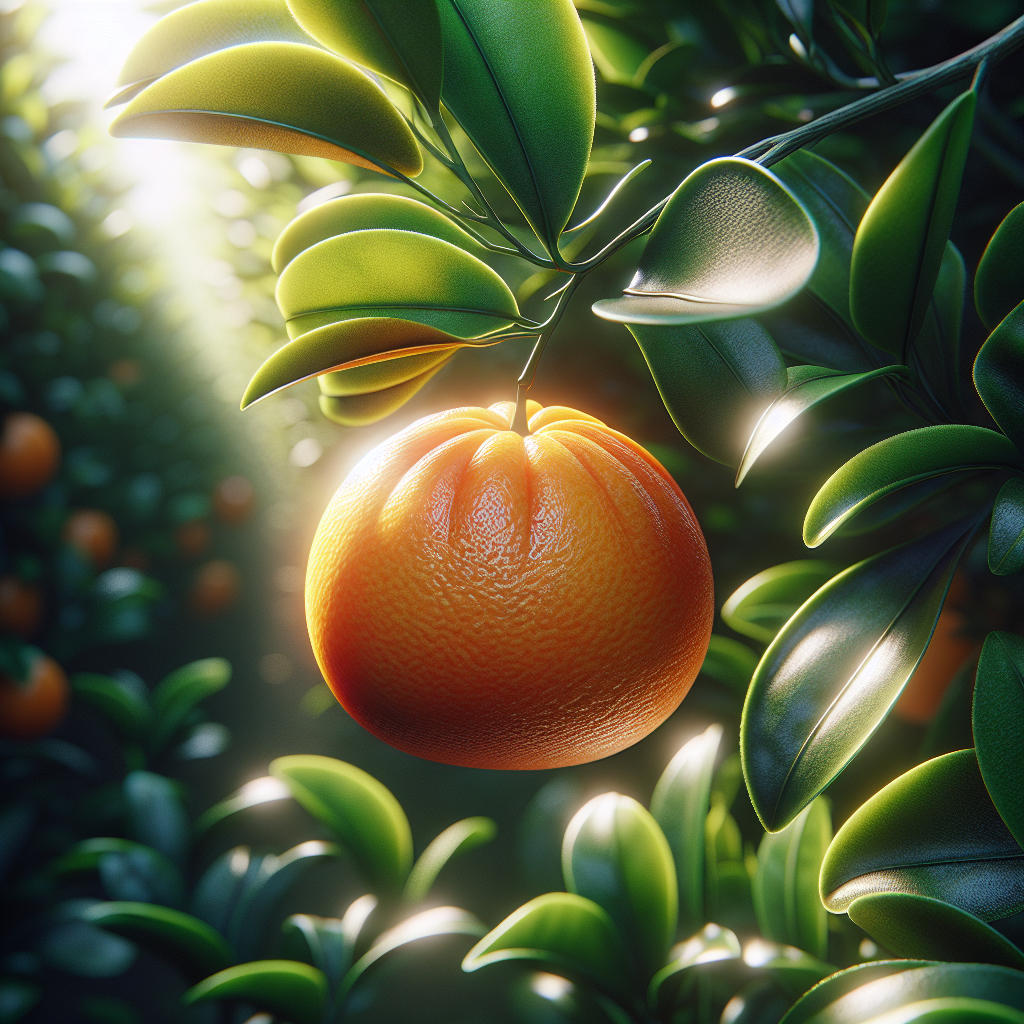
Introduction to Tangelo (Minneola)
A classic Florida-developed tangelo, this cultivar is a hybrid generally understood to derive from grapefruit and mandarin parentage, most commonly Duncan grapefruit crossed with Dancy tangerine. It is easily recognized by the pronounced neck at the stem end, which gives the fruit its familiar “honeybell” silhouette. Minneola is valued for a balanced flavor profile: higher acidity than many easy-peeling mandarins, but with substantial sugars when grown under strong light and warm days followed by cooler nights.
Commercially and in home orchards, it is often considered one of the finest fresh-eating tangelos when properly pollinated and harvested at full maturity. The tree is moderately vigorous, evergreen, and capable of heavy bearing, but it is not the most forgiving citrus cultivar. Fruit set can be inconsistent without compatible pollen sources, the tree is susceptible to alternate bearing if stressed, and fruit quality declines noticeably in poorly drained soils. In climates suited to sweet citrus, however, Minneola rewards precision management with high-value fruit that peels reasonably well, juices beautifully, and develops an excellent internal color.
Historically, Minneola gained importance in subtropical citrus belts where consumers appreciated a richer, more aromatic alternative to standard oranges. Growers comparing it with Orange types often note that Minneola usually offers a more pronounced sweet-acid complexity and a softer segment membrane, making it excellent for fresh use and juicing.
Botanical Profile of Tangelo (Minneola)
This is an interspecific citrus hybrid in the Rutaceae family. Trees are typically medium-sized, with a rounded to somewhat upright canopy, glossy lanceolate leaves, and thorniness that is usually moderate in young growth but often reduced as the tree matures. Flowering occurs in spring, with fragrant white blossoms borne singly or in clusters. Like many citrus, the tree is self-fertile at the floral level, but Minneola is widely known to set heavier and more regular crops when cross-pollinated by compatible mandarins or related citrus flowering at the same time.
Fruit is medium to large, usually 7-9 cm in diameter, with a flattened globe shape and a characteristic neck. Rind color develops from green to rich orange as cool weather arrives; external color can precede or lag internal maturity depending on climate. The peel is moderately thin and somewhat adherent, less loose than many mandarins. Flesh is deep orange, very juicy, typically with 10-12 segments, and may contain seeds if cross-pollinated. Seedless fruit is possible under some conditions, but where pollinators and compatible pollen are present, seeded fruit is common.
Key cultivar traits include:
- Strong sweet-tart flavor rather than purely sweet flavor.
- Better eating quality when allowed to fully mature on the tree.
- Tendency toward shy bearing without pollination support.
- Sensitivity to cold compared with hardier mandarins.
- Improved color and sugar balance in regions with warm summers and mild, relatively dry winters.
Rootstock choice strongly influences size, productivity, soil adaptation, and disease tolerance. In professional production, rootstock selection is never incidental. Vigorous rootstocks may improve canopy development on weak soils, while more size-controlling rootstocks can be useful in high-density or protected plantings. The best rootstock depends on local nematodes, salinity, calcareous soil, tristeza pressure, and drainage profile.
Soil, pH, and Climate Requirements for Tangelo (Minneola)
The ideal soil is a deep, well-drained sandy loam or loam with good aeration through at least the top 60-90 cm. Citrus roots require oxygen, and Minneola performs poorly in compacted, waterlogged, or perched-water-table conditions. If water remains in a planting hole for more than 24 hours after heavy irrigation or rain, the site is marginal; if it remains for 48 hours, it is unsuitable without drainage correction or berm planting.
Target soil pH is 6.0-7.0, with acceptable performance from about 5.8-7.5. Below pH 5.5, manganese and aluminum issues may intensify and root performance may suffer. Above pH 7.5, iron, zinc, and manganese deficiencies become common, often appearing as interveinal chlorosis on young leaves. On calcareous soils, Minneola may remain alive but never achieve premium vigor or fruit finish unless micronutrients are managed aggressively.
Essential soil characteristics include:
- Organic matter of roughly 2-5% for moisture buffering without excessive water retention.
- Good infiltration, ideally avoiding crusting or puddling.
- Low to moderate salinity; citrus is moderately salt-sensitive, and Minneola is not a top choice for saline irrigation zones.
- No hardpan directly beneath the root zone.
Climate is best described as subtropical to warm Mediterranean. Optimal growing temperatures range from 23-32°C during active growth, while flowering and fruit set are favored by mild spring conditions without heat spikes or extended rain. Trees can tolerate brief light frost once mature, but young trees are quite vulnerable. Damage often begins around -2 to -3°C, especially on tender flushes and small fruit. Severe freezes can kill scaffold wood or the entire canopy.
For reliable fruit maturation, choose a site with full sun, ideally 8 or more hours daily. Shaded trees grow but produce lower sugars, lighter color, and weaker flowering. Inland valleys with winter chill-free but cool nights often produce better flavor concentration than excessively humid tropical lowlands, where acidity may remain high and peel quality can decline.
Rainfall is less important than distribution. Annual precipitation of 900-1500 mm can support strong growth, but only if drainage is excellent and dry periods do not coincide with flowering and early fruit development. Excess rain during bloom can suppress pollinator activity and reduce fruit set. In monsoonal climates, raised beds or broad berms are strongly recommended.
For broader fertility principles in perennial plantings, see soil health strategies.
Step-by-Step Planting & Propagation
Propagation for true-to-type production is done by budding or grafting onto a suitable rootstock. Seed propagation is not recommended for orchard establishment because seedlings segregate genetically, vary in vigor, and take longer to bear. Purchase certified disease-free nursery stock whenever possible, especially in regions with citrus greening regulations.
Follow this sequence for planting:
- Select a warm, frost-sheltered, full-sun site with free drainage. Avoid low pockets where cold air settles.
- Test soil pH and drainage before planting. Correct pH gradually; do not add excessive lime or sulfur immediately before planting.
- Prepare a weed-free circle at least 1-1.5 m wide. Citrus dislikes root competition when young.
- If soil is heavy, plant on a mound or berm 30-45 cm high and 1-1.5 m wide.
- Dig a hole only as deep as the root ball and 2-3 times as wide. Planting too deep is one of the most common causes of decline.
- Set the tree so the graft union remains clearly above the final soil line, typically 10-20 cm above grade.
- Backfill with native soil rather than a rich pocket mix. This encourages roots to move outward instead of circling in amended soil.
- Water immediately to settle soil and eliminate air gaps.
- Apply 5-8 cm of mulch, keeping it 10-15 cm away from the trunk to prevent collar rot.
- Stake only if the site is windy or the tree is unstable; remove ties before they girdle the trunk.
Spacing depends on rootstock vigor and pruning system. Standard backyard spacing is commonly 4.5-6 m between trees. Commercial plantings may go tighter with size-controlling rootstocks and disciplined canopy management. Crowding reduces air movement, increases disease pressure, and limits light penetration, which directly lowers fruit quality inside the canopy.
Pollination planning is especially important. Minneola often benefits from a nearby compatible pollinizer, commonly a flowering mandarin or tangerine blooming at the same time. The pollinizer should be close enough for bee movement, ideally within the same block or within 10-15 m in home orchards. Without this, bloom may be profuse but fruit set light.
Container growing is possible for several years if trees are grafted on dwarfing rootstocks. Use a free-draining citrus medium, not ordinary garden soil. Containers should have excellent drainage and sufficient volume, with repotting as roots fill the pot. Long-term production in containers is possible but requires much tighter irrigation and nutrition control.
Care & Maintenance regimes for Tangelo (Minneola)
Water management determines whether the tree merely survives or performs at high quality. Young trees need consistently moist but not saturated soil. As a field rule, the active root zone should remain lightly moist through the upper 15-30 cm during establishment. If soil in that zone dries to powder and pulls away from the root ball, the tree is under stress. If it remains sticky, sour-smelling, or gray for days, oxygen starvation is likely.
In the first year, irrigate deeply 1-3 times per week depending on heat, soil texture, and rainfall. Sandy soils may require more frequent watering; heavier loams need less frequent but carefully monitored irrigation. Mature trees prefer deep irrigation followed by partial drying. Constant shallow watering encourages surface roots and worsens drought sensitivity.
Useful moisture cues:
- Underwatering: leaves fold slightly along the midrib, young fruit drops, flushes stall, and soil at 10 cm depth is dry and warm.
- Overwatering: leaves appear dull, yellowing begins without crisp edges, growth is soft, and roots may smell anaerobic if exposed.
- Ideal condition: soil feels cool and slightly damp below the surface, not muddy, and canopy retains a firm, glossy appearance.
Nutrition should be split through the growing season rather than delivered in one heavy application. Nitrogen drives canopy growth and fruiting, but excess nitrogen produces coarse peel, rank shoots, lower flavor concentration, and greater pest pressure. Young trees generally receive light, frequent feeding from spring through late summer. Mature bearing trees need a more substantial annual nutrient budget with emphasis on nitrogen, potassium, calcium, magnesium, and micronutrients such as zinc, manganese, and iron where deficient.
A professional maintenance approach includes:
- Spring: balanced citrus fertilizer after bloom begins, plus micronutrient sprays if chlorosis history exists.
- Early summer: second feeding to support canopy and fruit sizing.
- Mid to late summer: final feeding in warm regions, avoiding late excessive nitrogen that delays hardening before cool weather.
- Autumn/winter: generally avoid strong nitrogen push unless local climate permits year-round growth safely.
Pruning should be light and purposeful. Remove deadwood, crossing branches, rootstock suckers, and low weak shoots. Open the canopy enough for light penetration but do not over-thin, as citrus fruit and scaffold bark are prone to sunburn after sudden exposure. The best timing is after harvest and before strong spring flush, or whenever dead/diseased wood must be removed. Heavy pruning often causes vigorous vegetative regrowth at the expense of the next crop.
Fruit thinning is rarely done on mature orchard trees, but if a young tree sets heavily, removing some fruit helps prevent limb strain and supports structural development. Alternate bearing can be moderated by preventing extreme crop loads one year followed by exhaustion the next.
Cold protection for young trees is essential in marginal areas. Use trunk wraps, frost cloth, or temporary frames during freeze events. Moist soil holds and releases more heat than dry soil, so irrigating the ground before a freeze can help, but never ice-saturate the root zone in already poorly drained conditions.
Pests, Diseases & Organic Management
Minneola is subject to the standard citrus pest complex, and integrated management is far more effective than reactive spraying. The major principle is to maintain tree vigor, reduce excess flush caused by overfertilization, improve airflow, monitor frequently, and intervene early.
Common pests include aphids, citrus leafminer, scale insects, mealybugs, whiteflies, mites, and sometimes thrips. aphids cluster on tender new growth and may distort flushes while producing honeydew that leads to sooty mold. Leafminer causes serpentine mines in young leaves, especially in warm flush periods; severe infestations reduce photosynthetic efficiency in young trees. Scale and mealybugs weaken branches gradually and often hide in dense canopies.
Organic strategies include:
- Horticultural oil during non-stress periods to suppress scale, mites, and some soft-bodied pests.
- Insecticidal soap on active infestations of aphids or whiteflies, applied thoroughly to leaf undersides.
- Preservation of beneficial insects by avoiding broad-spectrum insecticides.
- Pruning dense, shaded interiors where scale and mealybugs flourish.
- Controlling ants, which protect honeydew-producing pests from predators.
Companion habitat can help predator populations. Flowering insectary borders featuring Thyme, Yarrow, and Nasturtium support beneficial insects while occupying the orchard floor more usefully than bare soil.
Disease concerns include Phytophthora root rot and gummosis, melanose, greasy spot in humid climates, alternaria brown spot in susceptible citrus environments, and various postharvest rots. Poor drainage is the single greatest cultural trigger for root disease. Symptoms include canopy thinning, reduced leaf size, pale foliage, twig dieback, and bark lesions exuding gum near the crown.
Management priorities:
- Keep mulch away from the trunk.
- Avoid wetting the trunk with micro-sprinklers.
- Plant high in heavy soils.
- Remove fallen fruit and diseased debris.
- Sanitize pruning tools.
- Improve airflow and sunlight penetration.
Where citrus greening (huanglongbing) is present regionally, psyllid control and certified nursery stock are non-negotiable. Symptoms can include asymmetric leaf mottling, misshapen bitter fruit, twig dieback, and long-term decline. There is no simple cure; prevention and regulatory compliance are critical.
Harvesting, Curing & Optimal Storage
Harvest timing is one of the most important quality decisions with this cultivar. Unlike some fruit, citrus does not continue to sweeten after picking. External orange color is helpful but not definitive; fruit should be tested for flavor, juice content, and sugar-acid balance. Minneola typically reaches best eating quality from midwinter into late winter in many subtropical regions, though exact timing varies widely by climate.
Harvest fruit when:
- Peel is well colored and no longer predominantly green.
- Fruit feels heavy for its size, indicating strong juice content.
- Flavor has shifted from sharply acidic to rich sweet-tart.
- Segments are fully orange internally.
Use clippers rather than pulling fruit, especially for premium storage lots. Leave a very short stem, but avoid sharp protrusions that puncture neighboring fruit. Handle gently; rind injury encourages Penicillium and other storage rots.
Curing in the classic sense is less central for citrus than for onions or squash, but harvested fruit benefits from a short conditioning period in a shaded, well-ventilated space to dry surface moisture before packing. Never leave harvested fruit in direct sun or stacked deeply while warm, as heat buildup rapidly reduces shelf life.
For storage, keep fruit at about 5-10°C with relative humidity around 85-90%. Lower humidity causes rind shrivel; excessively cold storage risks chilling injury, especially if fruit is held too near freezing. Under good conditions, Minneola can store for several weeks, but best flavor is usually obtained within 2-4 weeks of harvest. At room temperature, expect substantially shorter keeping quality.
Do not wash fruit until use unless sanitation is required for market. Surface moisture during storage encourages mold. Sort fruit regularly and remove any with soft spots, rind breakdown, or mold growth.
Companion Planting for Tangelo (Minneola)
The best companions support pollinators, beneficial insects, and soil protection without competing aggressively for water or forming dense, humid vegetation around the trunk. Low-growing aromatic herbs and flowering insectary species are usually superior to heavy feeders.
Thyme is particularly useful in warm citrus plantings because it stays relatively low, tolerates dry conditions once established, and attracts small predatory and parasitic insects. Yarrow is valuable for drawing hoverflies and parasitoids, while nasturtium can act as a visual trap crop for aphids in mixed plantings. In larger orchards, clover can also function as a managed living mulch if irrigation is sufficient and trunk zones are kept clear.
Guidelines for companion placement:
- Keep a trunk-free ring of at least 30-60 cm around young trees.
- Do not allow companions to grow into the graft union area.
- Avoid tall, dense companions that reduce airflow or shade the lower canopy.
- Irrigate companion zones according to citrus needs, not the reverse.
- Mow or trim flowering strips before they become rodent habitat.
Good companion planting around Minneola is less about crowding the tree with many species and more about creating a biologically active orchard floor that improves predator presence, soil cover, and pollinator movement while preserving root-zone aeration.