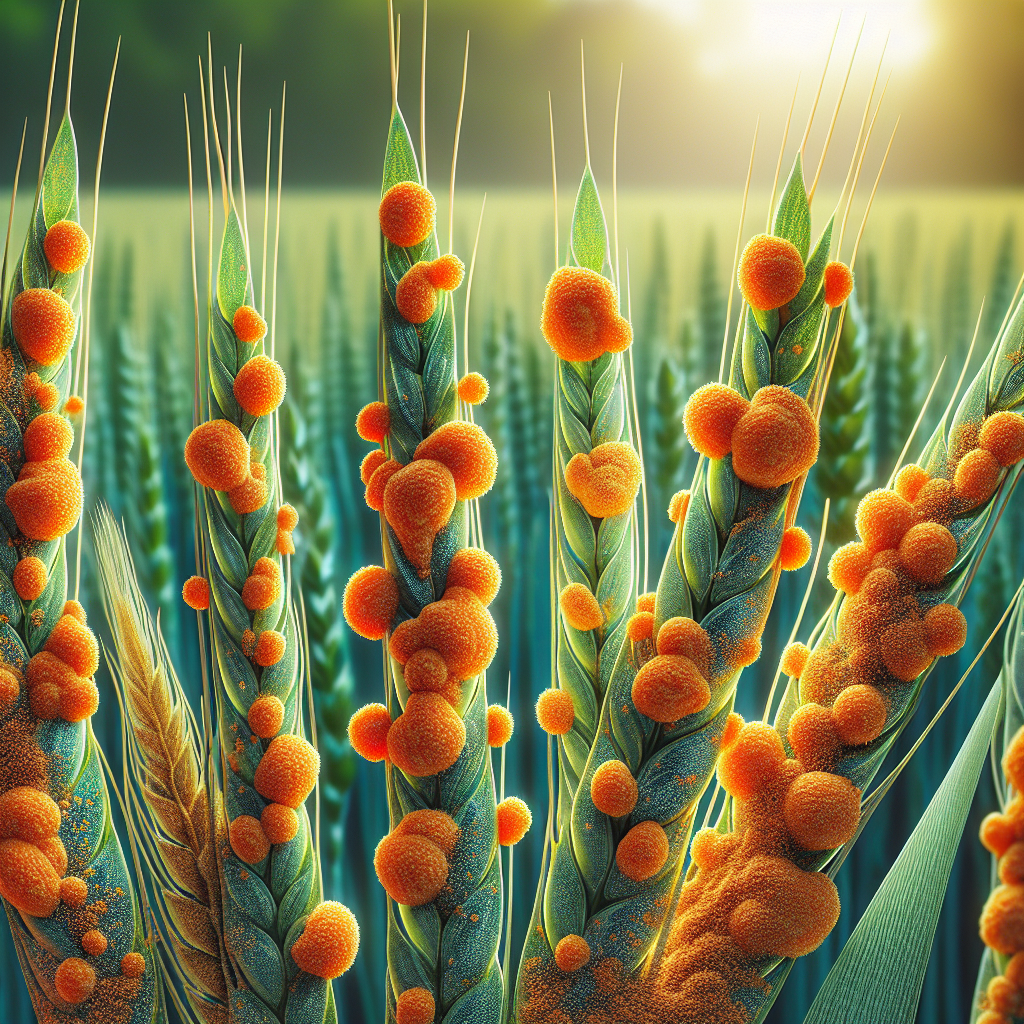
Introduction to Rusts
Rusts represent one of the most widespread and destructive groups of plant diseases affecting agriculture worldwide. Caused by obligate parasitic fungi primarily from the order Pucciniales (formerly Uredinales), rusts infect a broad spectrum of crops, from staple grains like wheat and barley to fruits, vegetables, and ornamentals. The name 'rust' derives from the distinctive reddish-brown pustules of urediniospores that erupt on infected leaves, stems, and fruits, resembling flakes of rust on metal.
Over 7,000 species of rust fungi have been identified, with many exhibiting host specificity. Notable pathogens include Puccinia graminis (stem rust), Puccinia triticina (leaf rust), and Puccinia striiformis (stripe rust) on cereals; Uromyces phaseoli on beans; and Puccinia hemerocallis on daylilies. These diseases can reduce yields by 20-50% in severe epidemics, costing billions annually in lost production and control measures. In small-scale farming, rusts pose a particular threat due to limited resources for chemical interventions, making organic and cultural strategies essential.
Understanding rusts is critical for timely diagnosis and intervention. Unlike many foliar diseases, rusts often have multi-stage lifecycles involving up to five spore types and alternate hosts, complicating management. This guide provides professional-grade diagnostic criteria, lifecycle details, and proven organic control plans tailored for sustainable agriculture. Early detection through scouting—checking undersides of leaves for orange pustules—can prevent outbreaks from escalating. For more on related cereal issues, see Stem Rust.
Identifying Symptoms & Damage
Rust symptoms are highly diagnostic, beginning with small, chlorotic flecks on upper leaf surfaces that evolve into raised pustules. These pustules rupture to release powdery masses of urediniospores, typically orange to cinnamon-brown, though colors vary by species: yellow for stripe rust, black for teliospores in late season. On corn, common rust (Puccinia sorghi) produces brick-red pustules primarily on upper leaf surfaces, while southern rust (Puccinia polysora) favors lower surfaces with smaller, brighter orange pustules.
Damage manifests as reduced photosynthesis from leaf chlorosis and necrosis surrounding pustules. In cereals, leaf rust causes elongated yellow-orange stripes along veins, leading to premature senescence and 10-30% yield loss. Stem rust produces larger, darker pustules on stems and sheaths, weakening culms and causing lodging. On beans, uredinia appear as scattered orange spots, defoliating plants and scarring pods. Fruit infections, like cedar-apple rust on apple, produce gelatinous horn-like telia on fruit, rendering them unmarketable.
Secondary symptoms include stunted growth, distorted leaves (e.g., crinkling in hollyhock rust), and plant death in monocultures. Differentiate rusts from similar diseases: powdery mildew has white superficial mycelium; leaf spot diseases lack pustules. Use a hand lens to confirm bicellular urediniospores with pedicels. Economic thresholds vary: in wheat, 1% severity on flag leaves warrants action. Scouting weekly during humid periods is key; for AI-assisted identification, check Why Misidentifying Plants Costs Small Farms Thousands.
Lifecycle and Progression of Rusts
Rust fungi exhibit complex lifecycles, often heteroecious (alternating hosts) and macrocyclic (producing all five spore stages). Urediniospores, the repeating asexual stage, drive epidemics: wind-dispersed, they germinate in free water (dew >8 hours at 15-25°C), penetrate stomata, and produce new pustules in 7-14 days. This polycyclic nature allows 5-10 generations per season, amplifying from trace infections to 50% severity.
The full cycle starts with teliospores overwintering in plant debris, germinating to basidiospores infecting primary (alternate) hosts like barberry for wheat stem rust. Aeciospores from galls then infect cereal crops. Microcyclic rusts (e.g., on chrysanthemum) lack alternate hosts, relying solely on urediniospores. Progression: incubation 4-6 days; latent period to sporulation 7-10 days; infectious period 2-4 weeks per pustule. Temperature optima: 15-30°C; high humidity (>90% RH) essential for infection.
In tropics, urediniospores persist year-round; temperate zones rely on debris or volunteers. Eradicate barberry near wheat fields to break cycles. Progression accelerates post-heading in grains, targeting flag leaves for max yield impact.
Environmental Triggers & Risk Factors
Rusts thrive in cool, moist conditions: 10-25°C with leaf wetness >6-12 hours. Nightly dew, fog, and low winds favor urediniospore deposition. Risk spikes after rain events dispersing spores >1 km. Dense canopies trap humidity; excessive nitrogen promotes succulent growth, enhancing susceptibility.
Key triggers: bridge-season volunteers (self-sown crops) as green bridges; contaminated seed/equipment; alternate hosts nearby. Susceptible varieties, monoculture, and reduced tillage leaving debris increase risk. Climate change extends seasons, with warmer nights boosting overwintering. Monitor downy mildew overlaps, as both favor wet springs. In soybeans, phakopsora pachyrhizi (Asian soybean rust) spreads via southern winds from tropics.
Organic Control & Treatment Plans
Integrated organic management emphasizes prevention, but curative options exist. Cultural: Remove volunteers, rogue infected plants, rotate 2-3 years away from host crops. Deep plow debris to bury telia. Resistant varieties: Choose multi-race resistant cultivars (e.g., wheat with Lr genes). Biological: Apply Bacillus subtilis or Trichoderma pre-infection to prime defenses. Compost teas with silicon enhance cell walls.
Organic fungicides: Sulfur (70% wettable, 5-10 lbs/acre, 7-day intervals) contacts spores; potassium bicarbonate (2-4 lbs/100 gal) alters pH. Neem oil (1-2%) suppresses sporulation. Copper octanoate (OMRI-listed) for early season (0.5-1 gal/acre). Timing: protectant schedule from first symptoms, 7-10 day reapplication during wet periods. Efficacy: 60-80% reduction if <5% severity at first spray.
Plan: Scout twice weekly; threshold 1-5% severity. Alternate modes of action. For wheat, stripe rust control combines sulfur + resistant varieties. Integrate with aphids management, as vectors. See Spring Pest Patrol for broader strategies.
Preventing Rusts in the Future
Long-term prevention builds resilient systems. Crop rotation: 3+ years non-hosts (e.g., brassicas after cereals). Sanitation: Destroy volunteers, clean equipment with 10% bleach. Site selection: Avoid low-lying frost pockets trapping dew. Airflow: Wide rows, pruning for ventilation; avoid overhead irrigation.
Resistances: Stack genes (e.g., Yr for stripe rust). Nutrient balance: Moderate N, add potassium/silicon. Forecasting: Use degree-day models (e.g., urediniospore deposition risk). Eradicate alternates: barberry for stem rust. Cover crops like mustard biofumigate soil. Monitor regional reports; quarantine new introductions. Annual planning prevents 90% outbreaks.
Crops Most Affected by Rusts
Cereals dominate: wheat (leaf/stem/stripe rusts, 10-40% losses), barley (leaf/scald), oats (crown rust), rye. Corn suffers common/southern rusts, synergizing with northern corn leaf blight. Legumes: soybeans (Asian rust), beans (bean rust). Fruits: apple (cedar-apple), grapes. Others: potato, sunflower, sorghum, sugarcane. Global staples hit hardest; diversify to mitigate.