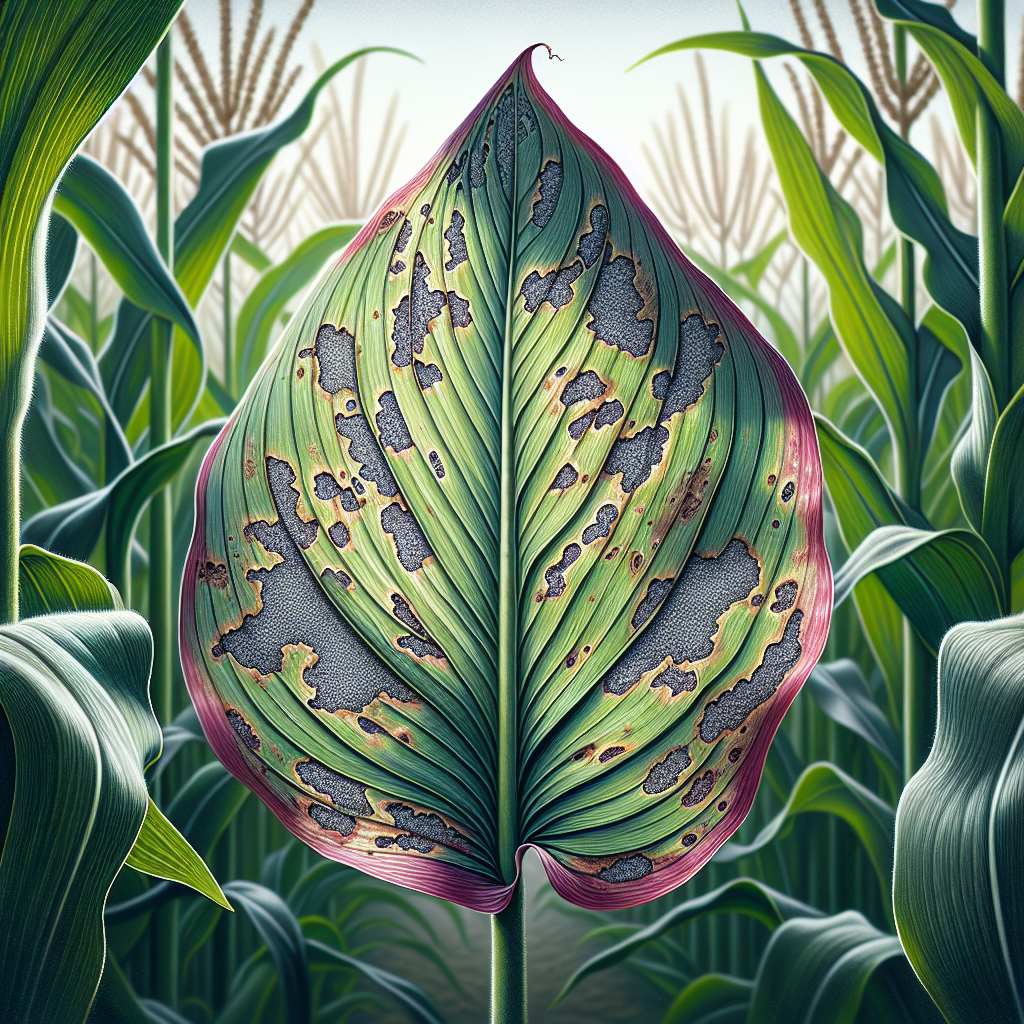
Introduction to Northern Corn Leaf Blight
Northern Corn Leaf Blight (NCLB), caused by the fungus Exserohilum turcicum, stands as one of the most destructive foliar diseases impacting corn production worldwide, particularly in temperate growing regions. First identified in the northern United States in the early 20th century, NCLB has since spread to major corn-growing areas across North America, Europe, Asia, and Africa, causing annual economic losses estimated in the hundreds of millions of dollars. The pathogen infects corn leaves, disrupting photosynthesis and weakening plants, which can result in yield reductions of 10-50% or more under severe conditions.
This disease primarily targets susceptible corn hybrids during prolonged periods of high humidity and moderate temperatures, making it a persistent threat to both commercial fields and small-scale farms. Unlike some corn diseases that affect roots or ears, NCLB focuses on foliage, producing characteristic grayish lesions that expand over time. Early detection and integrated management are crucial, as unchecked infections can lead to premature leaf senescence and reduced kernel fill. For detailed insights on common rust, another key corn foe, see our comprehensive guide. Understanding NCLB's biology and implementing proactive strategies empowers growers to protect their harvests effectively.
Identifying Symptoms & Damage
Recognizing Northern Corn Leaf Blight early is essential for minimizing damage. Initial symptoms appear as small, diamond- or spindle-shaped lesions on the lower leaves during the vegetative growth stages (V8 to VT). These lesions measure 1/4 to 1/2 inch long, with a light gray to tan center and a distinctive dark brown to purple border. Unlike bacterial leaf spots, NCLB lesions often show fine, dark green to black fungal mycelium or sporulation in the center under humid conditions, resembling a "bird's eye" appearance when mature.
As the disease progresses into the reproductive stages (R1-R3), lesions enlarge to 1-6 inches, merging to form extensive blighted areas covering up to 50-80% of the leaf surface. Severely infected leaves turn gray and necrotic, shredding along lesion boundaries due to wind and rain. Upper leaves become infected when lower lesions produce spores that splash upward. Differentiate NCLB from gray leaf spot by lesion shape—NCLB lesions taper at ends, while gray leaf spot produces rectangular lesions parallel to veins.
Damage manifests as reduced photosynthesis, leading to smaller ears, fewer kernels per row, lighter kernel weight, and lower test weight. Yield losses correlate directly with disease severity: 10% leaf area affected at silking reduces yield by 6%; 50% loss can slash yields by 28%. In severe epidemics, stalk lodging increases due to weakened vascular tissue. Scout fields weekly from V8 onward, focusing on lower leaves during cool, wet weather. Use a 10x hand lens to confirm fungal structures. For small farms, early identification prevents total crop failure—check our Spring Pest Patrol blog for AI-assisted scouting tips.
Lifecycle and Progression of Northern Corn Leaf Blight
Exserohilum turcicum follows a polycyclic lifecycle, with multiple infection cycles per season driven by abundant spore production. The fungus overwinters as dormant mycelium or conidia in infected corn residue on the soil surface, surviving up to 18 months in dry conditions or indefinitely in moist debris. Spores (conidia) germinate in free water (dew, rain) at 50-86°F (10-30°C), with optimal infection at 77°F (25°C) and leaf wetness >12 hours.
Primary inoculum splashes from residue to lower leaves via rain or wind, penetrating through stomata or wounds within 6-12 hours. Lesions develop in 5-7 days, producing secondary conidia (100,000+ per lesion) that disperse by wind up to 300 miles. Each cycle repeats every 7-14 days, accelerating in humid microclimates. Disease progression peaks from tasseling to milk stage (R1-R3), when leaf area index is maximal and humidity high.
Infection requires susceptible tissue, moisture, and moderate temperatures; UV light and drought suppress sporulation. Hybrid resistance alters progression—resistant varieties limit lesion size and sporulation, slowing epidemics. Track progression using the Griffith-Nyquist model: disease severity doubles every 5-10 days under ideal conditions. Residue management breaks the cycle by promoting decomposition.
Environmental Triggers & Risk Factors
NCLB epidemics erupt under specific conditions favoring spore germination and dispersal. Key triggers include prolonged leaf wetness (>10-12 hours) from frequent rain, heavy dews, or irrigation, combined with temperatures of 65-85°F (18-29°C). High relative humidity (>90%) within dense canopies amplifies infection; avoid overhead irrigation.
Risk factors include continuous corn rotations, which build inoculum (residue from prior crops harbors 80% of overwintering fungus). Susceptible hybrids in narrow-row spacings (<30 inches) create humid microclimates, increasing risk 2-3x. No-till fields with >20% surface residue heighten primary inoculum. Moderate nitrogen fertility promotes lush foliage ideal for infection, while excessive N exacerbates severity.
Regional hotspots include the U.S. Corn Belt (Iowa, Illinois, Indiana), where humid summers prevail. Climate change extends risk periods with warmer nights sustaining dew. Assess field risk via residue cover, hybrid maturity, and prior-year incidence. Tools like disease forecasting models (e.g., ND Corn NCLB Predictor) integrate weather data for timely alerts.
Organic Control & Treatment Plans
Organic management emphasizes cultural practices, biologicals, and resistant varieties, avoiding synthetic fungicides. Select hybrids with moderate resistance (ratings 3-5 on 1-9 scale, where 1=highly resistant), such as those from Dent Corn (Yellow Dent) lines bred for tolerance. Rotate with non-hosts like soybeans or wheat for 2-3 years to dilute inoculum.
Tillage buries residue, reducing primary inoculum by 70-90%; minimum till with cover crops like rye hastens decomposition. Plant at optimal populations (28,000-34,000 plants/acre) in wider rows (36+ inches) for better airflow. Apply foliar organic biocontrols like Bacillus subtilis or Trichoderma harzianum at V10 and VT (7-14 day intervals) during high-risk periods—efficacy reaches 40-60% suppression. Potassium phosphite boosts plant defenses, enhancing resistance.
Scout intensively; apply treatments when 5-10% lower leaves show lesions before tassel. Compost teas with compost extracts suppress sporulation. Integrate with companion planting using marigold borders to deter spore dispersal. Monitor via sticky traps for spore counts. Organic plans yield 80-90% control when layered; track via field maps for precision.
Preventing Northern Corn Leaf Blight in the Future
Long-term prevention hinges on integrated pest management (IPM) combining genetics, agronomics, and monitoring. Prioritize resistant hybrids—seek those with Ht1, Ht2, or Ht3 genes conferring partial resistance, reducing severity by 50-70%. Source seed from reputable breeders tested against local NCLB races.
Implement 2-4 year rotations with sorghum or peas to break residue cycles. Minimum tillage with aggressive residue management (shredding, fall disking) cuts inoculum 60%. Time planting to avoid peak humidity windows; early maturity hybrids (95-105 RM) escape late-season epidemics.
Enhance field airflow via 30-36 inch rows, 6-8 inch drops, and 20-25% residue removal. Balanced fertility avoids excess N; soil-test annually. Fungicide resistance management rotates modes of action (FRAC groups 3, 11, 7). Use decision aids like GrowPath or local extension apps for spray timing—apply at VT-R1 when 50% risk factors align. Seed treatments with biologicals protect seedlings. Annual scouting and record-keeping refine strategies, targeting <5% incidence.
Crops Most Affected by Northern Corn Leaf Blight
NCLB primarily devastates corn (Zea mays), with all types susceptible: dent, flint, sweet, popcorn, and silage. Sweet Corn (Honey Select), Dent Corn (Yellow Dent), and Flint Corn (Indian Corn) suffer most in commercial settings due to dense plantings. Susceptibility varies by hybrid—older varieties lack resistance genes, while tropical lines from sorghum backgrounds show tolerance.
Minor hosts include sorghum, sudangrass, and Johnsongrass, serving as inoculum bridges. Teosinte relatives harbor the pathogen but rarely sustain epidemics. No significant impact on other major crops like potato or rice. Focus protection on corn rotations; diverse systems with soybeans minimize carryover. Global hotspots report 20-40% losses in susceptible field corn.