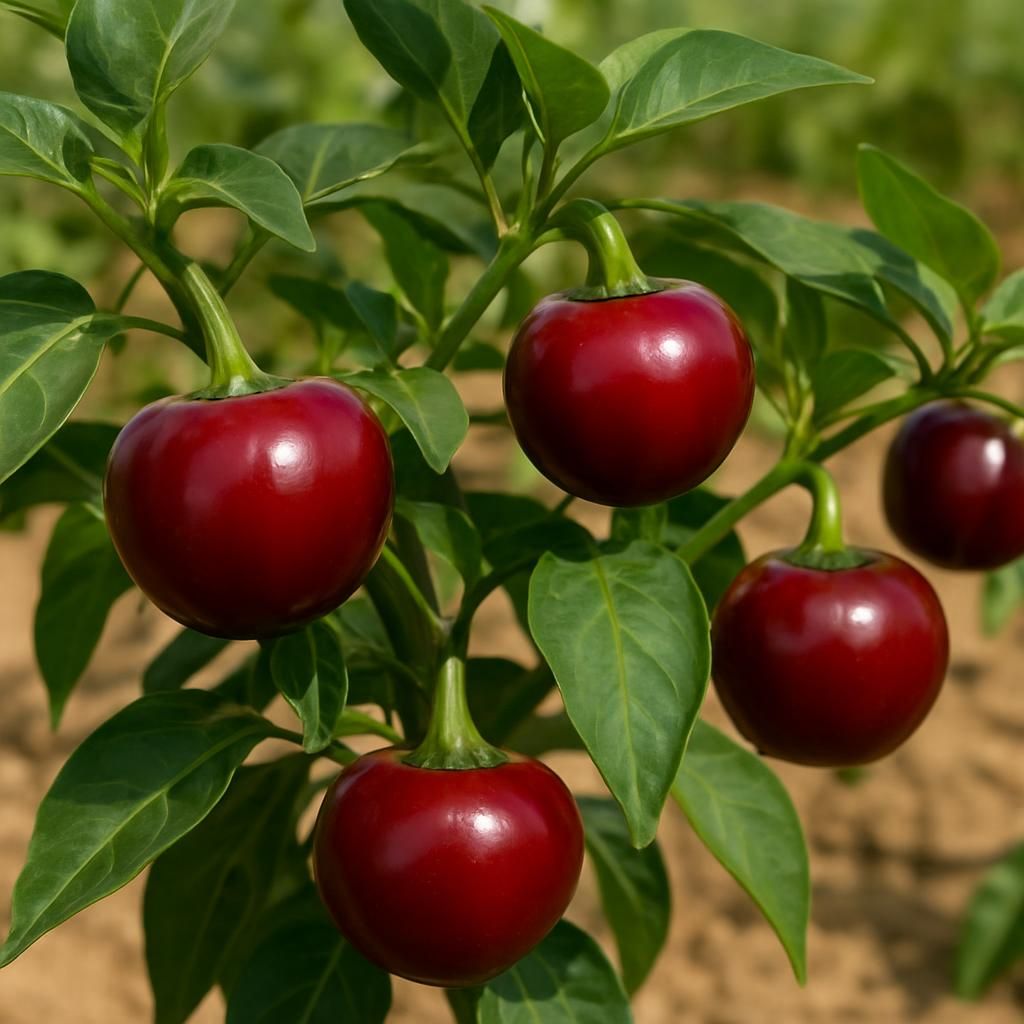
Introduction to Ramnad Mundu Chili
Ramnad Mundu Chili (Capsicum annuum) is a traditional South Indian chili variety originating from the arid plains of Ramanathapuram district in Tamil Nadu. Known for its small, round, thick-fleshed pods that deliver a sharp, lingering heat, this landrace has become a cornerstone of local cuisine and commercial spice production. Farmers appreciate its resilience in high-temperature, low-rainfall environments where many other chili types struggle. The variety’s name derives from the Tamil word “Mundu,” referring to its distinctive rounded shape. Today, it is cultivated across southern India and exported as a premium dried chili for both domestic markets and international spice blends.
Botanical Profile of Ramnad Mundu Chili
The plant grows as a compact, bushy annual reaching 45–70 cm in height with a spread of 40–60 cm. Stems are semi-woody at the base, branching profusely and bearing dark-green, ovate-lanceolate leaves. Flowers are small, white, and typically solitary or in pairs at each node. The fruit is a small, spherical to slightly flattened pod, 2–3.5 cm in diameter, with thick, fleshy walls and a smooth, glossy surface that ripens from green to deep red. The placenta contains high concentrations of capsaicinoids, giving the chili its characteristic pungency rated between 35,000–55,000 Scoville Heat Units. Seeds are cream-colored, flattened, and approximately 3–4 mm long.
Soil, pH, and Climate Requirements for Ramnad Mundu Chili
Ramnad Mundu Chili performs best in well-drained sandy loam to red loamy soils with good organic matter. It tolerates slightly alkaline conditions but is sensitive to waterlogging and salinity buildup.
| Parameter | Ideal Range | Notes |
|---|---|---|
| Soil Type | Sandy loam to red loam | Excellent drainage essential |
| Soil pH | 6.0–7.5 | Slightly acidic to neutral preferred |
| Temperature (Day) | 25–35 °C | Optimal fruit set above 28 °C |
| Temperature (Night) | 18–24 °C | Avoid prolonged nights below 15 °C |
| Annual Rainfall | 600–900 mm | Supplemental irrigation required |
| Relative Humidity | 50–70 % | Lower humidity reduces fungal risk |
| Altitude | 0–600 m | Performs well in coastal plains |
Step-by-Step Planting & Propagation
- Seed Selection & Treatment: Choose certified disease-free seed. Soak in 0.2 % carbendazim or Trichoderma viride suspension for 30 minutes before sowing.
- Nursery Preparation: Raise seedlings in 1 m × 3 m raised beds enriched with well-decomposed farmyard manure at 5 kg/m². Sow seeds 1 cm deep in rows 10 cm apart during September–October or February–March in southern India.
- Seedling Care: Maintain 60–70 % soil moisture; seedlings are ready for transplanting in 35–45 days when they reach 12–15 cm height with 4–6 true leaves.
- Land Preparation: Plough twice, incorporate 10–12 t/ha FYM, and form raised beds or ridges 30 cm high spaced 60 cm apart.
- Transplanting: Plant seedlings at 45 cm × 45 cm spacing during cooler evening hours; irrigate immediately after transplanting.
Care & Maintenance regimes for Ramnad Mundu Chili
Consistent moisture without waterlogging, balanced nutrition, and timely pruning are critical for maximizing pod size and pungency.
| Growth Stage | Irrigation Frequency | Fertilizer Application (per ha) | Pruning / Training |
|---|---|---|---|
| Seedling (0–4 wks) | Light daily watering | 20 kg N, 40 kg P₂O₅, 20 kg K₂O basal | Remove lower leaves at transplant |
| Vegetative (4–8 wks) | Every 4–5 days | 30 kg N at 30 DAT | Pinch terminal bud at 30 cm height |
| Flowering (8–12 wks) | Every 5–6 days | 20 kg N + 20 kg K₂O at 45 DAT | Remove basal suckers and diseased branches |
| Fruiting (12+ wks) | Every 6–7 days | 20 kg N + 20 kg K₂O at 60 DAT; foliar Ca & Mg sprays | Light tipping of long branches |
Pests, Diseases & Organic Management
Common threats include Aphids, Thrips, Spider mites, fruit and shoot borers, Fusarium wilt, Anthracnose, and Chili leaf curl disease. Implement integrated pest management: install yellow sticky traps at 20 traps/ha for aphids and whiteflies; release Trichogramma chilonis at 50,000/ha weekly during flowering; apply neem oil (3 ml/L) or Beauveria bassiana sprays every 10–12 days. For soil-borne diseases, treat nursery beds with Trichoderma harzianum and rotate with Onion or Garlic every third season. Mulch with paddy straw to suppress weeds and conserve moisture while reducing splash-borne pathogens.
Harvesting, Curing & Optimal Storage
Harvest when pods turn fully red and firm, typically 90–110 days after transplanting. Pick in the early morning to minimize field heat. Sun-dry pods on clean tarpaulins for 5–7 days until moisture content reaches 10–12 %. For mechanical drying, maintain 45–50 °C for 8–10 hours. Grade by size and color; store in moisture-proof jute bags or HDPE-lined sacks with 5 g silica gel sachets per 10 kg. Maintain storage temperature below 20 °C and relative humidity under 65 % to preserve pungency and color for up to 12 months.
Companion Planting for Ramnad Mundu Chili
Intercrop with Marigold or Thai Basil to repel nematodes and aphids. Border rows of Sorghum or Pearl Millet provide windbreaks and reduce thrips incidence. Avoid planting near Eggplant and Tomato to minimize shared viral vectors. Coriander sown as a living mulch suppresses weeds and attracts beneficial insects. Rotate with legumes such as Chickpeas to improve soil nitrogen and break disease cycles.