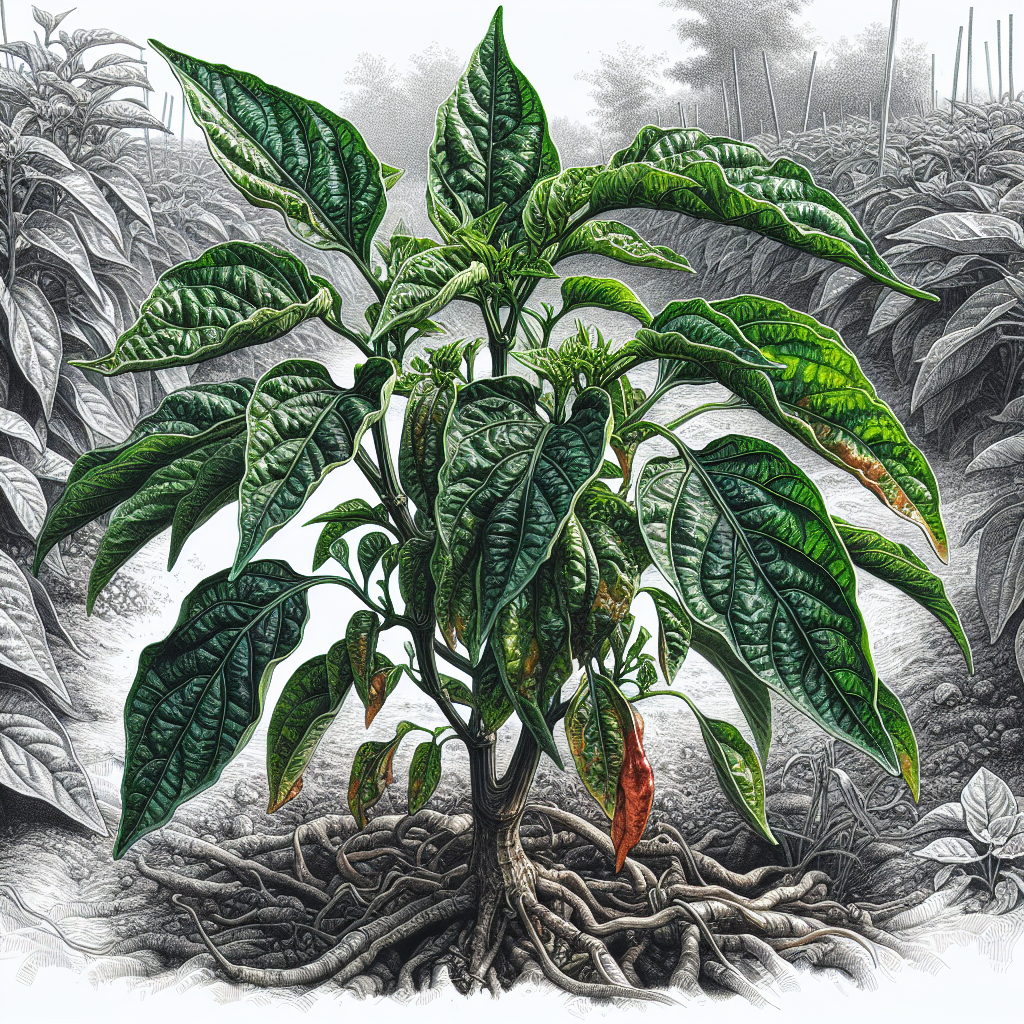
Introduction to Chili leaf curl disease
Chili leaf curl disease (CLCD) is one of the most destructive viral diseases affecting chili peppers (Capsicum spp.), causing up to 100% yield loss in severe outbreaks. Primarily caused by a complex of begomoviruses like Chili leaf curl virus (ChiLCV), Papaya leaf curl virus (PaLCuV), and Tomato leaf curl New Delhi virus (ToLCNDV), it is transmitted by the whitefly vector Bemisia tabaci. First identified in India in the early 20th century, CLCD has spread globally to Asia, Africa, and parts of the Americas, posing a major threat to chili production.
Farmers often confuse CLCD with nutrient deficiencies or herbicide damage, but distinctive symptoms set it apart. The disease thrives in warm, humid conditions, making it a perennial challenge in tropical agriculture. Early detection and vector management are critical, as no curative treatments exist for infected plants. This guide provides comprehensive diagnostics, organic management strategies, and prevention tactics for sustainable chili farming. For more on integrated pest management, check this insightful blog post on spring pest patrol.
Understanding CLCD's epidemiology is key: whiteflies acquire the virus from infected weeds or crop residues and transmit it persistently. High vector populations during dry spells exacerbate spread. Resistant varieties like Arka Sweta and Pusa Jwala offer partial protection, but integrated approaches yield best results. Global chili production, valued at over $5 billion annually, suffers immensely from this disease, underscoring the need for vigilant management.
Identifying Symptoms & Damage
Recognizing CLCD early is essential for limiting spread. Initial symptoms appear 10-20 days post-infection on young leaves: upward curling, puckering, and crinkling, giving a 'ferned' appearance. Leaves become leathery, turn yellow or chlorotic, and may roll inwards. Severely affected plants exhibit stunted internodes, reduced leaf size, and bushy growth due to proliferation of axillary shoots.
Flower production drops, with buds dropping prematurely; fruits, if formed, are small, malformed, and necrotic. Plants show overall dwarfing, with brittle stems. Secondary symptoms include enations (leaf-like outgrowths) on veins and phyllody (floral parts turning leafy). Damage assessment reveals 40-90% yield loss, with quality decline making fruits unmarketable.
Differentiate from look-alikes: Aphids cause honeydew and sooty mold without leaf curling; powdery mildew shows white powder; mosaic viruses cause mottling without upward curl. Use lab tests like PCR for confirmation. Scout fields weekly, focusing on lower leaves. Economic threshold: 5-10% symptomatic plants warrant action. In bell pepper and eggplant, similar symptoms occur but with less severity.
Lifecycle and Progression of Chili leaf curl disease
CLCD follows a vector-mediated lifecycle tied to whitefly biology. Begomoviruses are circulative, persistent pathogens: whiteflies acquire virus during nymphal feeding (2-3 hours), retain it lifelong, and transmit to healthy plants (15-30 min acquisition, lifelong retention). Virus multiplies in vector salivary glands.
Disease progression spans crop seasons: primary spread from weed reservoirs like tomato, cotton, or malva; secondary via whitefly migration. Incubation: 10-35 days, faster in heat (28-32°C). Acute phase: rapid symptom development; chronic: persistent stunting. Perennial weeds harbor virus year-round.
Whitefly lifecycle (egg to adult: 15-25 days) aligns with disease peaks. Nymphs and adults vector equally. In fields, infection foci expand radially. Harvested plants remain sources if not destroyed. Understanding this informs timely interventions, like rogueing infected plants before vector flights peak.
Environmental Triggers & Risk Factors
CLCD favors warm (25-35°C), dry conditions ideal for whitefly proliferation. High temperatures accelerate vector reproduction (up to 20 generations/year). Low humidity (<60%) enhances whitefly activity; rainfall disrupts but monsoon crops face resurgence.
Risk factors: dense planting (>60x30cm spacing), susceptible varieties (e.g., Pusa Sadabahar), nearby infected crops like okra or tomato, weed hosts (Abutilon, Croton), nitrogen excess promoting tender growth. Poor sanitation, overhead irrigation splashing vectors, and farmer tool sharing amplify spread. Monocropping chilis heightens vulnerability; mixed cropping with marigold repels whiteflies.
Soil pH >7.5 and low organic matter stress plants, increasing susceptibility. Climate change extends vector seasons, intensifying outbreaks. Map fields for hotspots using GIS for targeted management.
Organic Control & Treatment Plans
No chemical cures exist; focus on vector suppression and cultural controls. 1. Cultural Practices: Rogue infected plants weekly (burn/destroy); rotate with non-hosts like onion or cereals (3-4 months); maintain 75-90cm row spacing for airflow; mulch to deter weeds.
2. Vector Management: Use yellow sticky traps (20-30/ha); interplant with trap crops like okra; release predators like ladybirds, lacewings. Organic sprays: neem oil (5ml/L, 3x/week), pongamia (2%), garlic-chili extract. Reflective mulches (silver) repel alates by 50-70%.
3. Biocontrol: Encourage parasitoids (Encarsia, Eretmocerus); apply Beauveria bassiana (10^9 spores/ml). 4. Plant Boosters: Foliar calcium (2g/L), micronutrients (Zn, Fe); biostimulants like seaweed extract enhance resilience.
Integrated Plan: Week 1-4: traps + neem; monitor; rogue >5% infection. Varieties: Arka Khyati, VRCH-203. Yields recover 30-50% with timely action. Avoid broad-spectrum insecticides to preserve predators.
Preventing Chili leaf curl disease in the Future
Prevention beats cure. Seed/Seedling Certification: Use virus-indexed seeds; hot-water treat (50°C, 25min). Resistant Varieties: Adopt hybrids like Nishat, Punjab Lavanya (tolerance to ChiLCV).
Field Sanitation: Destroy volunteers, weeds; deep plow post-harvest; barrier crops (maize, sorghum). Vector Barriers: Windbreaks, nets; UV-reflective nets reduce incidence 80%. Monitoring: Yellow pan traps, sweep nets for whitefly counts (>10/leaf = spray).
Soil Health: Balanced NPK (120:60:40 kg/ha), organics (5t FYM/ha); mycorrhizae for vigor. Crop Rotation: Alternate with garlic, ginger. Forecasting: Track whitefly migrations via regional alerts. Long-term: breed stacked resistances; quarantine new stock. These yield 70% disease-free crops.
Crops Most Affected by Chili leaf curl disease
Primarily chilis (Chili Pepper), with 50-100% losses; also bell pepper, jalapeño pepper, habanero pepper, ghost pepper. Solanaceae relatives like tomato, eggplant suffer milder infections. Non-hosts include cucurbits, legumes. Weeds (Solanum nigrum, Datura) amplify reservoirs. Global hotspots: India (80% acreage), Pakistan, Bangladesh.