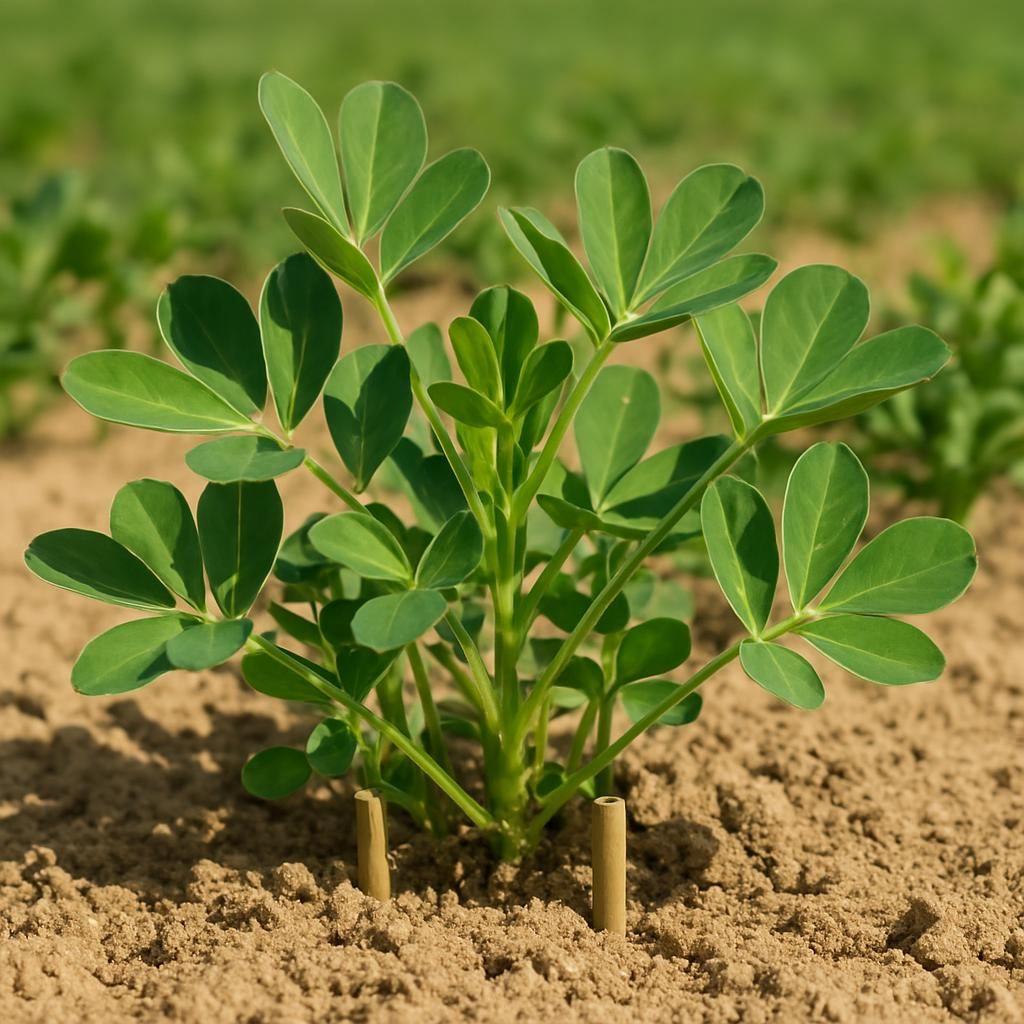
Introduction to Peanut (Spanish)
Spanish peanuts (Arachis hypogaea var. vulgaris) are among the most widely grown peanut types globally due to their early maturity, compact growth habit, and kernels rich in oil. These varieties typically reach harvest 90–110 days after planting and produce smaller, rounder seeds than Runner or Virginia types. Their high oil percentage makes them ideal for roasting, candy, and oil extraction industries.
Farmers favor Spanish peanuts for their drought tolerance once established and their ability to fix atmospheric nitrogen, reducing fertilizer inputs. Because pods develop underground, success depends on loose, well-drained soils and precise harvest timing. This guide delivers actionable, research-based recommendations for commercial and small-scale growers seeking consistent, high-quality Spanish peanut production.
Botanical Profile of Peanut (Spanish)
Spanish peanuts belong to the Fabaceae family and exhibit a determinate growth habit with upright, bunch-type architecture. Plants typically reach 30–45 cm in height with a compact canopy that facilitates mechanical harvesting. Leaves are pinnately compound with four leaflets, and small, self-pollinating yellow-orange flowers appear 30–40 days after emergence.
After fertilization, the ovary elongates into a peg that penetrates the soil to form pods. Each pod usually contains two seeds enclosed in a thin, tan shell. Spanish types are distinguished by their smaller seed size (approximately 0.4–0.6 g per seed) and higher oil content (48–52 %) compared with other market types.
Soil, pH, and Climate Requirements for Peanut (Spanish)
Spanish peanuts thrive in sandy loam to loamy sand soils that remain loose at harvest. Heavy clays increase the risk of pod rot and mechanical damage during digging. Ideal soil conditions are summarized below.
| Parameter | Ideal Range | Notes |
|---|---|---|
| Soil Texture | Sandy loam to loamy sand | Ensures peg penetration and easy harvest |
| Soil pH | 6.0–6.5 | Below 5.8 increases aluminum toxicity |
| Organic Matter | 1.5–2.5 % | Improves water retention without compaction |
| Drainage | Well-drained; water table >1 m | Prevents pod rot and aflatoxin risk |
| Temperature (Soil) | 18–30 °C at planting | Minimum 15 °C for germination |
| Air Temperature | 21–32 °C daytime | Frost-free period of 120+ days required |
| Annual Rainfall | 500–750 mm, well distributed | Supplemental irrigation improves yield |
Step-by-Step Planting & Propagation
Site Selection & Preparation: Choose fields with prior corn or wheat rotation to reduce soil-borne disease pressure. Perform deep tillage (20–25 cm) followed by leveling to create a smooth seedbed.
Soil Testing & Amendment: Collect composite samples to 15 cm depth. Apply agricultural lime 3–6 months before planting if pH is below 5.8. Incorporate 20–30 kg ha⁻¹ of sulfur if soil tests indicate deficiency.
Seed Selection & Treatment: Use certified, fungicide-treated seed of adapted Spanish cultivars (e.g., Tamspan 90, Pronto). Target 85 % germination or higher.
Planting Window: Plant when soil temperature at 10 cm depth consistently exceeds 18 °C, typically 7–10 days after the last frost. In temperate zones this corresponds to late April through mid-May.
Seeding Rate & Depth: Drill seeds 5–6 cm deep in 76–91 cm rows at 112–134 kg ha⁻¹ (approximately 200 000–250 000 seeds ha⁻¹). In-row spacing of 5–8 cm produces optimal pod set.
Inoculation: Apply Rhizobium inoculant specific to peanuts at planting if the field has no history of legume cultivation. This ensures effective nitrogen fixation.
Care & Maintenance regimes for Peanut (Spanish)
Consistent moisture during flowering and pegging is critical. Avoid both water stress and waterlogging. Nutrient management focuses on phosphorus, potassium, calcium, and boron.
| Growth Stage | Irrigation (mm/week) | Fertilizer Application | Pruning / Canopy Management |
|---|---|---|---|
| Pre-plant | 0 | 0-20-20 at 200 kg ha⁻¹; incorporate 2–3 cm | None |
| Emergence–30 DAP | 12–15 | None unless tissue tests indicate deficiency | None |
| Flowering (30–50 DAP) | 20–25 | 200 kg ha⁻¹ gypsum at first flower | None |
| Pegging (50–80 DAP) | 20–25 | Foliar boron 0.3 kg ha⁻¹ at 60 DAP | Light weeding only |
| Pod Fill (80–100 DAP) | 15–20 | Stop nitrogen; maintain K levels | None |
| Maturation | Withhold 10–14 days before harvest | None | None |
Pests, Diseases & Organic Management
Key insect pests include thrips, leafhoppers, and cutworms. Monitor with yellow sticky traps and apply Bacillus thuringiensis or spinosad when thresholds are reached. Root-knot nematodes can be suppressed by rotating with sorghum or millet and incorporating marigold residues.
Major diseases are leaf spot diseases (early and late), southern blight, and aflatoxin-producing Aspergillus. Cultural controls include crop rotation, resistant varieties, and timely harvest. Organic-approved copper or Bacillus subtilis sprays at 10–14 day intervals reduce leaf spot severity when initiated at first detection.
Harvesting, Curing & Optimal Storage
Spanish peanuts reach physiological maturity when 70–75 % of pods show darkened internal hull color. Dig when soil moisture is moderate to minimize pod loss. Invert windrows and allow 3–5 days of field drying to 18–20 % moisture. Complete curing in forced-air dryers at 35 °C until kernel moisture reaches 10 %. Store at 7–10 °C and 65 % relative humidity in breathable bags or bins to preserve quality and prevent mold.
Companion Planting for Peanut (Spanish)
Peanuts form beneficial relationships with nitrogen-fixing bacteria and improve soil for following crops. Compatible companions include corn, squash, and cucumber in a three-sisters inspired system. Aromatic herbs such as thyme and rosemary deter foliage pests. Avoid planting near onion or garlic families, which can inhibit Rhizobium activity. See our detailed guide on Summer Companion Planting: 10 Organic Pairings to Boost Small Farm Resilience for expanded pairings and layouts.