Introduction to Panama disease
Panama disease, scientifically known as Fusarium wilt of banana and caused by the soil-borne fungus Fusarium oxysporum f. sp. cubense (Foc), represents one of the most severe threats to global banana production. First identified in Panama in the early 20th century—hence its name—this disease decimated the dominant 'Gros Michel' banana variety, forcing the industry to shift to the Cavendish banana, which is now under siege from Tropical Race 4 (TR4), a highly virulent strain. Unlike many foliar diseases, Panama disease attacks the roots and vascular system, making it nearly impossible to cure once established in the soil, with infected fields remaining unproductive for decades.
The economic impact is staggering: bananas are the world's most important fruit crop, with over 150 million tons produced annually, and Panama disease threatens up to 80% of global production. Smallholder farmers in tropical regions like Southeast Asia, Australia, Latin America, and Africa are particularly vulnerable, as TR4 spreads through contaminated soil, water, equipment, and infected planting material. Early detection and stringent prevention are critical, as no effective chemical treatments exist for this persistent pathogen. This comprehensive guide equips agricultural professionals, growers, and researchers with diagnostic tools, organic management strategies, and long-term prevention plans to combat Panama disease effectively. Understanding its biology and implementing integrated approaches can safeguard yields and sustain the banana industry. For real-world insights from affected farms, check this detailed case study on Founders Farm: Building a Farm From Scratch (and Using OnlyCrops AI to Stay Sane).
Identifying Symptoms & Damage
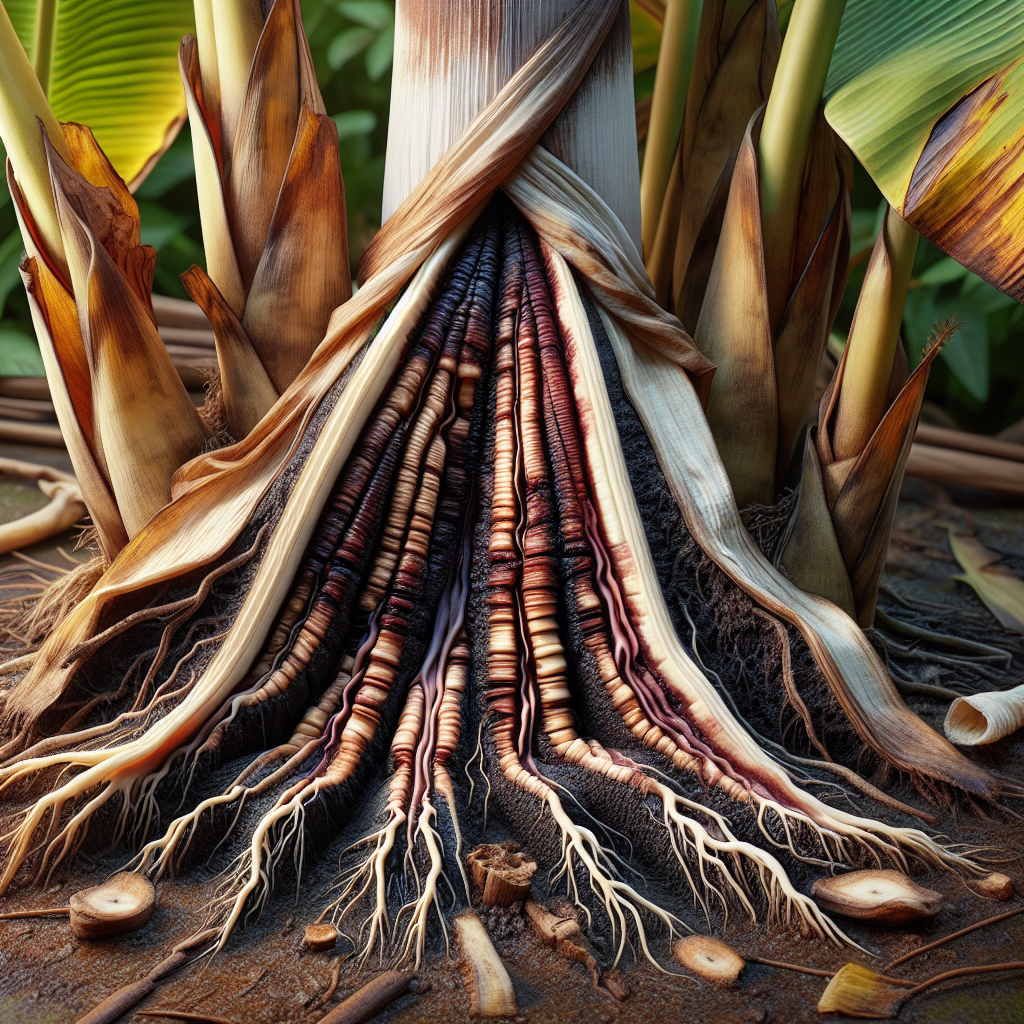
Panama disease progresses stealthily from roots to leaves, with symptoms often appearing 6-12 months after infection, though younger plants may show signs sooner under stress. The hallmark is vascular discoloration: cut open the pseudostem (the upright trunk-like structure) at the base, and you'll see yellowish to dark brown streaks in the vascular bundles, resembling a 'wedding cake' pattern in cross-section. This blockage prevents water transport, causing wilting of older leaves first—the margins turn yellow, then brown, while younger leaves remain green initially.
As the disease advances, premature leaf drop occurs, leaving the plant with a 'skirt' of dead leaves around the pseudostem. The rhizome (corm) turns brown and rots internally, often with a pinkish fungal growth visible upon splitting. Infected plants stunt growth, produce small, deformed bunches, and eventually collapse, with the pseudostem splitting longitudinally. External signs include yellowing foliage, buckling leaves, and a musty odor from rotting roots. Damage is severe: yield losses reach 100% in susceptible varieties, with Dwarf Cavendish banana plantations showing 50-90% mortality within 2-3 years of TR4 introduction.
Differential diagnosis is key: distinguish from root rot (waterlogged roots, no vascular streaking), Phytophthora (external lesions, ooze), or nutrient deficiencies (uniform yellowing). Lab confirmation via PCR testing for Foc races (1, 2, TR4) is recommended. Early scouting in wet seasons, when symptoms peak, prevents spread—check for Fusarium in soil samples too.
Lifecycle and Progression of Panama disease
Fusarium oxysporum f. sp. cubense is a soil-borne ascomycete fungus that survives indefinitely as chlamydospores (thick-walled resting spores) in soil, persisting 20-30 years without a host. Infection begins when macroconidia (asexual spores) from infested debris or water enter root wounds or natural openings during rainy periods. The fungus colonizes xylem vessels, producing mycelium that blocks water flow and secretes toxins, inducing wilting.
The lifecycle spans months to years: spores germinate in warm, moist soil (optimal 25-30°C, pH 5.5-7.0), penetrate roots within days, and spread upward via microconidia reproduction inside vessels. Symptoms emerge post-colonization, with disease progression in waves—mild in dry conditions, explosive in wet. TR4 produces microsclerotia for enhanced survival. In ratoon crops (successive harvests from suckers), reinfection is rapid, as suckers inherit contaminated rhizomes. Airborne spread is minimal; primary dissemination is human-mediated via tools, boots, and nursery stock. Understanding this cycle underscores soil as the eternal reservoir, dictating long-term management.
Environmental Triggers & Risk Factors
Panama disease thrives in tropical/subtropical climates (20-30°C), with high soil moisture (>60% field capacity) triggering spore germination and root infection. Poor drainage, compaction, and alkaline soils (pH >7) exacerbate spread, as does monoculture of susceptible bananas like Lady Finger banana. Risk spikes with flooding, mechanical injury from cultivation, and import of infested material—TR4 has spread globally via contaminated farms in the Philippines and Jordan.
Other factors: high nitrogen fertilizers promote lush growth vulnerable to wilt, while low organic matter (<2%) limits microbial suppression. Weed hosts and crop rotations with non-hosts like cassava reduce buildup. Climate change intensifies risks via erratic rains. Assess fields with soil tests for Foc and nematodes (root-knot nematodes), which synergize damage.
Organic Control & Treatment Plans
No cure exists for Panama disease, but organic strategies suppress spread and extend productivity. Immediate action on detection: destroy infected plants (uproot, burn, bury >2m deep) to curb spore production. Soil solarization (cover with plastic 4-6 weeks in summer) kills surface chlamydospores, reducing inoculum by 70-90%. Biofumigation with brassicas (cabbage) releases isothiocyanates toxic to Fusarium.
Biological controls: Trichoderma spp. and Pseudomonas fluorescens antagonize Foc—apply as seed treatments or drenches (10^9 CFU/g soil). Mycorrhizal fungi boost root health. Organic amendments: compost (>30 t/ha) and green manures (clover) enhance suppression via competition. Resistant varieties: plant Goldfinger or FHIA hybrids. Integrated plan: quarantine new stock, disinfect tools (1% bleach), footbaths. For small farms, Soil Health Mastery: 5 Proven Strategies for Small Farms to Build Fertile Ground Without Breaking the Bank offers compatible tactics. Monitor with bait plants; rotate to suppressants like Crotalaria (not listed, general).
Preventing Panama disease in the Future
Prevention is paramount: certified disease-free planting material from tissue culture labs is non-negotiable. Quarantine protocols—separate new fields, inspect imports. Site selection: well-drained, non-infested soils; avoid lowlands. Crop rotation (5-10 years) with non-hosts like pineapple or bare fallow. Sanitation: clean equipment, restrict foot traffic, use boot dips.
Flood control: raised beds, ditches. Soil management: lime to pH 6.0-6.5, add organic matter (>4%). Resistant cultivars: prioritize TR4-tolerant like FHIA-01. Monitoring: annual soil tests, sentinel plants. Global efforts include breeding and GM bananas. Educate workers; use biosecurity signage. Long-term, diversify to mango or papaya. Proactive measures have kept clean farms productive indefinitely.
Crops Most Affected by Panama disease
Panama disease primarily devastates bananas (Musa spp.), especially AAA genome cultivars. Cavendish subgroup (Cavendish banana, Dwarf Cavendish) is hypersusceptible to TR4, powering 99% of export trade. Gros Michel fell to Race 1; ABB cooking bananas (plantain) show partial resistance. Minor hosts include Heliconia ornamentals and wild Musa. No major impacts on avocado or mango, but soil persistence risks nearby plantings. Global hotspots: Queensland (TR4 quarantine), Philippines (80% losses), Colombia. Diversify to resistant Blue Java banana or non-Musa fruits.