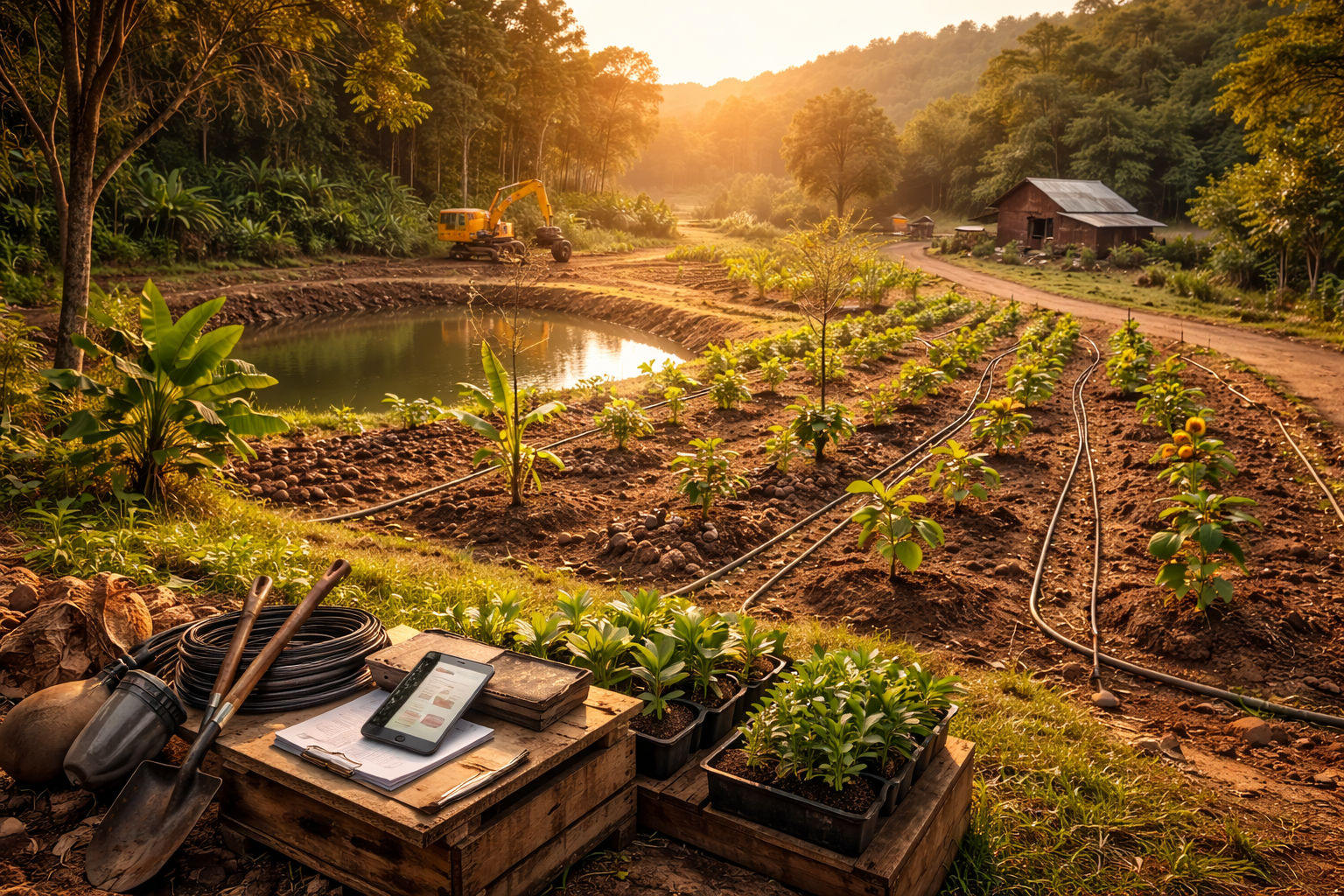
Welcome to Founders Farm
This is the first post in a series about my real-world journey building a farm from the ground up--while also building OnlyCrops AI, the tool I wish I'd had from day one.
The "Founders Farm" theme is simple: build something real, learn fast, document honestly, and keep it sustainable. Not just financially--also mentally. Because starting a farm can be incredibly rewarding, but it can also become a blur of half-finished tasks, forgotten purchases, and "Wait... when did we plant that?"
This first post is the overview: the major steps we took to transform raw land into a farm, without going too deep into each one (future posts will do that).
The Reality of Starting From Raw Land
Before there are crops, there's everything else:
- access
- drainage
- water storage
- irrigation
- paths and tracks
- basic infrastructure
- and then... finally... planting
And even when planting begins, it's not "done." It's just the start of a long relationship with time, weather, and maintenance.
What surprised me most wasn't the physical work--it was the coordination. The constant need to answer questions like:
- What did we do last week, exactly?
- What's next, and what's blocked?
- How much did that cost, and where's the receipt?
- Which area is planted with what?
- When should we fertilize, prune, water, or check for pests?
That's where OnlyCrops AI started earning its keep.
Step 1: Clearing Wild Bamboo (Slash & Burn)
The land we started with wasn't "empty." It was full of wild growth--especially bamboo--dense enough to make parts of the property feel like a wall.
The first major milestone was clearing. In our case, it involved slash & burn, done in a controlled way as part of land preparation. The goal wasn't destruction for its own sake--it was opening space for:
- access paths
- planting zones
- sunlight and airflow
- irrigation lines
- future maintenance
Founders lesson: clearing isn't a single job. It's the first of many cycles of "remove → prepare → maintain."
How OnlyCrops AI helped here
Even at this early stage, OnlyCrops AI was useful for tracking the practical realities:
- creating tasks for each clearing area
- logging tool and labor-related transactions
- keeping notes on which sections were cleared and when
- capturing photos so "before vs after" wasn't just in my memory
Step 2: Building Roads and Dirt Tracks (With a JCB)
Once the land was open enough to move, the next priority was access--because a farm without internal access becomes a farm you avoid.
We used a JCB to build roads and dirt tracks within the farm. This wasn't about making it pretty--it was about making it usable:
- moving compost, mulch, and tools
- reaching planting areas without struggling
- preventing "one rainy week" from shutting down work
Founders lesson: internal access pays for itself fast--especially when the land is uneven or the weather turns.
How OnlyCrops AI helped here
This is where planning mattered:
- breaking the road work into steps (mark → clear → cut → level → compact)
- tracking expenses (fuel, machine time, materials)
- logging progress with photos and notes per area
When you build over time, you forget what's finished and what's "almost finished." OnlyCrops AI made that visible.
Step 3: Digging a Pond (Water = Options)
A pond changes everything. It's not just a water source--it's flexibility:
- irrigation backup
- resilience in dry periods
- easier expansion later
- a buffer against "one system failure" ruining the week
We dug a pond as part of the foundation work--because water planning is not something you want to retrofit after the farm is already planted.
Founders lesson: farms don't fail because of one big disaster. They fail because of repeated small constraints--water is the biggest constraint of all.
How OnlyCrops AI helped here
Pond work has a lot of moving parts:
- scheduling machine time
- tracking costs across multiple days
- keeping notes on location decisions and why we chose them
- recording follow-up tasks (edges, overflow, access points)
All of that went into OnlyCrops AI so it didn't live in "random messages and vague memories."
Step 4: Installing Irrigation (Making the Farm Runnable)
Irrigation is one of those things that turns a farm from "possible" into "manageable."
Once irrigation is in place, you're not relying entirely on hope, buckets, or improvisation. You can create a routine, and routines are what prevent burnout.
We installed irrigation as a core system--not an afterthought--so that once trees were planted, we could actually keep them alive through consistent watering.
Founders lesson: the best irrigation system is the one that gets used consistently.
How OnlyCrops AI helped here
Irrigation is perfect for task-based management:
- tasks for layout planning, trenching, fitting, testing
- recurring maintenance reminders (filter checks, leak checks)
- notes on pressure issues, weak zones, and fixes
- mapping which zones feed which planting areas
Instead of "Where did we run that line?" it becomes "Zone 3 feeds that block."
Step 5: Planting the First Trees and Crops
With access and water in place, we started planting. The first wave focused on a mix of longer-term and faster-return plants:
- mango
- durian
- avocado
- papaya
- banana
Each has a different timeline and personality. Some are long-term investments, others give quicker feedback and momentum.
I'm intentionally not going deep here--each crop (and its early-stage issues) deserves its own post--but the key point is: once planting starts, the farm becomes a living calendar.
Founders lesson: planting is the easy part. The hard part is everything that comes after planting--repeatedly.
How OnlyCrops AI helped here
This is where OnlyCrops AI becomes the "second brain":
- logging planting dates and quantities
- tracking inputs (compost, amendments, mulch)
- creating recurring tasks (watering schedules, observation walks, feeding intervals)
- attaching photos to each crop block so changes over time are obvious
- recording issues early (yellowing, pests, slow growth) before they become disasters
And importantly: transaction logging. Farms leak money through a thousand small purchases. Tracking them isn't glamorous, but it's the difference between "I think this is working" and "I know what it costs."
What This Series Will Cover Next
This post is the overview. Future "Founders Farm" posts will go deeper into each topic, including:
- clearing bamboo responsibly and safely
- building tracks that survive rain and use
- pond planning and water strategy
- irrigation layout, zones, and maintenance
- establishing mango, durian, avocado, papaya, and banana successfully
- pest and disease scouting routines
- and how OnlyCrops AI evolves as the farm evolves
The goal is to share what's real: what worked, what didn't, what I'd do differently, and how simple systems made the difference.
Call to Action: Follow the Series and Build Your Farm With a System
If you're building a farm--or dreaming about starting one--don't underestimate the power of being organized. The difference between a joyful farm and a stressful one is often not effort, but systems.
Start using OnlyCrops AI to:
- plan and repeat tasks without relying on memory
- log transactions so you understand true costs
- track planting, irrigation, and maintenance in one place
- build a timeline you can learn from season after season
Start with OnlyCrops AI today, and follow along with Founders Farm--where we build the land, the systems, and the future, one season at a time.