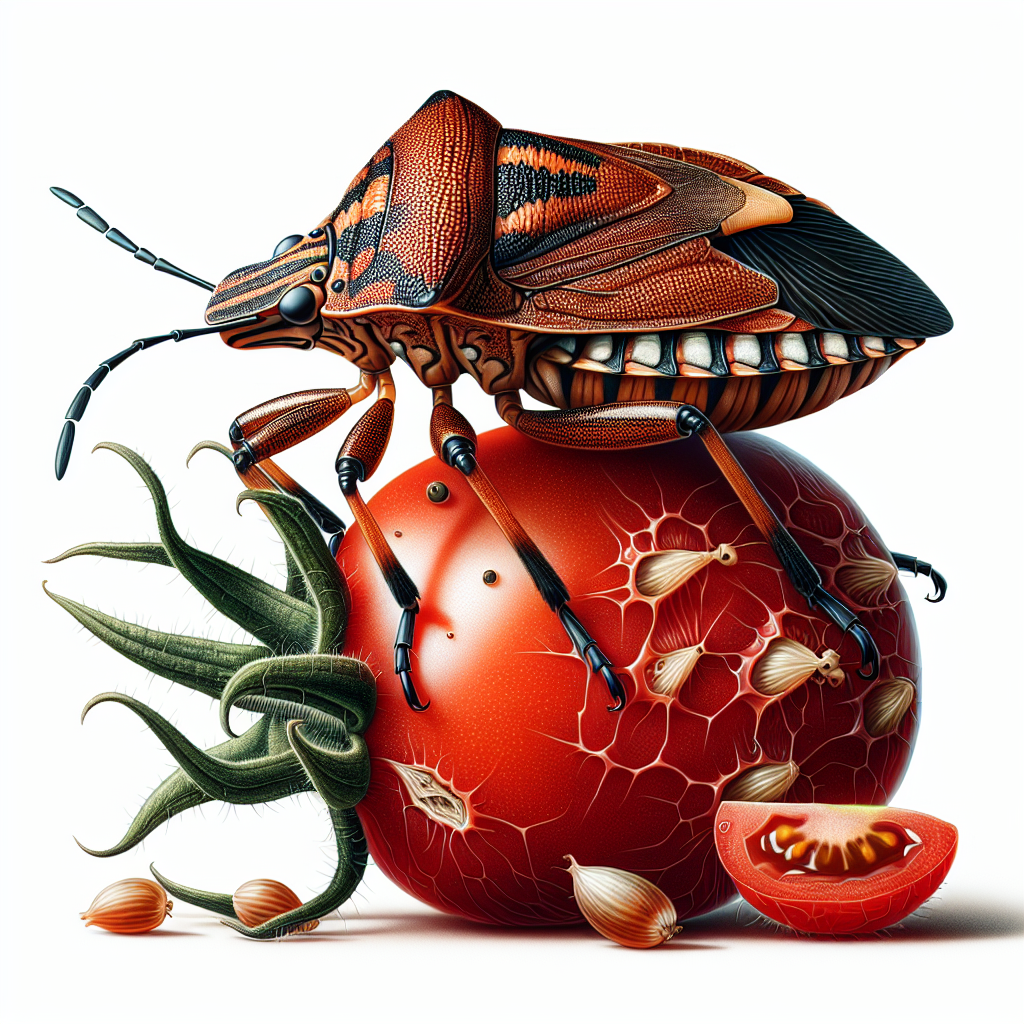
Introduction to Leaffooted bugs
Leaffooted bugs (Leptoglossus spp.), particularly the western leaffooted bug (Leptoglossus zonatus) and the eastern leaffooted bug (Leptoglossus phyllopus), are piercing-sucking insects in the Coreidae family, commonly known as leaf-footed bugs due to their distinctive leaf-like expansions on their hind legs. These pests are significant agricultural threats across the southern United States, Mexico, Central America, and parts of South America, where they feed on a wide range of crops by inserting their needle-like mouthparts into plant tissues to extract sap. This feeding not only deprives plants of vital nutrients but also injects salivary toxins that disrupt plant physiology, leading to deformed fruits, premature drop, and reduced yields.
Adult leaffooted bugs measure 0.75 to 1 inch long, with brown to gray bodies marked by white zigzag patterns. Their hind legs feature flattened, leaf-shaped tibiae, which aid in camouflage among foliage. Nymphs are smaller, wingless, and gregarious, often appearing reddish-brown with black markings. These bugs overwinter as adults in sheltered areas like leaf litter or structures, emerging in spring to feed and reproduce. A single female can lay up to 300 eggs, leading to rapid population explosions in favorable conditions. Stink bugs are often confused with leaffooted bugs, but the latter's leaf-shaped legs and lack of a strong odor distinguish them.
In commercial and home gardens, leaffooted bugs target ripening fruits and seeds, causing economic losses estimated in millions annually for crops like tomato, pomegranate, and almonds. Early detection and integrated pest management (IPM) are crucial, as populations can build quickly. This guide provides comprehensive diagnostics, lifecycle insights, and organic strategies to protect your crops effectively. For more on small farm pest strategies, check this Spring Pest Patrol blog.
Identifying Symptoms & Damage
Diagnosing leaffooted bug infestations requires keen observation of both insects and plant damage. Adults and nymphs cluster on stems, leaves, and fruits, often feeding in groups. Look for their characteristic leaf-shaped hind legs and the bugs' tendency to fly short distances when disturbed, emitting a mild buzzing sound.
Primary damage manifests as clear, sticky exudate (bug excrement) on leaves and fruits, resembling honeydew that attracts ants and sooty mold. Feeding punctures appear as small, pale spots or depressions on fruit skins, especially on developing seeds or pulp. In tomato and citrus, this causes 'catfacing'—ugly, scarred, deformed fruits with hardened, necrotic areas. Fruits may drop prematurely, with seeds shriveled or aborted. On nuts like almonds or pecans, feeding leads to kernel blackening and empty shells.
Nymphal feeding is particularly destructive, as their higher populations amplify damage. Scout undersides of leaves and fruit clusters during early morning or evening when bugs are less active. Use a beat sheet: shake branches over white cloth to dislodge bugs for counting. Damage thresholds vary: in tomatoes, 1-2 bugs per plant warrant action; in orchards, 1% damaged fruit signals infestation. Differentiate from stink bugs by leg shape and from aphids by size and mobility. Severe cases show wilting terminals and stunted growth due to sap loss.
Lifecycle and Progression of Leaffooted bugs
Understanding the lifecycle is key to timing interventions. Leaffooted bugs undergo incomplete metamorphosis: egg, nymph (5 instars), and adult stages. Females lay pale yellow eggs in linear clusters of 10-50 on leaf undersides or stems, hatching in 1-2 weeks at 80°F (27°C).
Nymphs, resembling mini-adults without wings, pass through five instars over 4-6 weeks, molting between stages. Early instars are gregarious and ant-tended; later ones disperse. Nymphs feed voraciously on tender growth and fruits. Adults emerge after the final molt, living 3-12 months, overwintering in aggregations. There are 1-3 generations per year, depending on climate—more in southern regions.
Peak activity aligns with host fruiting: spring emergence targets early blooms, summer generations hit ripening fruits. Overwintering adults seek cracks, woodpiles, or buildings. Eggs take 5-10 days to hatch; total generation time is 30-60 days. Monitor with pheromone traps or visual scouts starting in spring. Lifecycle knowledge enables targeting eggs/nymphs, which are more vulnerable than mobile adults. In cooler areas, one generation; tropics see continuous breeding.
Environmental Triggers & Risk Factors
Leaffooted bugs flourish in warm, dry conditions above 70°F (21°C), with optimal reproduction at 85°F (29°C). Drought stress weakens plants, making them prime targets as bugs prefer succulent tissues. Proximity to wild hosts like sunflower, mustard, or legume weeds serves as reservoirs, facilitating migration to crops.
Overly fertile soils producing lush growth attract egg-laying females. Monocultures, especially in tomato or pomegranate fields, amplify outbreaks. Poor sanitation—unremoved debris or volunteer plants—harbors overwintering sites. Wind currents aid adult dispersal from weedy borders. High nitrogen levels promote tender shoots, increasing susceptibility.
Risk spikes near urban edges with ornamental hosts like citrus or figs. Late-season plantings extend exposure windows. Companion pests like ants protect nymphs, worsening infestations. Climate change extends ranges northward, with models predicting increased pressure in mid-latitudes.
Organic Control & Treatment Plans
Organic management emphasizes IPM: prevention, monitoring, and targeted controls. Start with cultural practices: remove weeds, especially nightshades and mustards, and destroy crop residues post-harvest. Use row covers over young plants; hand-pick and drown bugs in soapy water for small infestations.
Encourage predators like assassin bugs, spiders, and birds via habitat strips of yarrow or marigold. Kaolin clay sprays (Surround WP) create a particle barrier, repelling bugs without residue—apply at 1/4 lb/gal, reapply after rain. Insecticidal soaps or neem oil target nymphs: mix 2% solution, spray evenings to avoid bees. Pyrethrins offer knockdown but use sparingly to preserve beneficials.
For orchards, shake-trap adults into tarps for disposal. Pheromone traps monitor and mass-trap adults. Bacillus thuringiensis (Bt) has limited efficacy; focus on spinosad for severe nymph outbreaks, OMRI-listed at 0.5 oz/gal. Treatment plan: Scout weekly; act if >1 bug/10 plants. Rotate tactics; integrate with stink bugs controls. Success rates exceed 80% with consistent IPM.
Preventing Leaffooted bugs in the Future
Long-term prevention builds resilient systems. Plant resistant varieties like thick-skinned tomatoes (e.g., Roma types). Time plantings to avoid peak flights: early tomatoes miss summer generations. Maintain borders free of hosts; mulch to suppress weeds.
Install 1/4-inch mesh screens or floating row covers until flowering ends. Promote biodiversity with trap crops like sunflower to lure bugs away. Winter cleanup: rake leaves, seal structures. Reflective mulches deter settling. Release predatory insects like minute pirate bugs.
Monitor with sticky traps; use degree-day models (base 55°F) for predictions. Crop rotation disrupts cycles. Healthy soils via compost reduce stress susceptibility. Community efforts: coordinate area-wide sanitation. Annual prevention cuts populations 70-90%.
Crops Most Affected by Leaffooted bugs
Leaffooted bugs attack over 100 hosts, prioritizing fruits/nuts. Top targets: tomatoes (tomato, cherry tomato), causing catfacing (20-50% loss); citrus (orange, lemon); pomegranates (pomegranate); almonds/pecans with kernel damage; figs (fig); eggplant; peppers (bell pepper, chili pepper); squash, pumpkin. Row crops like cotton, soybeans. Weeds sustain them. In Hass avocado, feeding scars fruits. Yields drop 10-100% untreated.