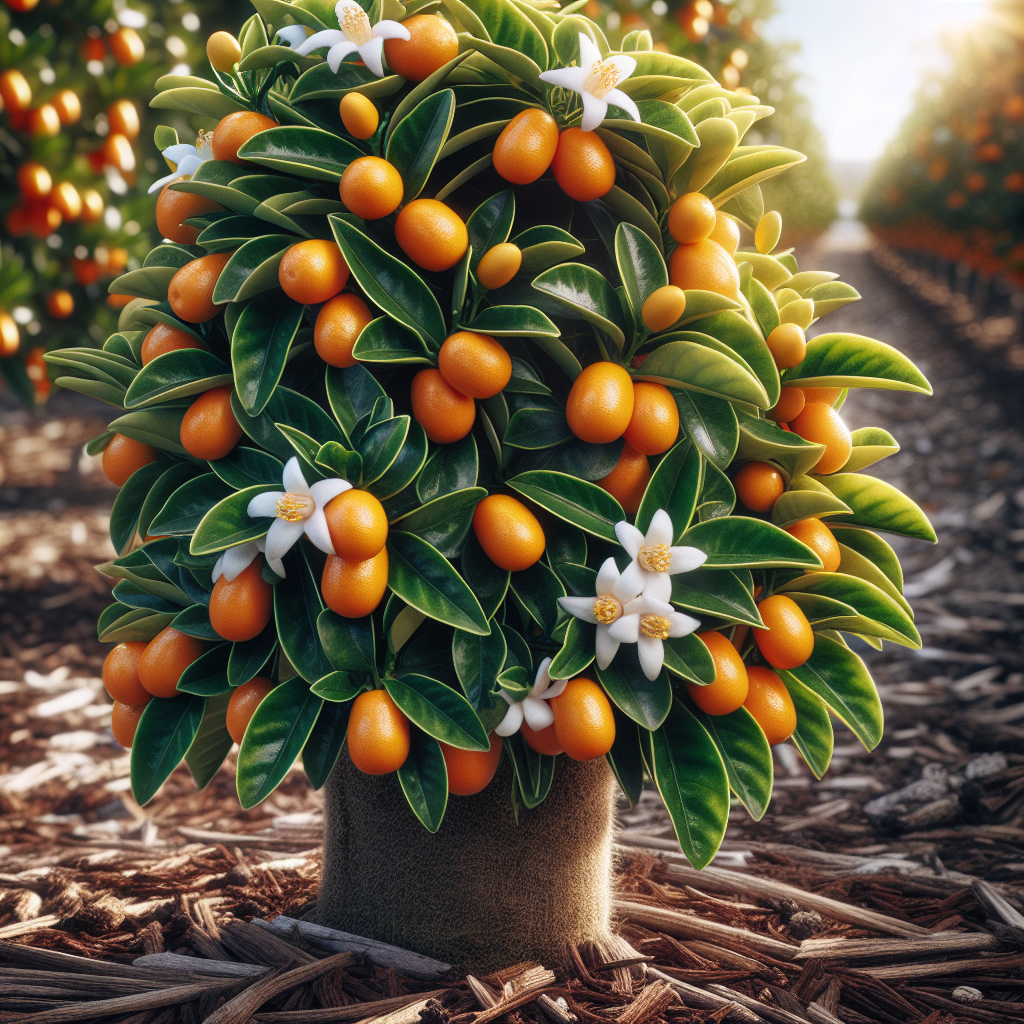
Introduction to Kumquat (Nagami)
A distinctive small citrus with elongated, olive-shaped fruit, Nagami is the benchmark kumquat variety in many regions and the one most growers mean when they simply say “kumquat.” Unlike most citrus, the peel is the sweetest part and the flesh is briskly acidic, so the fruit is typically eaten whole. That sensory contrast gives it fresh-market appeal, strong culinary versatility for marmalade, candying, syrups, and preserves, and excellent ornamental value because mature trees often carry fragrant white flowers and ripening orange fruit at the same time.
Nagami kumquat likely traces its cultivation history through East Asia, especially China, before spreading through Japan, Europe, and eventually subtropical production regions worldwide. Botanically, kumquats were historically placed in the genus Fortunella, but modern classification often folds them into Citrus. For growers, the practical takeaway is that Nagami behaves much like a compact, dense, evergreen citrus tree, but with slightly better cold tolerance than many oranges or limes. If you already grow Orange, think of Nagami as a smaller, slower, denser citrus with superior ornamental compactness and more forgiving winter hardiness.
Its strengths are consistency, manageable size, and decorative productivity. A healthy tree can become heavily laden with fruit, but fruit quality depends strongly on light intensity, balanced nutrition, and careful water management. Excess nitrogen, poor drainage, and shaded placement are the most common causes of lush foliage with weak flowering or bland fruit.
Botanical Profile of Kumquat (Nagami)
Nagami typically grows as a dense, upright to rounded evergreen shrub or small tree, often reaching 2-4 m in the ground, though it can be maintained smaller with pruning and container culture. Branches are fine-textured and may carry short thorns, especially on vigorous juvenile shoots or rootstock suckers. Leaves are small, glossy, lanceolate, and darker green than many larger-fruited citrus cultivars, contributing to its tidy ornamental appearance.
The flowers are white, star-like, strongly fragrant, and usually borne singly or in small clusters on current-season growth. Like many citrus, Nagami is self-fertile, so a single tree can set fruit without a separate pollinizer. Insect activity, especially bees and hoverflies, still improves pollination efficiency and fruit set under many conditions.
Fruit are characteristically oblong to oval, usually 3-5 cm long, with a bright orange rind when mature. The rind is thin, smooth, aromatic, and sweet; the pulp is segmented, juicy, and distinctly tart. Seeds may be few to moderate depending on pollination and growing conditions. The fruit can hold well on the tree after coloring, which gives growers a flexible harvest window, but flavor usually improves after full color development and a slight softening of the rind.
Nagami is among the more cold-tolerant edible citrus selections, with mature, acclimated trees tolerating short dips roughly into the -6 to -8°C range better than many standard citrus, though damage depends on duration, wind, tree age, water status, and rootstock. Young trees are considerably more vulnerable. Cold tolerance does not mean freeze immunity; flower buds, tender flushes, and fruit are damaged sooner than hardened wood.
Rootstock strongly influences vigor, precocity, soil adaptation, and cold response. Common rootstocks include trifoliate orange and its hybrids, which are often chosen for improved cold hardiness and tolerance of heavier soils, though exact compatibility and performance vary by nursery source and region.
Soil, pH, and Climate Requirements for Kumquat (Nagami)
Nagami performs best in well-drained, aerated soils with moderate water-holding capacity. Sandy loams and loams are ideal, but the tree can also do well in improved clay loams if drainage is excellent and the root zone does not remain saturated after rain or irrigation. The critical issue is oxygen around the roots. Citrus feeder roots are sensitive to prolonged waterlogging, and kumquats are no exception. If water stands longer than 24 hours in the planting zone after heavy irrigation or rain, root stress becomes likely.
Optimal soil pH is slightly acidic to near neutral, about 5.8-7.0, with best nutrient availability often around 6.0-6.5. At pH above 7.5, iron, manganese, and zinc deficiencies become common, leading to interveinal chlorosis on new leaves. At very low pH, below about 5.5, calcium and magnesium imbalances may appear and root performance often declines. Before planting, test soil rather than guessing. If pH is high, elemental sulfur is preferred for gradual correction; if very acidic, agricultural lime can moderate pH.
For in-ground trees, build organic matter carefully. A modest incorporation of mature compost into a broad planting area can improve structure, but avoid creating a small “potting soil pocket” inside native soil because roots may circle or stall at the interface. In heavy soils, mounding or raised berm planting is often superior to deep amendment.
Climatically, Nagami is best suited to subtropical, Mediterranean, frost-light warm temperate, and protected coastal climates. It requires full sun for strong flowering, dense canopy, high sugar accumulation in the rind, and good fruit color. A minimum of 6 hours of direct sun is acceptable, but 8 or more hours is markedly better. In partial shade, the tree often becomes leggy, flowers less, and sets fewer fruits.
Ideal temperature for active vegetative growth is roughly 20-32°C. Flowering and fruit set are best when spring temperatures are mild and not excessively hot or windy. Very high summer heat above 38°C can cause leaf stress, sunburn on exposed fruit, and blossom or small fruit drop if water is inconsistent. Wind protection is valuable because constant wind dehydrates foliage, scars fruit, and interferes with pollinators.
Relative humidity in the moderate range is favorable, but Nagami tolerates dry air better than many assume if the root zone is kept evenly moist and mulch is used. In very humid climates, canopy thinning and sanitation become more important to reduce scale insects, sooty mold, and fungal pressure. For broader fertility and orchard floor strategies, see soil health tips.
Container culture is especially successful with Nagami. Use a sharply drained citrus mix: roughly 40-50% bark-based material, 20-30% coarse mineral fraction such as perlite or pumice, and the remainder high-quality composted organic matter or peat/coco-based mix. Container pH should still target about 6.0-6.5.
Step-by-Step Planting & Propagation
Start with a grafted nursery tree whenever possible. Seed-grown kumquats are interesting for breeding or rootstock experimentation, but grafted Nagami trees are far more predictable for fruit quality, tree size, and early bearing. Purchase from a reputable citrus nursery with certified clean plant material where required by local law.
Choose the site. Select full sun, excellent air drainage, and protection from cold north or west winds if you are near the edge of kumquat hardiness. South-facing masonry walls can create a favorable microclimate, but avoid reflected heat pockets in very hot deserts.
Check drainage. Dig a hole 30-40 cm deep and fill it with water. If it has not drained within 12-24 hours, improve drainage or plant on a mound 20-40 cm high.
Prepare spacing. Give in-ground trees about 3-4.5 m between plants depending on training style. Dense hedgerow planting is possible, but air circulation and spray penetration suffer if spacing is too tight.
Plant at proper depth. Dig a hole no deeper than the root ball and two to three times as wide. Set the tree so the top of the root ball sits slightly above surrounding soil grade, especially in heavier soils. Keep the graft union clearly above the soil line.
Backfill simply. Use mostly native soil. Break up large clods, remove stones, and firm gently to eliminate air pockets without compacting. Water thoroughly after planting to settle soil.
Mulch correctly. Apply 5-8 cm of organic mulch over the root zone, keeping it 10-15 cm away from the trunk. Mulch moderates moisture and temperature and supports feeder-root health.
Stake only if necessary. If the tree is top-heavy or in a windy site, stake loosely for 6-12 months. Remove ties before they girdle.
For containers, begin with a pot only slightly larger than the root ball; oversizing traps moisture and increases root rot risk. Repot progressively as roots fill the container, usually every 2-3 years.
Propagation is mainly by budding or grafting. T-budding onto citrus-compatible rootstocks is standard commercial practice. Semi-hardwood cuttings can root under mist with bottom heat and hormone treatment, but they are slower and less common commercially. Seeds germinate readily but do not reliably preserve named cultivar traits and produce a longer juvenile period.
The best planting time is early spring after major frost risk has passed, when soils are warming and root growth can establish before peak summer stress. In mild winter climates, autumn planting can also work if roots have several months to establish before cold.
Care & Maintenance regimes for Kumquat (Nagami)
Irrigation should aim for evenly moist but never chronically saturated soil. Newly planted trees need the most consistent attention. For the first 8-12 weeks, water deeply enough to moisten the full root ball and adjacent soil, then allow the upper 2-5 cm of soil to begin drying before the next irrigation. In practical terms, that often means 1-3 times weekly depending on soil texture, heat, and wind. Sandy soil needs more frequent irrigation; heavier loam needs less frequent but deeper watering.
Once established, in-ground Nagami trees prefer deep, infrequent irrigation over daily shallow watering. A mature tree may need watering every 7-14 days in warm weather on loam, more often in sand and less often in cool weather. The target is moisture through the main feeder-root zone without keeping it swampy. Overwatered trees show dull yellowing leaves, poor vigor, premature fruit drop, and sometimes a sour smell or algae on chronically wet soil. Underwatered trees show leaf curl, loss of shine, twig dieback, small hard fruit, and rapid drop of flowers or young fruit.
Container plants need closer monitoring. Water when the top 2-4 cm of mix is dry but before the root ball becomes dust-dry or shrinks from the pot wall. During hot, windy weather this may mean daily watering; during cool cloudy periods it may be once every several days. Always empty saucers after watering.
Fertilization should be moderate and regular rather than heavy and sporadic. Young trees benefit from a citrus fertilizer with nitrogen plus micronutrients split into 3-5 applications during the growing season. Mature trees often respond well to spring, early summer, and midsummer feeding, avoiding late high-nitrogen applications that stimulate tender growth before winter. A fertilizer ratio near 2-1-1 or 3-1-1 is commonly effective. Micronutrients matter greatly in citrus, especially iron, zinc, manganese, and magnesium. Pale new leaves with green veins often indicate iron deficiency in high-pH soils; small, narrow chlorotic leaves may suggest zinc issues.
Pruning is light and mostly corrective. Nagami fruits on outer and recent growth, so aggressive pruning reduces crop. Remove dead, damaged, crossing, or inward-growing wood, and eliminate rootstock suckers immediately. Shape after harvest or before spring flush. If the canopy is very dense in humid climates, selective thinning to improve light penetration and spray access is useful, but never remove more than about 20-25% of the canopy in one season.
Fruit thinning is usually unnecessary, but branches loaded with heavy crops may need support to prevent splitting. Alternate bearing is less pronounced than in some citrus, though strong crop load one year can still reduce vegetative recovery if nutrition is inadequate.
Cold protection is essential for young trees. Before frost, water the soil thoroughly, mulch well, and use frost cloth that extends to the ground. Avoid plastic touching foliage. Trunk wraps and mini-frames help on small trees. Container trees should be moved to a bright, frost-free location when hard freezes threaten.
Weed control around the root zone should be gentle. Do not cultivate deeply because citrus feeder roots sit near the surface. Maintain a weed-free ring under mulch instead.
Pests, Diseases & Organic Management
Common Nagami kumquat pests include scale insects, aphids, mealybugs, whiteflies, spider mites, citrus leaf miner, and occasionally thrips. In some regions, snails, ants, and rodents also cause damage. Scale is especially frequent on dense or overfertilized trees. Look for small brown or gray shell-like bumps on stems and leaf undersides, sticky honeydew, and black sooty mold. aphids cluster on tender flushes and distort new growth; ants often protect them.
Organic management begins with prevention. Avoid excessive nitrogen, which creates lush pest-prone growth. Keep the canopy open enough for inspection. Wash minor infestations off with a strong water spray. Prune heavily infested twigs where practical. Control ants because they protect sap-sucking pests from natural enemies.
Horticultural oil is one of the most effective organic tools for scale, mealybugs, and mites when applied thoroughly to cover stems and leaf undersides. Apply during cooler parts of the day and never on drought-stressed plants or during extreme heat. Insecticidal soap helps on aphids and whiteflies but must contact the pest directly. Neem-based products can supplement a broader organic program, though coverage and timing matter more than brand.
citrus leaf miner attacks fresh flushes, creating serpentine trails and distorted leaves. Mature trees usually tolerate it, but repeated attacks on young trees can slow establishment. Protect major flushes with kaolin clay or horticultural oil-based programs where permitted, and avoid unnecessary summer pruning that triggers vulnerable soft growth.
Diseases of concern include root rot caused by Phytophthora, greasy spot in humid regions, melanose, sooty mold secondary to honeydew-producing insects, and occasionally cankers depending on region and regulation. Root rot is the most serious and most preventable. Symptoms include sparse yellow canopy, leaf drop, twig dieback, poor growth, and bark issues near the crown. The key control is drainage, proper planting height, and careful irrigation. Never pile mulch against the trunk, and never bury the graft union.
Nutritional disorders are often mistaken for disease. High pH chlorosis, magnesium deficiency on older leaves, and salt injury from poor-quality irrigation water can all reduce productivity. If leaf margins burn and growth stalls while soil tests show elevated soluble salts, leach containers thoroughly and improve irrigation quality where possible.
Biological diversity around the orchard helps natural enemies. Flowering insectary companions such as Thyme, Yarrow, and Clover can support pollinators and beneficial insects when managed so they do not compete heavily with the young tree.
Harvesting, Curing & Optimal Storage
Nagami kumquats are harvested when fully colored deep orange and when rind sweetness has developed enough to balance the tart pulp. Color alone is not always sufficient; taste several fruits from different canopy positions. Fruit exposed to full sun often color earlier than shaded fruit but may not always be most balanced in flavor. Cool autumn nights usually improve sugar-acid balance.
Harvest by clipping with fine pruners or carefully twisting if the stem releases cleanly. Avoid tearing the rind, since even minor skin injuries reduce storage life. For fresh market quality, handle kumquats gently and do not overfill picking containers because the thin rind can bruise.
Unlike curing crops such as onion or garlic, kumquats are not cured in the traditional sense. Instead, postharvest handling focuses on field heat removal, gentle cleaning, sorting, and cool storage. Remove damaged, split, insect-marked, or underripe fruit. If washing is necessary, dry the fruit completely before packing.
Ideal storage is cool and moderately humid: roughly 7-10°C with 85-90% relative humidity. At these conditions, sound fruit may store for 2-4 weeks, sometimes longer depending on harvest maturity and handling. At room temperature, quality is usually best within about a week. Refrigeration in household conditions extends life, but fruit can dry if left unprotected; perforated bags or ventilated clamshells help retain humidity without trapping condensation.
One advantage of Nagami is that fruit can often remain on the tree for an extended period after maturity, effectively turning the tree into short-term storage. However, very long hang time may lead to drying, peel roughening, loss of acidity, or pest exposure. For preserving, harvest fully mature fruit for marmalade, candying, or syrup production because rind aroma peaks near full ripeness.
Companion Planting for Kumquat (Nagami)
The best companions for Nagami kumquat are low-growing, non-competitive species that improve biodiversity, attract beneficial insects, suppress weeds, or protect soil without aggressively stealing water and nutrients. Avoid vigorous vines, heavy feeders, or dense groundcovers right against the trunk.
Thyme is one of the best companions because it stays relatively low, tolerates similar drainage conditions, attracts pollinators when in bloom, and can act as a living mulch once the tree is established. Keep a clear space around the trunk to prevent humidity buildup.
Yarrow is valuable as an insectary plant. Its umbels attract hoverflies, parasitic wasps, and other beneficials that help suppress aphids and soft-bodied pests. Place it near but not directly under the densest root zone of a young tree.
Clover can function as a managed living groundcover in wider orchard alleys or around mature trees. It helps protect soil, contributes some nitrogen cycling, and supports pollinators. Mow or trim it regularly so it does not become a moisture competitor during dry periods.
Nasturtium is useful as a seasonal companion for beneficial insect attraction and as a visual indicator plant for aphid pressure. In hotter climates, place it where it receives some afternoon relief so it does not collapse in peak summer heat.
Good companion planting for kumquats is less about crowding the root zone and more about creating a biologically active but well-managed understory. Keep the first 30-45 cm around the trunk clear, irrigate the tree separately from thirsty annuals, and remember that a young citrus tree should always have priority over companion plants for water and nutrients.