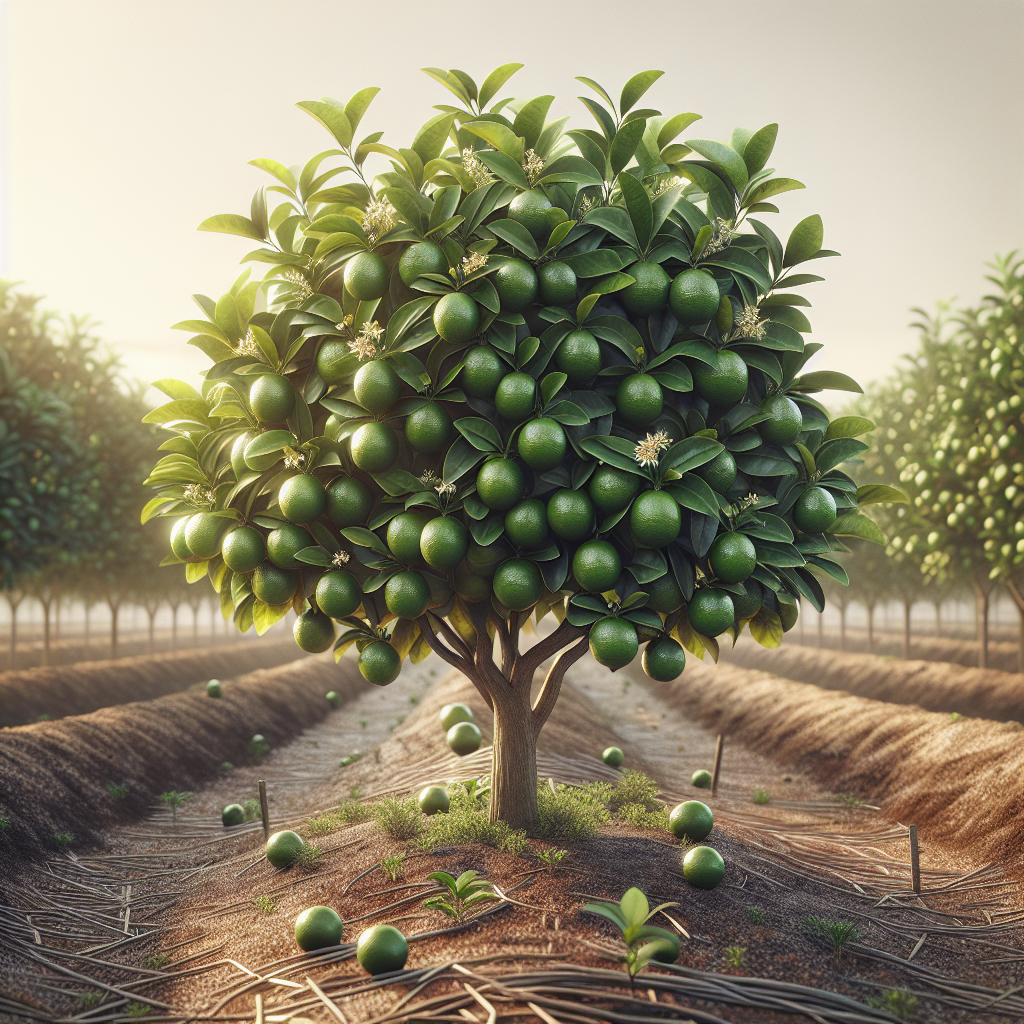
Introduction to Key Lime
Believed to have originated from a complex citrus lineage involving Southeast Asian species and later spread through the Middle East, North Africa, and the Caribbean, this lime became closely associated with tropical maritime climates and coastal trade routes. It is often called Mexican lime or West Indian lime, and it differs noticeably from larger seedless market limes in both tree habit and fruit character. The fruit is usually smaller, rounder, thinner-skinned, more aromatic, and more seedy, with juice that is highly valued for beverages, desserts, marinades, and preserves.
For growers, the crop combines high market appeal with several management challenges. Trees are naturally shrubby to small, usually thorny, and distinctly sensitive to cold, root-zone saturation, and micronutrient imbalance. In frost-free subtropical and tropical zones, however, well-managed trees can crop heavily and repeatedly through the year, with flushes of bloom and overlapping fruiting cycles. If you already grow citrus, the care profile is closer to a delicate tropical lime than to a tougher orchard orange; see the broader citrus comparison in our lime guide. For general soil-building principles that support perennial fruit crops, growers may also benefit from soil health strategies.
Botanical Profile of Key Lime
This citrus belongs to Citrus × aurantiifolia, a small-fruited acid lime with hybrid origins. It is typically a compact evergreen tree or large shrub, commonly maturing at about 2 to 5 meters tall in managed plantings, though vigor varies by rootstock, climate, pruning style, and whether the plant is seedling-grown or grafted. Branches are often irregular and armed with short but sharp thorns, especially on vigorous juvenile growth.
Leaves are relatively small, ovate to elliptic, and aromatic when crushed. Petioles are narrowly winged or nearly wingless, a useful trait when distinguishing it from some other citrus. Flowers are white, strongly fragrant, and may appear singly or in clusters. In warm conditions, flowering can occur multiple times annually, especially after stress relief such as irrigation following dry weather.
Fruit is generally 3 to 5 centimeters across, thin-rinded, and harvested green to light green for commercial use, though full maturity often brings a yellowish cast. The rind is rich in volatile oils, and the juice is sharply acidic, with a characteristic perfume that is more intense than many larger limes. Seeds are common, especially in open-pollinated fruit. Trees may show some degree of polyembryony in seed, meaning seedlings can sometimes resemble the mother plant, but seed propagation still creates inconsistency in thorniness, vigor, disease tolerance, and fruit quality.
From a production standpoint, the crop is notable for precocity under warm conditions, but also for shorter economic life in poorly drained soils or areas with serious disease pressure. It is less cold-hardy than many other citrus and can be damaged near 0°C, with foliage injury possible even slightly above freezing if exposure is prolonged, wind is high, or trees are young.
Soil, pH, and Climate Requirements for Key Lime
Excellent drainage is the first non-negotiable requirement. The tree performs best in sandy loam, light loam, or gravelly citrus soils where water percolates quickly and roots receive abundant oxygen. Heavy clay is risky unless planted on raised berms or mounds at least 30 to 45 centimeters above grade. Standing water for even 24 to 48 hours can trigger root stress, leaf yellowing, fruit drop, and eventual decline. If a planting hole fills with water after irrigation or rain and remains waterlogged the next day, the site is unsuitable without drainage correction.
Ideal soil pH is approximately 6.0 to 7.0, though trees can tolerate a somewhat wider range if micronutrients remain available. Once pH rises above about 7.5, iron, zinc, and manganese deficiencies become common. These deficiencies often appear first on new growth: interveinal chlorosis, small leaves, weak flushes, and poor fruit set. In alkaline soils, rootstocks and regular foliar nutrition become especially important.
The best climates are tropical and warm subtropical, with annual temperatures commonly between 21 and 32°C during active growth. The tree prefers full sun, ideally 8 or more hours daily. Fruit quality improves with high light intensity, and dense shade reduces bloom, increases lanky growth, and encourages pest persistence. Key lime is strongly frost-sensitive. Young trees may be seriously injured at -1 to 0°C, and mature trees can suffer twig death, bark splitting, and crop loss with even brief freezes. Wind exposure also matters: hot dry winds desiccate flowers and young fruit, while persistent coastal winds can scar fruit and distort canopy development.
Humidity is generally well tolerated, but high humidity plus poor airflow increases fungal pressure, especially on dense canopies. In areas with monsoon rains or tropical wet seasons, plant on slight slopes or ridges and maintain an open canopy. Salinity tolerance is moderate at best; while the crop is often grown near coasts, saline irrigation water gradually reduces vigor, causes leaf tip burn, and suppresses yield. Electrical conductivity problems are especially damaging in containers.
Step-by-Step Planting & Propagation
Choose grafted nursery trees whenever possible. Grafted plants give more predictable fruit quality, earlier bearing, and better adaptation to difficult soils through rootstock selection. Seedlings can be grown, but they are usually slower to fruit and more variable. Select disease-free nursery stock with a straight trunk, healthy green leaves, no circling roots, and no signs of gum exudation at the crown.
For orchard planting, prepare the site by removing perennial weeds in at least a 1-meter diameter circle. Test soil pH and drainage before planting. If drainage is borderline, construct a mound or berm 30 to 60 centimeters high and 1 to 1.5 meters wide. Space trees roughly 3 to 5 meters apart within rows and 4 to 6 meters between rows, depending on vigor, pruning intensity, and whether machinery access is needed.
Planting steps:
- Dig a hole only as deep as the root ball and about twice as wide.
- Loosen surrounding soil so new roots can penetrate laterally.
- Set the tree with the top of the root ball slightly above surrounding soil level, typically 2 to 5 centimeters high, to allow settling.
- Keep the graft union well above soil line.
- Backfill with native soil rather than a highly amended pocket, which can create a water-holding basin.
- Water thoroughly to settle soil and remove air gaps.
- Mulch with 5 to 8 centimeters of coarse organic mulch, but keep it 15 to 20 centimeters away from the trunk to prevent crown rot.
For container culture, start with a pot at least 40 to 60 liters for a young tree and move upward as roots fill the container. Use a sharply draining mix with pine bark, coarse composted material, sand or perlite, and only moderate peat or coco coir. Containers must have abundant drainage holes. Never allow saucers to hold water for long periods.
Propagation by seed is simple but not ideal for production orchards. Sow fresh seed in a sterile, free-draining medium and keep at 24 to 30°C. Germination is usually good when seed is fresh. For clonal propagation, budding or grafting onto adapted citrus rootstocks is standard. T-budding is commonly done when bark slips easily and rootstock diameter is appropriate. Air-layering is less common commercially because grafted trees usually perform better structurally and adaptively.
After planting, remove any fruit on very young trees for the first season if canopy size is limited. Early fruiting can divert resources from root establishment and structural branching.
Care & Maintenance regimes for Key Lime
Irrigation should maintain even but never saturated soil moisture. During establishment, water deeply 2 to 3 times per week in sandy soils, or about once weekly in heavier but well-drained soils, adjusting for rainfall and temperature. The goal is to wet the main root zone thoroughly and then allow the upper few centimeters of soil to dry slightly before the next irrigation. Mature trees in warm weather often benefit from deep irrigation every 5 to 10 days in sandy soils and every 7 to 14 days in loams, though exact intervals depend on evapotranspiration and canopy size.
Practical moisture cues matter. A healthy root zone should feel cool and lightly moist 10 to 15 centimeters below the surface, not sticky, sour-smelling, or swampy. Overwatered trees often show pale leaves, reduced new growth, fruit drop, algae or moss on the soil surface, and in severe cases leaf wilting despite wet soil due to root dysfunction. Underwatered trees show folded leaves, dull leaf color, blossom drop, small hard fruit, and temporary midday wilt that progresses to persistent wilt if stress continues.
Nutrition should be frequent and balanced. Key lime is a relatively hungry citrus, especially in warm climates with repeated flowering. Use a citrus fertilizer with nitrogen plus magnesium, iron, manganese, zinc, and boron. Young trees may be fed every 6 to 8 weeks during active growth with small doses, while mature trees may receive 3 to 5 split applications annually. As a rough guide, nitrogen demand rises with canopy size, but avoid heavy late-season nitrogen where cool weather follows, because it can push tender growth that is more cold-sensitive.
Micronutrient monitoring is essential. Zinc deficiency produces small leaves and rosetting; iron deficiency causes yellow new leaves with greener veins; magnesium deficiency often appears on older leaves as a yellowing pattern leaving a green triangle near the leaf base. Foliar feeds can correct deficiencies quickly, but long-term success depends on suitable soil pH and root health.
Prune lightly. The crop fruits on relatively young growth, so severe pruning reduces the next crop. Remove dead wood, inward-growing shoots, low suckers from below the graft union, and crossing branches that create abrasion. Open the center enough to improve light and airflow, but do not strip the canopy. Thorny juvenile shoots may require selective heading to shape young trees. In container plants, pinch or tip-prune vigorous whips to maintain a compact, productive canopy.
Cold protection is crucial in marginal climates. Before a freeze event, water the soil thoroughly if it is dry, because moist soil releases more heat than dry soil. Use frost cloth that reaches the ground and trap radiant heat beneath it. Avoid plastic directly touching foliage. For young trees, trunk wraps and temporary frames can prevent bark injury. Whitewashing exposed trunks helps reduce sunscald after freeze damage.
Fruit thinning is rarely necessary, but extremely young trees carrying too many fruit should be relieved of some crop load to prevent branch bending and stunting. Weed control around the root zone reduces competition; maintain a weed-free mulch ring at least 0.75 to 1 meter wide around young trees.
Pests, Diseases & Organic Management
The main pest and disease issues vary by region, but several problems are common. Citrus leaf miner attacks new flush, creating serpentine trails and distorted leaves. Damage is usually cosmetic on mature trees but can slow young trees significantly. Time nitrogen applications to avoid constant weak flushing, encourage beneficial insects, and use organic sprays such as neem or horticultural oil only on vulnerable new growth, applied carefully during cooler parts of the day.
Scale insects, Mealybugs, Aphids, and Whiteflies suck sap and excrete honeydew that leads to sooty mold. Ant control is essential because ants protect these pests from predators. Sticky barriers on trunks, sanitation, and preservation of lady beetles and lacewings are core organic tactics. Horticultural oil can suppress soft-bodied infestations when coverage is thorough.
Spider mites become problematic in hot, dusty, dry conditions. Leaves may look stippled or bronzed. Reduce dust, avoid excessive broad-spectrum sprays that kill predators, and wash foliage with water where practical.
Fruit flies can attack ripening fruit in some tropical regions. Prompt harvesting, orchard sanitation, trapping, and removing dropped fruit are essential. Snails and Slugs may damage young trees or low-hanging fruit in humid sites.
Among diseases, root rot caused by Phytophthora is one of the most serious and is strongly linked to poor drainage or wet trunk bases. Symptoms include leaf yellowing, sparse canopy, twig dieback, fruit drop, and bark lesions with gumming near the crown. Prevention is far more effective than treatment: keep mulch away from the trunk, avoid overirrigation, and plant high.
Citrus canker, Melanose, Greasy spot, Anthracnose, and various post-rain fungal blemishes may affect foliage and fruit depending on climate. Copper-based sprays are often used in organic programs where legal and appropriate, especially during wet periods, but they should be integrated with pruning and sanitation rather than used alone.
Citrus greening disease (Huanglongbing) and its Psyllid vector are devastating in many regions. There is no simple organic cure. If the disease occurs locally, source certified clean nursery stock, monitor aggressively, and follow all regional quarantine and management regulations. Infected trees show blotchy mottled leaves, misshapen bitter fruit, shoot yellowing, and progressive decline.
Good organic management relies on prevention: high drainage, balanced fertility, moderate pruning, clean propagation material, rapid removal of diseased debris, and avoidance of trunk injury. Interplanting with flowering insectary species such as Thai Basil, Clover, and Garlic can support beneficial insects and help diversify the orchard floor, provided competition near young trunks is controlled.
Harvesting, Curing & Optimal Storage
Fruit is typically harvested when full-sized, glossy, and still green to light green for the classic market stage. Unlike some fruits, external color alone is not the best maturity indicator because warm tropical conditions can keep fruit green even when mature, while cooler conditions may induce yellowing. Mature fruit feels slightly heavier and juicier than immature fruit, and juice percentage rises as fruit completes sizing.
For fresh market use, clip fruit with short stems rather than pulling, which can tear the thin rind and create entry points for decay. Wear gloves if the canopy is thorny and harvest during cooler parts of the day to reduce field heat. Avoid overripe yellow fruit if the market expects green fruit, although yellow fruit may still be excellent for home juicing and processing.
Key limes are not typically “cured” in the same way as onions or sweet potatoes, but postharvest conditioning matters. Keep harvested fruit shaded, dry, and clean. Wash only if necessary, and dry thoroughly before packing. Fruit with rind injury, punctures, or early rot should be sorted out immediately.
Optimal short-term storage is usually around 8 to 10°C with high relative humidity, roughly 85 to 90%. Temperatures that are too low can cause chilling injury, while warm storage accelerates yellowing, moisture loss, and decay. In household conditions, fruit often keeps for 1 to 2 weeks at room temperature and 2 to 4 weeks under careful cool storage, depending on harvest maturity and handling quality.
For juice processing, harvest at peak juiciness rather than visual perfection. Fruit intended for zest should come from unsprayed or appropriately managed trees and be used promptly because the aromatic oils are most expressive when fresh.
Companion Planting for Key Lime
Companion planting around citrus should support pollinators and beneficial insects, suppress weeds, and improve soil cover without creating dense, humid growth directly against the trunk. The most effective companions are shallow-rooted or manageable understory species that can be kept outside the immediate crown zone.
Thai Basil is useful near but not under the trunk because its flowers attract pollinators and predatory insects. Clover can serve as a living mulch in row middles or outer basins, helping reduce erosion and contribute organic matter, though it should be kept from competing strongly with young trees for water. Garlic can fit well at the orchard edge or in nearby guild plantings, where its upright habit does not overly shade the soil and its strong scent is often appreciated in diversified systems.
Avoid aggressive vines, tall thirsty annuals, and plants that force constant irrigation near the trunk. The first 30 to 45 centimeters around the trunk should usually remain clear of dense planting. In humid climates, too much companion density around the base increases pest shelter and disease pressure. The best layout is often a clean mulch ring around the tree, insectary companions beyond that ring, and groundcovers in the alleys rather than directly at the crown.
Well-designed companion systems are especially valuable in small orchards, where biodiversity helps stabilize pest pressure. The key is distance and discipline: encourage beneficial habitat, but preserve airflow, sunlight, and dry trunk conditions.