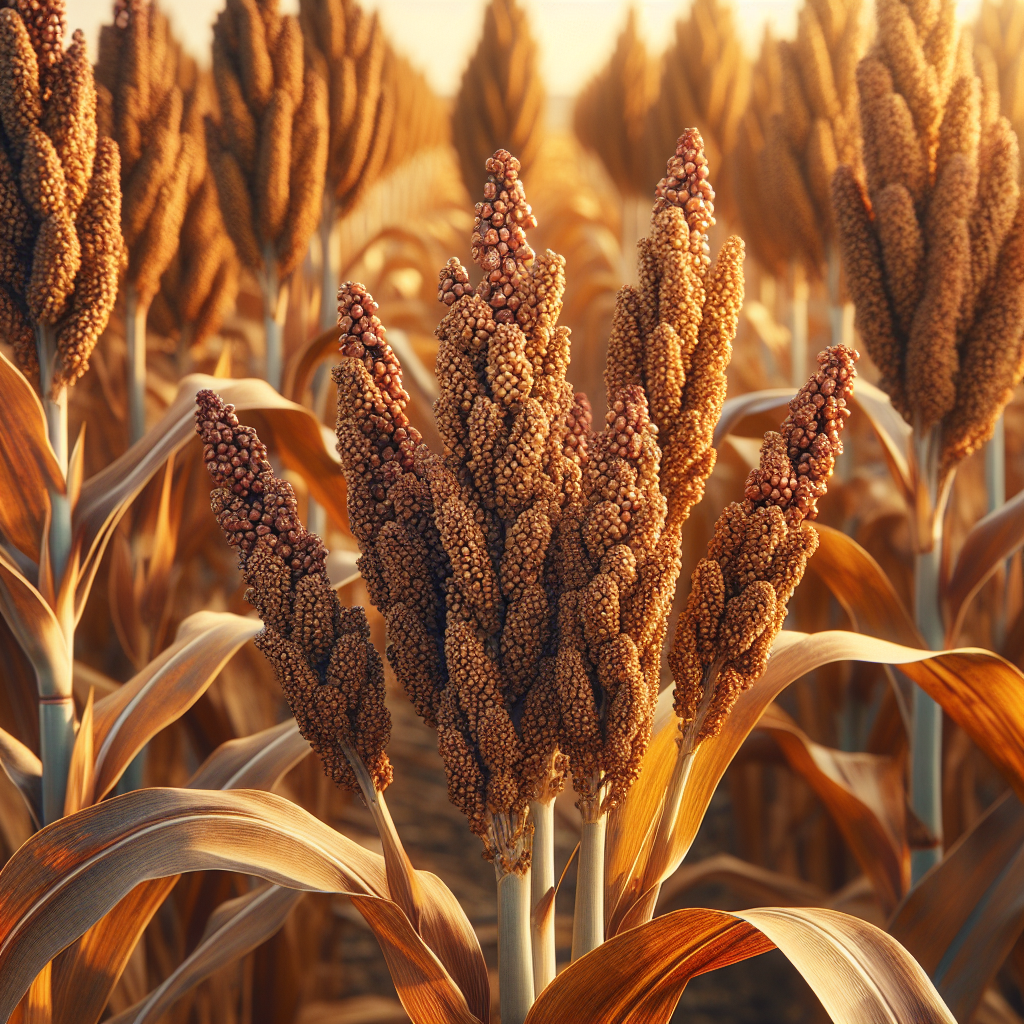
Introduction to Grain Sorghum
A warm-season annual cereal native to Africa and domesticated thousands of years ago, this crop became one of the world’s foundational dryland grains because it can keep producing when rainfall is erratic and temperatures are high. It is grown for human food, livestock feed, brewing, and industrial uses, with grain color ranging from white and tan to red and bronze depending on genetics and tannin content. In many semi-arid farming systems, it serves the same strategic role that Wheat serves in cooler zones: a dependable staple grain with strong storage life and broad utility.
Modern grain sorghum differs from sweet sorghum, forage sorghum, and sorghum-sudangrass hybrids. Grain types are selected for compact to semi-open panicles, strong standability, and efficient grain fill rather than juicy stalks or heavy biomass. In professional production, the crop is valued not just for drought tolerance, but for its ability to pause growth during stress and resume when moisture returns, a survival trait that often preserves at least partial yield under harsh field conditions.
Its resilience does not mean it performs best under neglect. High-yield grain sorghum still depends on proper seedbed preparation, precise planting depth, adequate nitrogen, timely weed control, and special attention during the boot, flowering, and grain-filling stages. A well-managed stand can outperform expectations on land too hot, too dry, or too variable for maize.
Botanical Profile of Grain Sorghum
This species belongs to the Poaceae family, the true grass family, and is a C4 plant. That C4 photosynthetic pathway explains much of its performance in hot, bright environments: it uses water efficiently, maintains productivity under high solar load, and tolerates temperatures that reduce performance in many cool-season grains.
Growth begins from a fibrous root system with notable capacity to explore deep soil profiles when structure permits. Compared with many cereals, it develops a waxy cuticle on leaves and stems, helping reduce moisture loss. Leaves are alternate, linear, and often broader than small millets, with a pronounced midrib. Some cultivars show bluish-green foliage from surface wax, a useful visual cue of adaptation to hot, dry conditions.
The stem is a solid culm rather than the hollow stem common in some grasses. Plant height in grain types usually ranges from about 0.9 to 1.8 meters, though some cultivars can be shorter or taller depending on maturity group and region. Excessive nitrogen or dense stands can push plants taller, sometimes increasing lodging risk in fertile or irrigated fields.
The inflorescence is a terminal panicle. Panicle architecture matters agronomically: compact heads often reduce bird feeding access somewhat, but in humid climates they may dry more slowly and can be more prone to mold if weather is wet at maturity. Loose or semi-open panicles dry faster and improve airflow, often a useful trait where late-season humidity is high.
Flowers are mostly self-pollinating, though some outcrossing occurs. Flowering usually progresses from the top of the panicle downward over several days. This staggered flowering pattern means stress at anthesis can create uneven grain set within the head. Grain itself is a caryopsis, typically round to slightly flattened. Seed coat color, endosperm traits, and tannin levels influence food quality, bird resistance, and feed value. White-grained types are often preferred for food markets, while red or bronze types may be common in feed channels.
Common maturity classes range from roughly 90 to 130 days depending on cultivar, planting date, latitude, and temperature accumulation. Early-maturing cultivars are useful in shorter seasons or where terminal drought is common, while fuller-season types can yield more where moisture and heat units are sufficient.
Soil, pH, and Climate Requirements for Grain Sorghum
This crop performs best in well-drained loams, sandy loams, silt loams, and clay loams with good internal drainage. It is more tolerant of heavy soils than many growers assume, but prolonged saturation sharply reduces root respiration and invites seedling disease. If water stands longer than 24 to 48 hours after rain during early growth, establishment losses become likely.
Ideal soil pH is about 6.0 to 7.5, though it can still produce reasonably from about 5.8 to 8.0 if fertility is balanced and toxicities are absent. Below pH 5.5, aluminum toxicity and phosphorus fixation become more likely, while micronutrient imbalances may increase on highly alkaline ground. Liming acid soils well ahead of planting is beneficial where pH has fallen from continuous nitrogen use or leaching.
A target of at least moderate soil organic matter improves emergence consistency and drought buffering. Even though grain sorghum is drought tolerant, it is not drought-proof. The most sensitive stages are from flag leaf through flowering and early grain fill. Severe moisture stress then can reduce pollen viability, impair fertilization, and shrink kernel weight. For field interpretation, aim to keep the top 5 to 7 cm moist during germination, then maintain enough subsoil moisture so plants do not roll leaves persistently before noon or develop gray-green stress color for multiple consecutive days.
Temperature is critical. Seed should go into soil only when the 5 cm depth has reached at least 16 to 18°C consistently, with faster and more uniform emergence at 18 to 21°C. Chilling injury from cold soils often causes weak emergence, seed rot, and patchy stands. Optimal vegetative growth usually occurs around 26 to 34°C. The crop tolerates heat above this if root-zone moisture is available, but flowering under extreme hot, dry winds can still depress grain set.
Rainfall requirements vary by soil depth and cultivar, but 450 to 650 mm over the season often supports solid dryland production, especially where rainfall is well distributed. Under irrigation, avoid keeping the root zone continuously wet. Sorghum generally prefers a wet-dry rhythm rather than saturated conditions. Soil moisture tension approaching moderate depletion between irrigations often encourages deeper rooting than light, frequent applications.
The crop demands full sun. Shade lowers tillering, stem strength, and grain fill. Wind exposure is usually tolerated, but lodging can become an issue when fertile soils, dense populations, late storms, and tall hybrids combine.
For broader cropping system fertility planning, practices described in soil health strategies are particularly useful before establishing a dryland cereal like this.
Step-by-Step Planting & Propagation
Propagation is by seed. Use certified, high-germination seed adapted to local day length, disease pressures, and harvest window. Choose cultivars based on intended use: food-grade white sorghums, feed types, bird-resistant tannin types, or regionally adapted hybrids with stay-green traits.
Prepare a firm, weed-free seedbed. In tilled systems, create a fine but not powdery surface with enough firmness that a footprint sinks no deeper than about 1 to 2 cm. In no-till systems, ensure residue is evenly distributed and seed slots close completely.
Soil test before planting. A realistic baseline for many medium-yield situations is moderate phosphorus and potassium with nitrogen applied according to yield target and residual nitrate. Excess nitrogen without matching moisture can produce rank growth, delayed maturity, and lodging.
Plant after frost danger has passed and soil is warm. Cold planting is one of the most common establishment mistakes.
Sow seed 2.5 to 4 cm deep in moist soils. In lighter, drying soils, depth may extend to about 5 cm if moisture is deeper, but emergence slows as depth increases. Uneven depth creates uneven maturity, complicating harvest.
Space rows according to moisture regime and equipment. Common commercial row widths range from 38 to 76 cm. Narrower rows improve canopy closure and weed suppression where rainfall is adequate; wider rows may conserve moisture in drier zones by reducing competition and allowing inter-row cultivation.
Adjust seeding rate to environment. Dryland stands often target roughly 100,000 to 180,000 plants per hectare, while higher-rainfall or irrigated systems may support 180,000 to 250,000 plants per hectare or more depending on hybrid and lodging risk. Too high a population under drought can produce thin stems, small heads, and severe stress at flowering.
Consider seed treatment where damping-off, seedling blights, or early insects are common. Organic growers often rely more heavily on warm soils, rapid emergence, rotation, and biological seed treatments.
Roll or lightly firm if the seedbed is fluffy. Good seed-to-soil contact is essential for uniform imbibition.
Emergence usually occurs in 5 to 10 days under warm conditions. Once plants reach 3 to 5 leaves, evaluate stand uniformity rather than obsessing over perfect plant count. A slightly thinner but even stand often yields better than a dense, uneven one.
Care & Maintenance regimes for Grain Sorghum
Weed control is most important during the first 4 to 6 weeks after emergence. Young plants grow slowly at first and compete poorly with early flushes of pigweed, foxtail, crabgrass, and broadleaf weeds. Mechanical cultivation is effective in row systems when done shallowly to avoid root pruning. Mulch is less common in broadacre production but can help in small plots if applied after emergence and warming.
Nitrogen management should match yield potential. As a broad rule, grain sorghum commonly requires about 18 to 25 kg of available nitrogen per expected tonne of grain, adjusted for soil residuals, previous legumes, and manure history. Split application is often beneficial on sandy soils or in high-rainfall environments: apply part at planting and the rest at the 5- to 8-leaf stage. If leaves become pale green beginning with older foliage, growth slows, and lower leaves senesce early, nitrogen may be limiting. If plants become excessively lush, dark green, and tall with delayed heading, nitrogen may be excessive for the moisture regime.
Phosphorus is particularly important for early rooting and cool-start vigor, even though the crop is planted into warm soils. Deficiency often appears as stunting and purplish leaf discoloration in young plants. Potassium supports stalk strength, water regulation, and stress tolerance; deficiency may show as marginal scorch or weak stems on low-K soils.
Irrigation, where used, should be strategic rather than constant. Critical timings are establishment, rapid vegetative growth if drought is severe, boot stage, flowering, and early grain fill. A common professional approach is to allow mild depletion between irrigations during vegetative growth, then avoid stress from boot through soft dough. Overwatering signs include persistently wet surface soil, yellowing lower leaves not explained by nitrogen deficiency, reduced root vigor, shallow rooting, algae growth in furrows, and eventually lodging or disease flare-ups. Severe waterlogging can cause leaf chlorosis, plant stunting, and a sour soil odor due to anaerobic conditions.
Topdress or fertigate only when rainfall or irrigation can move nutrients into the root zone. Surface-applied nitrogen on dry soil may volatilize or remain unavailable. Foliar feeding can correct minor micronutrient issues temporarily, but it will not substitute for balanced soil fertility.
Watch crop development by stage rather than calendar date: emergence, 3-leaf, 5-leaf, growing point differentiation, flag leaf, boot, flowering, milk, soft dough, hard dough, and physiological maturity. Small management delays around boot and flowering cost more yield than minor delays earlier in the season.
Bird pressure can become serious as heads mature, especially near tree lines or wetlands. Reflective tape, coordinated neighborhood deterrence, netting in small plots, and choosing tannin-containing or less exposed panicle types can reduce losses.
Pests, Diseases & Organic Management
Major insect issues vary by region but often include sorghum midge, aphids, armyworms, cutworms, chinch bugs, and stem borers. sorghum midge is especially damaging because adults lay eggs in flowering heads; larvae feed on developing grain, leaving empty florets. Management depends heavily on synchronized planting, uniform flowering, destruction of volunteer sorghum, and choosing hybrids that do not flower over a prolonged window.
sugarcane aphid has become a severe pest in some production areas. Colonies develop on leaf undersides and produce sticky honeydew that interferes with photosynthesis and harvest. Early signs include pale stippling, curling, and shiny residue on leaves. Encourage beneficial insects, avoid excessive nitrogen that stimulates soft growth, destroy grassy hosts, and scout field edges first because infestations often begin there. Strong water sprays help only in garden-scale plantings.
armyworms and headworms can skeletonize leaves or feed directly in heads. Organic management includes frequent scouting at dawn or dusk, encouraging birds and predatory insects, and using Bacillus thuringiensis products where labeled and timed to small larvae.
Disease pressure increases with continuous cereal culture, high residue, susceptible hybrids, and wet weather. Common concerns include anthracnose, leaf blights, rust, downy mildew, charcoal rot, stalk rots, grain mold, and smuts. anthracnose often appears as leaf lesions with dark fruiting bodies and can spread rapidly in warm, humid weather. charcoal rot is more common under hot drought stress, where plants weakened during grain fill show shredded lower stalk tissue and poor standability.
grain mold is a major quality problem where rains occur during maturation. Compact panicles, delayed harvest, and humid nights worsen it. Selecting mold-tolerant cultivars, promoting airflow, and harvesting promptly at safe moisture are the best defenses.
For organic systems, the backbone of management is prevention:
- Rotate away from cereals for at least one season, ideally with legumes such as Soybeans.
- Eliminate volunteer sorghum and grassy weeds that host insects and pathogens.
- Use resistant or tolerant cultivars suited to local disease complexes.
- Avoid over-irrigation and excessive nitrogen, both of which increase soft, disease-prone growth.
- Maintain balanced potassium and micronutrients for stronger stalks and better stress tolerance.
- Scout weekly, and twice weekly from boot through grain fill.
Seedborne smuts and seedling diseases are best prevented through clean seed and appropriate seed treatment strategies. Once systemic infections are established, curative options are limited.
Harvesting, Curing & Optimal Storage
Grain reaches physiological maturity when a black layer forms at the kernel base and maximum dry matter has accumulated. However, grain is usually still too wet for safe storage at that moment. Field harvest typically begins when grain moisture falls to about 18 to 20% for combine harvest followed by artificial drying, or lower where natural drying conditions are reliable. For long-term safe storage, aim for about 13% moisture or lower; in warm climates or for storage beyond several months, 12% is safer.
Visual indicators of readiness include panicles turning fully mature in color, hard kernels that cannot be dented easily with a thumbnail, and leaves beginning to senesce naturally. Stalks may remain somewhat green in stay-green hybrids even when grain is ready, so head and kernel condition matter more than whole-plant color.
Combine settings must minimize cracked grain while still threshing cleanly. Sorghum kernels are relatively small, so sieve and air settings need careful adjustment. Harvest too early and drying costs rise sharply; harvest too late and lodging, bird loss, weathering, and mold risk increase.
After harvest, clean grain to remove chaff, broken kernels, and insect-damaged seed. Debris pockets trap moisture and create hotspots in storage. If using ambient-air drying, move sufficient airflow through the grain mass and monitor temperature regularly. A musty odor, condensation on bin surfaces, crusting, or localized heating indicates dangerous storage conditions.
For small farms storing bagged grain, use breathable sacks only if grain is already fully dry and storage humidity is controlled. Keep sacks off the floor on pallets, at least 30 cm from walls, and protected from rodents. For sealed storage, grain must be uniformly dry before binning.
Curing in the traditional sense is limited because this is a grain crop rather than a fleshy harvested product. The postharvest goal is drying and conditioning, not curing. Aerate bins during cool, dry weather to equalize temperature, and inspect frequently for weevils, moths, or mold. Grain intended for seed should be dried more gently than feed grain to preserve germination.
Companion Planting for Grain Sorghum
In broadacre systems, companion planting is less about close mixed intercropping in every row and more about purposeful associations that improve nitrogen supply, beneficial insect presence, erosion control, or land use efficiency. The best companions are usually low-growing legumes or insectary species that do not heavily shade young plants or compete aggressively for the same moisture zone during the reproductive stage.
Clover can be used as a living groundcover in wider-row or lower-rainfall edge zones if it is managed carefully and not allowed to outcompete seedlings. It helps protect soil, contributes organic matter, and supports pollinators and beneficial insects. In dry climates, however, terminate or suppress it early if moisture becomes limiting.
Cowpea-type systems are classic companions in many hot regions, but among the available listed crops, Black Eyed Peas are an excellent functional equivalent. They fix nitrogen, cover exposed soil, and can reduce weed pressure when established after the cereal is sufficiently rooted. Their greatest value is often in relay or strip systems rather than same-day direct seeding into dense sorghum stands.
Sunflower can serve as a biodiversity strip crop around fields, drawing beneficial insects and functioning as a wind-modifying border. It should be placed strategically rather than densely mixed through the crop, because both species are tall and can compete for light and subsoil moisture.
Herbary insectaries such as yarrow or flowering borders can also improve predator activity, but in production fields the practical companions are those that fit machinery and moisture realities. The most successful system usually places companions in strips, borders, or planned relay sequences rather than forcing intimate mixtures that complicate harvest.
The key rule is simple: any companion must support the system without increasing harvest difficulty, moisture stress, or disease humidity around the heads. In dryland cereal agronomy, restraint and timing matter more than diversity for its own sake.